
Four Rabbis Entered Paradise and Only One Survived
The Talmud tells of four rabbis who entered Pardes - Paradise. One died, one went insane, one became a heretic. Only Rabbi Akiva walked out whole. This is the foundational story of Jewish mysticism.
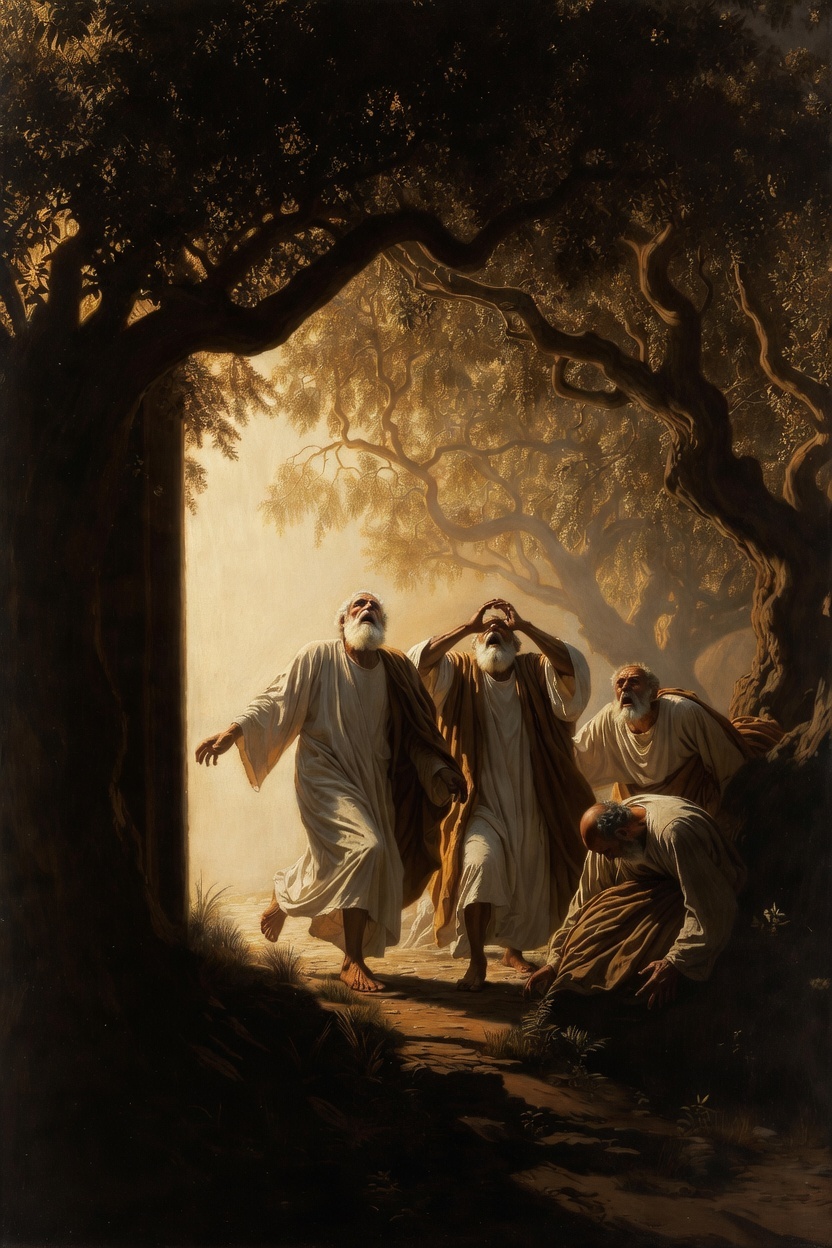
The Babylonian Talmud records one of the most haunting stories in all of Jewish literature in just a few lines. Four rabbis entered Pardes - Paradise. One died on the spot. One lost his mind. One became a heretic and destroyed everything he believed in. Only one walked out whole. The passage appears in Tractate Chagigah 14b (redacted c. 500-600 CE), and it has shaped the boundaries of Jewish mysticism for over 1,500 years.
The story is short. Disturbingly short. The Talmud doesn't explain what Paradise looked like, what the rabbis saw there, or how they got in. It just tells you what happened to each of them. And the implication is clear - some knowledge is genuinely dangerous.
The Four Who Entered Pardes
The Talmud names all four. Ben Azzai, Ben Zoma, Aher (whose real name was Elisha ben Abuyah), and Rabbi Akiva. These were not minor figures. They were among the greatest sages of the Tannaitic period, active in the late 1st and early 2nd centuries CE in Roman-occupied Judea.
Ben Azzai "looked and died." The Talmud applies (Psalms 116:15) to him - "Precious in the sight of the Lord is the death of His pious ones." He saw something so overwhelming that his soul simply left his body. Some later commentators understood this as a mystical death, the soul being drawn so powerfully toward the divine that it could not return to the flesh. Ben Zoma "looked and was stricken" - he lost his mind. The Talmud elsewhere (Chagigah 15a) records that after his experience, Ben Zoma could no longer reason coherently. When asked about a point of law, he gave answers that made no sense. His body survived. His intellect did not.
Aher "cut the shoots" - a phrase the Talmud uses to mean he became a heretic. He abandoned Torah observance entirely. The name "Aher" itself means "the Other One," because after his experience in Paradise, the rabbis would no longer call him by his real name, Elisha ben Abuyah. He had seen something in Paradise that broke his faith. Only Rabbi Akiva "entered in peace and departed in peace." Read the full account in The Four Who Entered Paradise from Howard Schwartz's Tree of Souls (645 texts in our database).
What Did They Actually Enter?
The word Pardes (פרדס) literally means "orchard" or "garden" in Hebrew, borrowed from the Persian pairidaeza. But what did the four rabbis actually walk into? The Talmud never says directly, and that ambiguity has generated centuries of debate.
One tradition, rooted in the Heikhalot literature (composed c. 3rd-7th centuries CE), understood Pardes as a real mystical ascent through the heavenly palaces. The Rabbi Akiva's Vision from Heikhalot Rabbati (3rd-7th century CE) describes Akiva navigating the seven heavenly halls, confronting angelic gatekeepers, and standing before the divine throne. In this reading, the four rabbis literally traveled through the upper worlds, and three of them were destroyed by what they encountered there. Our Kabbalah collection (3,298 texts) preserves dozens of accounts of these heavenly palace journeys.
A second tradition, favored by Maimonides (1138-1204 CE) in his Mishneh Torah, understood the ascent as purely intellectual. Pardes was not a place but a state of contemplation - the study of ma'aseh merkavah (the workings of the divine chariot described in Ezekiel chapter 1) and ma'aseh bereishit (the workings of creation). In this reading, the dangers were philosophical, not physical. Ben Azzai died from intellectual ecstasy. Ben Zoma's reason collapsed under the weight of what he understood. Aher drew heretical conclusions. And Akiva alone had the discipline to absorb the knowledge without being consumed by it.
Why Did Akiva Survive?
The Talmud says Rabbi Akiva "entered in peace and departed in peace," applying (Song of Songs 1:4) - "The king has brought me into his chambers." But it doesn't explain what made him different. Later sources offer competing theories.
The Rabbi Akiva Entered Paradise and Emerged Whole tradition emphasizes Akiva's unique combination of intellectual mastery and spiritual humility. He knew the boundaries. According to the Talmud in Chagigah 14b, Akiva warned the others before they entered - "When you arrive at the stones of pure marble, do not say 'Water! Water!' for it is said (Psalms 101:7), 'He who speaks falsehood shall not be established before My eyes.'" The stones of pure marble looked like water but were not. The test was whether you could resist the impulse to name what you saw based on appearances.
Ben Azzai and Ben Zoma apparently could not handle the raw encounter with the divine. Aher saw something that contradicted his theology - possibly the angel Metatron seated on a throne, which led him to believe there were "two powers in heaven," a heresy in rabbinic Judaism. Akiva had the rare ability to see and not be destroyed by seeing. The Story of Rabbi Akiva from Mitpachat Sefarim (18th century CE, by Rabbi Ya'akov Emden) explores how Akiva's character prepared him for this encounter.
The PaRDeS Acronym and Four Levels of Torah
The word Pardes later became one of the most influential acronyms in Jewish interpretation. By the medieval period, Jewish scholars read PaRDeS as standing for four layers of meaning in every Torah text. Peshat (פשט) is the plain, literal meaning. Remez (רמז) is the hinted or allegorical meaning. Derash (דרש) is the homiletical or interpretive meaning, the kind of reading found across 2,921 texts in our Midrash Rabbah collection and 3,763 texts in our Midrash Aggadah collection. Sod (סוד) is the secret, mystical meaning - the domain of Kabbalah.
This acronym appears explicitly in the work of Rabbi Moshe de Leon (c. 1240-1305 CE), the author of the Zohar, and was further systematized by Rabbi Bahya ben Asher (1255-1340 CE) in his Torah commentary. The connection back to the Talmudic story is deliberate. Just as the four rabbis entered the Pardes and only one survived, anyone who studies Torah must navigate all four levels carefully. The peshat is safe. The remez requires intelligence. The derash requires creativity. But the sod - the secret level - can destroy you if you are not prepared, exactly as it destroyed Ben Azzai, Ben Zoma, and Aher.
Merkavah Mysticism and the Dangerous Tradition
The Pardes story sits at the heart of ma'aseh merkavah - the "Account of the Chariot" - the earliest form of Jewish mysticism. This tradition centers on the vision of the divine throne-chariot in (Ezekiel 1:4-28), with its four living creatures, wheels within wheels covered in eyes, and the figure "like the appearance of a man" seated on a sapphire throne above. The Mishnah (Chagigah 2:1, compiled c. 200 CE by Rabbi Yehudah HaNasi) explicitly restricts who can study this material - the merkavah may not be expounded "before one person alone, unless he is a sage and understands of his own knowledge."
The Heikhalot Rabbati (3rd-7th century CE) takes the merkavah tradition further, describing detailed techniques for ascending through the seven heavenly palaces to reach the throne of God. Each palace is guarded by angels who test the worthiness of the ascending mystic. Those who fail are cast down or destroyed. The parallel to the Pardes story is unmistakable - three out of four failed, and the tradition treats this as expected, not exceptional. Merkavah mysticism was always understood as a practice that would destroy most people who attempted it. Our database preserves 1,464 texts tagged with the mysticism theme, many of them rooted in this merkavah tradition.
Explore the Pardes Texts
The Pardes story radiates outward through centuries of Jewish literature. Start with The Four Who Entered Paradise from Howard Schwartz's Tree of Souls for the core narrative. Then read Rabbi Akiva Entered Paradise and Emerged Whole for a philosophical treatment of why Akiva alone survived. The Rabbi Akiva's Vision from Heikhalot Rabbati places Akiva inside the heavenly palaces themselves. Story of Rabbi Akiva and Rabbi Akiva Asks Rabbi Shimon to Pray for Death from Mitpachat Sefarim explore Akiva's later life and martyrdom under the Romans.
Our database holds over 2,291 texts about heaven and the heavenly realms, drawn from every major collection - Midrash Rabbah (2,921 texts), Kabbalah (3,298 texts), Legends of the Jews (2,650 texts), and Tree of Souls (645 texts). Search for paradise to find more accounts of what the rabbis believed lay beyond the veil.