Rabbi Judah Sends Teachers Into the Dark
Rabbi Judah the Prince sent scholars to a town without teachers. They asked who guarded the city. When soldiers appeared, the rabbis said: these are destroyers.
Table of Contents
 Click for full size
The Town That Had Nothing
Rabbi Judah the Prince had already done what seemed impossible: he had compiled the Mishnah, drawn together centuries of oral teaching into a structure that could survive exile and dispersal. He held the accumulated law of Israel in his head like a living library. And he knew that a library in one place is not the same as a tradition distributed through a people. He sent three of his best scholars out from the established center.
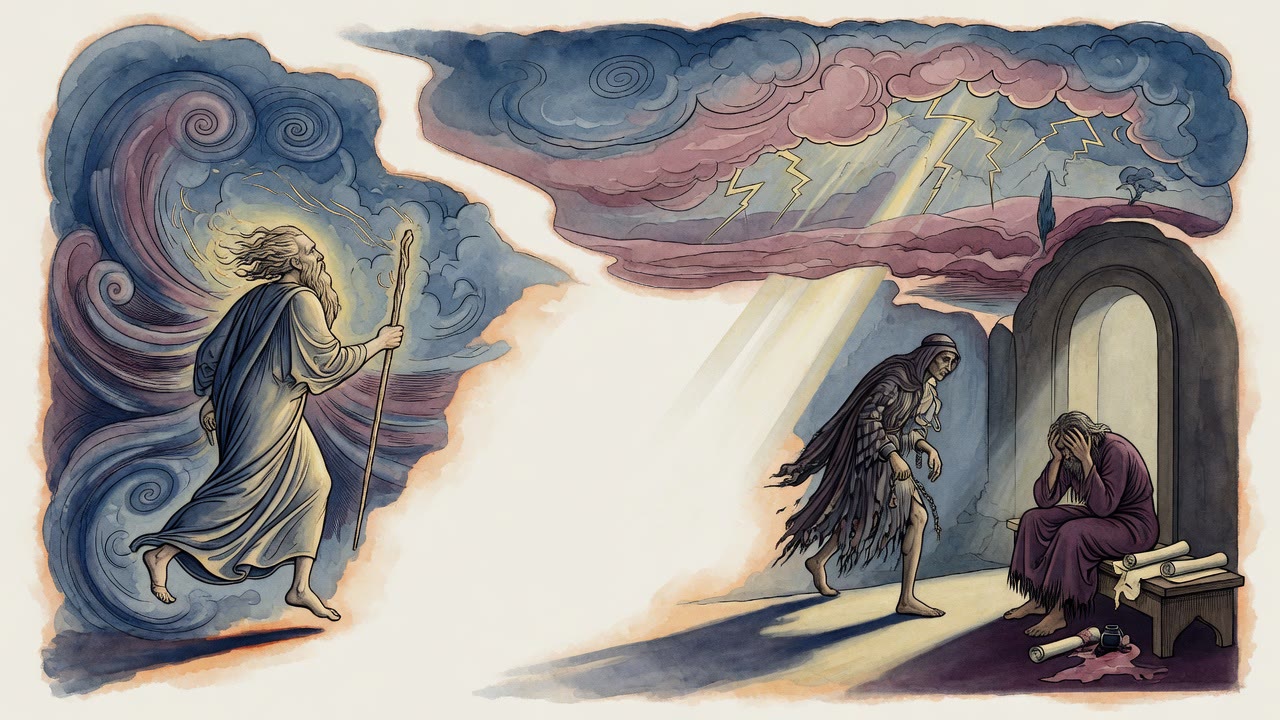
Rabbi Hiyya, Rabbi Yosei, and Rabbi Ami arrived at a certain town and found it empty in the specific way that mattered. No scribes. No teachers. No one to read the Torah aloud on Shabbat, no one to answer a child's first question about why we do what we do, no one to sit with the dying and speak the words that make death bearable. They asked for a Torah scroll and were told there was none. They asked for a Pentateuch and were told there was none. They asked for a book of Psalms and were told there was none.
The Question That Changed the Visit
The three rabbis then asked the question that stands at the center of the entire passage in Midrash Tehillim 127:1. They asked: bring us the men who guard the town.
The townspeople brought the officers of the watch. The soldiers with their weapons and their authority and their institutional role. And the rabbis said: these are not the guardians of the town. These are its destroyers.
It is a startling verdict. The soldiers had done nothing wrong. They were performing their function. But the rabbis were operating with a different definition of what constitutes a threat to a town's existence. Armies can be defeated. Walls can be breached. The destruction that ends a community's life is not always external and military. A town without teachers is already dying, regardless of how many soldiers stand at its gates. The absence of scribes is a longer-working enemy than any army. The rabbis were naming what they saw: this town was being destroyed by its own emptiness.
The Real Guardians
Who, then, guards the town? The rabbis told the townspeople: bring us the teachers of Torah and the scribes. When those men arrived, the rabbis said: these are the guardians. Unless the Lord builds the house, its builders labor in vain. Unless the Lord guards the city, the watchmen watch in vain. The psalm they were drawing on was Psalm 127, the psalm that sits at the center of the Psalms of Ascent, the psalms sung by pilgrims climbing to Jerusalem.
The scribes and teachers were the Lord's building crew. Not because their work was supernatural but because they were the mechanism through which the covenant was transmitted and maintained. A town with soldiers and no scribes had defended the body and abandoned the soul. A town with scribes and no soldiers was more dangerous but more alive. The rabbis were making a triage decision: the life that mattered was the one that could be handed from one generation to the next through study and teaching and the specific act of reading aloud to people who could not yet read themselves.
What Josiah Knew and What Rabbi Akiva Asked For
Legends of the Jews records that Josiah, the reforming king who found the book of the law in the Temple during his renovation and wept when he read it, was the only king after Solomon to rule over both Judah and Israel. Jeremiah himself brought back the ten exiled northern tribes and placed them under Josiah's rule. When Josiah died, even Jeremiah mourned him in his Lamentations. A king who had rebuilt the scribal tradition from a found scroll, who had made the reading of Torah a national event again, was mourned by the greatest prophet of his generation as something irreplaceable.
Mitpachat Sefarim preserves the strange tradition that Rabbi Akiva asked Rabbi Shimon bar Yochai to pray for his death. Whatever the underlying meaning of this request, it points at something the rabbis understood: that the transmission of teaching required a specific kind of relationship between teacher and student, one in which the student's complete dependence on the teacher was not weakness but the correct posture for receiving what could not be simply explained. The town without teachers had no one to be completely dependent on. It had guardians who could not give it what it most needed.
← All myths