
Aaron Saw the Golden Calf on the Altar and Froze
Most people assume Aaron was forgiven for the Golden Calf. The Targum says he never stopped seeing it. Every time he approached the altar, the shape was there.
Table of Contents
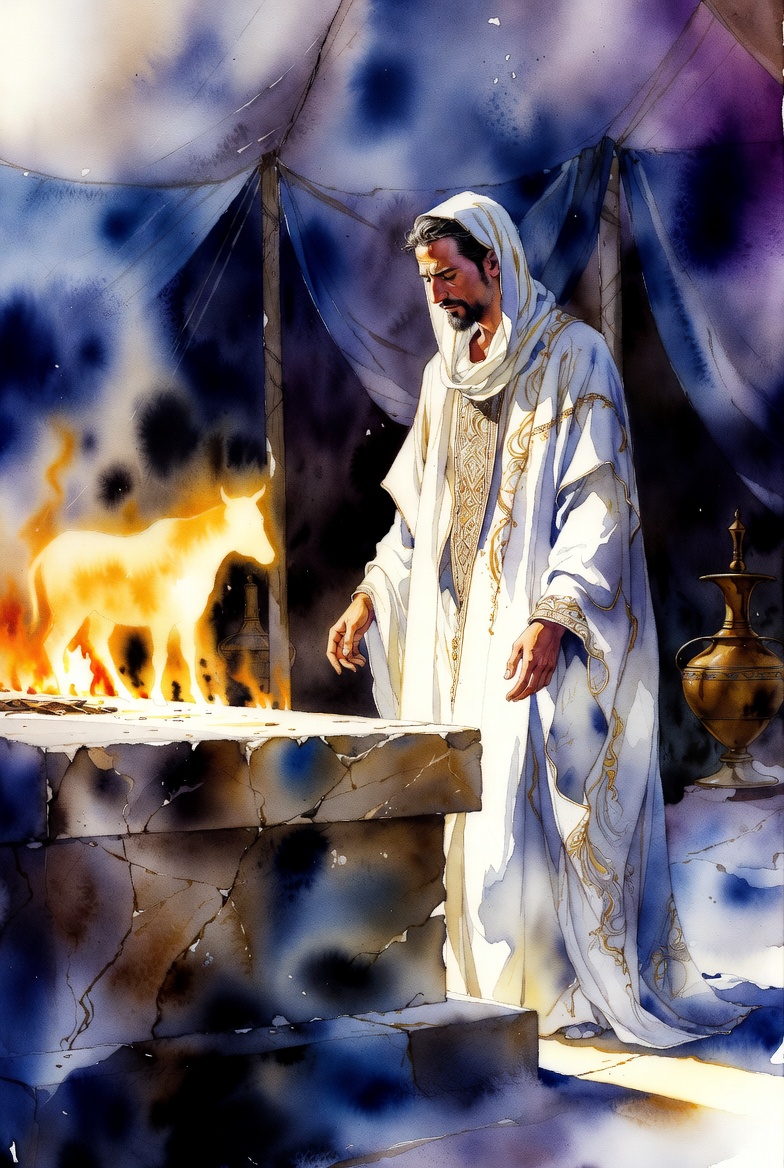
Most people assume Aaron was forgiven for the Golden Calf. The Targum Jonathan says something sharper: he never stopped seeing it. The Targum Jonathan on Leviticus 8-9 (composed c. 2nd-4th century CE in the Land of Israel) preserves a scene the Hebrew Bible never mentions. Aaron was about to become high priest. He approached the altar for his first sacrifice. He froze. He saw, at the corner of the altar, the shape of the Golden Calf. His sin, projected onto the very instrument of atonement. The man who built the idol was now supposed to atone for idolatry. Aaron Saw the Shape of the Calf on the Altar from the Targum Jonathan records every detail of this moment, and it is one of the most psychologically raw passages in ancient Jewish literature.
Moses had to talk him through it. "Take courage, and go near to the altar, fearing not." This entire scene is absent from the biblical text. The Targum invented it to answer a question the rabbis couldn't ignore: how could the man who cast a golden idol stand before God and offer sacrifices? The answer wasn't that Aaron was innocent. The answer was that God wanted him anyway.
"Who Is Afar Off on Account of the Work of the Calf"
The setup begins one chapter earlier. God tells Moses to "bring near Aaron" for the priestly consecration in (Leviticus 8:2). The Hebrew Bible leaves it at that. The Targum adds three words that change everything: "who is afar off on account of the work of the calf." Aaron was spiritually disqualified. He had built the Golden Calf at Sinai (Exodus 32). He was distant from God. And God told Moses to close that distance anyway.
Aaron Had to Be Brought Near After the Golden Calf records that the consecration ceremony began on the twenty-third of Adar, a date the Targum supplies but the Bible does not. For seven days, the Tabernacle was erected and dismantled daily while Aaron and his sons completed their ordination. Moses himself officiated at the altar during this entire period. The Targum specifies that the blood ritual purified the altar of "all double-mindedness, constraint, and force, from the thoughts of his heart." If any Israelite prince had donated materials for the Tabernacle under social pressure rather than genuine willingness, the altar had to be cleansed of that tainted intention. God didn't just want correct actions. He wanted correct hearts.
Every Sacrifice Was a Legal Brief Against the Accuser
On the eighth day of consecration, the first of Nisan, Aaron was finally supposed to offer his own sacrifice. That's when he saw the calf. Moses told him to proceed. The Targum turns what follows into a courtroom drama.
Each animal Aaron sacrificed that day carried a specific legal argument against Ha-Satan, the heavenly Accuser. The calf for Aaron's sin offering was chosen "that Satan may not accuse thee concerning the calf that thou madest at Horeb." Fight fire with fire. Atone for the golden calf by sacrificing an actual calf. The ram recalled "the righteousness of Isaac whom his father bound as a ram on the mountain of worship," invoking the merit of the Akedah (Genesis 22). The goat for the people's sin offering was selected because "Satan resembles him, lest he recount against you the accusation concerning the kid of the goats, which the sons of Jacob killed," a reference to the brothers dipping Joseph's coat in goat blood (Genesis 37:31). Every animal was a counter-motion in a heavenly court. The inauguration of the priesthood wasn't a ceremony. It was a trial. Read the full account in Aaron Saw the Shape of the Calf on the Altar.
Why Did God Choose Aaron Over Moses?
Why God Chose Aaron as the High Priest Over Moses from Kohelet Rabbah 1:2 (compiled c. 6th-8th century CE) preserves the moment Moses learned he wouldn't be high priest. God told him to appoint a priest from the tribe of Levi. Moses was pleased. His own tribe. Then God specified: "It is not your tribe, but it is your brother." Moses was devastated. He had assumed the priesthood was his. The Golden Calf of Aaron from Legends of the Jews 3:32 (compiled 1909-1938 by Louis Ginzberg from hundreds of rabbinic sources) adds that Moses served faithfully for the seven days of consecration, expecting to be named high priest himself. On the eighth day, God told him the job belonged to Aaron.
The choice is deliberately counterintuitive. Moses never built an idol. Moses ascended Sinai and spoke to God face to face. The priesthood didn't go to the man with the cleanest record. It went to the man who had failed publicly and would carry that failure into the sanctuary every single day. Anyone asking why a person with a complicated past might be better suited for certain work than someone who has never struggled knows the logic here. Moses Served as Priest for All Forty Years in the Desert from Vayikra Rabbah 11:6 records a dissenting tradition: Rabbi Yudan claimed Moses never stopped serving as high priest for all forty years in the wilderness, citing (Psalm 99:6). The mainstream tradition, though, is clear. Aaron got the job. The sinner became the atoner.
The Fire That Burns for Thoughts Alone
Parshat Tzav opens with a command about the altar fire: "A perpetual fire shall be kept burning on the altar; it shall not go out" (Leviticus 6:6). The Hebrew Bible treats this as a practical instruction. The Eternal Fire That Atoned for Sins of the Heart from the Targum Jonathan on Leviticus 6 transforms it into something far stranger. The burnt offering, the Targum claims, "is brought to make atonement for the thoughts of the heart." This line does not exist in the Hebrew Bible. The Targum invented an entire category of invisible sin that demanded a visible sacrifice.
Bad thoughts. Wrong intentions. The errors of the heart that no court could ever prosecute. The fire on the altar burned for these. It burned perpetually because the human heart never stops generating them. The priest added wood every morning "at four hours of the day," a time the Targum specifies but the Bible does not. The Burnt Offering That Atoned for Thoughts Alone from Targum Jonathan on Leviticus 7 repeats the claim as a conclusion, framing it as settled law. And How the Priestly Garments Atoned Just Like the Offerings from Vayikra Rabbah 10:6 (compiled c. 5th-7th century CE) extends the principle further: "Just as the offerings atone, so do the vestments atone." The priest's clothing wasn't decorative. Each garment counteracted a specific sin of the people.
The Shekinah That Almost Didn't Come
After Aaron completed his first sacrifices on the eighth day, the Shekinah, God's visible presence, did not appear. Aaron was ashamed. He assumed it was because of him. Because of the calf. Because the altar remembered what he had done. Only after Moses entered the Tabernacle with him and the two brothers prayed together did fire descend from heaven and consume the offering. The people fell on their faces. Not from fear. From praise.
The Targum's point is unsparing. Aaron's past was not erased. It was present at the altar, visible in the shape of the calf, embedded in the choice of every sacrificial animal. The priesthood wasn't given to someone despite his failure. It was given to someone because of it. A priest who has never sinned doesn't understand what atonement costs. Aaron understood. He saw the calf every time he approached the altar. And he offered the sacrifice anyway.
Explore Aaron and the Priesthood
Start with Aaron Saw the Shape of the Calf on the Altar and Aaron Had to Be Brought Near After the Golden Calf for the Targum's full account of Aaron's consecration. Read The Eternal Fire That Atoned for Sins of the Heart for the Targum's radical addition to the laws of sacrifice. Browse Why God Chose Aaron as the High Priest Over Moses from Midrash Rabbah (3,279 texts) and The Golden Calf of Aaron from Legends of the Jews (2,672 texts) for the traditions about Moses losing the priesthood to his brother.
Our database contains over 18,000 ancient Jewish texts. Explore Midrash Aggadah (4,247 texts) for the Targum traditions, Midrash Rabbah (3,279 texts) for the priestly garment symbolism, and Legends of the Jews (2,672 texts) for the most complete retelling of Aaron's story from the Golden Calf to the Holy of Holies.