Translation of the source text.William Davidson Edition - Vocalized Aramaic + William Davidson Edition - English · CC-BY-NC
verse deals with the creation of the world, when all the water was contained in the deep.
The Sages taught in a baraita: Eretz Yisrael was created first and the rest of the entire world was created afterward, as it is stated: “While as yet He had not made the land, nor the fields” (Proverbs 8:26). Here, and in the following statements, the term “land” is understood as a reference to the Land of Israel, while “the fields” means all the fields in other lands. Furthermore, Eretz Yisrael is watered by the Holy One, Blessed be He, Himself, and the rest of the entire world is watered through an intermediary, as it is stated: “Who gives rain upon the land, and sends water upon the fields” (Job 5:10).
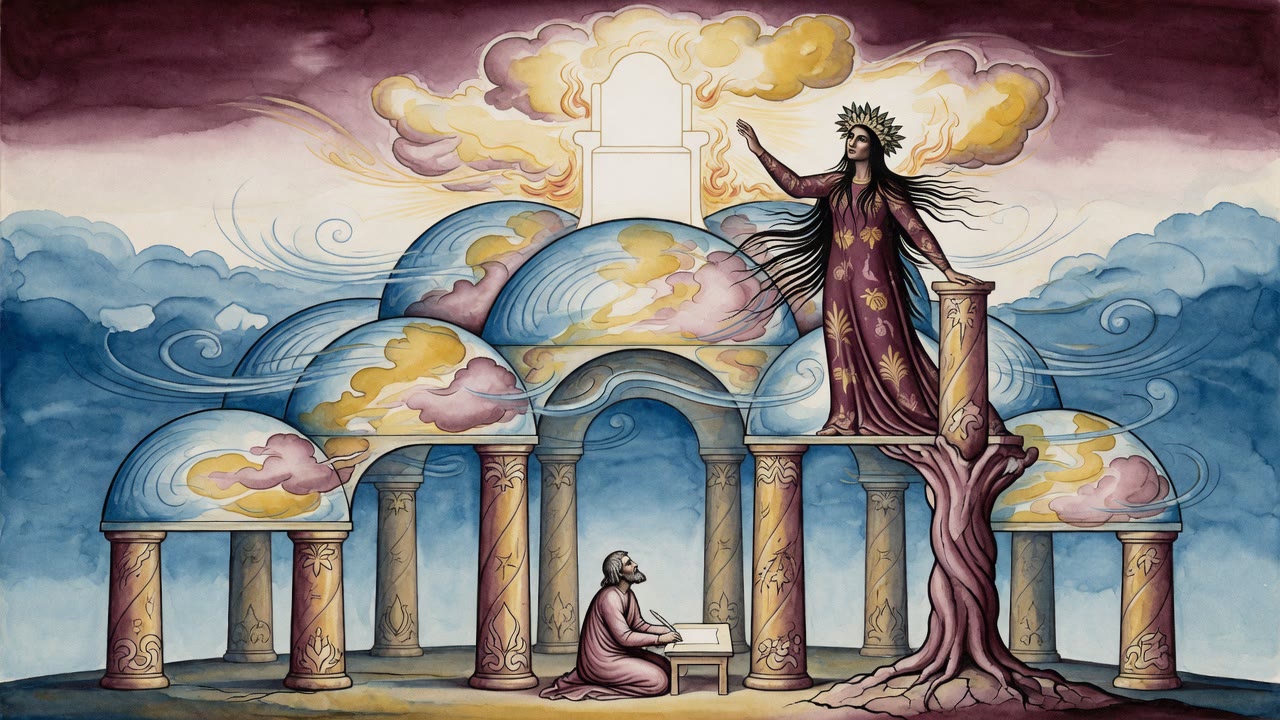
Additionally, Eretz Yisrael drinks rainwater and the rest of the entire world drinks from the remaining residue of rainwater left in the clouds, as it is stated that God is He “who gives rain upon the land” and only afterward takes what is left “and sends water upon the fields.” Eretz Yisrael drinks first, and the rest of the entire world afterward, as it is stated: “Who gives rain upon the land and sends water upon the fields.” There is a parable that illustrates this: A person who kneads his cheese after it has curdled takes the food and leaves the refuse.
The Master said above: The ocean waters are sweetened in the clouds. The Gemara asks: From where does Rabbi Eliezer derive this? The Gemara answers that Rav Yitzḥak bar Yosef said that Rabbi Yoḥanan said that it is written: “Darkness [ḥeshkhat] of waters, thick clouds of the skies” (Psalms 18:12). And it is written, in a similar verse: “Gathering of [ḥashrat] waters, thick clouds of the skies” (II Samuel 22:12).
The Gemara explains the significance of this minor variation. These two phrases vary in only one word, which themselves differ by only one letter, a kaf for a reish. If you join the two versions together, and take the letter kaf from the first version and place it with the second version of the word, which has a reish, you can read into the verse a new word meaning rendering fit [ḥakhsharat]. Accordingly, the verse can be interpreted as: The rendering fit of water is performed in the clouds of the sky.
The Gemara asks: And Rabbi Yehoshua, with regard to these verses, what does he learn from them? The Gemara answers that Rabbi Yehoshua holds in accordance with the opinion of this Sage, Rav Dimi. As when Rav Dimi came from Eretz Yisrael to Babylonia, he said that they say in the West, Eretz Yisrael: When clouds are bright, they have little water; when clouds are dark, they have much water. Accordingly, Rabbi Yehoshua explains that when there is “a darkness of waters” in the clouds, there is also “a gathering of waters,” as rain will fall from them.
The Gemara asks: In accordance with whose opinion is that which is taught in a baraita: The upper waters do not stand in any defined place; rather, they are suspended by the word of God, and their fruit is rainwater, as it is stated: “Who waters the mountains from His upper chambers; the earth is full of the fruit of Your works” (Psalms 104:13). In accordance with whose opinion is this statement? It is in accordance with the opinion of Rabbi Yehoshua. And Rabbi Eliezer, how does he explain this verse? Rabbi Eliezer could say: That verse from Psalms is written with regard to the handiwork of the Holy One, Blessed be He, not the upper waters.
Rabbi Yehoshua ben Levi said: The entire world drinks from the runoff of the Garden of Eden, as it is stated: “And a river went out of Eden to water the garden” (Genesis 2:10). It was taught in a baraita: From the runoff of a beit kor, a field in which a kor of seed can be planted, which is approximately seventy-five thousand square cubits, a field in which a half-se’a [tarkav], of seed can be sown, i.e. one-sixtieth the size of a beit kor, can be watered. If the runoff from a beit kor is sufficient for a field one-sixtieth its size, it can be inferred that the rest of the world is one-sixtieth the size of the Garden of Eden.
The Sages taught in a baraita: The area of the land of Egypt is four hundred parasangs [parsa] by four hundred parasangs. And this is one sixtieth the size of Cush, and Cush itself is one sixtieth the size of the rest of the world. And the world is one sixtieth of the Garden of Eden, and the Garden of Eden is one sixtieth of Eden itself, and Eden is one sixtieth of Gehenna. You find that the entire world is like a pot cover for Gehenna, as Eden, which is far larger than the rest of the world, is only one sixtieth the size of Gehenna. And some say: Gehenna has no measure. And some say that Eden has no measure.
Rabbi Oshaya said: What is the meaning of that which is written about Babylonia: “You who dwells on many waters, abundant in storehouses” (Jeremiah 51:13)? What caused Babylonia to have storehouses full of grain? You must say that it is due to the fact that it resides on many waters, the Tigris and the Euphrates Rivers, which render its land easy to irrigate. Similarly, Rav said: Babylonia is wealthy since it can grow crops for harvest even without rain. Abaye said: We hold that it is better for a land to be swampy like Babylonia, and not dry, as crops in Babylonia grow all year.
MISHNA: On the third of the month of Marḥeshvan one starts to request rain by inserting the phrase: And give dew and rain, in the blessing of the years, the ninth blessing of the Amida. Rabban Gamliel says: One starts to request rain on the seventh of Marḥeshvan, which is fifteen days after the festival of Sukkot. Rabban Gamliel explains that one waits these extra four days so that the last pilgrim of the Jewish people, who traveled to Jerusalem on foot for the Festival, can reach the Euphrates River without being inconvenienced by rain on his journey home.
GEMARA: Rabbi Elazar said: The halakha is in accordance with the opinion of Rabban Gamliel, that one does not begin to request rain until the seventh of Marḥeshvan. It is taught in a baraita that Ḥananya says: And in the Diaspora one does not begin to request rain until sixty days into the season, i.e., sixty days after the autumnal equinox. Rav Huna bar Ḥiyya said that Shmuel said: The halakha is in accordance with the opinion of Ḥananya.
The Gemara asks: Is that so? But they raised a dilemma before Shmuel: From when does one mention: And give dew and rain? He said to them: From when they bring wood into the house of Tavut the bird hunter [rishba]. This is apparently a different date than that mentioned by Ḥananya. The Gemara suggests: Perhaps this and that are one measure of time, i.e., Shmuel merely provided a sign of sixty days after the autumnal equinox.
A dilemma was raised before the Sages: Is the sixtieth day itself treated as part of the period before the sixtieth day or is it included in the period after the sixtieth day? The Gemara answers. Come and hear that there is a dispute in this regard. Rav said: The sixtieth day is part of the period after the sixtieth day, and Shmuel said: The sixtieth day is part of the period before the sixtieth.
Rav Naḥman bar Yitzḥak said: And your mnemonic to remember the divergent opinions is: Those above require water; those below do not require water. Since water flows downward, those who live in low places receive their water from above and are generally in less need of additional water. Accordingly, Shmuel, who lived in the lowlands of Babylonia, ruled that one begins to request for rain later, whereas Rav, who studied in Eretz Yisrael, which is higher in elevation and has a greater need for rain, stated an earlier date. Rav Pappa said: The halakha is that the sixtieth day is part of the period after the sixtieth day, as stated by Rav, and therefore one begins to mention the request for rain on the sixtieth day after the autumnal equinox.
MISHNA: If the seventeenth of Marḥeshvan arrived and rain has not fallen, individuals, but not the entire community, begin to fast three fasts for rain. How are these fasts conducted? As the fast begins in the morning, one may eat and drink after dark, and one is permitted during the days of the fasts themselves to engage in the performance of work, in bathing, in smearing oil on one’s body, in wearing shoes, and in conjugal relations. If the New Moon of Kislev arrived and rain has still not fallen, the court decrees three fasts on the entire community. Similar to the individual fasts, everyone may eat and drink after dark, and they are permitted to engage in the performance of work, in bathing, in smearing one’s body with oil, in wearing shoes, and in conjugal relations.
GEMARA: The Gemara asks: Who are these individuals mentioned in the mishna? Rav Huna said: This is referring to the Sages, who are held to a higher standard and are expected to undertake fasts even when ordinary people do not. And Rav Huna further said: The individuals who fast the three fasts do so on a Monday, and on the next Thursday, and again on the following Monday.
The Gemara asks: What is Rav Huna teaching us? We already learned this (15b): The court may not decree a fast on the community starting from a Thursday, so as not to cause an increase in prices. Rather, the first three fasts are established on Monday, and Thursday, and Monday. What does Rav Huna’s statement add to this ruling?
The Gemara answers: Rav Huna’s comment is necessary, lest you say that this applies only to a community, but that in the case of an individual, no, the series of three fasts does not have to start on a Monday. This opinion is also taught in a baraita with regard to those mentioned in the mishna: When the individuals begin to fast, they fast on a Monday, a Thursday, and a Monday. And if one of the fast days occurs on a day with special observances, they interrupt the sequence for New Moons,

 Click for full size