Phinehas Sent a Sorcerer Into the Sky After Balaam
Balaam left the ground and found a road in the air no soldier could walk. Zaliah of Dan followed and lost him in the fifth sky.
Table of Contents
Phinehas walked into a tent at Shittim with a javelin and came out having killed two people with one thrust. One was Zimri, head of the tribe of Simeon. The other was Cozbi, daughter of a Midianite prince named Zur.
 Click for full size
It had been building for weeks. Balaam had failed to curse Israel and had gone to Balak with a better idea. Send the daughters of Midian and Moab into the camp. Let the young men fall in love. Then let the women name their price. Give up the God of Israel. Eat at our altars. Bow where we bow. It worked from the edges inward. When Moses called the people together and told them to turn back, Zimri got to his feet in front of everyone and called Moses a tyrant. He said he would worship what he liked and marry whom he liked. He went to the tent with the woman while the assembly watched.
Phinehas ended it with the javelin. The plague that had already started stopped where he stood. It had taken twenty-four thousand.
Twelve Thousand Men and a Priest With Trumpets
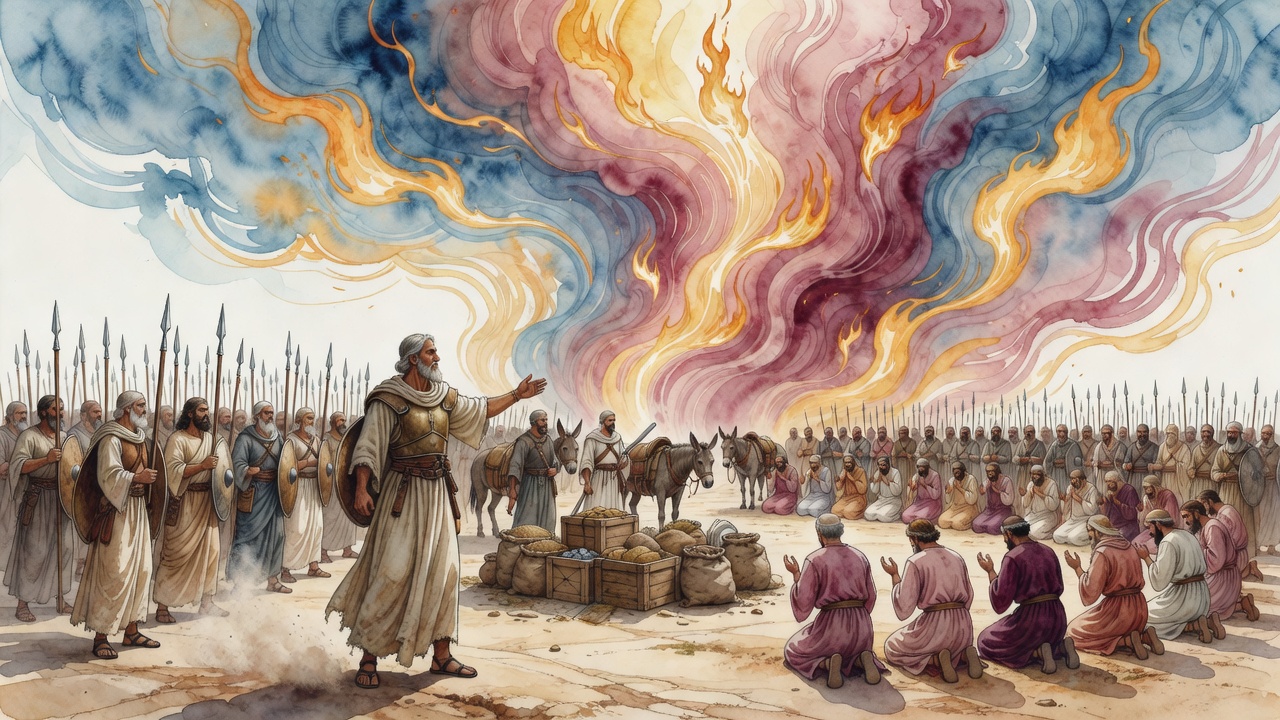
The order came to Moses to collect the debt from Midian before he died. A thousand men from each tribe, twelve thousand armed and chosen, and Phinehas going out with them. He did not carry a sword. He carried the Urim and Thummim, to be asked when nobody knew what to do next, and the jubilee trumpets, to move the whole host with a note.
They came at Midian from three sides and killed every male. Five kings went down with their armies: Evi, Rekem, Hur, Reba, and Zur, whose daughter had died on the floor of Zimri's tent. Some say that Zur was Balak himself.
Balaam was there.
Balaam Went Up Through Five Layers of Air
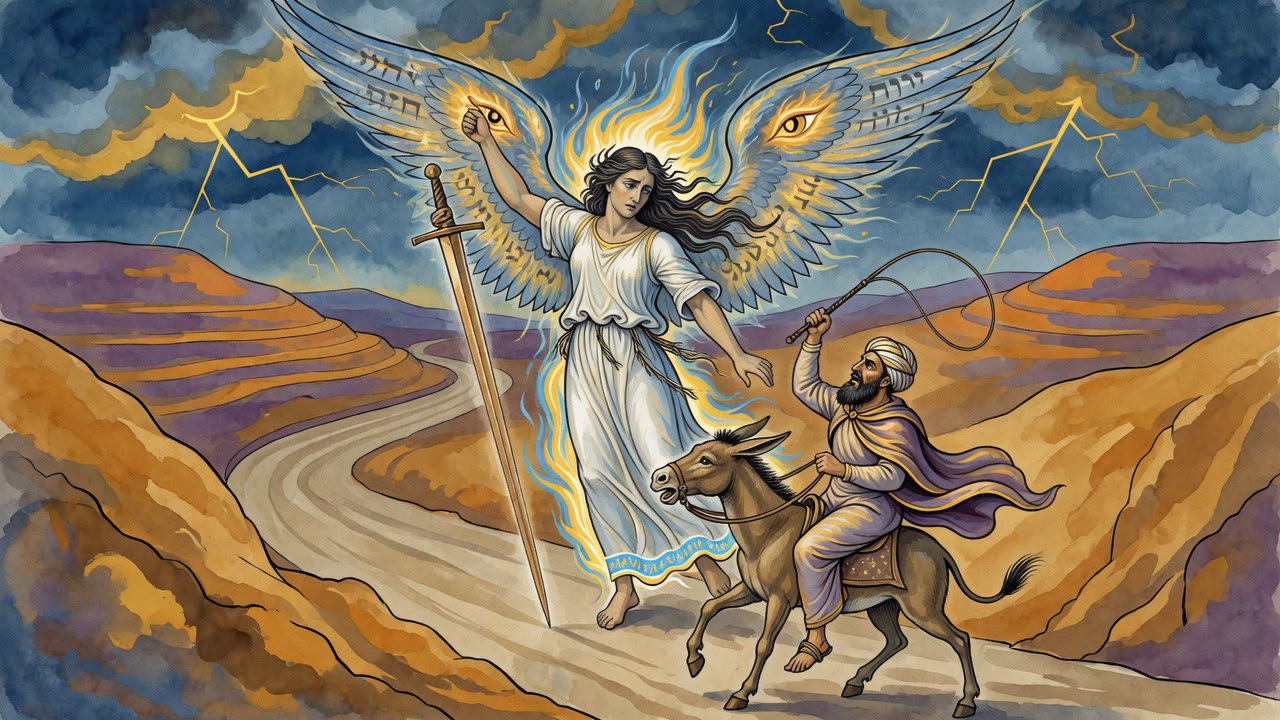
He saw Phinehas coming for him across the field and he did the one thing no soldier could answer. He spoke, and his two sons, Jannes and Jambres, who had learned everything he knew, spoke with him, and Balaam rose off the ground and kept rising.
Phinehas turned to the army and shouted, "Is there any man here who can fly after that villain?"
One man answered. Zaliah of the tribe of Dan was a sorcerer himself, trained on the same arts Balaam had spent a lifetime perfecting, and Phinehas sent him up. He was fast. He was not fast enough. Balaam found a road in the air that Zaliah could not get onto, and went up through five separate layers of the sky, and at the top of the fifth he was gone. The battle went out of the sky as fast as it had gone into it. Zaliah hung there with nothing above him but cloud, turning, not knowing which way to look.
Down on the ground Phinehas said a word over the sky, and the clouds pulled apart like a curtain, and there Balaam was. Zaliah closed on him, took him, and brought him down through all five layers to stand in front of the priest.
The Charge Sheet Phinehas Read Him
Balaam started talking before his feet were settled. Spare me. Let me live and I swear that as long as I have breath I will never curse your people again. Not one word. Not ever.
Phinehas did not answer the offer. He answered the man.
"Are you not Laban the Aramean, who tried to destroy our father Jacob? Then you went down into Egypt to destroy his children. When they came out of Egypt you set Amalek on them in the wilderness. Then you came yourself to curse them, and when you saw that your work would not prosper and that God would not listen to you, you gave Balak the counsel about his daughters, and twenty-four thousand of us are in the ground because of it. Your life cannot be spared."
Then Phinehas gave Zaliah an instruction that mattered more than it sounds. Do not kill him with the holy Name. A death like that is too good for a sinner of this size.
The Sword With a Serpent on Both Sides
Zaliah tried. He struck and the blade turned. He struck again with another weapon and it did nothing. Balaam stood there under the swords of an army he had emptied a nation into, and no edge in the camp would bite him. Whatever he had wrapped around himself, he had wrapped it well.
Phinehas went and got a different sword. On both sides of the blade a serpent was cut into the steel, and words with it. He put it in Zaliah's hand.
"Kill him with the thing he belongs to," Phinehas said. "By this he dies."
Zaliah went in once more, and this time the sword found him, and the man who had taught kings how to break Israel from the inside died on the ground at the edge of a burning Midianite town, with a snake looking up at him from the metal.
← All myths