Samael Agreed to Every Condition If Ten of the Mighty Were Destroyed
Rabbi Ishmael heard his own name eighth on the list. He came back down and repeated every name, including the one that was his.
Table of Contents
 Click for full size
The Conditions Laid on Him
The warnings came first. Then the limits, one after another, and Samael stood and took every one of them. What he was permitted to do. When. Whom he could touch and whom he had to walk past. He is not a free power. He is an appointed one, and the appointment arrived with terms spoken to his face.
He took all of it.
"I have taken all upon me," he said, "provided only that ten of the mighty shall be destroyed."
Then he named them. Not a quota to be filled later by whoever happened to be standing nearby. Ten sages, by name, in order, the way a creditor reads a list he has already written out.
Ten Names Spoken in Order
Rabbi Akiva ben Joseph. Rabbi Judah ben Baba. Rabbi Jeshbab the scribe. Rabbi Hananya ben Teradyon. Rabbi Hozpit the interpreter. Rabbi Elazar ben Shammua. Rabbi Hanina ben Hakinai. Rabbi Ishmael ben Elisha. Rabban Simon ben Gamaliel. Rabbi Eliezer ben Dama.
The man who carried that list back down had heard his own name inside it. Rabbi Ishmael ben Elisha stood eighth in the reading. He did not learn that Rome would kill ten teachers. He learned the order, and he learned where he came in it.
He came back and repeated the whole thing anyway, including the line with himself in it. He had stood in the palaces above and watched the appointment being made. He could have left his own name out of the report. He did not.
The Nine Who Did Not Hear
None of the other nine knew. They went on teaching. They ordained. They argued over clean and unclean. They walked to the study hall in the morning, while the account against them had already been agreed to somewhere they could not see.
Akiva stretched out the word One while iron opened him. His students asked how far a man was supposed to go. He answered them with his flesh coming off. Hananya ben Teradyon was wrapped in the scroll he had been caught teaching from. They set the wool over his heart wet so the dying would take longer. He told the men watching that the parchment was burning and the letters were going up. Judah ben Baba ordained five students in a valley between two towns, because Rome had made ordination a capital crime. When the soldiers came into the valley he told the five to run. He stood in the gap himself until he was pierced through like a sieve.
Every one of those deaths had a Roman name attached to it, a governor, a decree, a season of reprisals. The soldiers thought they were enforcing policy. They were paying an invoice.
Where He Keeps What He Is Given
His country is not a pit under the earth. It is the liver.
The organ sits in the body and takes what the blood carries. Its veins are his camps and his troops, and every defilement that moves through them ends there, collected, held, kept out of the rest of the body. That is his function and that is his skill. He is the place where filth is put so that the thing it came out of can go on living.
Which is why one animal a year walks out of the sanctuary alive.
The Goat and the Land Cut Off
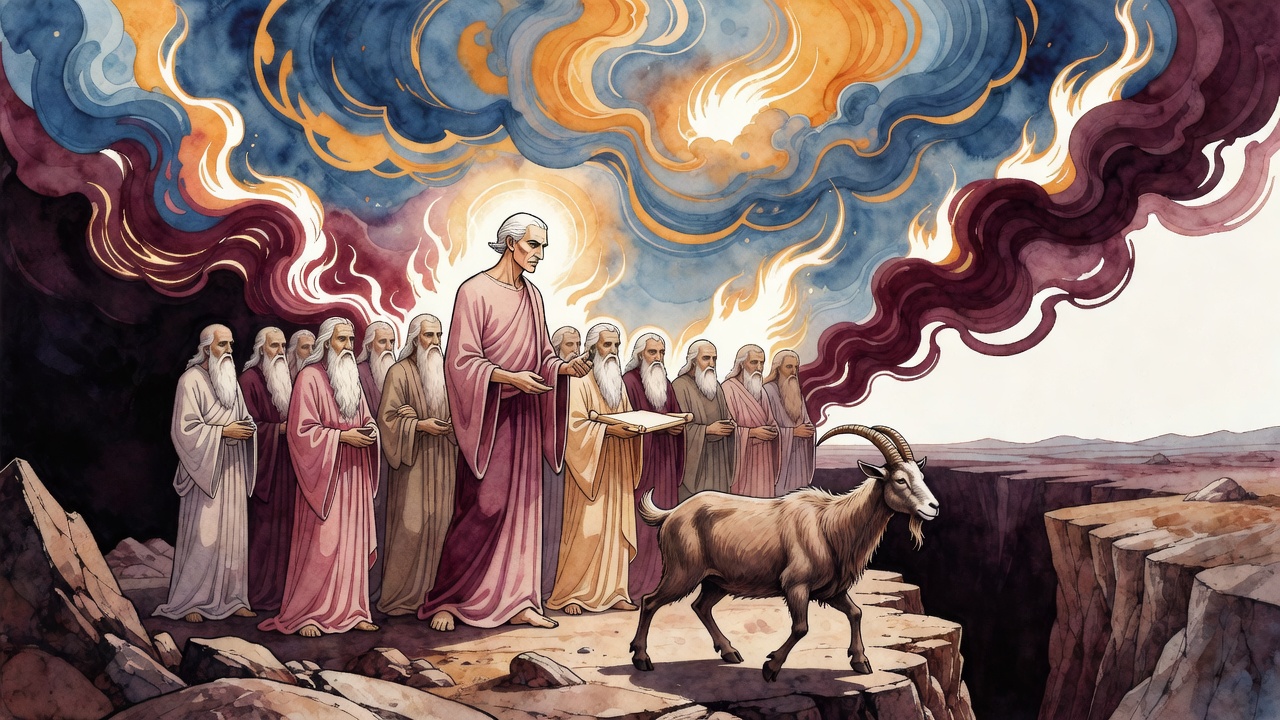
Two goats stood in front of the priest. One went to the altar. The other stood there while the whole weight of a year was laid on its head. Then a man led it out past the last houses and sent it into a dark place, country nobody farms.
The Torah says the goat carries their iniquities away with it (Leviticus 16:22). The Hebrew for their iniquities, avonotam, holds another word inside it. The same letters can be heard as avonot tam, the iniquities of the perfect one. Only one man in the Torah is called tam, perfect, and it is Jacob, sitting in the tents while his brother hunted (Genesis 25:27). The goat that walks into the wilderness carries Jacob's household on its back. The whole line of them. Out to a land under a decree, ge-zeirah. Into the territory of the one who agreed to every condition if ten of the mighty were destroyed (Daniel 4:14).
Nobody follows it. The man who led it out turns around and walks back toward the smoke of the altar. The goat keeps going, smaller and smaller, until the ground it is crossing belongs to somebody else.
← All myths