Shammai Drove the Stranger Away and Hillel Proved the Point With Aleph
A non-Jew demanded the whole Torah in one lesson. Shammai refused. Hillel accepted and then reversed the alphabet to win the argument.
Table of Contents
 Click for full size
Two Laws and One Objection
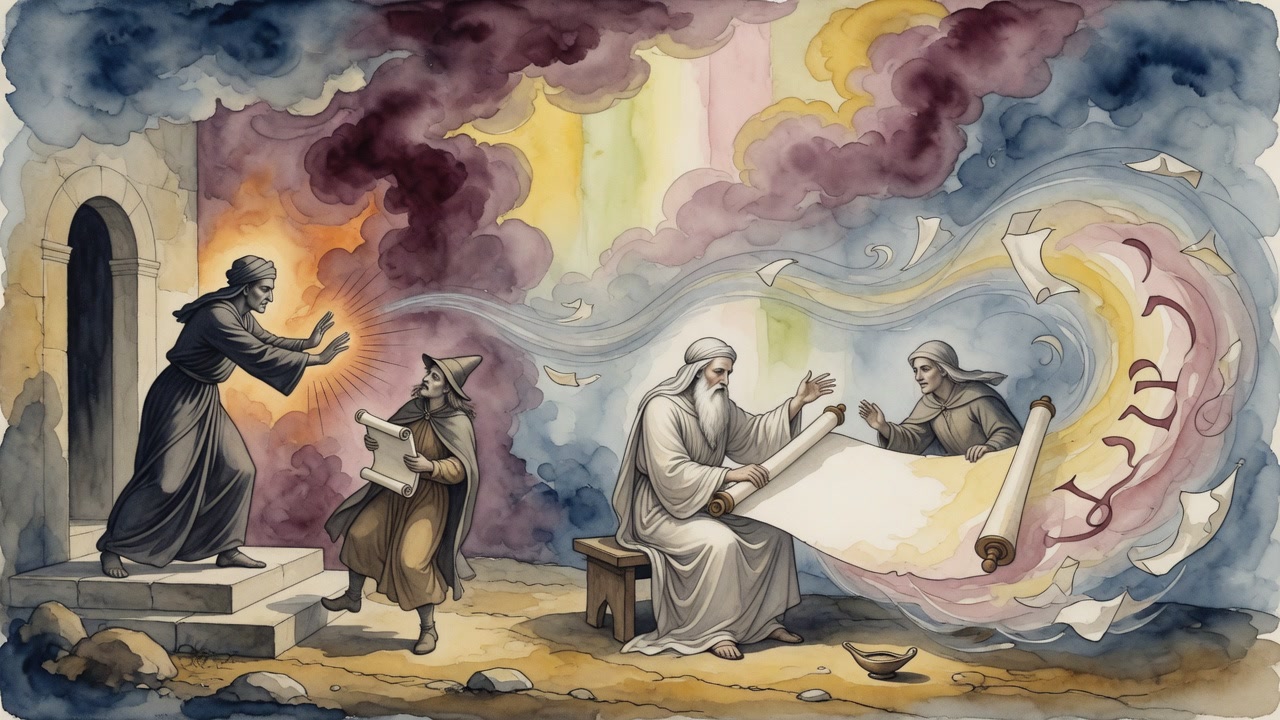
The man came with a condition. He wanted to become a proselyte, he told Shammai, but only if he could be taught the Written Torah alone. The Oral Torah, the tradition passed mouth to ear for generations, the interpretations and rulings that unlocked what the written text could not say on its own, that he would not accept. He wanted the text he could read with his own eyes. What he could not hold in his hands, he did not trust.
Shammai's response was immediate and physical. He took the builder's rod in his hand and drove the man out. This was not cruelty. Shammai had a settled conviction about the relationship between the Written Torah and the Oral Torah: the two were one thing. You could not accept one and reject the other any more than you could accept a building and reject its foundation. The man's condition was not a religious preference. It was a logical contradiction dressed as a request.
Hillel and the First Lesson
The same man went to Hillel with the same condition, and Hillel accepted him without argument. He asked the man to come back the next day and they would begin.
On the first day, Hillel taught him the Hebrew letters in their proper order. Aleph. Bet. Gimel. Dalet. The man returned the second day and Hillel taught them to him again, but in reverse order. The man objected at once. "But yesterday you taught them differently!" Hillel paused. "You accepted what I told you yesterday about the letters," he said. "You trusted me. Why will you not trust me now when I tell you about the Oral Torah?"
The exchange was so compressed that its weight is easy to miss. The man had not questioned the alphabet. Hillel could have said any sequence he wanted and the student would have believed him, because Hillel was the teacher. He had extended trust without realizing it. Hillel had simply waited to show him where that trust had already been given.
What Shammai Was Protecting
Sifrei Devarim, the tannaitic midrash on Deuteronomy shaped in the third century CE, preserves Shammai's legal sensibility in a different context: his ruling on divorce. Deuteronomy 24:1 permits a man to send away his wife if he has found "a thing of nakedness" in her. Beth Shammai read this narrowly. The phrase meant sexual misconduct and nothing else. A man could not divorce his wife because she spoiled his meal or because he found a more attractive woman. Beth Hillel read the verse differently, allowing the grounds to be broader.
Shammai's strictness on divorce and his strictness with the stranger who rejected the Oral Torah come from the same place. He protected institutions from casual dissolution. A marriage was not to be ended on thin grounds. A conversion was not to be built on a flawed premise. In both cases, Shammai held the line.
The Convert Who Became a Defender
The man who learned the letters from Hillel became a proselyte. More than that: he became an advocate. When he later encountered people who challenged the Oral Torah, he answered them himself with the argument Hillel had built into him. The teacher had not simply taught a lesson. He had created someone who could carry the argument forward.
The contrast between Shammai and Hillel is not between a cruel man and a kind one. Both were right in their own terms. Shammai was correct that the condition was incoherent. Hillel was correct that a teacher can sometimes bring a student past an incoherence by giving him the experience of trust before naming it. The man arrived with a boundary and left without it, not because the boundary was wrong, but because Hillel showed him he had already crossed it.
← All myths