Adam Woke With a Wound and a Woman Beside Him
God opens Adam's side while he sleeps, and what emerges is not just a companion but a mirror the first human cannot look away from.
Table of Contents
 Click for full size
The Wound That Came Before the Meeting
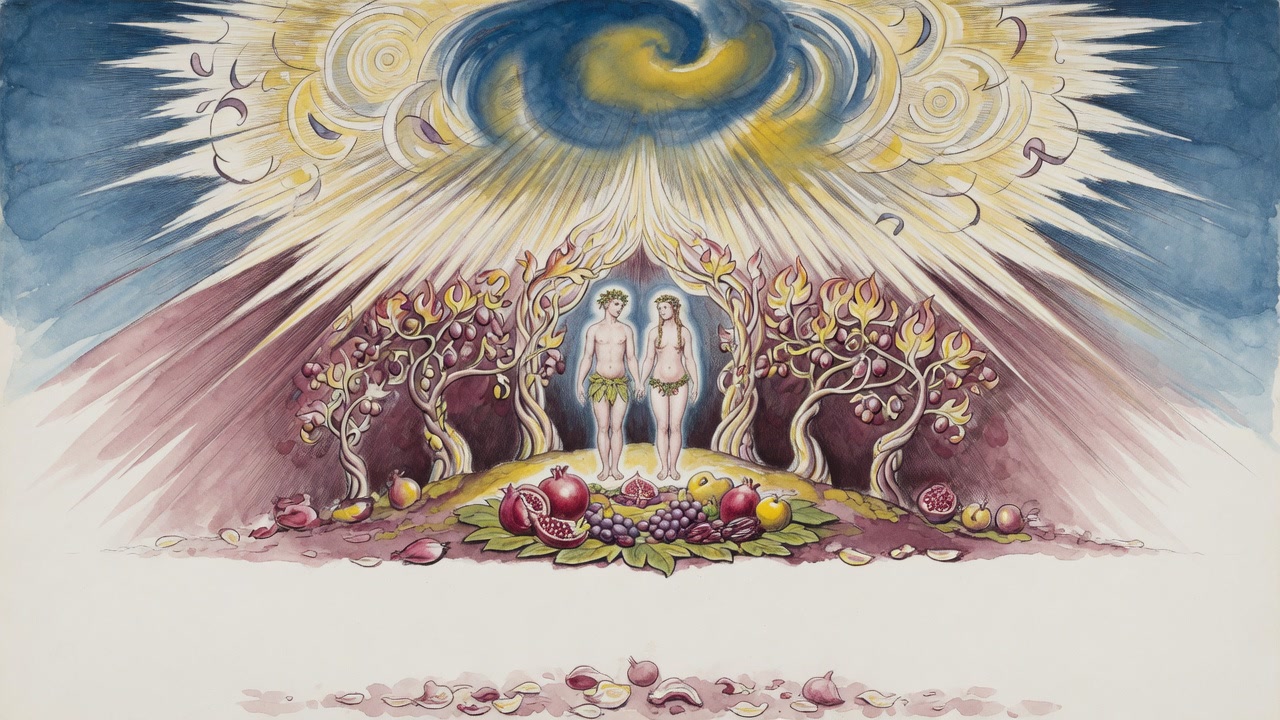
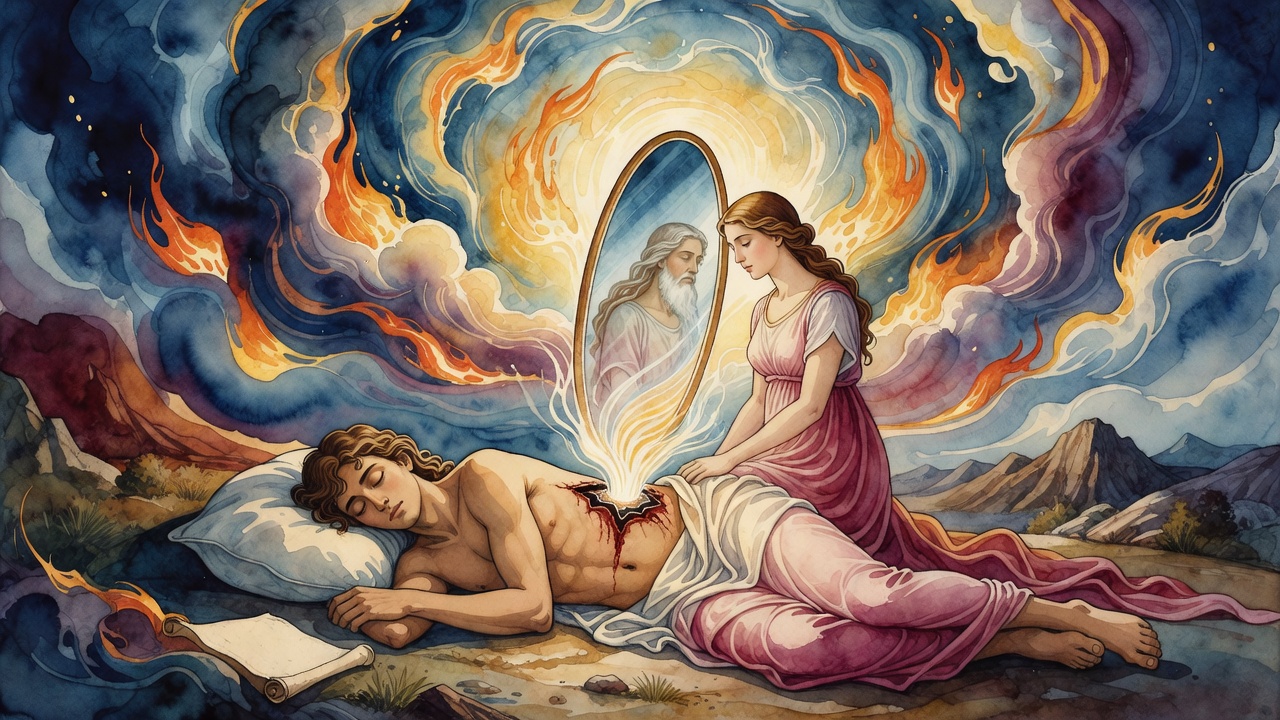
Adam slept, and when he woke, there was a wound in his side and a woman standing before him.
He had not asked for this. No animal had filled the deep longing that passed through him when the creatures paraded before God and each one left with its mate. Something was missing that Adam could not name, because he had never possessed it. God saw the lack and answered it not with clay and breath, the way He had made everything else, but with a surgery. Sleep fell over Adam. A side was opened. Flesh closed over the gap. And from what was taken, a woman was built and brought to him.
The Book of Jubilees, composed in the second century BCE, slows the scene just enough to feel its strangeness. God takes a single rib from among Adam's ribs. The woman is made from that rib. The flesh is sealed where she was removed. Then she is led to the man. And Adam, still drowsy from divine sleep, looks at her and speaks his first recorded words: bone of my bones, flesh of my flesh. He knows her before he has any theory about her.
What the Hebrew Word Carries
The word the Torah uses is tzel'a. It can mean rib, the curved bone that shelters the heart. It can also mean side, the half of a body that faces away from the front, the part a person cannot see in a mirror. Both meanings press against Adam at once.
A rib is hidden until the body is opened. Its owner does not know it is there until something forces the interior into view. A side is what you present to the world when you are not facing anyone directly. Eve arrives from the part of Adam that was invisible to him. She is literally the thing he could not see about himself.
Philo of Alexandria, the Jewish philosopher writing in the first century CE, builds an entire allegory on this. His two Adams are not two people but two conditions of the human being. The first Adam, formed from dust and breath, is the general type, a mind without a body, pure thought. The second is the particular human being who enters time, takes a body, and encounters the other. Eve's creation marks the exact moment when the undivided becomes paired, when the singular becomes relational.
In Philo's reading, this is not a loss. It looks like one. Adam is opened. Flesh is taken. A wound stays where something was removed. But what arrives is not a diminishment. Eve is not Adam's missing piece in the mechanical sense, as if he were incomplete before her. She is the part of him that could only become itself by becoming separate. No one can have a relationship with himself. The interior has to become exterior before it can be encountered.
The Timetable at the Garden's Edge
Jubilees adds a calendar. Adam entered the garden on the fortieth day after his creation. Eve entered on the eightieth. The gap is deliberate. Adam had to be present first, alone in the garden, naming and learning and standing in the place that was made for human habitation, before the woman was brought to complete it.
These numbers carry weight in Jubilees. The book is obsessed with sacred time, with the idea that creation has a structure and that every event occupies the right moment in a carefully laid timetable. Adam at forty days, Eve at eighty: the double interval suggests that Eve's arrival was not an afterthought or a correction to a mistake but the intended second movement of a two-part act.
If Eve was planned from the beginning, then Adam's loneliness was not God's error but God's preparation. The wound was not an accident. The opening was not a flaw in the design. It was the design. Adam had to become someone who had been opened before he could stand beside the person built from what was taken from him.
The Mirror That Does Not Lie
There is something Philo notices that most readers pass over. Adam names the woman immediately. He does not wait, does not ask God what to call her. He speaks. Ishah, he says: woman, because she was taken from ish, man. The names are bound together at the root. She carries his name inside hers.
This is not possession. It is recognition. Adam looks at Eve and sees himself reflected in a way no animal and no mirror could have produced. She is made from his substance but stands apart from him. She is him and not him. The moment he names her, he is also, for the first time, naming himself. A person can only know what he is when something is beside him that shares his nature but is not him.
The first human relationship begins with a wound, a naming, and a recognition that cannot be taken back.
← All myths