141 texts · Page 2 of 3
A man had three daughters, and each carried a flaw. The first was a thief who could not keep her hand from what was not hers. The second was lazy and refused the work a household r...
A man was in the habit of rising from his meals without washing his hands properly. He left the table with crumbs and traces of the food on his fingers, indifferent to the small ri...
The prophet Elijah came to a young man with a simple offer. He could have seven good years of prosperity, either at the beginning of his life or at the end. The choice was his. The...
In the time of King Suleiman, a vizier's wife had borne nine daughters in a row. As her tenth pregnancy advanced, the vizier grew frantic for a son. He warned his wife that if she ...
Ben Sabar was a man famous for his tzedakah. When word came that a poor couple in a distant town needed money for their wedding, he packed a sack of coin and set out without hesita...
Rabbi Akiva had a pious first wife who fed and housed his five hundred students for years. On her deathbed she asked her daughter to continue the work. The daughter accepted the tr...
The Talmud and early midrashic collections preserve rabbinic mishlei, proverbs, in loose clusters — one-line teachings meant to be memorized and turned over slowly. Here is a sampl...
Rabbi Shimon bar Yochai, the second-century sage to whom tradition attributes the core of the Zohar, once sent his son to the study house so that the scholars might bless him. What...
It was prophesied to Rabbi Akiva that his beloved daughter would die on the day of her wedding. Akiva was a student of signs and omens; he believed the prediction. But he also beli...
Gaster's exemplum No. 333 tells a longer, stranger story of Mar Ukva — the same Babylonian exilarch celebrated for his secret charity — before he became the man of secret charity. ...
A woman attended the lectures of Rabbi Meir and came home late. Her husband, furious, demanded to know where she had been. When she told him she had been listening to Torah, he gav...
A man should not be hasty, and above all he should not be angry. The sages held up Hillel the Elder as the standard against which every temper was measured — and his wife's behavio...
Rabbi Meir, on his yearly pilgrimage to Jerusalem, used to lodge with Judah the butcher, whose wife took loving care of him. One year Judah's wife died. Judah remarried, and when R...
A great scholar who spent all his days teaching Torah had a son late in life. He cherished the boy and kept him inside the study house, afraid that the world would distract him. Hi...
A woman had been married for ten years and could not conceive. Her husband, following the ruling that a childless marriage of ten years permits divorce, declared his intention to s...
A rich man had one son. When the son turned eighteen, he begged his father for permission to travel to a famous academy. The father let him go, and three times over three years the...
Two brothers lived side by side. One was rich and had a bad wife. The other was poor and had a good one. On the eve of Passover, the poor brother's wife urged him to open his home ...
A merchant left his young wife at the start of a long trading voyage. She was pregnant at his departure, though he did not know it. He was gone many years — so many that the infant...
A young man rode from Tiberias to Betar and met a young woman who fell in love with him on sight. They married within days. A year later she asked him to bring her to visit her par...
Rabbi Akiva began his life illiterate and ended it the greatest Torah teacher of his generation. The bridge between the two was a woman named Rachel. Rachel was the daughter of Kal...
Rabbi Hanina ben Dosa lived in such poverty that his family often had nothing for Shabbat. One Friday, his wife stood in the empty kitchen, ashamed. The neighbors would notice the ...
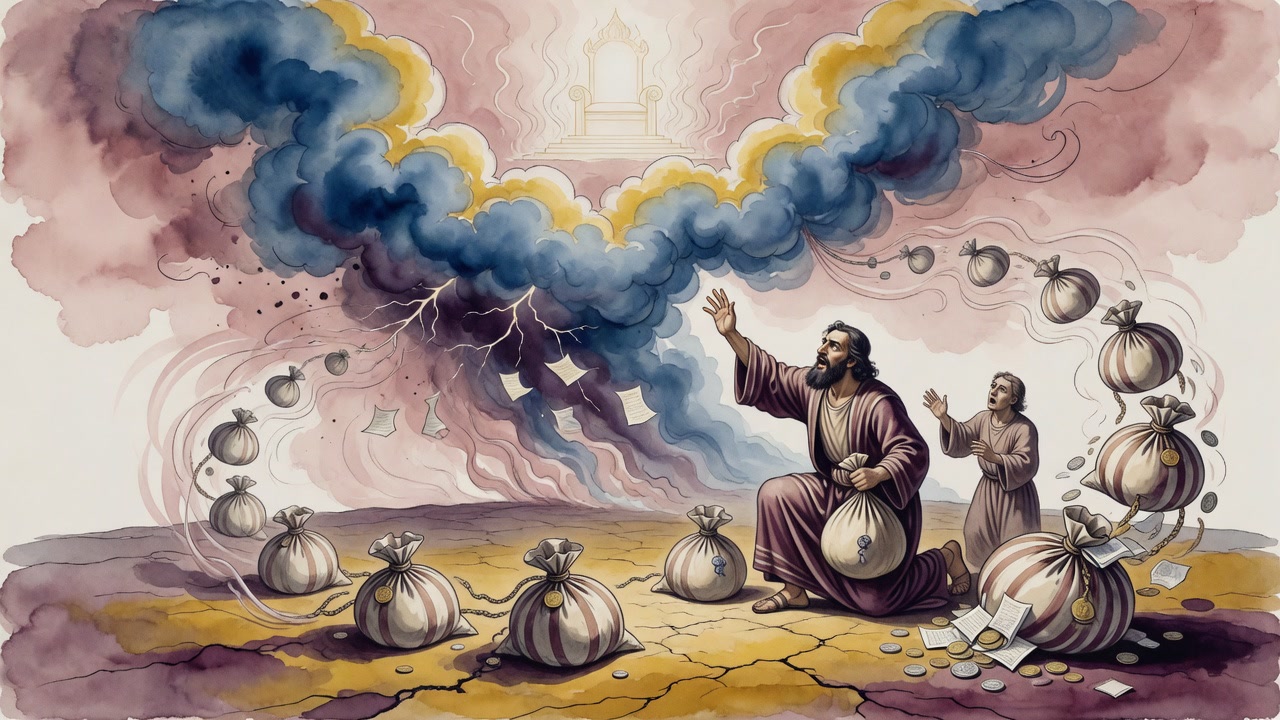
A charitable man kept three chests in his house. One filled with gold, one with silver, one with copper. From these he gave to every beggar who came to his door, matching the gift ...
King Solomon and King Hiram of Tyre once marched their armies to opposite banks of a river. Tension rose. Solomon, worried his soldiers would collapse in the sun, summoned birds to...
King Solomon warned a skilled builder — the man who had constructed his palace — that the builder's wife was unfaithful. The builder refused to believe it. Solomon did not argue. H...
There was once a custom in a Jewish town that newlyweds were greeted with a hen and a rooster, symbols of fruitfulness. One day Roman soldiers marched through the town, saw the bir...
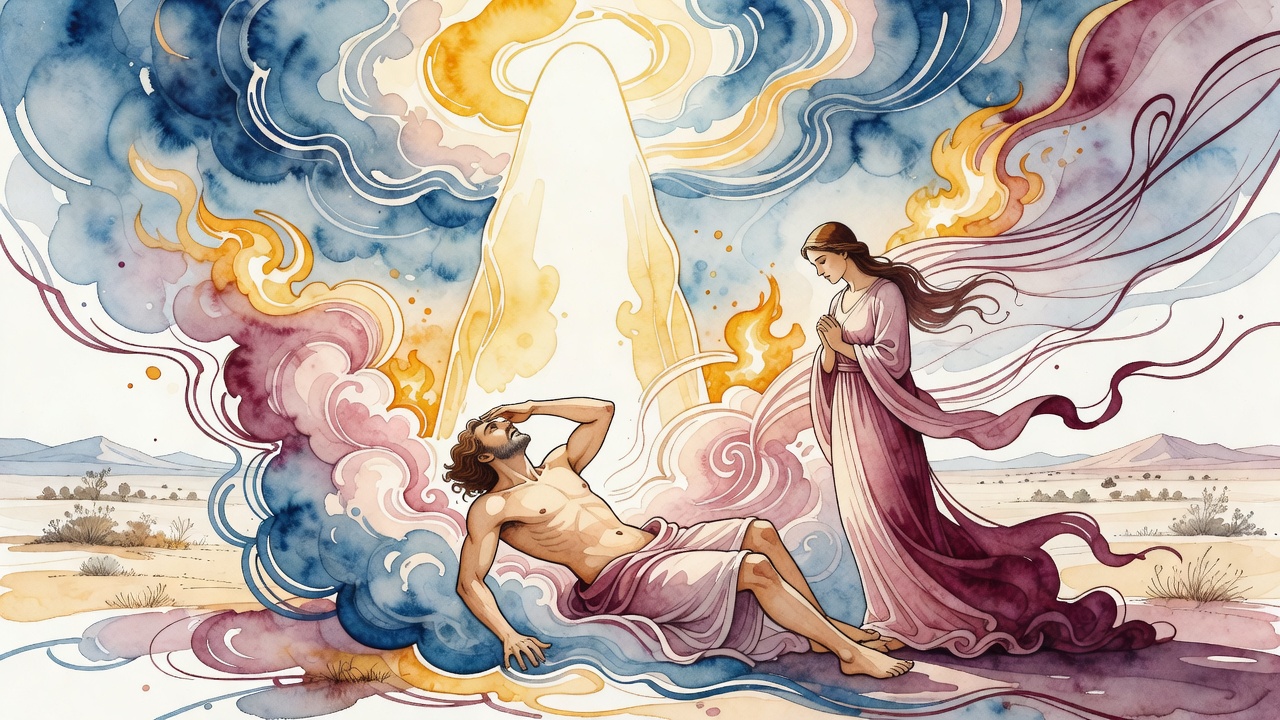
Before any commandment and before any punishment, humanity's first word from God is a blessing. Targum Pseudo-Jonathan on (Genesis 1:28) tells us Adam and his wife were blessed and...
The naming finished. Targum Pseudo-Jonathan on (Genesis 2:20) closes the scene with a quiet loneliness: "Adam called the names of all cattle, and all fowl of the heavens, and all b...
The Torah says God took "one of his ribs" to make the woman. Targum Pseudo-Jonathan on (Genesis 2:21) gets oddly specific. "He took one of his ribs, it was the thirteenth rib of th...
Adam wakes up and speaks. Targum Pseudo-Jonathan on (Genesis 2:23) gives him a line with an unusual opening: "This time, and not again, is woman created from man."The Targumist is ...
The Torah's famous line — "therefore a man leaves his father and mother and cleaves to his wife" — gets a pointed rewording in Targum Pseudo-Jonathan on (Genesis 2:24). A man "shal...
Eve's sentence in the Torah is brief. Targum Pseudo-Jonathan on (Genesis 3:16) weighs it. "Multiplying, I will multiply thy affliction by the blood of thy virginity, and by thy con...
Lamech's cryptic boast in the Torah — "I have slain a man to my wounding" — becomes, in Targum Pseudo-Jonathan on (Genesis 4:23), a defense plea. "Hear my voice, wives of Lemek, he...
Targum Pseudo-Jonathan on (Genesis 4:25) slows the Torah down. Adam did not immediately father another son after the murder. The Targumist tells us it took a hundred and thirty yea...
One of the Torah's most mysterious verses, (Genesis 6:2), talks about "the sons of God" taking "the daughters of men." The Targumist keeps the image but sharpens it.Targum Pseudo-J...
A genealogy in the Hebrew Bible almost always repays slow reading. The Targumist on (Genesis 11:29) drops a single clause into the list of wives and changes the whole family tree: ...
Targum Pseudo-Jonathan on (Genesis 12:11) offers one of the most quietly astonishing readings in the entire Aramaic paraphrase tradition. It explains how Abram can suddenly, after ...
The plain verse in (Genesis 12:12) is a husband's anxious calculation: when the Egyptians see thee, they will say, This is his wife, and they will kill me, and thee they will keep ...
The verse in (Genesis 12:19) is Pharaoh's outburst, and Targum Pseudo-Jonathan sharpens its center. Why saidst thou, She is my sister? When I would take her to me to wife, plagues ...
There is a detail in the Hebrew of Genesis 16:2 that the Targum will not let pass quietly. Sarah sends her husband to her handmaid Hagar. The Hebrew says simply go in unto my maid....
The Hebrew of Genesis 16:3 marks the moment with a small, precise number: after Abram had dwelt ten years in the land of Canaan. Targum Pseudo-Jonathan holds onto that ten and adds...
Targum Pseudo-Jonathan on Genesis 16:5 lets Sarah speak at length, and the speech is a small masterpiece of grief, accusation, and memory. It begins quietly — my affliction is from...
The Hebrew of Genesis 16:6 is terse, almost stenographic. Targum Pseudo-Jonathan keeps the brevity but sharpens one word: authority. Behold, thy handmaid is under thy authority, Ab...
Every family has a story it tells to the outside world. Abraham's was quieter than most. In Targum Pseudo-Jonathan on Genesis 20:13, he finally explains to Abimelech why he left th...
A thousand pieces of silver. That is what the king paid — and in Targum Pseudo-Jonathan on Genesis 20:16, the Aramaic paraphrase lingers on what the coins mean. They are a keseiat ...
Dawn in the house of Abraham. Bread on a shoulder. A cruse of water tied to a woman's waist. In Targum Pseudo-Jonathan on Genesis 21:14, the Aramaic paraphrase adds a detail the He...
Here is one of the strangest verses in the Targum, and one of the most historically suggestive. In Targum Pseudo-Jonathan on Genesis 21:21, Ishmael grows up in the wilderness of Ph...
Abraham is old, and the question of Isaac's wife must be settled. In Targum Pseudo-Jonathan on Genesis 24:2, the Aramaic makes explicit what the Hebrew only hints at: Abraham tells...
The command is unambiguous. In Targum Pseudo-Jonathan on Genesis 24:3, Abraham makes Eliezer swear by the Word of the Lord God, whose habitation is in heaven on high, the God whose...