
God Had to Convince Moses to Free His Own People
Moses didn't want to lead the Exodus. He argued with God through five excuses at the burning bush. God finally lost patience, and the punishment stuck.
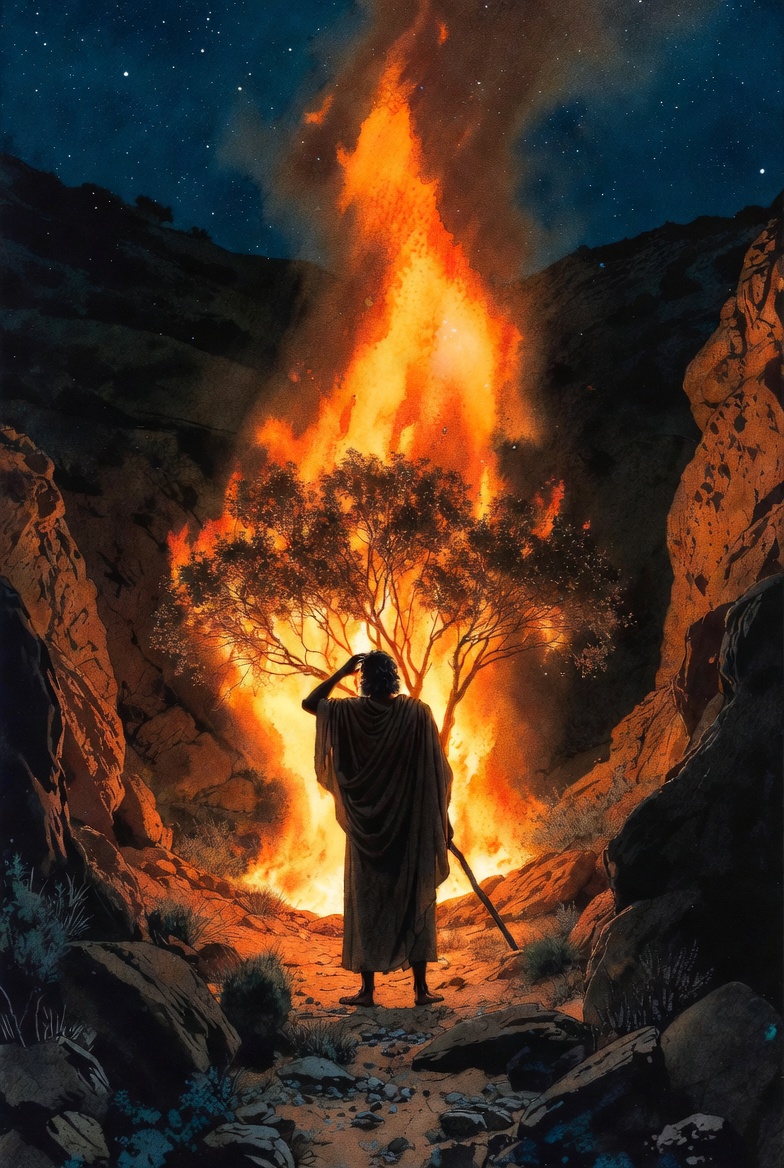
Moses was eighty years old when God appeared to him in the burning bush. He had been a shepherd for forty years. Prince of Egypt, killer of an overseer, fugitive. That life was decades behind him. He had a wife, children, a quiet life in Midian. The last thing he wanted was to go back to Egypt.
So when God told him to, he said no. Repeatedly.
The Five Excuses
The Exodus narrative in Chapters 3-4 records Moses's resistance in detail. According to the Legends of the Jews, Moses offered five distinct objections over the course of the conversation at the burning bush.
"Who am I to go to Pharaoh?" (Exodus 3:11). He questioned his own worth. God answered: I will be with you.
"What if they ask Your name?" (Exodus 3:13). He questioned his knowledge. God answered: Tell them I AM WHO I AM.
"They won't believe me" (Exodus 4:1). He questioned his credibility. God answered with three miracles: the staff, the leprous hand, the water turned to blood.
"I am not a man of words" (Exodus 4:10). He questioned his ability. God answered: Who made mouths?
And finally: "Please send someone else" (Exodus 4:13). No excuse at all. Just refusal.
Anyone who has ever stalled on a calling they knew was real will recognize this sequence. The objections get thinner as they go. By the fifth one, Moses isn't arguing. He's just hoping God will give up and pick someone else.
When God Lost Patience
The Torah records something unusual at this point: "And the anger of God burned against Moses" (Exodus 4:14). Not tested, not disappointed. Angry. According to the Legends of the Jews, God's frustration had been building through all five arguments. "You deserve to be castigated with your own staff," God says. The very rod Moses held, the one God had just empowered to work miracles, was almost used against him.
The Legends of the Jews records the actual punishment. God told Moses that Aaron would be his spokesman. This sounds like a gift. Moses hated public speaking. But the text frames it as a demotion. The priesthood had originally been destined for Moses. Because Moses delayed and argued past the point of acceptable reluctance, it passed to Aaron. Aaron became the High Priest. Moses became the prophet. The distinction shaped their descendants' lives for centuries.
What the Reluctance Was Really About
The rabbis debated whether Moses's resistance showed humility or something more troubling. The early objections, "who am I?", read as genuine modesty. But "send someone else" after God has answered every concern, multiple times, looks like something else. It starts to look like a man choosing his own comfort over an entire people's need.
The midrash doesn't let him off the hook. The burning bush was burning for a reason. The moment was chosen. Israel had cried out from Egypt for generations (Exodus 2:23). Moses's hesitation cost him the priesthood. His descendants never served at the altar. Aaron's did, from the first day the Tabernacle was dedicated until the Temple fell.
Moses became the greatest prophet who ever lived. But he walked into that role arguing all the way.