
The Lamed Vav - 36 Hidden Saints Who Keep the World Alive
In every generation, exactly 36 hidden righteous people sustain the entire world. They do not know who they are.
Table of Contents
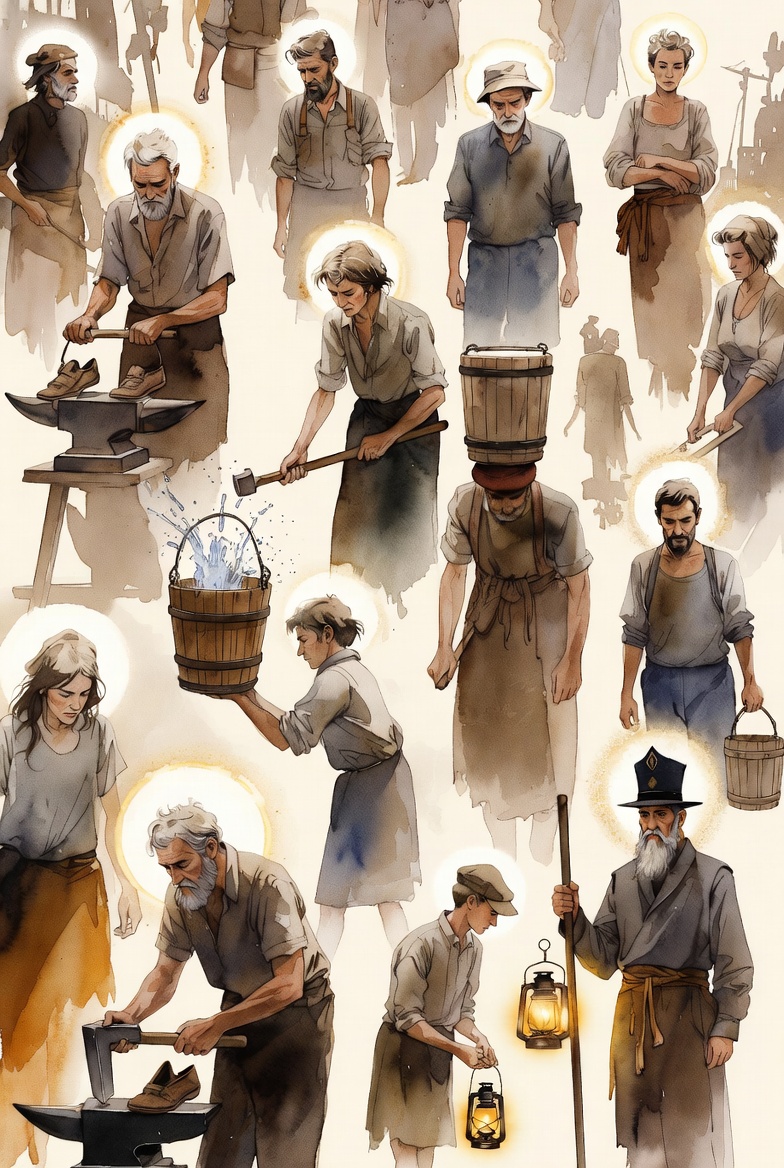
Somewhere in the world right now, 36 people are keeping all of existence from collapsing. They do not know this. They do not know each other. They are scattered across the globe, living ordinary lives in ordinary places, working, eating, sleeping, walking to the store. They might be poor. They are probably poor. They are almost certainly anonymous. And if even one of them were to disappear, the world would end. Not metaphorically. Not eventually. The world would be destroyed. This is the doctrine of the Lamed Vav Tzadikim (ל"ו צדיקים), the 36 Hidden Righteous Ones, also known as the Tzadikim Nistarim (צדיקים נסתרים, "Hidden Righteous Ones") or, in Yiddish, the Lamedvovniks, and it is one of the most enduring and haunting ideas in all of Jewish mystical thought.
The number 36 comes from the Hebrew letters lamed (ל), which has the numerical value of 30, and vav (ו), which has the numerical value of 6. Lamed Vav. Thirty-six. The concept appears in the Babylonian Talmud (redacted c. 500 CE), is developed in the Zohar (first published c. 1290 CE), and reaches its fullest expression in Chasidic tradition beginning in the 18th century. Our database contains The Thirty-Six Just Men from our collection, which collects the major strands of this tradition into a single narrative. The roots go back nearly two thousand years.
The Talmudic Origins
The earliest source is the Babylonian Talmud, Tractate Sukkah 45b (redacted c. 500 CE). Abaye (c. 280-339 CE, Babylonia) states: "There are no fewer than thirty-six righteous persons in every generation who receive the face of the Shekhinah (שכינה), the Divine Presence." He derives this from (Isaiah 30:18), "Blessed are all those who wait for Him," noting that the Hebrew word for "for Him" (lo, לו) has the numerical value of 36. Thirty-six people in every generation are so righteous that they personally encounter God's presence. Not through study. Not through prayer. Through the sheer force of their moral existence.
A parallel statement appears in Tractate Sanhedrin 97b, where Rav (Abba Arikha, 3rd century CE, Babylonia) teaches that the world must contain a minimum number of righteous people at all times or it cannot continue to exist. The exact number varies by source. Some traditions say 45, derived from (Genesis 18:28), where Abraham bargains with God over the fate of Sodom and God agrees to spare the city for the sake of 45 righteous people, then 40, then 30, then 20, then 10. The number that lodged permanently in Jewish consciousness was 36. Always 36. The Midrash Rabbah (2,921 texts in our database) in Bereishit Rabbah (compiled c. 5th century CE) reinforces this number, connecting it to the 36 hours that the primordial light of creation shone before God hid it away for the righteous in the world to come.
Why Must They Be Hidden?
The most distinctive feature of the Lamed Vav is not their number. It is their anonymity. They do not know they are among the 36. If one of them were to become aware of his or her status, that awareness would immediately disqualify them. The moment a person thinks "I am one of the 36 righteous who sustain the world," they are not. Pride is incompatible with the role. The 36 must be hidden, nistarim (נסתרים), even from themselves.
This creates a theological paradox that the Chasidic masters found endlessly fascinating. How can a person fulfill a cosmic role without knowing they are fulfilling it? The answer, developed across multiple Chasidic traditions beginning with Rabbi Israel ben Eliezer, the Baal Shem Tov (c. 1700-1760 CE, Ukraine), is that righteousness at this level is not a conscious achievement. It is a state of being. The Lamed Vav are not people who decided to be righteous. They are people who simply are righteous, instinctively, constitutionally, without effort or awareness. They give charity because it never occurs to them not to. They show kindness because cruelty is genuinely incomprehensible to them. They are, in a sense, the moral immune system of the world, and like an immune system, they function without conscious direction.
The Zohar (3,298 texts in our collection) adds a mystical dimension. The 36 correspond to the 36 candles lit during the eight nights of Chanukah (1 + 2 + 3 + 4 + 5 + 6 + 7 + 8 = 36). They also correspond to the 36 hours of the Ohr HaGanuz (אור הגנוז), the Hidden Light of Creation. According to the Talmud in Chagigah 12a, the light God created on the first day (Genesis 1:3) was not the light of the sun, which was not created until the fourth day. It was a spiritual light so powerful that a person could see from one end of the world to the other. God hid this light after 36 hours, reserving it for the righteous in the future. The Lamed Vav, in the Kabbalistic reading, carry fragments of this hidden primordial light within them. They are walking vessels of the original creation.
What Happens When One of Them Dies?
The tradition is precise on this point. When one of the 36 dies, another righteous person is immediately elevated to take their place. The number never drops below 36. It cannot. The Talmud in Sanhedrin 97b frames this as a structural requirement of reality itself. The world is sustained by a minimum quorum of righteousness, and if that quorum is ever broken, even for a moment, creation collapses. The Midrash Aggadah (3,763 texts) uses the metaphor of pillars. The 36 are the pillars holding up the sky. Remove one, and the ceiling falls.
Chasidic tradition adds emotional texture to this mechanical framework. Stories circulated in Eastern European Jewish communities from the 18th century onward about encounters with suspected Lamed Vavniks, people who seemed too poor, too humble, too selfless to be ordinary. The Baal Shem Tov himself was said to have occasionally identified one of the 36, always in the most unlikely person. A water carrier. A woodchopper. A woman who sold bread in the marketplace and gave half of it away. The identification was never certain, because certainty was impossible by definition. The 36 could not be verified. They could only be suspected.
The most poignant element of these stories is what happened when a suspected Lamed Vavnik was identified publicly. In several Chasidic tales, the moment the righteous person was recognized, they immediately fled, or fell ill, or died. Exposure was fatal to their role. The light they carried could only function in darkness. The Thirty-Six Just Men from our collection presents the Lamed Vav as the most powerful and most fragile people alive.
Could Anyone Be One of the 36?
This is the question that gives the Lamed Vav doctrine its unique power. The answer is yes. Anyone. The entire point of the tradition is that the 36 are unidentifiable. They are not rabbis, or at least not necessarily rabbis. They are not scholars. They are not famous. They are not leaders. They are, according to every major source, the people you would least suspect. The Talmud does not restrict the 36 to men, to Jews, or to any particular social class. Abaye's statement in Sukkah 45b uses the generic term "righteous persons" (tzadikim, צדיקים), without qualification.
Some later authorities did restrict the 36 to Jewish men, but the broader tradition, especially in Chasidic storytelling, is more expansive. Rabbi Nachman of Breslov (1772-1810 CE, Ukraine), the great-grandson of the Baal Shem Tov and one of the most creative storytellers in Jewish history, told tales in which the hidden righteous appeared as beggars, as servants, as people with no apparent connection to Torah scholarship at all. His stories, collected in Sipurei Maasiyot (published 1816), present a world in which holiness is distributed democratically, hiding in the last places anyone would look.
The practical implication is staggering. If anyone might be one of the 36, then everyone must be treated as though they could be. The stranger at your door might be sustaining the world. The person you dismiss as unimportant might be the reason the sun rose this morning. The Lamed Vav doctrine is, at its heart, an argument for radical humility in the face of other human beings. You do not know who is holy. You cannot know. So treat everyone as though they might be.
The Lamed Vav in Modern Jewish Thought
The concept of the 36 has proven remarkably durable. Andre Schwarz-Bart (1928-2006), a French novelist of Polish-Jewish origin, wrote The Last of the Just (1959), a novel tracing one family's lineage of Lamed Vavniks from the medieval York massacre of 1190 through the Holocaust. The novel won the Prix Goncourt, France's most prestigious literary prize, and introduced the concept of the Lamed Vav to a global readership. In Schwarz-Bart's telling, the 36 are not protected by their righteousness. They suffer more than anyone else, precisely because they absorb the world's pain.
This interpretation, the Lamed Vav as suffering servants who carry the weight of the world's evil, draws on earlier Kabbalistic sources, particularly the Zohar's concept of the tzaddik yesod olam (צדיק יסוד עולם), "the righteous one who is the foundation of the world" (Proverbs 10:25). In Kabbalistic cosmology, the sefirah of Yesod (יסוד), Foundation, channels all divine energy into the lowest sefirah, Malkhut (מלכות), which represents the physical world. The Lamed Vav are human embodiments of Yesod. They are the living conduit through which God's sustaining energy flows into creation. Without them, the channel closes. The world loses its connection to its source. And everything ends.
The doctrine persists today in communities across the Jewish world. It is referenced in synagogue sermons, in Chasidic gatherings, in Jewish literature and film. It appears in Yiddish folktales and Israeli poetry. It is perhaps the most democratic mystical doctrine ever conceived: the idea that the salvation of the world depends not on kings, generals, or prophets, but on 36 anonymous, humble, hidden people who will never be thanked, never be recognized, and never know what they are.
Explore the Hidden Righteous Texts
Start with The Thirty-Six Just Men from our collection for the core tradition. Then explore Light Is Sown for the Righteous and A Tabernacle for the Righteous for the broader theology of righteousness in Jewish mythology. The Chorus of the Righteous describes what the righteous do in the world to come.
Our database holds over 18,000 texts spanning Midrash Rabbah (2,921 texts), Kabbalah (3,298 texts), Legends of the Jews (2,650 texts), Midrash Aggadah (3,763 texts). Search for righteous or search for tzaddik to find the full tradition of hidden holiness in Jewish thought. Somewhere in those texts, the identity of the 36 is almost revealed. Almost. But never quite.