1,435 texts · Page 1 of 30
To a few verses from his writings. He starts with a seemingly straightforward observation: "A noble, ruler, judge shall be glorified, but nothing is greater than fearing the Lord."...
It’s a question that’s haunted humanity for ages, and it’s one the Book of Ben Sira, a work of wisdom literature not included in the Hebrew Bible but valued in Jewish tradition, gr...
That sense of belonging – or not belonging – is at the heart of a fascinating, and often overlooked, passage from the Book of Jubilees. Now, if you haven’t heard of the Book of Jub...
It's a retelling and expansion of stories we find in Genesis, offering a slightly different perspective. Our focus? Chapter 24. It's a short, sharp account of Isaac and his struggl...
The story continues with Holofernes, the general of Nebuchadnezzar's army, and his relentless campaign of conquest. After his initial victories, the text tells us, "And from there ...
It all starts with a letter. I'm talking about the Letter of Aristeas. It's not actually part of the Bible itself, but it's a fascinating ancient text that claims to tell us how th...
The Letter of Aristeas, an ancient text, gets right to that point. It tells us that the joy of learning, the pursuit of wisdom, it's just… different. More profound than any fleetin...
It’s a question that weaves through history, a tapestry of voluntary migration, military service, and, unfortunately, enslavement. One fascinating, though potentially embellished, ...
That’s exactly where Aristeas found himself, as recounted in the Letter of Aristeas. Imagine being tasked with securing the freedom of countless captives. It's a daunting mission, ...
We're about to dive into a story where freeing a people became not just a political act, but an offering to the Divine. Imagine this: King Ptolemy Philadelphus, ruler of Egypt in t...
The story, as told in the Letter of Aristeas, is a fascinating glimpse into a world of kings, scholars, and, well, a whole lot of money. The narrative picks up with a pressing matt...
Our tale begins with a letter – the Letter of Aristeas, to be precise. It purports to be from a courtier named Aristeas to his brother Philocrates, recounting the events surroundin...
This is the picture we get from the Letter of Aristeas, where the author describes the actions of a powerful ruler who went above and beyond. He boasts, "I have set at liberty more...
It all starts with a letter, aptly named the Letter of Aristeas. Imagine being a fly on the wall as this letter is dictated. It’s addressed to Philocrates, and the writer, Aristeas...
Among the oldest Jewish texts outside the Hebrew Bible is a peculiar document called the Letter of Aristeas — not a letter in scripture, but a letter about scripture, recounting ho...
That’s precisely the scene that unfolds in the Letter of Aristeas. It’s not just any letter; it’s a record, a moment frozen in time, detailing a remarkable exchange between a Jewis...
That's the request King Ptolemy II Philadelphus supposedly received, and it kicks off the fascinating story we find in the Letter of Aristeas. Now, this letter, attributed to someo...
The Letter of Aristeas, a fascinating text that purports to describe the creation of the Septuagint (the Greek translation of the Hebrew Bible), gives us a glimpse into this questi...
Picture the weight of it, the gleam of it. The Letter of Aristeas tells us it was two cubits long, one cubit broad, and one and a half cubits high. Now, a cubit is an ancient measu...
This letter, purportedly written by a Greek official named Aristeas, gives us a glimpse into the creation of the Septuagint, the Greek translation of the Hebrew Bible. But amidst t...
Around the edge, where the surface curves upward to meet your gaze, there's a mesmerizing pattern. What is it? A series of precious stone "eggs," meticulously carved. The Letter of...
The Letter of Aristeas, a fascinating text that purports to describe the translation of the Hebrew Bible into the Septuagint, gives us a glimpse. But within its pages, there are al...
Within its pages, we find a glimpse of the artistry involved in constructing the vessels of the Temple. One small detail in particular catches our eye, an ornate foot that supports...
The Letter of Aristeas gives us a tantalizing glimpse. This ancient text, purporting to be a letter from an official named Aristeas to his brother Philocrates, describes the proces...
We catch a glimpse of it, not from the Bible itself in this case, but from an ancient letter – The Letter of Aristeas. This fascinating text, though not part of the core biblical c...
That’s the kind of artistry we encounter in the Letter of Aristeas, a fascinating document that purports to describe the translation of the Hebrew Bible into Greek, creating what w...
There’s also another set of treasures that had a similar effect: the vessels created for the Temple in Jerusalem during the time of the Second Temple. And the Letter of Aristeas gi...
It’s a fascinating document, purporting to be written by a Greek official named Aristeas to his brother Philocrates. In it, he describes the process of commissioning the translatio...
The Letter of Aristeas asks us to do just that, to linger in the details. It’s a fascinating ancient text purporting to be a letter from an official in the court of Ptolemy II Phil...
We read about it, we imagine it, but sometimes it's the small, sensory details that truly bring history to life. One of the most fascinating accounts we have comes from the Letter ...
We get a glimpse, a vivid snapshot, from the Letter of Aristeas. This letter, a fascinating document from the Hellenistic period, purports to be written by a Greek official named A...
The Letter of Aristeas, a fascinating text attributed to an official in the court of Ptolemy II Philadelphus (285-247 BCE), gives us a glimpse into just such a scene. It describes,...
The Letter of Aristeas, a fascinating historical text, gives us a glimpse into just such a moment. It recounts the story of how the Septuagint – the Greek translation of the Hebrew...
Before we even get to the translation, the letter gives us a glimpse into the awe-inspiring presence of the High Priest in Jerusalem. The author, supposedly a Greek courtier named ...
It's not just a letter, it's a window into a world long gone. The Letter of Aristeas is a fascinating document. It purports to be a first-hand account of how the Septuagint – that'...
In the Letter of Aristeas, we get a glimpse into just such a place – likely referring to the Temple in Jerusalem. The text describes the elaborate security measures in place. It wa...
This isn’t just any crossroads. As the Letter of Aristeas describes, the path is divided. Some people are always going up, and others down. What’s happening? Well, it all comes dow...
It might sound strange, but bear with me. The Letter of Aristeas, an ancient text attributed to someone named Aristeas, though its true authorship is debated, gives us a glimpse in...
We're talking about a place that seemingly had it all. But here's the thing: All that prosperity attracted people from the countryside. Farmers, laborers, folks who knew the land. ...
It might surprise you. The Letter of Aristeas, a fascinating document from around the 2nd century BCE, gives us a glimpse into the mind of Ptolemy II Philadelphus, the Greek ruler ...
Tucked within this letter are some intriguing observations about the land itself. One thing that really stood out to the author was the importance of population distribution. They ...
The Letter of Aristeas, a text purporting to be from the 2nd century BCE, gives us a glimpse of the author's perception of Egypt. It paints a picture of immense scale, almost unbel...
The Letter of Aristeas, though not strictly a sacred text, offers us a fascinating glimpse, a sort of travelogue, into that world. It paints a picture, quite literally, of the land...
Let’s journey back in time, to a world of kings, scholars, and a burning desire to bridge cultures. Our tale begins with a concern. A very practical concern, actually. Imagine your...
This letter, purportedly written by a Greek official named Aristeas, describes the process of creating the Septuagint, the Greek translation of the Hebrew Bible. But it's more than...
The Letter of Aristeas gives us a glimpse into just that kind of bittersweet moment. It paints a picture of devotion, duty, and the complicated emotions that arise when brilliance ...
The Letter of Aristeas, a fascinating peek into the world of 3rd-century BCE Alexandria, gives us a clue. It's framed as a letter from Aristeas, an official in the court of Ptolemy...
The Letter of Aristeas, an ancient text purporting to describe the translation of the Hebrew Bible into Greek (the Septuagint), touches on this very question. And surprisingly, it ...
Most people think Lilith is a medieval folk demon. The truth is older: she begins in Mesopotamia, surfaces in Isaiah, and becomes Adam's first wife by the 10th century CE.
Most people think the Jewish creation story is seven days long. The rabbis thought it was infinite - from 974 destroyed worlds before Adam to the Kabbalistic shattering of divine vessels.
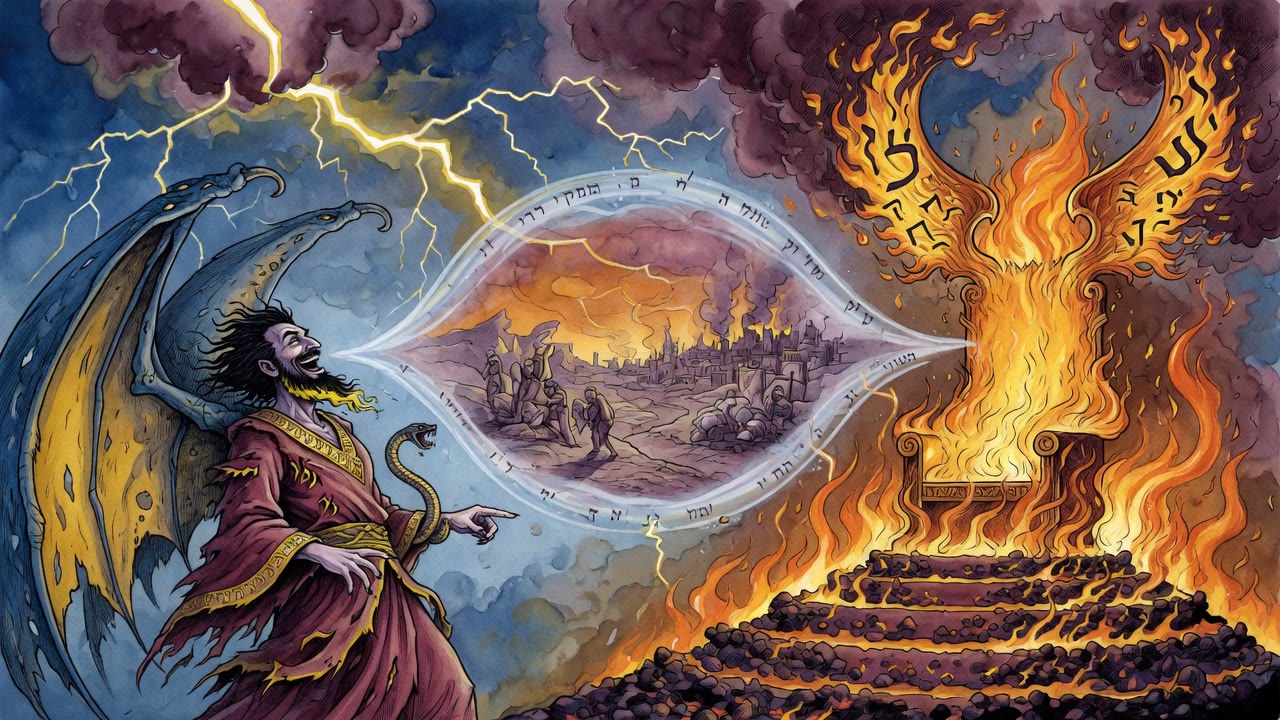
Samael is the angel who rode the serpent into Eden, the being whose name means 'Poison of God,' and the Angel of Death who carries a sword with a single drop...
The Torah ends the negotiation at ten righteous men. The midrash says Abraham never stopped arguing — and God brought the dead back to life.
When Adam named every creature, he wasn't coming up with labels at random. According to the rabbis, he perceived the essential nature of each animal and declared a name that was its spiritual truth — a feat of mystical vision no human has matched since.
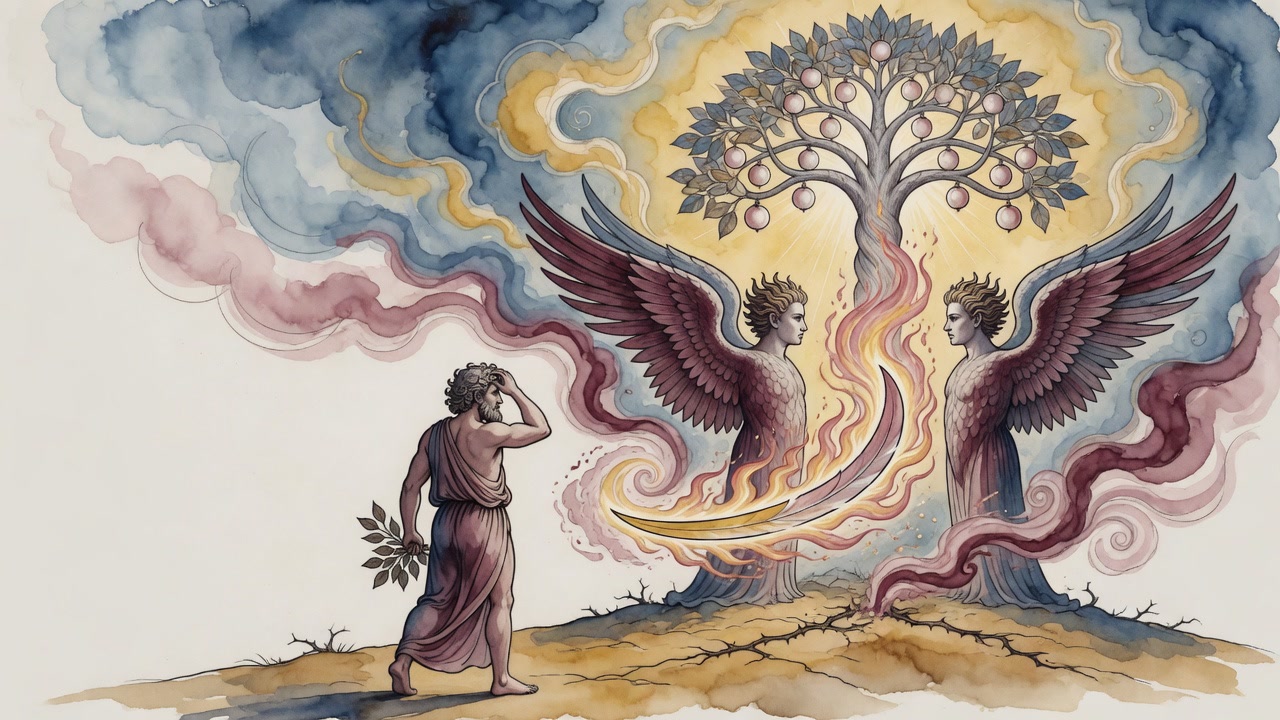
Most people read Genesis 3:24 as a locked gate. The rabbis saw something stranger. The cherubim were holding the way to the tree of life open.
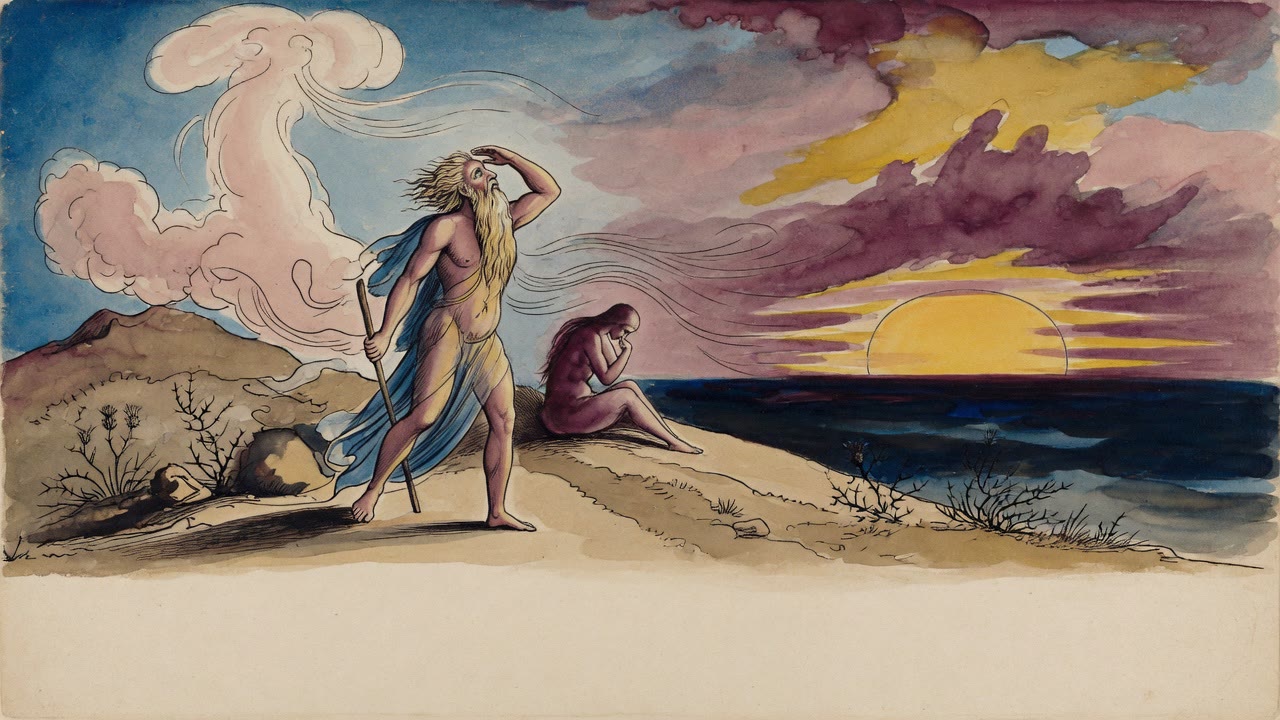
Genesis moves on from Eden immediately. But the rabbis traced what Adam and Eve experienced in the first hours and days after the expulsion — the shock, the cold, the first sunset they'd ever seen — and found in those details a story of survival that the Torah condensed to nothing.
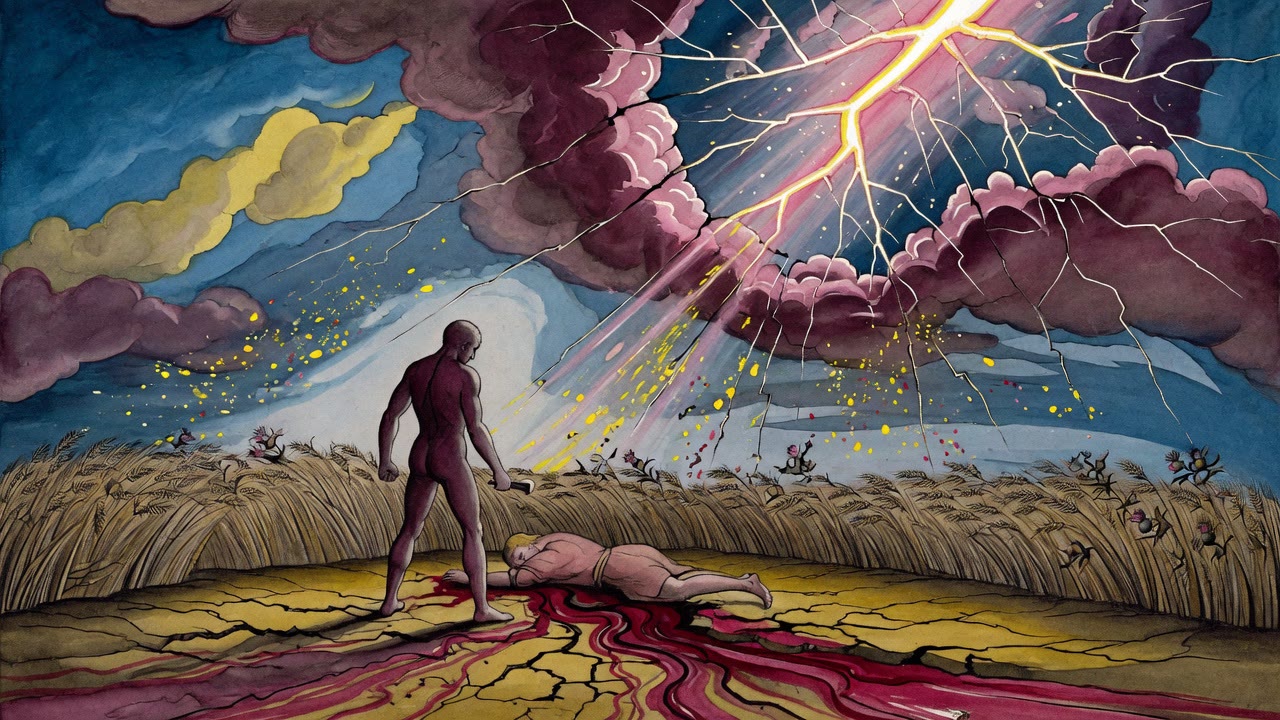
The Book of Jasher records the argument before the first murder. The Tikkunei Zohar says when Abel died, letters were removed from the divine name itself.
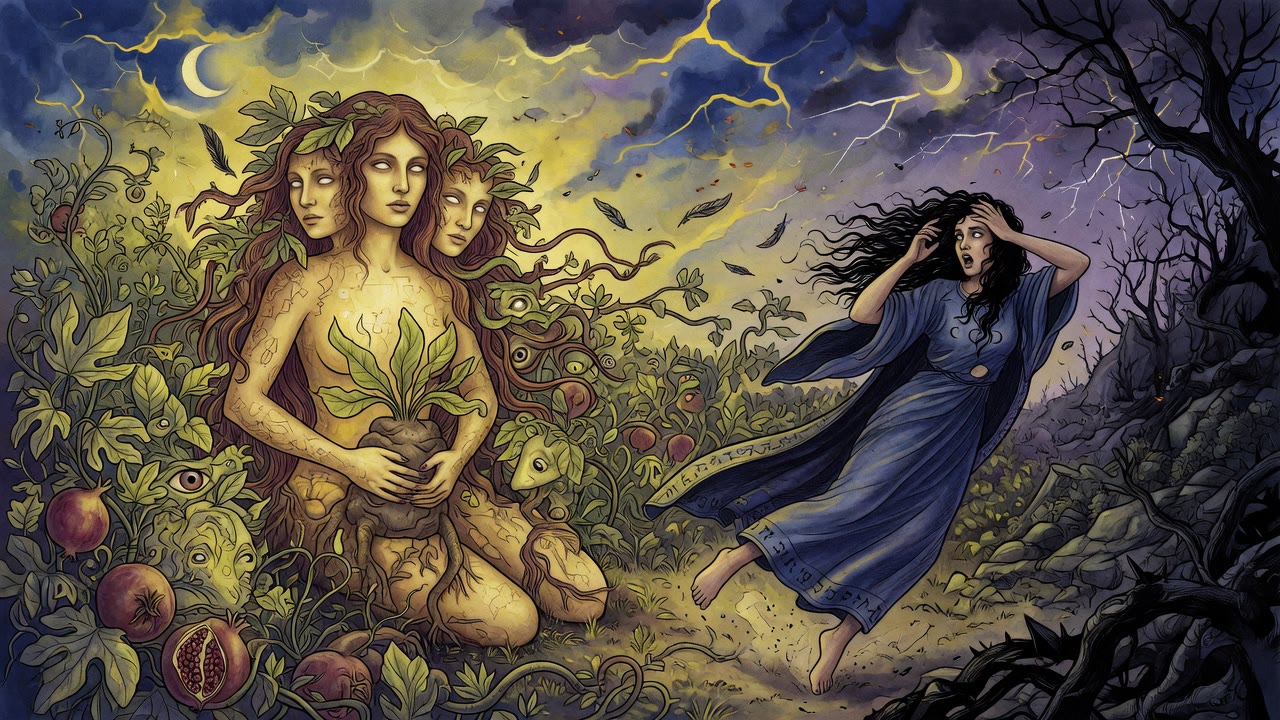
The Zohar says Lilith approached Adam seeking to seduce him. Then she saw Eve, still fused to his back as divine light, and ran from what she recognized.
Rabbi Nachman of Breslov traced the root of every exile to a single crisis of faith, and found in the Land of Israel the only true cure.
Noah saw a rainbow and called it a promise. Solomon saw the same symbol and called it a doorway. The Tikkunei Zohar says they were both right.
Adam entered the Garden on the eighth hour of the first day and was expelled by the twelfth. Four hours of paradise, and a debt the world is still paying.
The Torah says Adam and Eve were expelled from the garden. The Kabbalists say something stranger: Adam's soul contained every soul that would ever live.
The Kabbalists say God organized the spiritual architecture of the first human long before a single handful of dust was shaped. The body came last, not first.
Lurianic Kabbalah places a figure made of pure light before Genesis begins. Not the Adam of the garden, but the blueprint from which all of creation was drawn.
The rabbis and Kabbalists are nearly unanimous: Adam was the wisest being God ever made. Which is exactly what makes his choice in the garden so devastating to explain.
Jubilees warned that forgetting Shabbat would cost Israel everything. The Zohar said Israel's giving is what holds the cosmos flowing.
Eight kings ruled Edom and vanished before a single Israelite sat on a throne. The rabbis read their list as a prophecy, not just a genealogy.
Before Adam sinned, he was something more than human. The Zohar and the Tikkunei Zohar reveal what Shabbat preserved from that first light, and what it still carries.
The Baal HaSulam taught that every person contains an Israel within. The Heikhalot mystics found what God keeps in storehouses prepared for Israel.
Kabbalah says Adam was not just the first human — he was the master pattern of all creation, and when he fell, he took every world down with him.
When God took Abraham outside to count the stars, something stranger happened — Abraham discovered the hidden language that built the universe.
Somewhere in Hebron, Abraham, Isaac, and Jacob are sleeping — not dead, but waiting for the moment they are needed to wake the divine presence from her exile.
On the fifth day, God combined fire and water to make sea creatures. Leviathan was born male and female. Then God looked at what He had made and intervened.
The Kabbalists named Isaac as the force of divine judgment that holds the worlds apart so they can meet. His life was a repair always in process.
Leah holds two positions at once. She is the hidden face of Imma and Rachel's inner soul, which is why both matriarchs can claim precedence over the other.
The ancient sages taught that the Land of Israel was not merely a place Israel would inhabit but a landscape that had been matched to them from before creation.
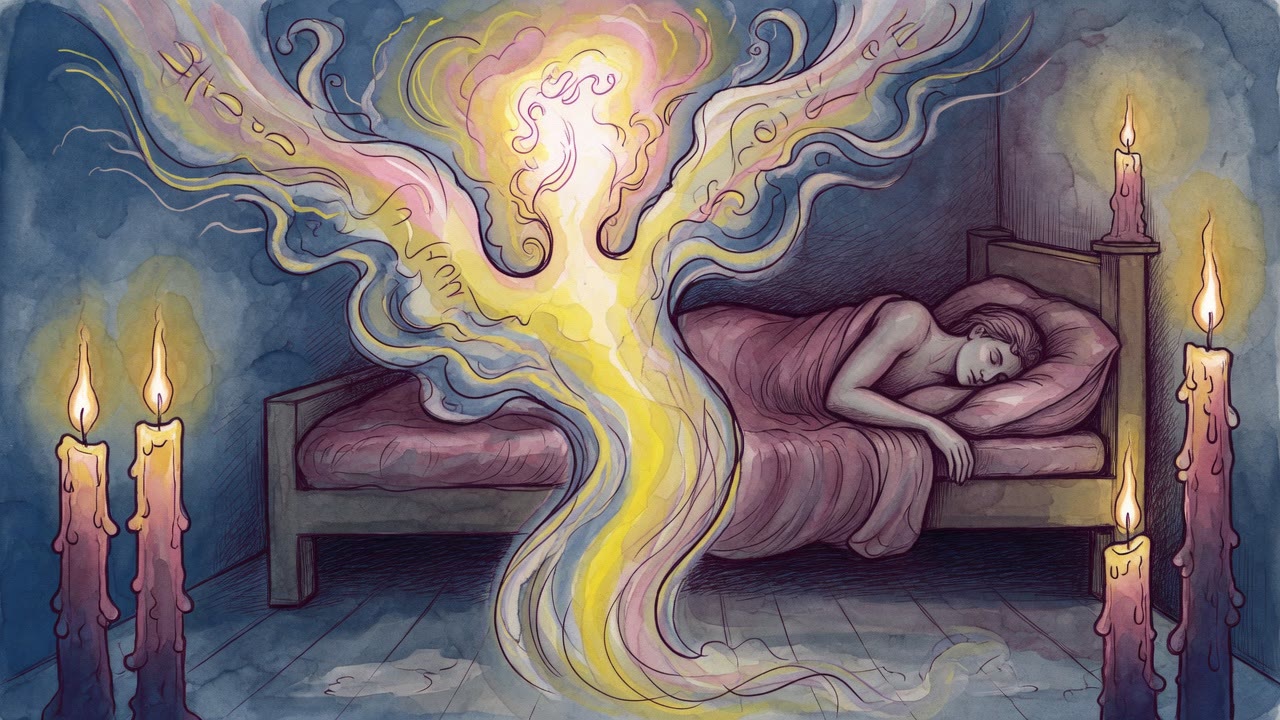
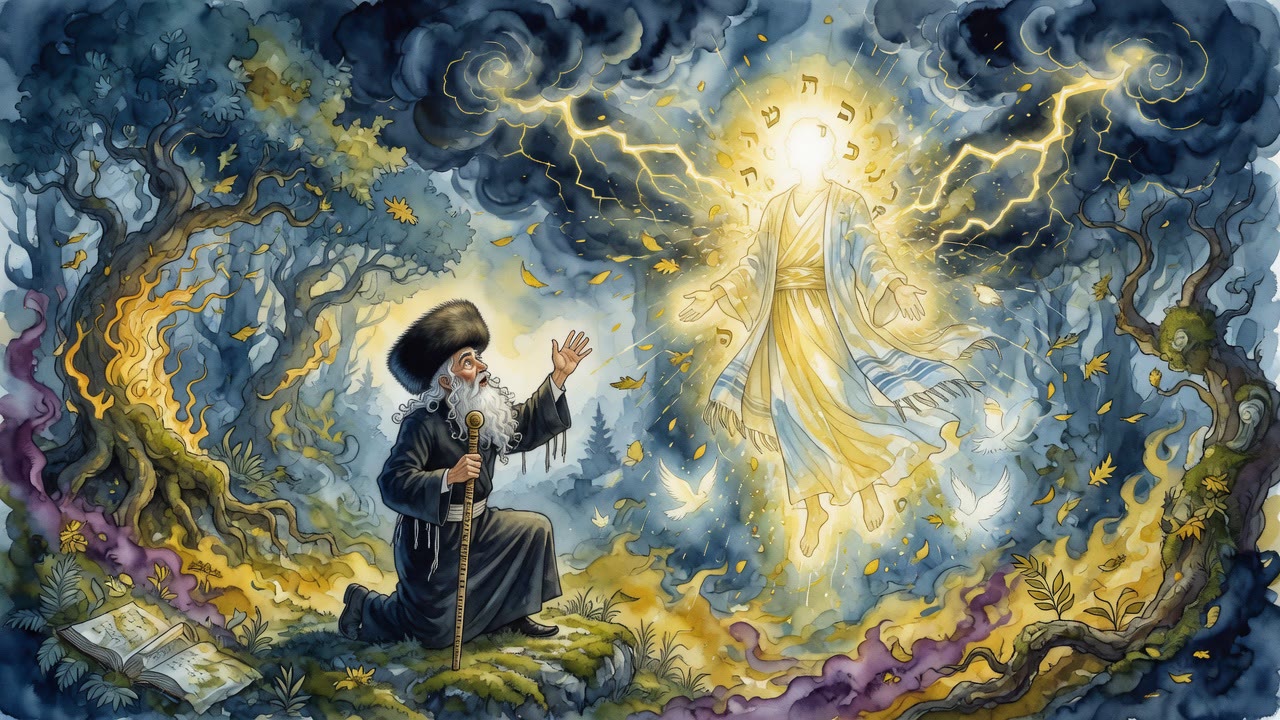
Rabbi Joseph Karo wrote the Shulchan Aruch by day and received a heavenly visitor by night. One night the maggid explained his wife's past life.
A Polish scholar compared his battle to Jacob's night fight with the angel. His enemy was not Esau -- it was men who wanted to destroy the tradition.
After Jerusalem fell, some argued the sin was too great for return. The Kabbalists answered them directly, and the answer was not simple comfort.
The oldest Jewish mystical text, attributed to Abraham himself, teaches that seven Hebrew letters hold the structure of existence together -- and that every blessing in the world has an opposite built into the same letter.
The Sefer Yetzirah maps the Hebrew letters onto the months of the year and the organs of the human body, revealing a single system that connects the cosmic calendar to the person reading it.
Hagar is the only person in the entire Torah to give God a new name. The Tikkunei Zohar reads her story alongside the Book of Lamentations and finds that exile, whether ancient or recent, always receives the same divine response.
The Temple Mount has two ancient names fused into one. Noah's son Shem called it Shalem. Abraham called it Yireh. The Tikkunei Zohar and rabbinic tradition explain why God combined both names rather than choose one, and what Melchizedek has to do with it.
The Tikkunei Zohar describes three specific shofar blasts from Isaiah chapter 24 that will shatter and remake the earth at the end of days. Each blast corresponds to one of the three patriarchs. The one that wakes Abraham from his place of rest will be the loudest.
The Tikkunei Zohar sees Noah's flood not only as water that covered the earth but as a symbol for cosmic imbalance triggered by human action. When the divine seed is misdirected, the Shekhinah withdraws, the other side floods in, and the world must wait until the seventh month to be restored.
The Tikkunei Zohar reveals that when Jews wrap themselves in tefillin, they are not merely fulfilling a commandment. They are clothing the Shekhinah, the divine feminine presence, in the same leather garments God sewed for Adam and Eve when they left the Garden of Eden.
The Tikkunei Zohar reveals that reciting the Shema morning and evening is not simply a declaration of divine unity. It is an act of testimony, a twice-daily vow of loyalty by Israel on behalf of the Shekhinah, swearing that she has not exchanged her husband for another.
The Tikkunei Zohar teaches that giving to the poor is not merely a good deed. It is the act that reopens the channel of divine abundance into the world.
Rabbi Levi Yitzchak of Berditchev asks why Sarah is the only woman in the Torah whose age is recorded, and his answer reveals that she defeated time itself through the purity of her soul.
The struggle between Jacob and Esau began inside Rebekah's womb, and Rabbi Levi Yitzchak of Berditchev found a complete theology of spiritual inheritance hidden in one seemingly redundant verse about Abraham and Isaac.
Joseph interpreted Pharaoh's dream with a precision that looked like prophecy, but Rabbi Levi Yitzchak of Berditchev found something more remarkable hidden in the wording: Joseph deliberately left a theological escape hatch so that a righteous person could override the decree.
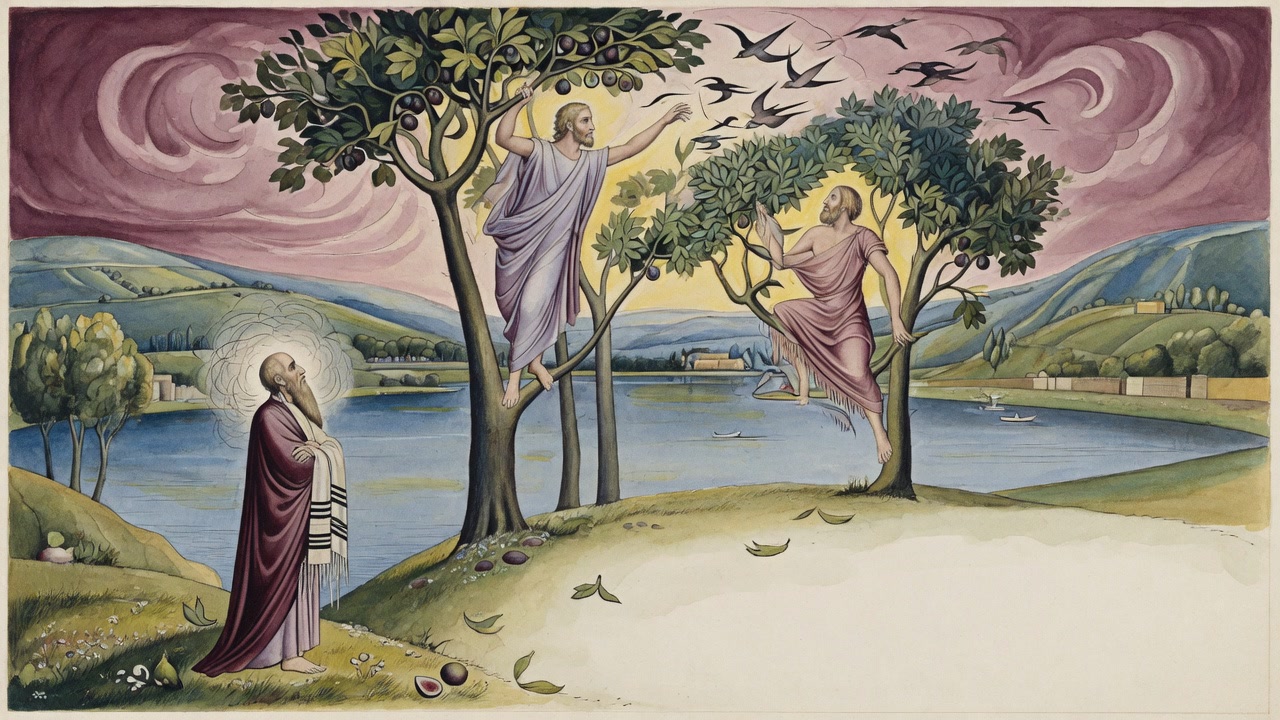
After the expulsion from Eden, Adam separated from Eve for one hundred and thirty years. The Talmud records two explanations for what happened during that time: either profound repentance in the River Gihon, or seduction by female demons who bore him a race of spirit-children. Both explanations come from the same three words in Genesis 5:3.
The Torah lists forbidden birds without explaining why each one is forbidden. No identifiable physical mark. No obvious pattern. The rabbis traced this silence back to Adam, who named every creature in Eden, and to the knowledge that was lost when he left.
When Deuteronomy says a man who wrongs a woman must marry her and cannot divorce her all his days, the rabbis hear an echo of Eden. The permanent marriage is not a punishment. It is a restoration of the bond Adam and Eve had before the expulsion changed everything.
Sifrei Devarim teaches that the Temple rests on Benjamin's shoulders whether it stands or lies in ruins, and that even during the centuries of destruction the sanctity of the site never diminished. This is not consolation theology; it is a precise claim about where holiness lives.
The Sefer Yetzirah, the Book of Formation, is attributed to Abraham himself. According to Kabbalistic tradition, Abraham did not receive this wisdom from a teacher. He derived it alone, through decades of investigation, until creation revealed itself to him.
Joseph's dreams were not lucky guesses. According to the Zohar and the Midrash, they were a form of mystical literacy that God placed directly into his soul.
When angels appeared to Abraham as men at Mamre, he prostrated himself before them. A medieval Kabbalistic text uses this to draw the exact line between honor and worship.
A medieval Jewish scholar wrote a letter arguing that worshipping God's agents -- the sun, the sefirot -- would be perfectly logical. And therefore perfectly forbidden.
God arranged two million Israelites in a precise square around the Tabernacle in the Sinai desert. East, West, North, South — three tribes per side. The kabbalists said the layout was copied from God's heavenly throne room. What did they mean?
God told Moses to tell Aaron how to light the seven-branched lampstand. Aaron was the High Priest. He had been serving at the Tabernacle for months. Why did he need to be instructed on something so basic? The kabbalists had an answer.
Two thousand years before the Torah was given at Sinai, the rabbis taught it already existed — written in black fire on white fire, the blueprint God used to build the universe.
Kabbalists discovered that three consecutive verses in Exodus each contain exactly 72 letters — and when read in a specific pattern, they form a divine name powerful enough to part an ocean.
Judaism has a name for when God seems silent and history seems abandoned — Hester Panim, the hiding of the Face. It's one of the most honest ideas in religious thought.
The Tabernacle was not merely a portable shrine. Its dimensions, materials, colors, and furniture were a precise model of the cosmos — with the Holy of Holies representing the innermost point of creation, and the outer courts representing the physical world.
Rebbe Elimelech of Lizhensk found in the grammar of a single verse the full spiritual architecture of how God moves from judgment to mercy -- and why Moses deserved both.
Moses asked God to show him his glory. God said no — then offered something stranger than yes would have been: a glimpse of the divine wake.
Moses received the Torah at Sinai. But it was Aaron who protected the living tradition — the thing that breaks when no one is watching.
God spoke at Sinai in thunder and fire. But the rabbis said Israel was not accountable for the Torah until it was explained in the Tent of Meeting.
The Torah says Moses will sing at the Red Sea — not sang. The Mekhilta turned that single verb into proof that the dead will rise.
In Da'at Tevunot, the Soul is certain about God but lost on providence and resurrection. Moses carried the same tension and never fully resolved it.
Moses taught Torah for forty years. One question about divine justice never had a satisfying answer. The Ramchal says that silence was the intended response.
Some have argued Israel sinned away its right to redemption. Da'at Tevunot calls this the fourth heresy and says it misunderstands the nature of God entirely.
When Pharaoh's daughter opened the basket in the Nile, the Tikkunei Zohar says she was not the only one who saw the crying infant. The Shekhinah was weeping too, and her tears were about an exile that had not yet happened.
Moses and Aaron were both prophets, yet the Kabbalists taught that only one of them crossed the final threshold of divine access. The difference between them reveals how the entire architecture of prophecy works.
The Shekhinah, the divine presence, dwells above the firmament. All the prophets saw it from below. Moses alone was brought above the firmament to stand within it. The Zohar explains what made this possible.
The Tikkunei Zohar teaches that Moses, the Faithful Shepherd, is not merely a historical figure. He is a spiritual presence who takes on the suffering of Israel in every exile, including the last one, and whose wounds carry the same power to heal that his intercession did at Sinai.
At Sinai, Moses was told to approach from a distance. Rabbi Levi Yitzchak of Berditchev read that instruction as a complete philosophy of how finite minds relate to infinite reality, and why both distance and nearness are necessary.
Jewish mysticism teaches that all of Israel shares a single collective soul, bound together at Sinai and responsible for one another across every generation.
When God commanded Moses to build the Tabernacle, the Hebrew says 'that I may dwell among them.' Targum Jonathan rewrites that sentence in a way that encodes an entire theology of divine presence: not God dwelling there, but the Shekinah, the indwelling presence that can be approached without diminishing the unknowable divine essence.
The mikveh is older than any synagogue, older than any prayer book. For three thousand years, Jews have been stepping into pools of gathered water and coming out changed. The kabbalists say they know why.
Sefer Yetzirah — the Book of Formation — is fewer than 2,000 words long, possibly the most cryptic text in the entire Jewish canon, and the foundation of every Kabbalistic system that came after it.
When Deuteronomy says God will 'place His name' at the chosen sanctuary, Sifrei Devarim reads that phrase against a priestly blessing in Numbers. The same divine name that rests on Israel in the Priestly Blessing is the name that rested in the Temple.
Every time Israel proclaims God's oneness, a voice from heaven answers back. The Mekhilta says the Shema is a two-way exchange, not a one-directional cry.
In the Zohar's reading of Samuel, the mysterious 'Watchers' of heaven are not guardians but enforcers, angels deputized to carry out divine judgments against those who have fallen out of favor above.
Sifrei Devarim identifies four distinct moments when God appeared in history, from the Exodus through the building of the Temple, and maps each appearance to a specific Psalm. The pattern reveals that divine presence does not repeat itself; each appearance responds to a new kind of human need.
At the high place of Gibeon, God appeared to Solomon in a dream and said: ask for whatever you want. Solomon asked for wisdom. The midrash says this was the most impressive prayer anyone ever made — and explains exactly why.
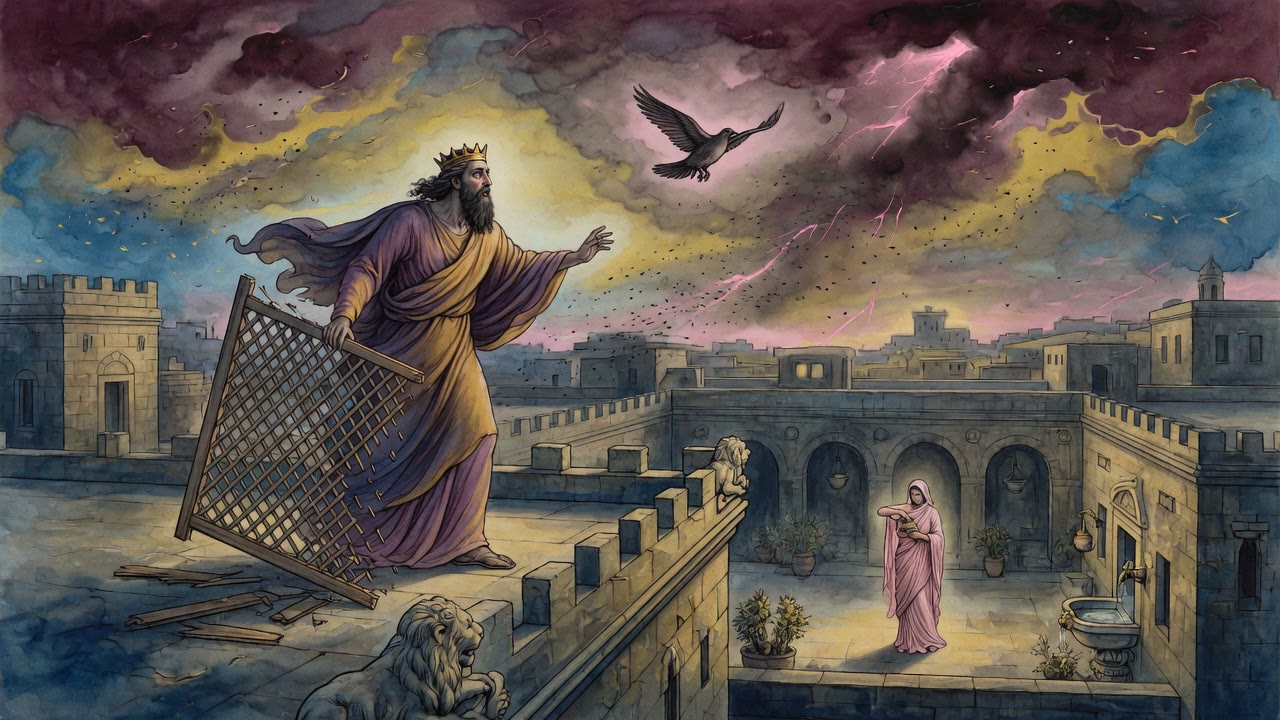
Asmodeus, king of the demons, didn't just torment humans — he outsmarted the wisest king in history and sat on his throne for three years.
Elisha ben Abuyah was one of the greatest Torah scholars of his generation. Then he entered a mystical realm, saw something, and left Judaism — and the rabbis were never able to explain exactly why.
The prophet Elijah descended to reveal a secret about plowing oxen and donkeys together. It had nothing to do with farming.
The Testament of Solomon records how the king built a catalog of 36 demons, their powers, and their weaknesses — turning interrogation into holy armor.
Solomon’s deepest wisdom was not statecraft or judgment. It was the hidden language of animals. He taught it once, with a warning that nearly came true.
Elisha ben Abuyah ascended to the highest heaven and saw Metatron seated on a throne. He concluded there were two powers in heaven, and it destroyed him.
From a cave in Roman Judea to a fiery rock in medieval Spain, Elijah was the prophet who carried Jewish mysticism across a thousand years of silence.
In the Mitpachat Sefarim the Torah appears in sackcloth, her face covered, treated as an object of ridicule. The image is modern. The wound is ancient.
Elijah looked for God in wind, fire, and earthquake. He found nothing. Then came a still small voice. The Zohar explains why only silence could carry the divine presence, and what that means for prayer.
The Tikkunei Zohar describes the Shekhinah arraying herself in white, red, and green to draw God's gaze back toward creation, and Elijah as the one who understands the fullness of that display.
Sifrei Devarim uses the verse about cream and milk from Deuteronomy 32 as a lens for examining the astonishing abundance of Solomon's reign, cross-referencing the daily provisions of the First Temple court to argue that the golden age was a literal, physical reality, not a metaphor.
Judaism's angelic hierarchy is vast and ancient - from the fiery Seraphim around God's throne to the archangels Michael and Gabriel, these cosmic forces...
The Tikkunei Zohar says that when Israel prayed in the Temple era, every heavenly gate opened immediately. In exile, every gate is locked. The prophet Isaiah appears in this text not as a figure of the past but as the diagnostic voice explaining exactly what went wrong.
Isaiah prophesied a new heaven and a new earth. The Zohar took him literally and explained exactly how new worlds get made: through new interpretations of Torah, rising each time someone understands something no one has understood before.
God hid the primordial light of the first day after Adam's sin. Isaiah prophesied its return. The Kabbalah mapped exactly where it went, how it was hidden, and what its restoration will mean for the world.
Jeremiah spent three years mastering the secrets of creation with his son. The being they made immediately erased its own name and turned to ashes.
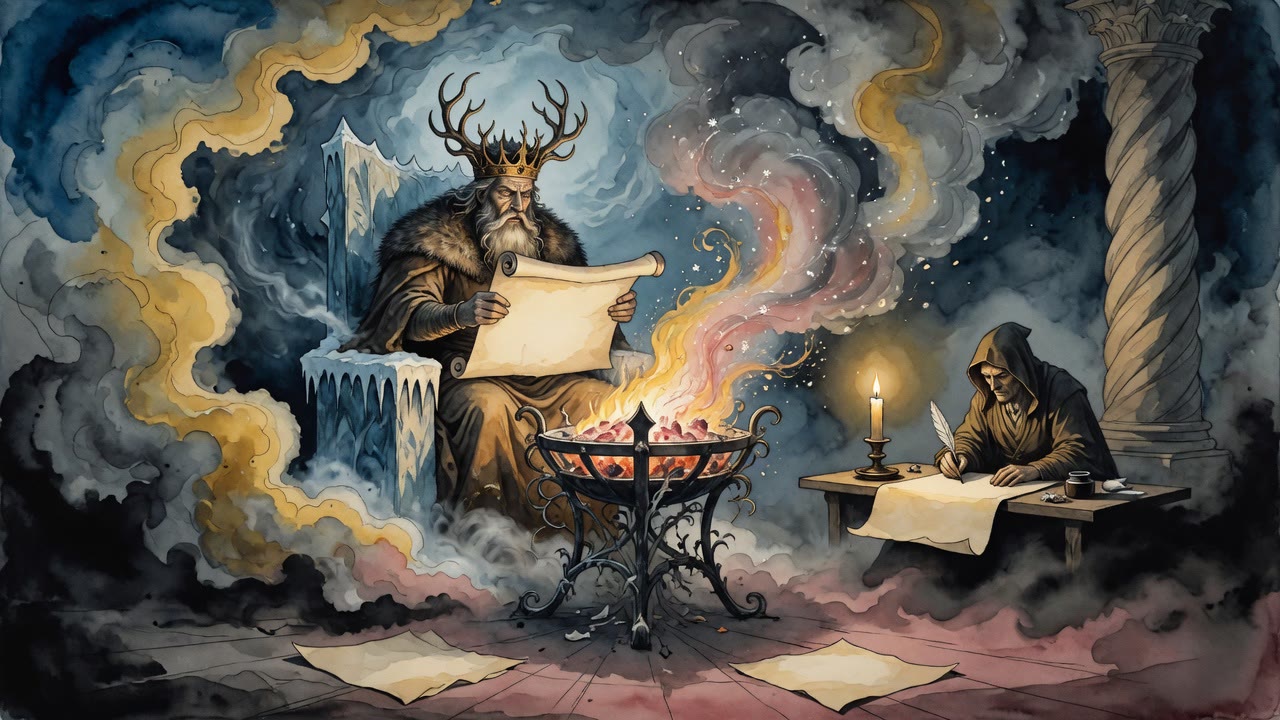
King Jehoiakim burned Jeremiah's scroll and erased every divine name from it. Jeremiah responded by adding four more chapters to Lamentations.
Most people assume mystical experience is harmless. The Talmud disagrees. Four sages entered Paradise. One died, one went mad, one lost his faith.
A river of liquid fire flows continuously beneath the divine throne. New angels are born from it every day, sing one song of praise, and are immediately consumed.
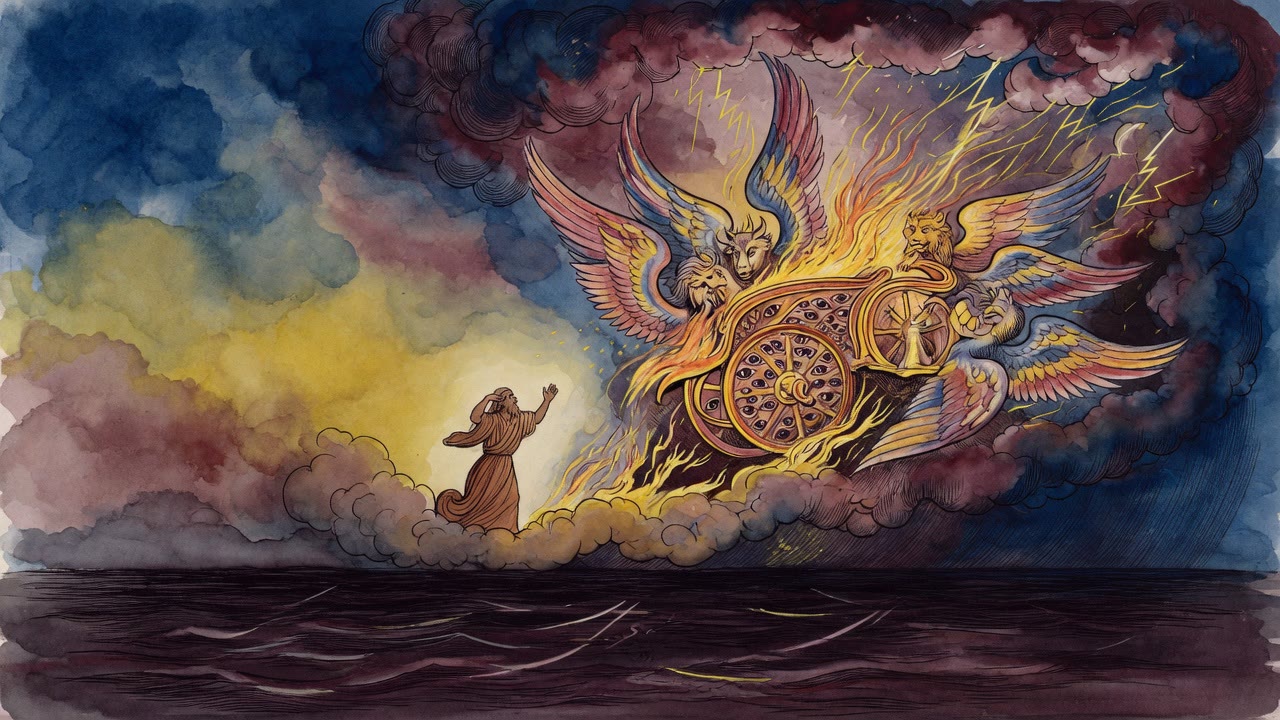
The most dangerous passage in the Hebrew Bible was a chariot. Not a weapon, not a battle — a description of what God rides, so dangerous the rabbis debated whether anyone under 30 should read it.
Metatron is called the Youth, the Prince of the Presence, and the keeper of the divine chariot. The Zohar maps exactly what that means.
Ezekiel's chariot vision was the most dangerous text in Jewish tradition. One boy read it alone and fire came out. The Talmud preserved the story as a warning.
Entering God's throne room required the right songs and knowing which angels would try to destroy you. Rabbi Ishmael asked how it was done safely.
When Ezekiel described the feet of the divine creatures as calf-like, the Kabbalists saw a teaching about standing in prayer. The feet that touch the ground carry the whole weight of heaven.
Ezekiel described wheels within wheels and creatures with legs both straight and circular. For a thousand years, Kabbalists have asked what these shapes reveal about the structure of divine governance.
The Tikkunei Zohar reveals that while the earthly Temple stood and fell, Michael continued his service in the heavenly sanctuary, accepting Israel's prayers as offerings on an altar that fire never consumed.
The prophet Ezekiel was carried by vision into the inner courtyard of the Jerusalem Temple, where he found twenty-five priests facing east, worshipping the sun with their backs to the sanctuary. Sifrei Devarim uses this scene to define what it means to 'abase the Rock of salvation.'
The Tikkunei Zohar reads the great fish of Jonah not as a simple sea creature but as a cosmic symbol layered with Egypt, Lilith, the mixed multitude, and the organs of the human body. What swallowed Jonah also swallowed everyone who has ever been enslaved by their own darkness.
The Tikkunei Zohar maps Jonah's three days inside the fish onto the organs of the human body, the history of the Exodus, and the spiritual condition of Israel in exile. The fish that held Jonah held something far older than one prophet's flight from God.
Song of Songs was almost excluded from the Hebrew Bible. Rabbi Akiva saved it by declaring it the holiest book in all of scripture. The entire debate turned on whether its love poetry was literally about lovers — or metaphorically about God and Israel.
In the Tikkunei Zohar, a sandal removed in Bethlehem unlocks one of Kabbalah's deepest teachings about God's hidden name and the angel who bridges heaven and earth.
The night Ruth uncovered Boaz's feet on the threshing floor is one of the strangest acts of loyalty in the Hebrew Bible. The Tikkunei Zohar reads that single gesture as a map of how the soul finds its way home.
When Ruth prostrated herself in Boaz's field, the Tikkunei Zohar saw more than a Moabite widow giving thanks. It saw the Shekhinah, the divine feminine presence, in the posture she has held throughout all of Israel's exiles.
A single line from Boaz to Ruth on the threshing floor became, in the Tikkunei Zohar, the promise God makes to the Shekhinah at the end of every exile. The morning that always comes is not just Ruth's morning.
The Tikkunei Zohar reads the halitzah ceremony from the Book of Ruth as a cosmic act, the Shekhinah herself removing the shoe that separates Israel from divine union.
The Kabbalists of medieval Castile read Ruth's story as a cosmic event — her arrival in Bethlehem was not migration but the Shekhinah itself returning from exile, and her loyalty was pre-woven into the fabric of creation.
The Sefer HaBahir, the oldest Kabbalistic text, opens with a strange and unsettling question -- and its answer reveals that God built conflict into the universe on purpose, then appointed angels to manage it.
The Tikkunei Zohar reveals that Esther's Hebrew name Hadassah, meaning myrtle, places her within a precise Kabbalistic structure connecting color, sovereignty, the three Patriarchs, and the Shekhinah's presence in the world. Her green-yellow color is not a physical description but a mystical signature.
The Tikkunei Zohar reads Esther's unchaperoned approach to Ahasuerus as a cosmic event: the Shekhinah entering a hostile realm without the Torah, through the merit of the Patriarchs alone. Her three-day fast corresponds to three witnesses, and her survival is the survival of divine presence in exile.
The Tikkunei Zohar reveals that Mordechai's role as Esther's guardian operates through the smallest mark in the Hebrew alphabet: the tip of the letter Dalet in the word Echad, meaning One. This point is the sign of the covenant, and through it the divine brother shields the Shekhinah from Ahasuerus.
The Tikkunei Zohar teaches that God protected Esther from Ahasuerus by placing a divine replica in her place during her nights in the palace. She emerged each morning unchanged, her holiness intact, while Haman's ten sons became vessels for the ten negative crowns opposing her sacred identity.
The Tikkunei Zohar reveals that Haman's destruction was not accidental. Heaven had been building the case against him long before Esther arrived at court.
The Tikkunei Zohar uses the Book of Daniel to explore what it means when God withdraws into concealment, and what the mystic must do when the divine face is hidden.
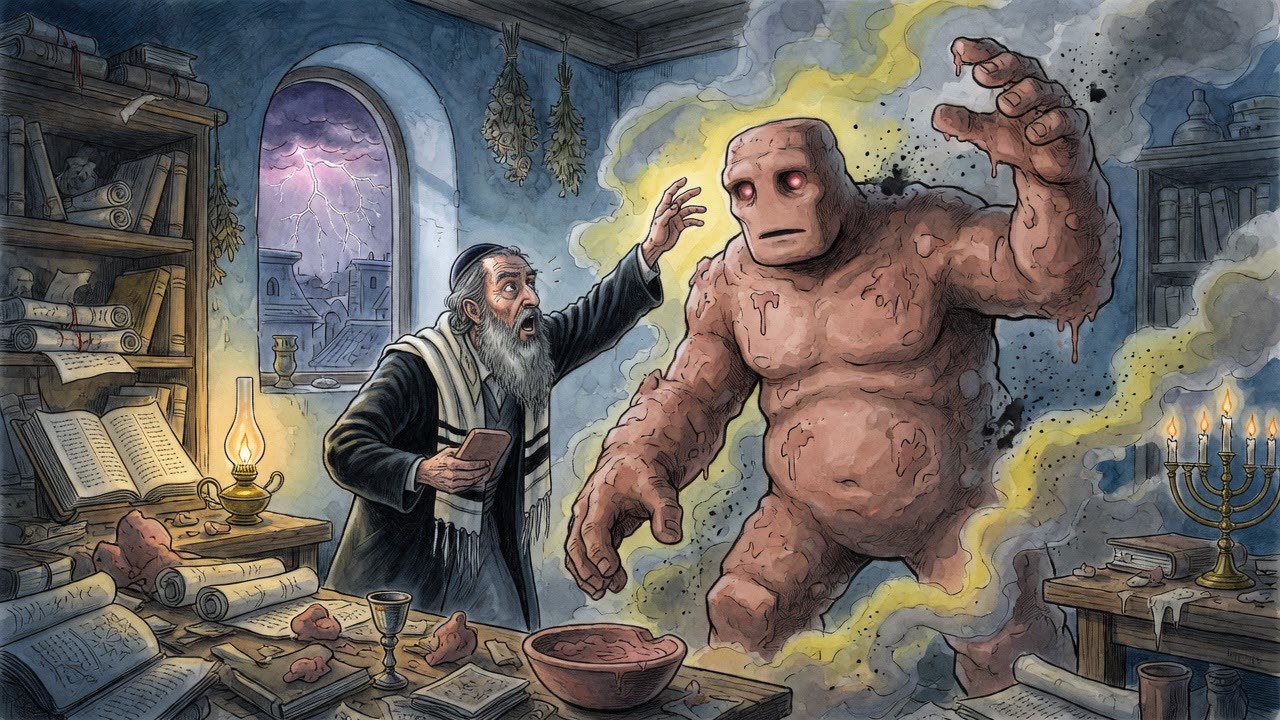
A rabbi sculpts a man from clay, writes the word for truth on its forehead, and brings it to life. The golem tradition spans from the Talmud to 16th-century Prague, and the remains may still be in a synagogue attic.
In every generation, exactly 36 hidden righteous people sustain the entire world. They do not know who they are.
Before God spoke a word, He wrapped Himself in light like a garment. That primordial radiance, not the sun, was the first light of creation, and God hid it before the wicked could use it.
Most people think Jewish mythology is a footnote to the Bible. The truth is it's one of the strangest bodies of ancient storytelling in the world, drawn from 20,000+ texts.
Ancient Jewish texts describe a divine council where 70 angels serve as the celestial representatives of the world's 70 nations — arguing, fighting, and sometimes falling when their nations fall.
Rabbi Elijah of Chelm created a clay man with the Sefer Yetzirah. It kept growing. Stopping it meant getting within reach of something that could crush him.
In 1580 Prague, Rabbi Judah Loew and two disciples walked to the Moldau before dawn. By sunrise they had shaped a being of clay named Joseph.
The Golem of Prague was not destroyed. His clay remains lie in the attic of the Old New Synagogue. No one dares go up. Children who tried could not come down.
Rabbi Loew built the Golem to defend Prague's Jews. When the emperor ended the blood libel, its work was done. Unmaking it was as ceremonial as creating it.
Rabbi Akiva gave Rabbi Ishmael a piece of wool and instructions that bordered on impossible. The mystery was not the cloth -- it was what touching it revealed.
Who actually wrote the Mishnah? The Mitpachat Sefarim reopened the question and found an answer more beautiful than anyone had admitted.
Rabbi Akiva died smiling. Before that he asked Rabbi Shimon bar Yohai to pray for his death. The Mitpachat Sefarim explains what the request meant.
Four sages entered the Pardes, the mystical orchard. Only Rabbi Akiva emerged whole. The Kabbalists explain why the others could not survive what he could.
Most people think the Zohar is ancient. It was likely written in 13th-century Spain, and it reshaped how Jews understand God, creation, and reality more than almost any book since.
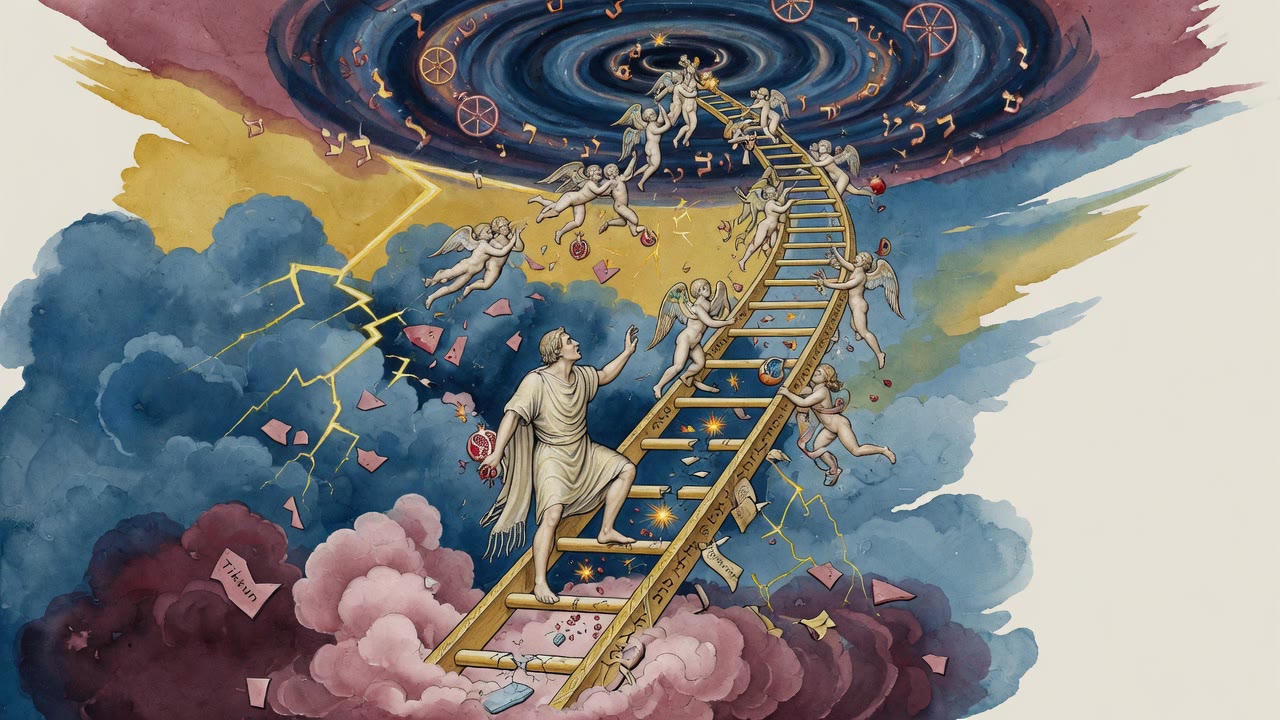
Before the world existed, God poured divine light into ten vessels. Seven of them shattered. We are living in the wreckage, and every good act gathers one more spark back toward its source.
Before creation, each of the 22 Hebrew letters appeared before God and begged to be the first letter of the Torah.
The rabbis taught that the Torah given at Sinai was a copy — the original was written in black fire on white fire and existed before God created anything else.
Long before modern psychology mapped the human mind, Kabbalists mapped the Divine — and what they drew looks nothing like you'd expect.
Kabbalists discovered that the God of the Bible had a face turned toward the world — and a deeper face turned away from it entirely.
In the 16th century, one rabbi answered the oldest question in theology — how can anything exist besides God — with an idea that changed Jewish mysticism forever.
The phrase now on every Jewish charity brochure was originally about something far stranger — repairing a catastrophe that happened before the universe began.
Most people assume reincarnation belongs to Eastern religions. Jewish mystics developed their own sophisticated doctrine of soul-return — and it goes back further than you think.
Jewish tradition developed a precise explanation for demonic possession — and it turns out the possessing spirit is almost always a tragic figure, not an evil one.
Every year during Sukkot, the souls of Abraham, Isaac, Jacob, Moses, Aaron, Joseph, and David leave their resting places and enter your sukkah. This is not folklore. It is Zoharic law.
The Zohar says the etrog is the heart, the lulav is the spine, the myrtle is the eyes, the willow is the lips. Hold them together and you build a body.
Most people think a name is a label. A Hasidic rebbe from eighteenth-century Galicia says it is the wire that pulls the soul back into the body.
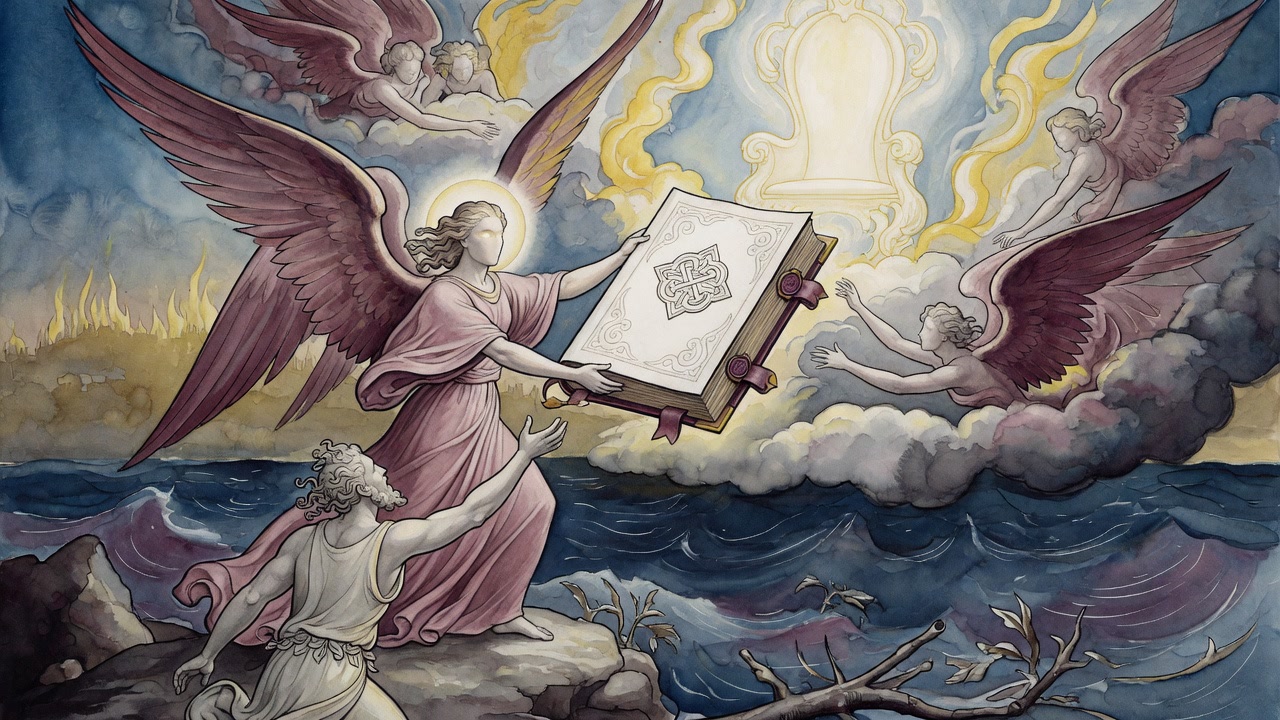
An angel gave Adam a book of secrets outside Eden. The other angels were furious. What happened to that book is one of the strangest chains in Jewish mysticism.
Most people think Moses came down Sinai with the Torah. A late antique Jewish mystical text says he came down with a second thing and gave it to an angel.
In 13th-century Kabbalistic tradition, Samael and Lilith were created together like a dark mirror of Adam and Eve, then torn apart by demonic rivalry.
On Rosh Hashana 1746, the Besht ascended through the heavens and reached the Messiah's palace. He asked when. The answer changed everything.
Before Rabbi Isaac Luria revolutionized Kabbalah, Elijah appeared at his birth and held the infant during his brit milah. Only the father knew what was happening.
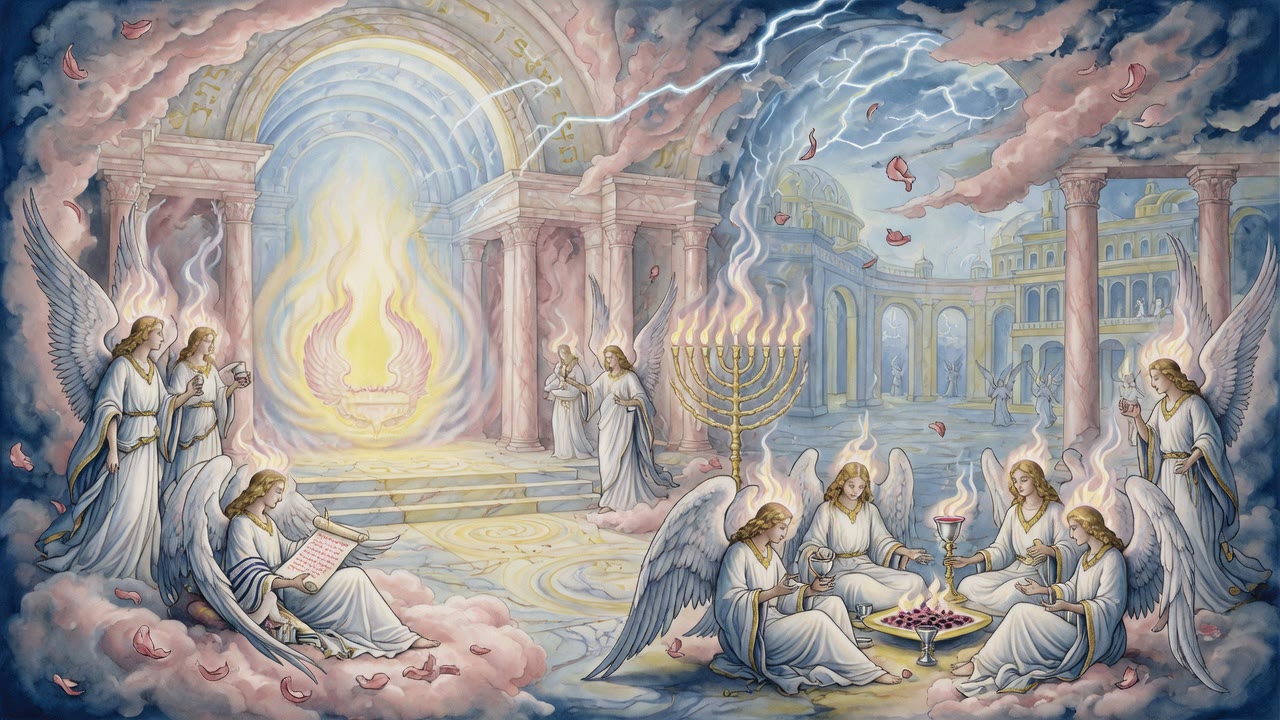
In the fourth heavenly palace, angels gather at Sabbath tables and are watched. Joy is rewarded with protection from the River of Fire. Failure earns something worse.
Before the first human breathed, a primordial Adam existed as the divine blueprint for all creation. Kabbalists say the entire cosmos is organized around four letters of one Name.
Before the exile, God revealed to Samael exactly what would happen and offered a reward for treating Israel with dignity. Samael chose mockery instead.
The Kabbalists found a song buried in the letters of Bereishit. They say it cannot be heard until Samael is gone from the world. Moses already sang a version of it once.
Adam Kadmon is not the Adam of Genesis. He is the primordial cosmic blueprint - ten divine attributes arranged in the shape of a human.
God announced that Moses had one hour remaining. Moses didn't accept it. He bargained, pleaded, offered to live as a bird or a beast , anything to stay in...
The Kabbalists say the universe was built around a human shape. Adam Kadmon existed before Eden, and humans carry his unfinished work.
The Tikkunei Zohar says Israel is not merely God's people but the feet of the Shechinah. When Israel goes into exile, the divine presence goes too.
Samael was not just a tempter. The Kabbalists found him woven into creation itself, embedded in the very music of the Torah.
Before the Adam of dust, Kabbalah says there was an Adam of light so vast that the entire universe was contained within his form.
The Tikkunei Zohar maps where Samael lives in the cosmic order with uncomfortable precision. He does not stand outside the divine structure.
When Solomon was stripped of his kingdom and wandered as a beggar, the Zohar read his exile as a map of the divine structure. The vanity he described in...
Before the first man, the Kabbalah says there was another Adam: a primordial body of divine light. What happened to that light is why repair is still necessary.
Everyone knows Metatron was once Enoch, the man who walked with God. But the Zohar preserves an older, stranger claim — Metatron existed before the world.
In the fourth heaven stands the Temple never destroyed. Michael is its high priest. The Sefer HaBahir says God built the whole structure alone, without angels.
The Tikkunei Zohar says the firmament is a wall between waters. Above it is an ocean. Leviathan swims in it as the Tzaddik, aligned with God, not fighting Him.
The Zohar places Lilith on the divine throne after the Temple falls. Kurdish folklore shows a midwife trapping her in a jug and making her serve.
Kabbalistic tradition insists Torah must be lived in the world, not abstracted into ideals. Moral principles without substance can kill.
Adam Kadmon is not the Adam of Genesis. It is the primordial human form that preceded creation, the blueprint on which the entire universe is built.
Rabbi Shimon bar Yochai gave himself entirely to Torah. Centuries later, a book was written in his name. The question of who wrote the Zohar is not simple.
Before Sinai could happen, God had to contract. And the contraction revealed something broken in the balance between masculine and feminine in the upper worlds.
Israel Sabba is the aged face of God that holds Wisdom before passing it down. Without him, the world would have no architecture for understanding itself.
Israel Sabba extends wisdom downward until it can be received. The land of Israel is where that extension touches ground, and Jacob's name is written into both.
In the Tikkunei Zohar, the most feared angel in heaven is not expelled from God's presence. He is given the Torah and told to study.
The Harba de-Moshe, a 7th-century mystical text, records how God gave Moses a weapon made entirely of divine names, transmitted through a chain of angels.
She emerged from the crevice of the deep. She rules Zemargad with fire below her waist. Two traditions reveal the full terror and sovereignty of Lilith.
Solomon ibn Gabirol, the 11th-century philosopher-poet, used Kabbalistic secrets to construct a female servant from wood. When accused, he dismantled her.
Every Lag ba-Omer, Rabbi Isaac Luria led students to dance at the grave of Rabbi Shimon bar Yohai. One year an old man in white joined the circle.
Lurianic Kabbalah maps the soul across four worlds. The rule is absolute: you cannot skip a level. Each must be fully repaired before the next opens.
When Adam sinned, he did not just damage himself. He shattered the human soul, scattering holy sparks into the darkest corners of creation.
Rabbi Isaac Luria taught that there are exactly 600,000 Jewish souls, each one connected to a unique interpretation of the Torah that no other soul can access.
Rabbi Yehuda Leib Ashlag spent decades writing a commentary on the Zohar so that ordinary people could finally enter its depths without being lost in them.
Greater scholars than us lived in every century between the Zohar's composition and today. So why did its deepest meaning only become available now?
Rabbi Isaac Luria revolutionized Jewish mysticism in the 1560s, yet his deepest teachings were kept from the world for centuries. Baal HaSulam explains why.
Baal HaSulam taught that what happens among the Jewish people is not separate from what happens in the world, in ways the Zohar traces through cosmic structure.
The Kabbalists asked how God can appear through forms and visions when God has no form at all. Baal HaSulam builds a precise answer from the Sefirot and Isaiah.
How can the four letters of God's name represent Sefirot that are supposed to be utterly beyond form and boundary? Baal HaSulam's answer reshapes everything.
The Kabbalists mapped divine light through creation with precision. The key to the whole system is a force that resists, and it was built in from the beginning.
Before the world could exist, three adjustments had to be made to the channels of divine energy. Without them, the light would shatter everything it touched.
Lurianic Kabbalah teaches that creation would collapse without a mediating force. That force has a name, a face, and a role no one else can fill.
At the beginning, the Zohar says, the sun and moon were equal. Then one was reduced. Kabbalistic tradition preserves the full story of why -- and what it cost.
The Zohar is the holiest text of Jewish mysticism. Even devoted readers noticed certain passages were different -- and the Mitpachat Sefarim said so out loud.
Every shofar blast on Rosh Hashanah is a weapon. The Sefer HaKanah says it targets Lilith and a demonic coalition in the heavenly court against Israel.
In the Ramchal's Kabbalah, Benjamin is not just a patriarch's youngest son. He is the cosmic spirit that makes creation fertile and whole.
In Kabbalistic teaching, Leah is not just a matriarch who wept for a husband who loved another. She is the concealed face of God turned toward the world.
Why does Jewish law allow a king eighteen wives? The Ramchal says the answer lies in the structure of Leah's presence across the divine worlds.
When Ezekiel saw a storm from the north, he was not watching weather. He was seeing four klipot, shells blocking divine light, called there by human failure.
Miriam's leprosy appeared the moment God departed. The Ramchal says this was not a punishment but what happens when divine protection simply withdraws.
In Da'at Tevunot, the Intellect asks a single question that the entire Kabbalistic system hangs on. What is it that is difficult for you in this?
The ten Sefirot are not God. They are how God becomes visible to creation. The Kabbalists built this distinction into the foundation of their entire system.
Rabbi Isaac Luria described the spiritual worlds as concentric circles and also as a vertical descent. Both are correct. The contradiction is the point.
Cordovero mapped the divine through Sefirot. Luria mapped it through Partzufim, divine faces. Both systems describe the same territory from different angles.
The Kabbalists asked why finite creation exists within an infinite God. Their answer begins in the Garden of Eden and ends at the edge of what language can say.
Rabbi Moshe Cordovero taught that holiness and evil share the same source, but they draw their existence in entirely different ways. The difference explains everything.
When God withdrew to make room for creation, something remained. Isaac Luria called it the primordial residue, and his entire system of Kabbalah flows from what that residue became.
The Kabbalists described a primordial human who existed before the Garden of Eden, before the first sin, before time. Adam Kadmon was the divine blueprint that all of creation was built inside.
God's infinite light did not pour into creation in one undifferentiated flood. The Kabbalists taught that it entered through precisely chosen pathways, and the choice of pathway is the difference between a world that can exist and one that cannot.
God tried to create a world before this one. The vessels shattered. The shards fell. And according to Isaac Luria, everything wrong with the world we inhabit comes from those fragments, scattered and waiting to be gathered.
Creation did not start clean. The Kabbalists taught that the four worlds were originally mixed with good and evil together, and that the separation is a cosmic process still underway.
Isaiah said God would swallow death forever. The Kabbalists asked what cosmic mechanism could actually produce that. Their answer involves the final absorption of the Other Side back into its source.
Before Adam, the Kabbalists taught, there were kings. They were early configurations of divine light that could not sustain themselves. Their failure explains why the fall of Adam went the way it did.
When Ezekiel saw the chariot, he was not watching a vision of heaven. He was seeing the internal structure of divine governance. The Kabbalists spent centuries mapping what he saw.
The Kabbalists taught that the Garden of Eden is not primarily a geographical location. It is a level of divine reality, the sefirah of Malchut made manifest, and its lights were the first things to emerge from Adam Kadmon's eyes.
The Kabbalists taught that cosmic repair requires two forces moving at once, and they mapped that partnership onto the patriarchs and matriarchs in ways that overturn everything we assume about who does the work.
The Kabbalists gave a name to the part of God that cannot be named, mapped, or understood -- and then spent centuries arguing about why it matters that we know it exists.
Deep in the Kabbalistic structure of the cosmos sit two figures called Israel Sabba and Tevunah, ancient divine archetypes who bear Jacob's name and carry the task of translating the infinite into something the world can receive.
After God contracted to make room for the universe, what remained in the empty space became the raw material of creation -- and the Kabbalists traced a direct line from that primordial residue to the longing at the heart of the Shekhinah.
The Vilna Gaon's reading of the Sefer Yetzirah reveals ten divine dimensions that are simultaneously infinite and bounded -- and the patriarch who first understood them spent his life demonstrating what that paradox looks like in practice.
The Idra Zuta, the Zohar's account of Rabbi Shimon's final day, reveals how divine wisdom and understanding pass from one level of the cosmic structure to the next -- and why the prophet Daniel's vision of a tree that feeds all the world is a Kabbalistic diagram.
When Jacob told Rachel he was her father's kinsman, the Zohar says something far more profound was passing between them. A word meaning 'told' conceals a river of divine wisdom.
The Zohar's most daring teachings describe God's 'face' using the geometry of a beard. Thirteen channels of divine mercy flow through the mystical configuration called Zeir Anpin, and Moses was the only human who grasped them fully.
The Tikkunei Zohar opens with a vision from Daniel: 'the wise shall radiate like the radiance of the firmament.' The Kabbalists identified these wise ones as Rabbi Shimon bar Yochai and his inner circle of mystics.
The Tikkunei Zohar draws a direct line between Elijah's work of inspiring righteousness in others and the promise that those who do so will shine like stars forever. His light, the text insists, was never meant to go out.
The Tikkunei Zohar uses the image of a bird's nest to explain the role of Metatron, the great angel stationed between the divine throne and the human world, holding the space between heaven and exile.
Isaiah declares that God will not give His glory to another. The Tikkunei Zohar names the 'another' precisely: Samael, the adversarial force that seeks to usurp the divine radiance. But God's glory is not a prize. It is a structural fact.
The Tikkunei Zohar makes a radical claim: God is not watching Israel from afar in exile. The Shekhinah, the divine feminine presence, descends into exile with Israel, and in Her love, God is bound with Her there.
When Torah says Moses looked 'this way and that' before striking the Egyptian taskmaster, the Tikkunei Zohar reads it as a devastating social critique: Moses scanned an entire society and found no one who cared about doing right.
The Tikkunei Zohar reveals that the three colors of the human eye correspond to the three colors of Noah's rainbow, and that when those colors shine, God 'remembers the eternal covenant' of mercy.
Most people have never heard of Sandalphon, the angel standing taller than a five-hundred-year journey, whose sole task is to weave human prayers into a crown for God. The Tikkunei Zohar reveals what happens to your words after you speak them.
Before a soul enters a body, the angel Metatron teaches it the entire Torah. The moment of birth is also the moment of forgetting. The Tikkunei Zohar explains what this erasure is meant to accomplish.
Samael did not destroy the Temple. He celebrated the destruction. The Tikkunei Zohar distinguishes between the angel who enables catastrophe and the humans who cause it, and the difference matters enormously.
The Tikkunei Zohar finds the architecture of the Jewish prayer service hidden in a single Hebrew letter, Vav, and traces its pattern back to Abraham. The discovery changes how the daily Amidah prayer looks when you understand what it is actually doing.
Ancient Kabbalah taught that prophecy is not a download from the sky but a transmission through a living divine body called Adam Kadmon. Every prophet who ever lived accessed a different limb of that body.
The Kabbalists taught that the world is sustained by one supremely righteous person in every generation. In the Bible, the first person to hold that title was Joseph. The Zohar explains what he carried.
Ham sinned against his father Noah and was cursed. The Kabbalists asked why this particular sin was so severe. Their answer mapped the yetzer hara onto the human body in a way that changed how desire is understood.
The Kabbalists taught that Abraham, Isaac, and Jacob are not merely historical ancestors but the living hands through which God channels blessing into the world. The Torah hid this teaching in a single phrase.
Hebrew was originally written without vowels. When vowel points were added centuries later, the Kabbalists found in them a secret map of how God's presence draws sustenance from Abraham, Isaac, and Jacob.
Most people picture Leviathan as pure chaos and destruction. The Tikkunei Zohar sees something stranger: the great sea beast is the tzaddik, the righteous one, the axis on which the divine world turns.
The Torah Moses wrote at Sinai was only half the revelation. The other half, the Tikkunei Zohar insists, was a living transmission of divine light that cannot be contained in letters.
When Rebekah lifted her pitcher at the well in Genesis, the Tikkunei Zohar saw something hidden in plain sight: the divine presence itself, drawing from the source that sustains all worlds.
Hidden inside Rebekah's generosity at the well is a number. The Tikkunei Zohar found it, counted it, and concluded that her acts of kindness mapped precisely onto the structure of the human body and the architecture of divine revelation.
God chose one letter of the Hebrew alphabet as the eternal sign of the covenant with Israel. The Tikkunei Zohar reveals why it was Hei, what it means in the structure of the divine world, and why its shape holds the entire history of exile and return.
In the Tikkunei Zohar, a hidden teacher reveals that the four sections of the Shema form a weapon, a spear built from the letter Vav, aimed at the forces that suppress divine unity in every generation.
The Tikkunei Zohar records a confrontation that happens not on a battlefield but inside the question of purification itself. Samael quotes Job to argue that no one can be cleansed. The Torah offers an answer from an unexpected direction.
The Tikkunei Zohar maps evil not as an abstract force but as an anatomical reality. Samael and the serpent inhabit specific organs, burn with specific colors of fire, and can be located if you know where to look.
The night Ruth lay down at Boaz's feet on the threshing floor is one of the most intimate scenes in the Hebrew Bible. The Tikkunei Zohar reads it as a precise act of mystical humility that mirrors the Shekhinah's own descent into the dust of the world.
The Tikkunei Zohar reveals that Samael's authority is not innate. It is derivative. He rules over Israel only when their own actions open the space for him, and at the end of days that space will close forever.
The blessing Balaam spoke against his will contained a claim so radical the Tikkunei Zohar could not move past it. He said God looks at Israel and sees no sin. The Kabbalists spent centuries explaining what that could possibly mean.
The Tikkunei Zohar built a complete theology of the human body around the liver, lungs, and heart. The battle inside every chest is a battle between the force that inflames and the force that cools, and the soul depends on the outcome.
The Tikkunei Zohar used a burning candle to explain how Esau relates to divine judgment. Each part of the flame corresponds to a letter of God's name, and the flicker that dances away from the wick is the force that Esau embodies.
The Tikkunei Zohar reads Jonah's flight to Tarshish not as a prophet's disobedience but as a map of what happens when the three layers of the soul fall out of alignment. The whale's belly is where they find each other again.
The Tikkunei Zohar used Jonah's ship as a model of the human body: the sailors are the limbs, the captain is the heart, and the Torah is the soul that keeps everything aloft. When the crew ignores Torah, the spirit abandons ship.
The whale that swallowed Jonah is one of the most famous images in the Hebrew Bible. The Tikkunei Zohar identified it as the Shekhinah herself, the divine presence in exile, receiving the soul that could not find its way home alone.
The Tikkunei Zohar noticed that Jonah's descent into the whale and Joseph's descent into the pit in Egypt run on identical spiritual tracks. Both men went down into a place of confinement and came out carrying a message the world needed.
The Tikkunei Zohar teaches that Lilith is not merely a demon. She is the name for the sadness that blocks the divine presence from entering human life.
The Tikkunei Zohar reveals that Samael's power is real but bounded. The sefirah of Chokhmah, divine wisdom, stands above him, and the person who rises to that level cannot be touched.
The Tikkunei Zohar finds Lilith encoded in the letters of Bereishit, the Torah's opening word, revealing that the shadow was built into creation before the first day had ended.
The actual Kabbalistic texts describe Lilith not as a liberated woman but as a force of cosmic unmaking, bound to Samael and thirsting for what Eden cost her.
From Jeremiah's golem that could not speak to Rabbi Loew's golem of Prague, every golem in Jewish tradition reaches a point where its creator must destroy it. The reason is always the same.
A student accuses his teacher of calling the Kabbalistic sefirot 'deities.' The teacher quotes Hillel back at him and then explains why the accusation is based on a misunderstanding.
A medieval Kabbalist writes to a colleague who suggested that divine agents deserve worship. His response uses the sun, the moon, the earth, and Sinai to shut the argument down.
In a series of letters in The Wars of God, a student attacked his Kabbalist teacher for making the divine emanations sound like separate gods.
Rabbi Israel Baal Shem Tov upended 18th-century Jewish life with a radical claim — that joy in God's service was not just permitted but required, and that depression could close the gates of heaven.
The Hasidic master whose followers still make pilgrimage to his grave in Ukraine taught a paradox — that joy and a broken heart are not opposites but the same thing seen from two different angles.
After the Baal Shem Tov died, one disciple had the task of turning a charismatic teacher's legacy into a living tradition — and the Maggid of Mezeritch succeeded beyond anyone's imagination.
The God of the Hebrew Bible has at least seven distinct names, and Jewish tradition holds that each one reveals a different face of the Divine — none of them interchangeable.