Ezekiel Stood in Exile and Described What Moses Never Put Into Words
Moses saw God most clearly of all the prophets. Ezekiel saw through nine clouded panes. So why is Ezekiel's vision so much stranger and more detailed?
Table of Contents
 Click for full size
The Problem the Vision Created
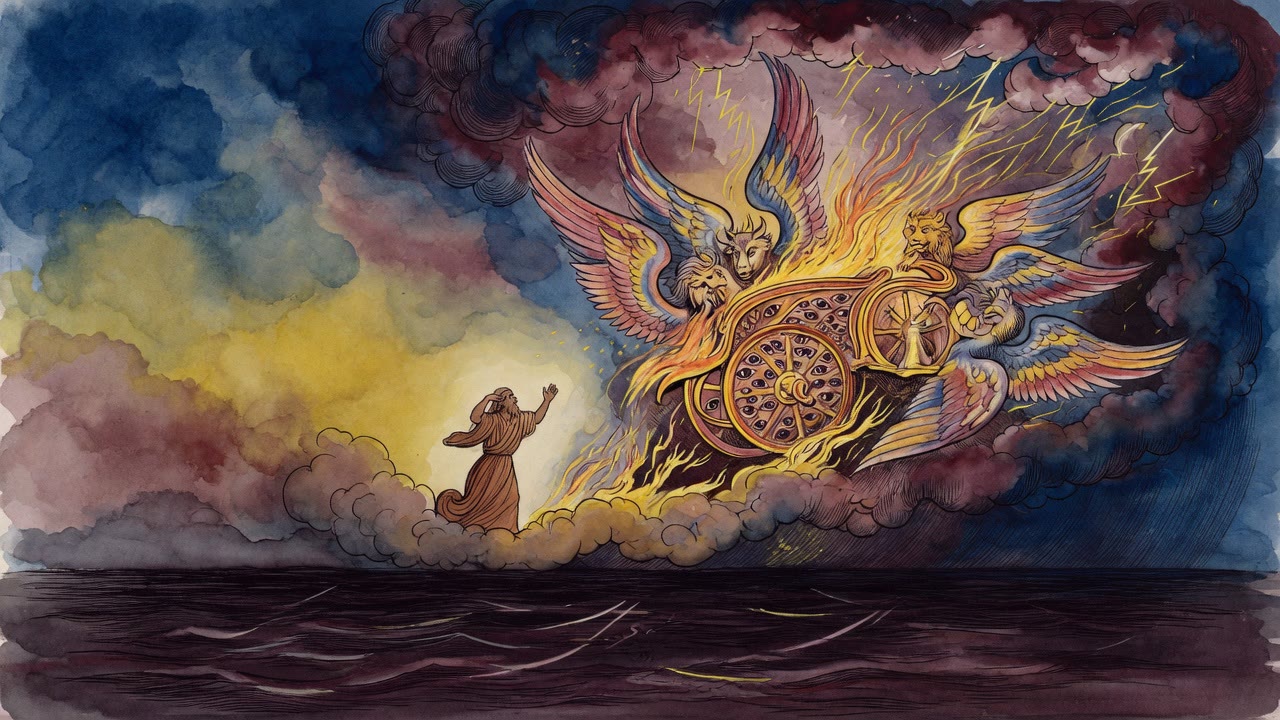
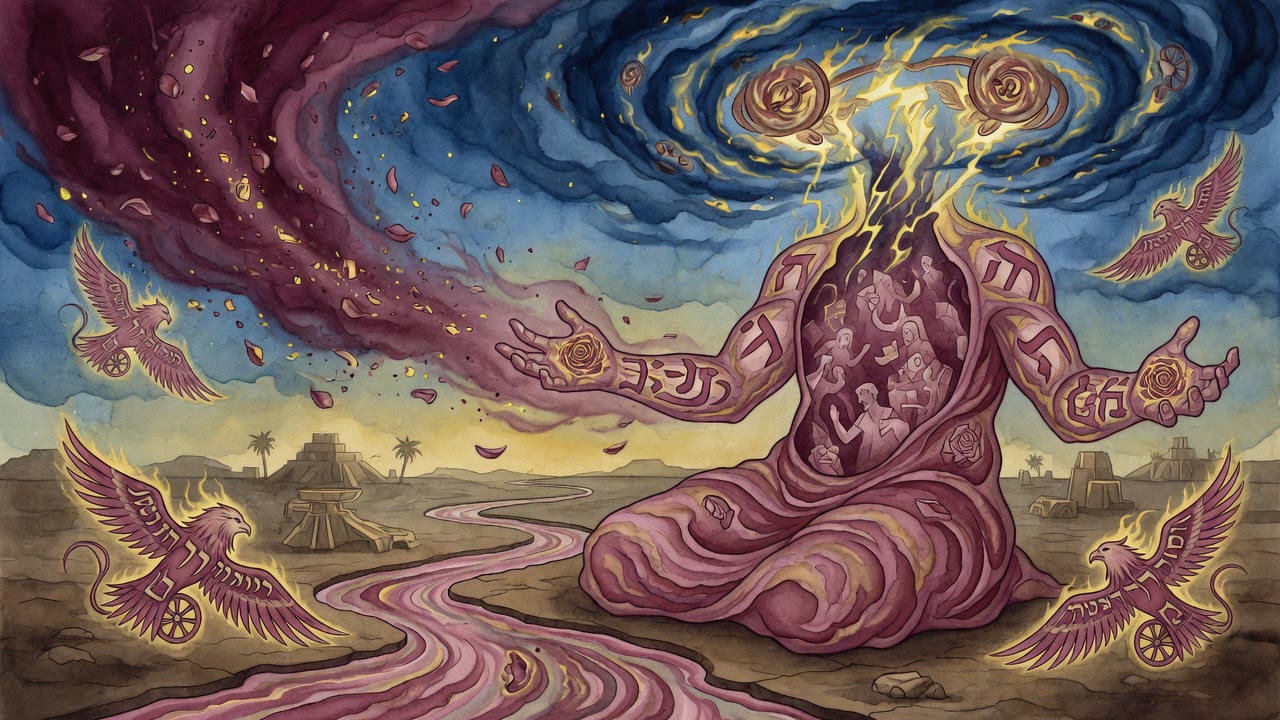
The first chapter of Ezekiel is one of the strangest passages in the Hebrew Bible. A storm cloud comes from the north, crackling with lightning, a fire that glows from inside. Out of it emerge four living creatures with four faces each: human, lion, ox, eagle. Their legs are straight, their feet like hooves, and they gleam like burnished bronze. They have human hands under their wings. They move in every direction simultaneously without turning.
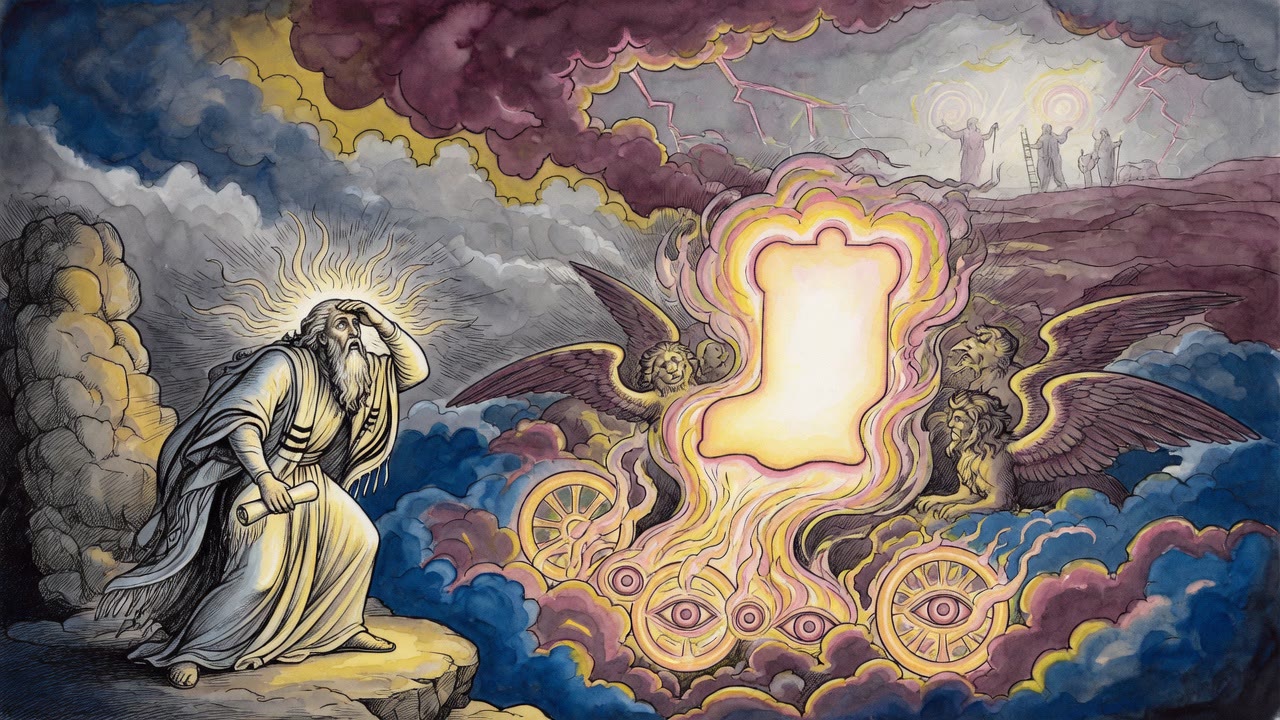
Beside each creature is a wheel. The wheels are tall and terrifying and covered with eyes. They move with the creatures as if the creatures and the wheels share a single intelligence. Above them is an expanse like ice, and above the expanse is a throne that looks like sapphire, and on the throne is a figure that looks like a human being, robed in fire above the waist and fire below, the whole thing surrounded by a rainbow.
Ezekiel spent six verses describing the living creatures, nine verses on the wheels, three on the expanse, and seven on the throne and its occupant. Then he fell on his face.
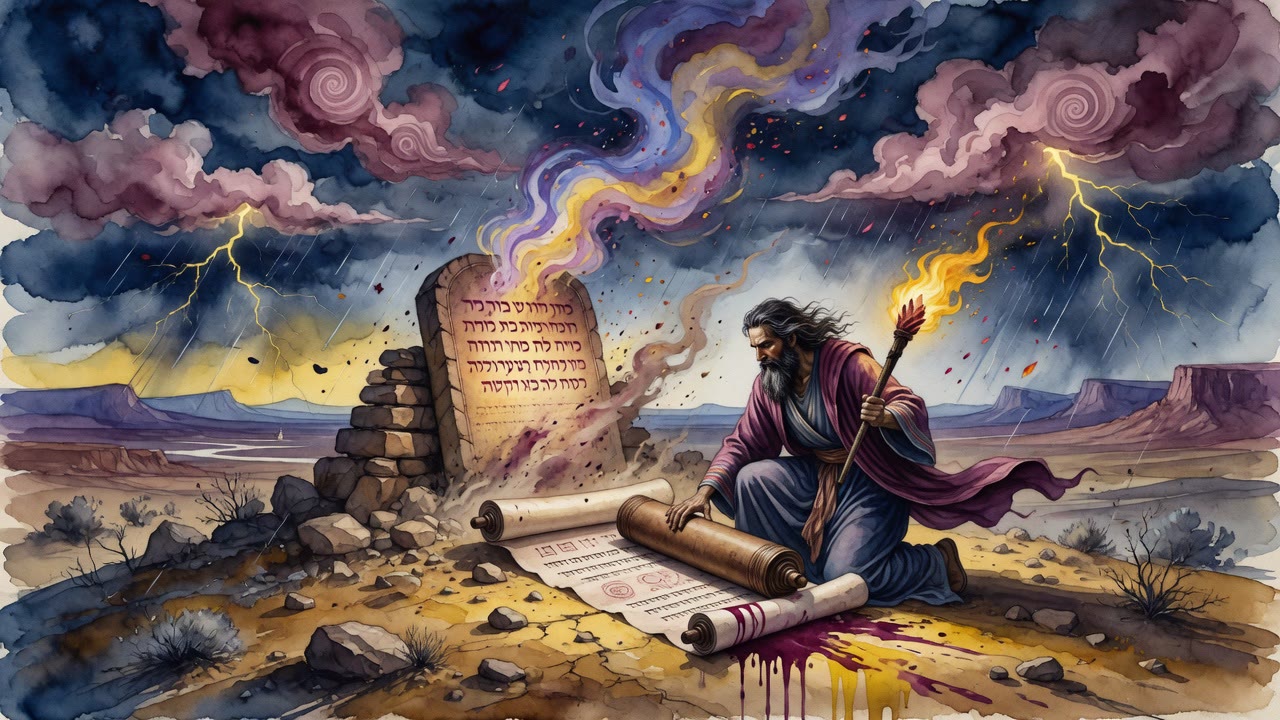
The rabbis had an immediate problem. Moses, about whom God had said explicitly that he spoke face to face, mouth to mouth, clearly and not in riddles, never produced anything this elaborate. If Moses was greater, why was Ezekiel's description denser?
Nine Panes of Glass
Vayikra Rabbah, the fifth-century Palestinian midrash on Leviticus, offers the framework through the figure of glass. Every prophet sees the divine through a medium, the way a flame is seen through a window. Moses saw through one clear pane. The image was exact, unfiltered, direct. Numbers 12:8 is the proof-text: I speak with him mouth to mouth, clearly, and not in dark speech.
Ezekiel, Rabbi Yehuda argued, saw through nine clouded panes. The count came from the text itself: Ezekiel chapter 1 uses the words appearance, vision, and saw in nine distinct combinations across the opening chapter, each one a grammatical hedge, each one a layer of uncertainty between the prophet and what he was perceiving.
On this reading, Ezekiel's description is elaborate not because his access was greater but because his access was more mediated. He was reaching through fog to describe what Moses had seen directly. More words were required because each word was less reliable.
The Country Person at the Royal Procession
But the tradition does not let this be the final answer. Vayikra Rabbah adds a second explanation, and the two sit in tension in a way that feels deliberate.
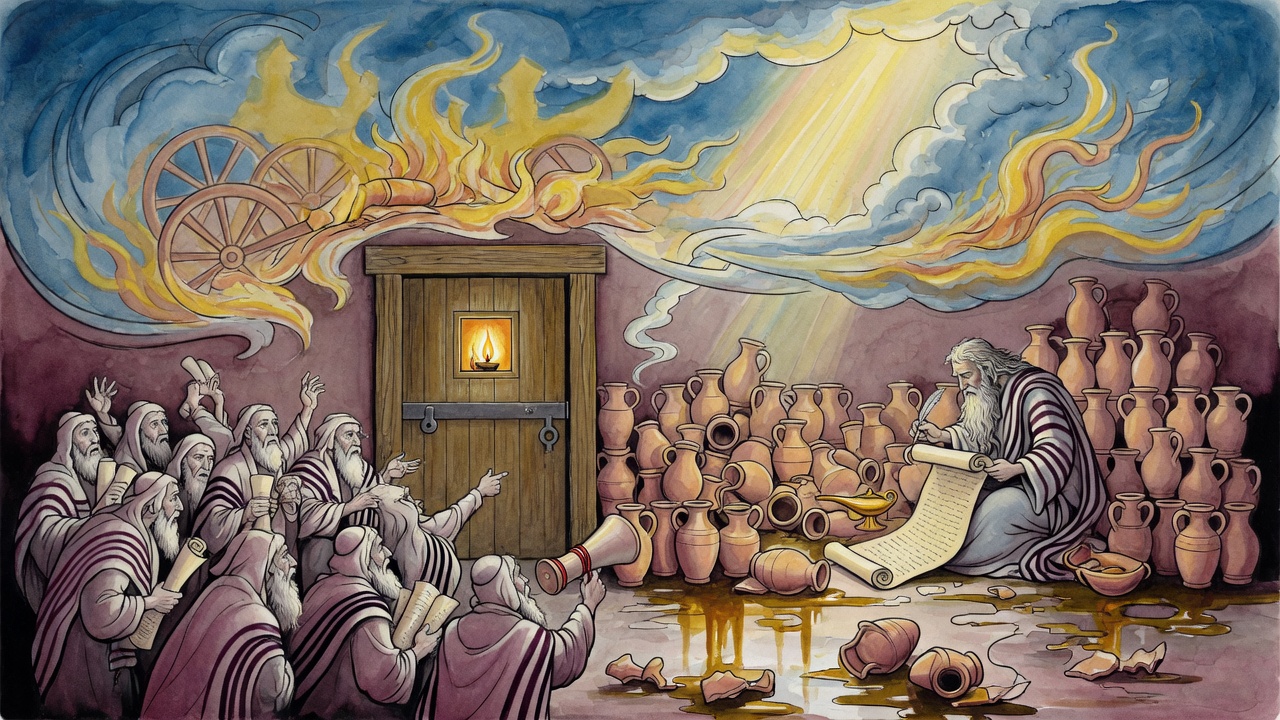
A person from the countryside, who has never been to court, sees the king's procession moving through the city. The horses, the banners, the outriders, the armor, the controlled spectacle of royal display: the country person describes everything. Every detail is new. Every detail needs a word. The description goes on and on because none of it can be taken for granted.
A city person who sees the same procession says: the king passed by. The description is complete. Nothing needs elaboration because the frame is already known.
Moses was the city person. He had been in the cloud at Sinai. He had been in the cleft of the rock. He had carried the tablets. The divine presence was not new to him. When he wrote about God, he wrote with the economy of someone who had seen this before and understood its shape from the inside.
Ezekiel was the country person. He was in Babylon. The Temple was standing but he was not there. He was by a foreign canal, in an empire that knew nothing of Sinai, and the heavens opened above him and something completely outside his existing categories descended. He wrote six verses on the creatures because he had no other framework for them. He counted the wheels and their eyes because this was the first time he had seen such things and he could not afford to leave any of it out.
The Message the Elaboration Carried
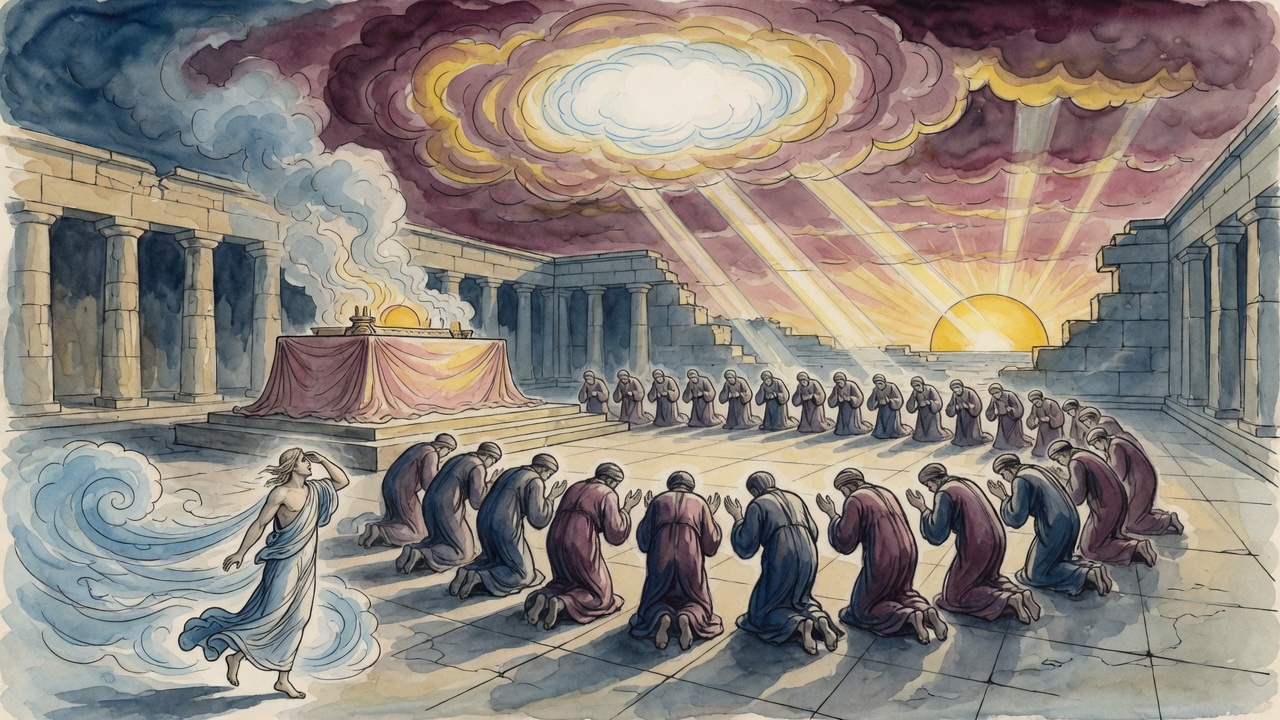
The sixth-century midrash on Ezekiel's vision, preserved in various rabbinic collections, emphasizes what the vision's location meant. The divine presence had followed the exiles to Babylon. This was not a comforting abstraction. Ezekiel was providing evidence. The chariot was in Babylon. The throne was visible from the Chebar Canal. Whatever Israel had lost in the destruction of the Temple, it had not lost this.
The detailed description was the argument. If the heavens opened and Ezekiel fell silent, the community could not use the silence. The density of the description, the nine-paned imperfect vision rendered in hundreds of words, was the testimony the exiles needed. Ezekiel had seen the divine presence on foreign soil. He had counted its wheels and its eyes and its fire. It was there.
← All myths