Laban Crossed Seven Days in One and Still Could Not Win
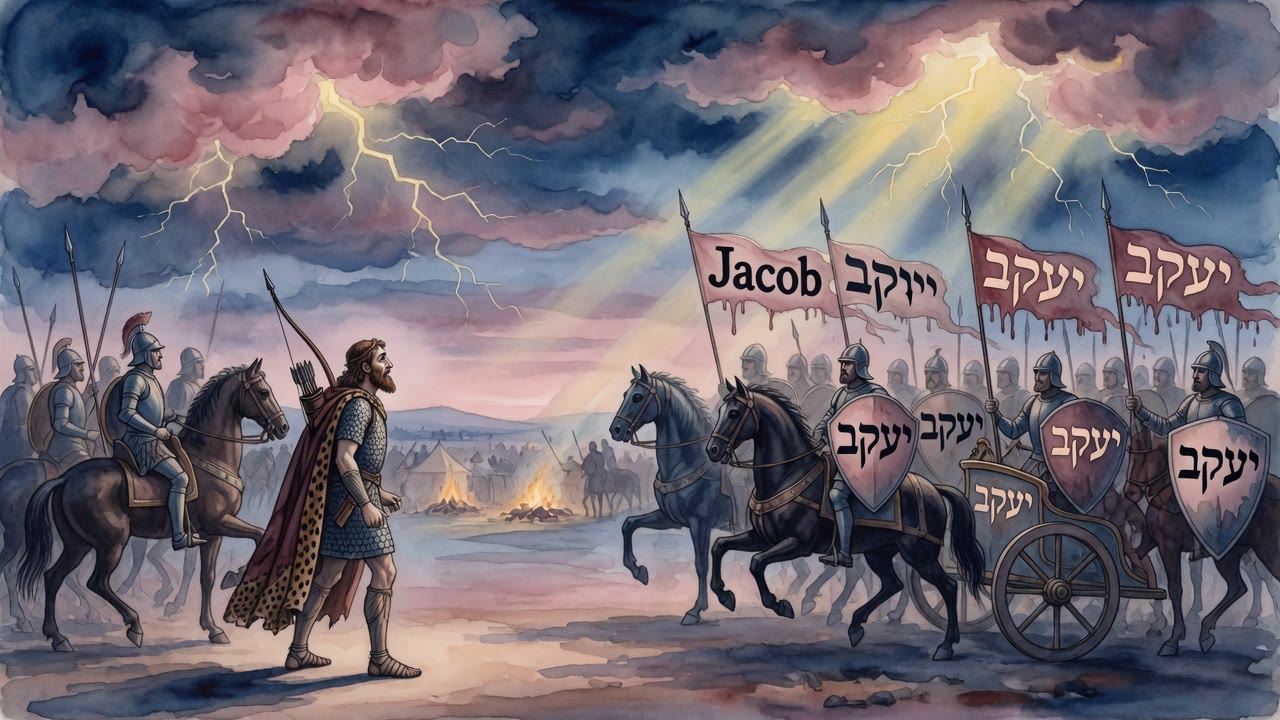
Laban tears across Gilead with supernatural speed, fast enough to catch Jacob and still unable to harm him once God's dream warning lands.
Table of Contents
 Click for full size
The Numbers That Did Not Add Up
Jacob had given himself a head start of three days. He waited until Laban was far enough away and then loaded his family onto camels and fled, crossing the river and heading toward the hills of Gilead. Three days passed before anyone told Laban that Jacob was gone. Then Laban gathered his kinsmen and set out after him, and the verse says he caught up with Jacob in the Gilead highlands after seven days of pursuit.
The rabbis stopped here and ran the arithmetic. Jacob had a three-day lead. Laban traveled seven days and found him. If both men moved at the same pace, Laban should have arrived at most four days behind Jacob's last position, not at the same camp. Rabbi Abbahu said what Jacob traversed in three days, Laban covered in one. Rabbi Ḥiyya Rabba extended it further: what Jacob traversed in seven days, Laban covered in one. The two calculations were not reconciled. Both were offered, because what they agreed on mattered more than the precise ratio. Laban could collapse distance. He moved through the wilderness of Gilead with a speed that had no natural explanation.
Why the Speed Made the Outcome More Significant
If Laban had been a slow, ordinary man plodding after his son-in-law across the wilderness, the fact that he did not overtake him would prove nothing. A slow man might simply have been outrun. But if Laban was capable of covering in a day what Jacob covered in seven, and still could not turn the chase into a victory, then something else was operating in the space between them.
God appeared to Laban that night in a dream and said: be careful what you say to Jacob. Not: you cannot catch him. Not: he has escaped your power. Be careful. The warning arrived exactly when Laban had the physical advantage, exactly when the speed that had brought him across the wilderness in impossible time placed Jacob's camp within reach. The dream did not remove Laban's ability to act. It installed a constraint on what the ability could produce.
The Speech of a Man Who Came to Harm
When Laban caught up with Jacob he delivered a speech. He said he had the power to harm Jacob and his family, and the threat sat in the open even as he spoke it. He said Jacob had stolen away secretly under cover, slipping off without a word, robbing him of the chance to kiss his daughters and grandchildren goodbye and send them off with timbrel and song. He said Jacob had also stolen his household gods, the small carved figures of his hearth, which Jacob did not know Rachel had taken and hidden beneath her in the saddle.
The speech was the act of a man who had crossed the wilderness in impossible time to do something and arrived to find his hands tied. He had the kinsmen at his back. He had the grievance. He had, by his own claim, the power. What he no longer had was the freedom to use it, and so the power spilled out of him as words instead of blows.
Twenty Years of Wages Changed Ten Times
Jacob answered him with twenty years. For fourteen years I served you for your two daughters. For six more years I served for your flocks. You changed my wages ten times. In the day the heat consumed me and at night the frost, and sleep fled from my eyes. Whatever was torn in the field I did not bring to you but bore the loss myself; from my hand you required it, stolen by day or stolen by night. And God saw all of this. God saw the affliction of my hands and rebuked you last night. That is why you are standing here giving speeches instead of doing the harm you just claimed you had the power to do.
← All myths