Rachel Stole Her Father's Idols and Jacob Cursed Whoever Took Them
Laban's household god was a salted human head set into a wall with a gold plate under its tongue. It answered questions. Rachel grew up with it.
Table of Contents
 Click for full size
The Head in the Wall
Rachel grew up in a house where something in the wall answered questions.
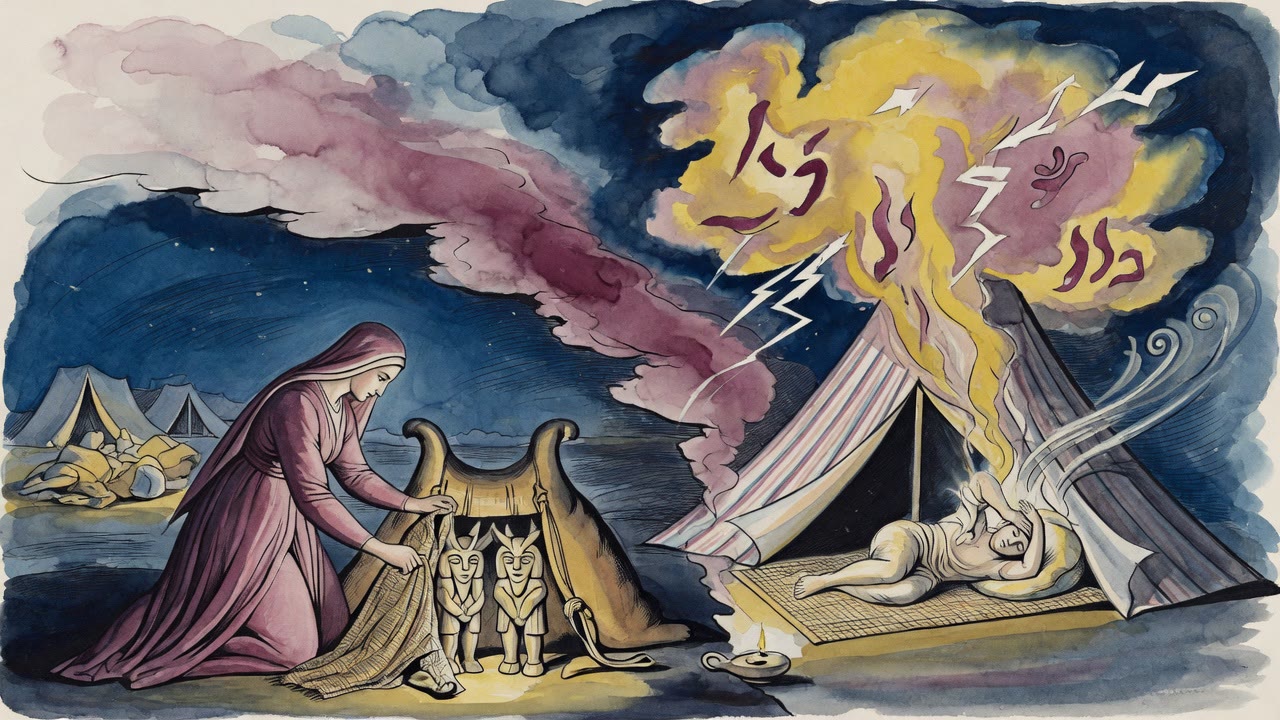
This is how the thing was made. They took a man, a firstborn, and they killed him. They cut the head off and stripped the hair away and packed the head in salt and rubbed it with oil until it kept. Then they wrote a name on a small plate of gold, or of copper, and lifted the tongue and laid the plate underneath it. One telling says the name they wrote was the name of an unclean spirit. Another says it was the Name itself, and that this was where the power came from.
They set the head into the wall and lit lamps in front of it. When the household bowed down, the head spoke, and it spoke about anything they asked.
Nobody wrote down the rest of the procedure. There was an argument among the men who knew it, and it was decided not to put the working details in writing, because whoever goes after that knowledge ends up in Gehinnom (the realm of judgment after death) and there is no reason to hold the door for him. What survives is what the head could do. It talked. Whatever it said was worthless, and it talked.
Her Father Was Out Shearing
Laban had gone off to shear his sheep, which meant days.
Jacob put the question to his wives and both of them said go, and he decided to leave without telling their father anything at all. That was the whole plan: distance, and a head start, and Laban finding out late.
Rachel knew what was wrong with the plan. There was a mouth in her father's wall that could be asked which road they had taken.
So she went and took it, and she had two reasons and both of them were hers. One was so that it could not tell Laban that Jacob had fled. The other was that she wanted it out of her father's house, permanently, whatever else happened on that road.
She carried it out to the camels and worked it down into the cushion of a saddle, and then she climbed up and sat on it, and they went.
Whoever Has Them Will Not Live
Laban caught them at the mountain of Gilead with his kinsmen behind him, and after the shouting about daughters and grandchildren and unsung farewells he came to the real charge. "Somebody in this camp took my gods."
Jacob had twenty years of changed wages behind him and he was not in a mood to be careful. He threw the whole camp open. "Search anybody," he said. "Search everything."
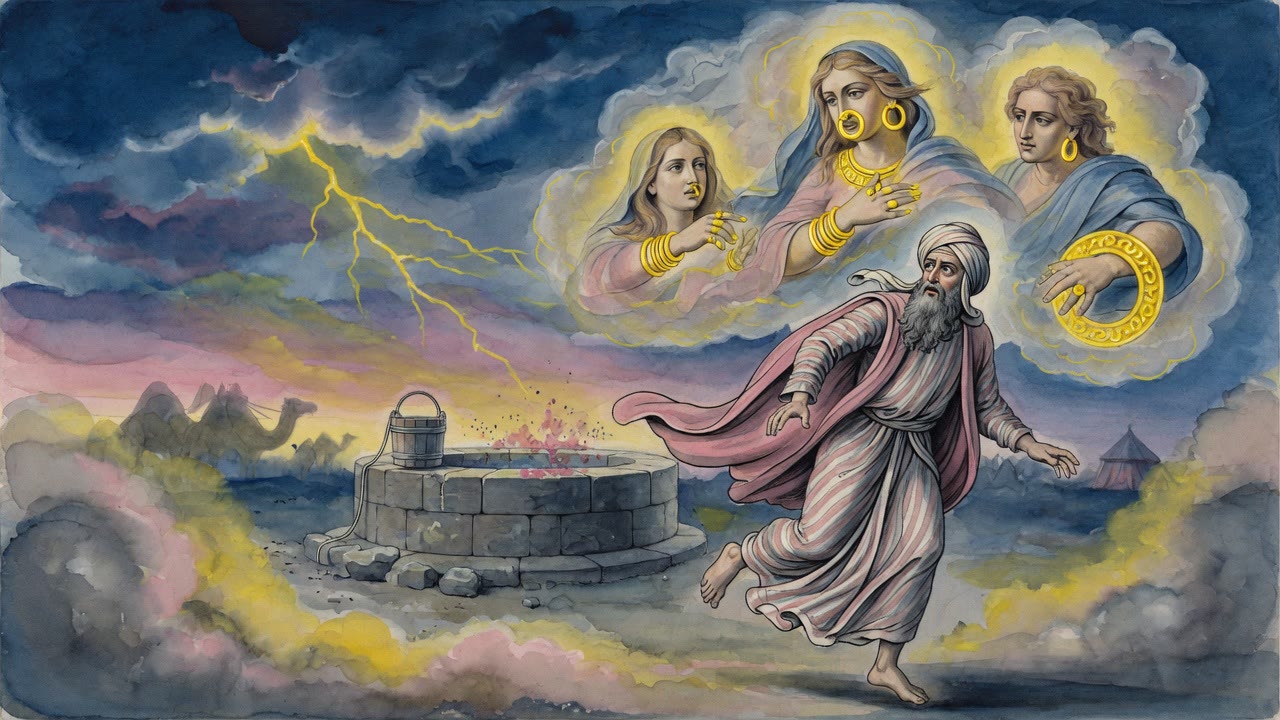
"And whoever you find your gods with," he said, "will not live."
He did not know. The verse that records the oath stops and says so in the same breath: Jacob did not know that Rachel had stolen them. It was a slip of the kind that comes out of a ruler's mouth, the sort of error that cannot be walked back because of whose mouth it came out of. When a righteous man says a thing, the saying travels like a sentence spoken by an angel. He had just handed down a death and he went back to arguing about sheep.
He Searched Her Tent Twice
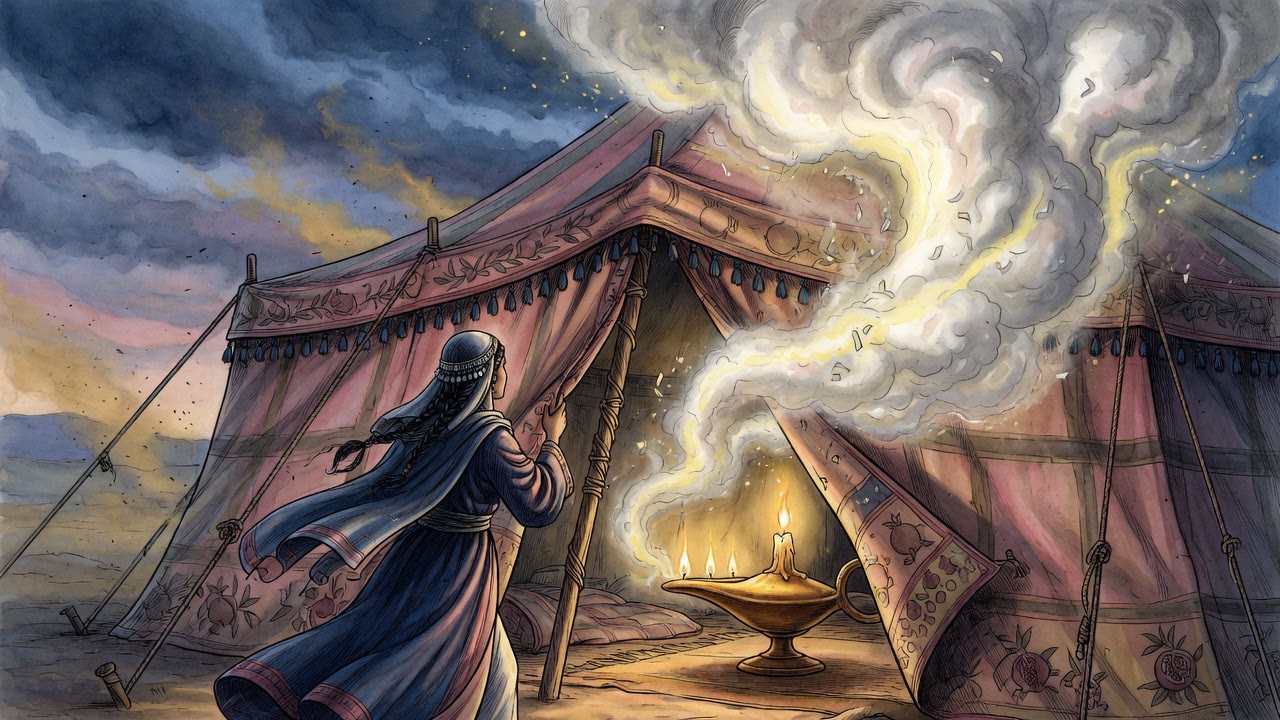
Laban went through Jacob's tent first, which was Rachel's tent, and found nothing. Then Leah's. Then the tents of the two maidservants. Then he came out of Leah's tent and went straight back into Rachel's.
He searched his younger daughter's tent twice, because he had raised her and he knew her hands. She had a habit of touching what was not hers.
She was sitting on the saddle when he came through the flap the second time and she did not get up.
"Do not be angry, my lord," she said. "I cannot rise in front of you. The manner of women is upon me."
He went over that tent with his hands. He felt through the bedding and the packs and he came to the camel cushion she was sitting on and he felt through that too, and what his fingers closed on was pottery. Jugs. Rabbi Yohanan said it plainly: Laban did not find idols in there, he found jugs, because the things had been turned into jugs so that his daughter would not have to be humiliated in front of him.
Laban straightened up with nothing and walked out.
She Knew, and She Was Silent
There was an older debt behind all of this.
On the night Rachel was supposed to be married, her father put Leah under the veil instead, and Rachel knew. She could have said one word in the doorway and taken her own wedding back and left her sister standing there in front of everyone. She knew, and she said nothing.
When the verse finally says that God remembered Rachel, that silence is what is being remembered. Three keys are held in God's own hand and given to no messenger, the key of the rain, the key of the grave, and the key of the womb, and the third one turned for her on account of a night she kept her mouth shut.
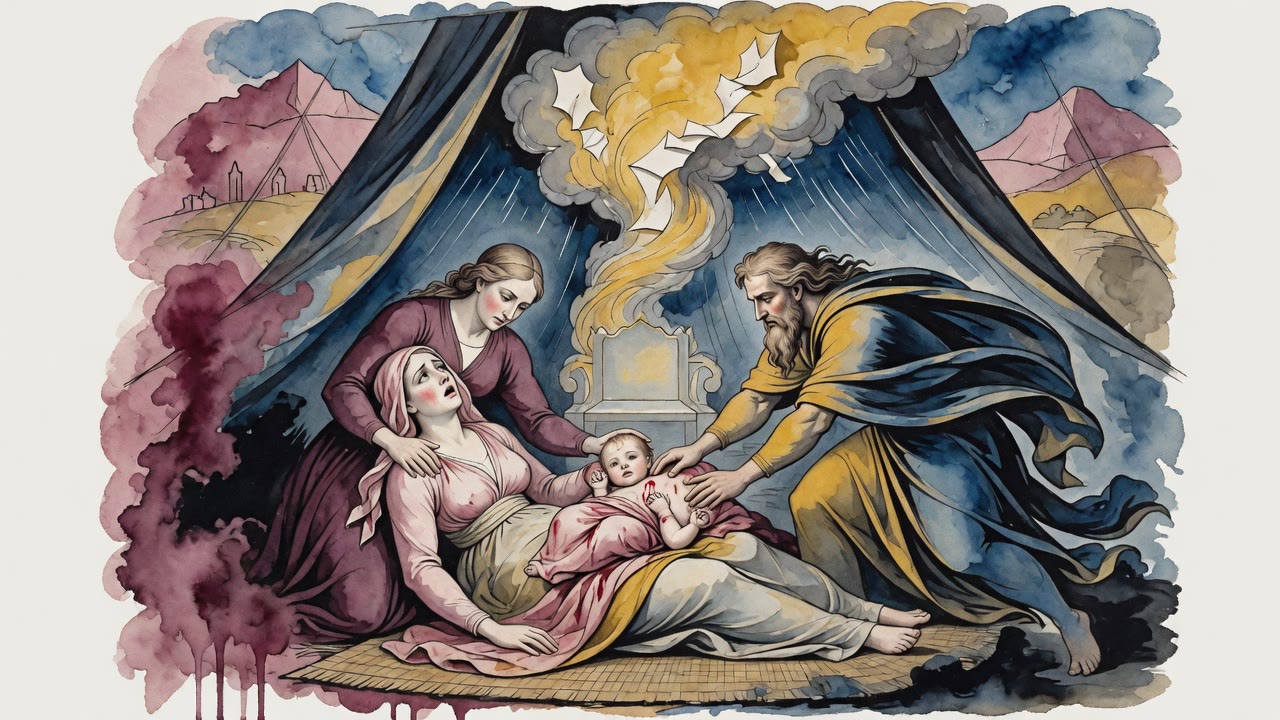
She got Joseph. Then, on the road, still short of Ephrath, she went into labor with the second one and it went wrong. She named him as she was dying. Jacob buried her there on the roadside instead of carrying her to the family cave, and set up a stone, and went on toward his father's country with eleven sons and an infant.
He had said it himself, out loud, in front of witnesses, with his own wife sitting on the evidence twenty paces away.
← All myths