37 texts
It’s a question that’s haunted humanity for ages, and it’s one the Book of Ben Sira, a work of wisdom literature not included in the Hebrew Bible but valued in Jewish tradition, gr...
By the letter Hey, Ben Sira's proverbs have shifted from gentle warnings to something more direct: "Blind your eyes because of the graceful woman, lest you be caught in her trap." ...
Buried in a cave near the Dead Sea for two thousand years, the War Scroll (Megillat HaMilchamah, מגילת המלחמה) lays out the most detailed battle plan ever written for the end of th...
The Community Rule (Serekh HaYachad, סרך היחד), one of the first seven scrolls discovered in Cave 1 in 1947, contains what may be the most startling theological statement in all of...
Abraham did everything the angel commanded. He slaughtered the animals, divided them, and gave the portions to the angels who had appeared beside him. Iaoel took the birds. Abraham...
God told Abraham to look beneath his feet at the firmaments and understand the creation that was foreshadowed in the expanse, the creatures existing upon it, and the age prepared a...
Abraham asked: "O Eternal, Mighty One! What is this picture of the creatures?" God answered: "This is my will with regard to those who exist in the divine world-counsel. It seemed ...
God answered Abraham's question about evil with a revelation about the nations. He was angered at them on account of Abraham's descendants, the people who would be separated after ...
Abraham asked the question that every prophet and mystic after him would ask: "O Eternal, Mighty One! Why have you established that things should be this way, and then proclaimed t...
Asher, tenth son of Jacob, born of Zilpah, spoke to his sons in the hundred and twenty-fifth year of his life, while still in health. "Hearken, you children of Asher, to your fathe...
Benjamin, twelfth and last son of Jacob, born of Rachel, had lived a hundred and twenty-five years. He kissed his sons and began to speak. "As Isaac was born to Abraham in his old ...
It wasn't just about finding a male and female of each species. According to tradition, moral character played a surprising role. The entire world was drowning in wickedness. Noah ...
And while there are no easy answers, Jewish mystical texts offer some fascinating insights. to a concept explored in the Kalach Pitchei Chokhmah, a Kabbalistic work. It speaks of a...
It’s a question that’s haunted humanity since… well, since humanity. Jewish mystical tradition, particularly the Kabbalah, wrestles with this in fascinating ways. one particularly ...
And Jewish mystical tradition, particularly in texts like the Sefer HaBahir, one of the earliest and most influential Kabbalistic works, wrestles directly with this thorny issue. T...
Rabbi Nachman began this tale with a warning: "You might think I will tell you everything and that you will be able to understand." He would not. And they would not. A king who had...
Two boys grew up in the same town, studied in the same school, and loved each other deeply. One was a khakham (חכם), clever and sophisticated. The other was a tam (תם), simple and ...
The ninth chapter of the Tanya maps the battlefield inside every human being. The animal soul—the nefesh (the vital soul) habehamit (נפש הבהמית)—lives in the left ventricle of the ...
Chapter ten of the Tanya defines the difference between two kinds of righteous people, and the gap between them is enormous. The "completely righteous" person—the tzaddik (a righte...
The Tanya's eleventh chapter turns the mirror around and examines wickedness with the same precision it applied to righteousness. The "wicked person who prospers"—the rasha v'tov l...
The benoni (בינוני)—the intermediate person—is the central figure of the Tanya, and chapter twelve defines him precisely. The benoni has never sinned. Not once. Not in action, not ...
Chapter thirteen of the Tanya explains why the evil inclination feels so much more powerful than the good one—and why that feeling is actually evidence that you are winning. The Ta...
"The rank of benoni is attainable by every person," the Tanya declares in chapter fourteen, "and each person should strive after it." This is Rabbi Schneur Zalman's most democratic...
Chapter fifteen of the Tanya draws a distinction so subtle that most people miss it entirely: the difference between a person who "serves God" and a person who "does not serve Him"...
The sixteenth chapter of the Tanya reveals the benoni's secret weapon—and admits that for most people, it will be hidden. The Tanya has established that the benoni must govern the ...
"For this thing is very near to you, in your mouth and in your heart, so you can fulfill it" (Deuteronomy 30:14). The Tanya's seventeenth chapter takes this verse—which seems to pr...
"These are the generations of Isaac, the son of Abraham; Abraham begot Isaac" (Genesis 25:19). The repetition seems redundant. If Isaac is the son of Abraham, we know Abraham begot...
"I have remained a stranger at Laban's" (Genesis 32:5). Rabbi Levi Yitzchak of Berditchev reports his father's brilliant reading of Jacob's message to Esau. The Hebrew word garti (...
"These are the generations of Isaac, the son of Abraham" (Genesis 25:19). Rashi comments simply: "these are Jacob and Esau, who are discussed in the portion." But Rebbe Elimelech o...
"And Jacob sent messengers ahead of him" (Genesis 32:4). On the surface, Jacob is preparing to meet his brother Esau. Rebbe Elimelech of Lizhensk, reading Parashat Vayishlach, sees...
Rabbi Yishmael asked: why did Job risk everything by demanding an answer from God (Job 31:35)? Because Job understood something terrible. Without death, life has no name. Without d...
At the end of days, the prophet Malachi says, you will be able to tell the righteous from the wicked at a glance: "You shall return and discern between the righteous and the wicked...
"And it shall come to pass in all the land, declares the Lord, that two-thirds shall be cut off and perish, and one-third shall be left alive" (Zechariah 13:8). Rabbi Berachiah sai...
We often focus on the sin, the temptation, the immediate consequences. But what about their reaction? How did they feel, and how did they act immediately after? There's a curious d...
to what some of our sages have said about it. The verse reads, “Unto the woman He said: ‘I will greatly multiply thy pain and thy travail; in pain thou shalt bring forth children; ...
Philo's writings, sometimes called "The Midrash of Philo," offer a unique blend of Jewish tradition and Greek philosophy. They delve into the deeper meanings behind the Torah, expl...
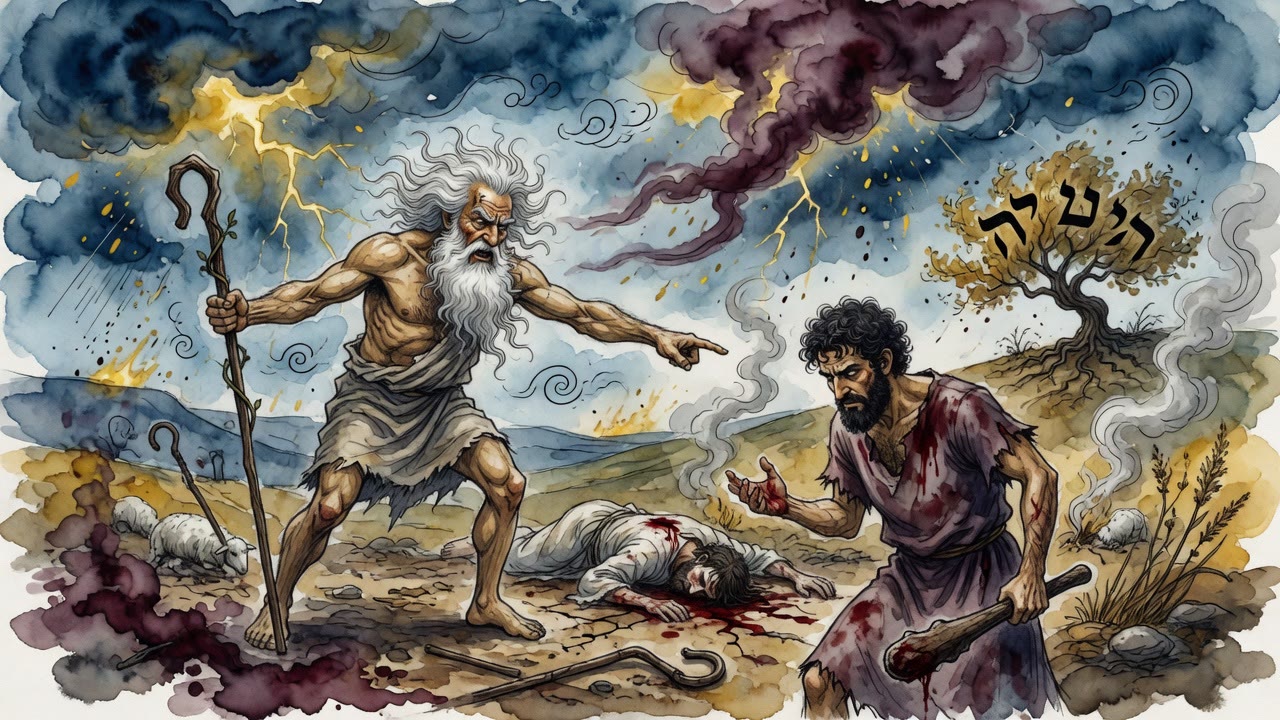
God asks him, "Where is your brother Abel?" And Cain replies, cool as you please, "I do not know: am I my brother's keeper?" (Genesis 4:9). Now, this moment, this exchange, gets so...