
Moses Made One Batch of Oil That Lasted a Thousand Years
God gave Moses a recipe for sacred oil in the wilderness. He made twelve logs of it. That tiny amount anointed the entire Tabernacle, every high priest, and...
Table of Contents
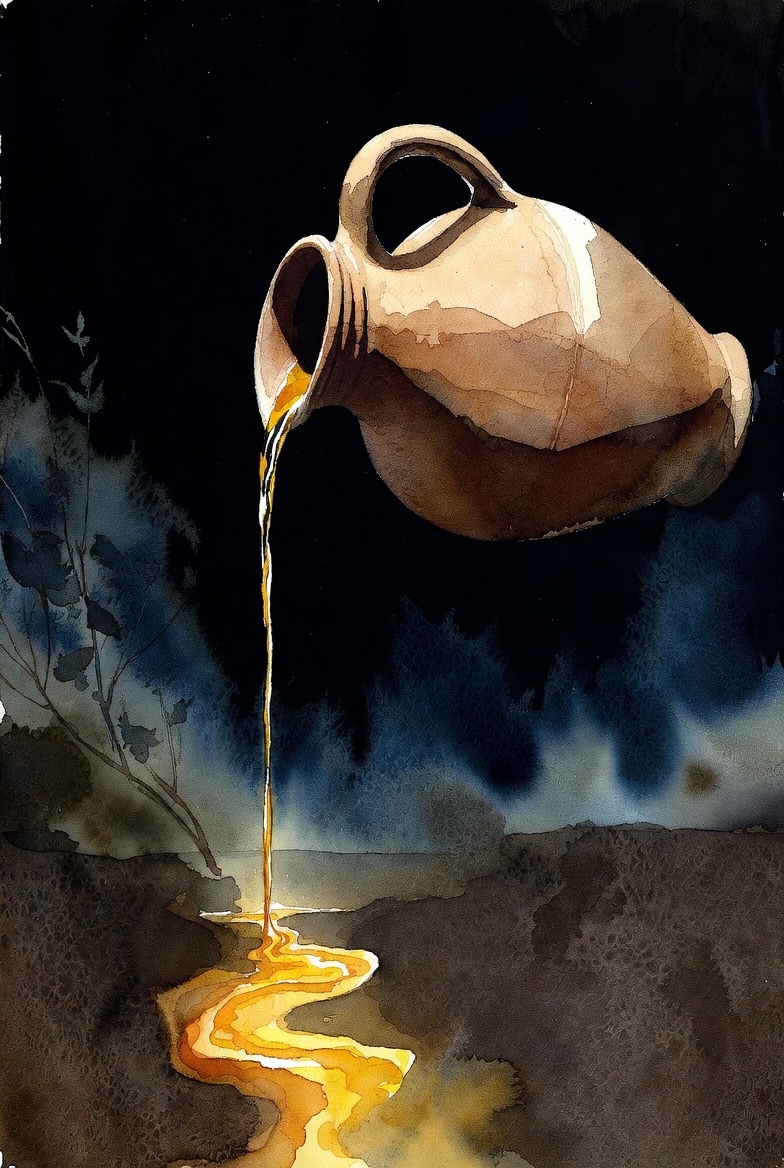
(Exodus 30:22-33) contains one of the strangest recipes in the Torah. God tells Moses to take 500 shekels of liquid myrrh, 250 of fragrant cinnamon, 250 of aromatic cane (kaneh bosem, קנה בושם), 500 of cassia, and a hin of olive oil, and blend them into a sacred anointing oil. The shemen ha-mishchah (שמן המשחה), the oil of anointing. This oil would consecrate the Tabernacle, every vessel inside it, the altar, the basin, and Aaron and his sons as priests. God's instructions are explicit: "This shall be My sacred anointing oil throughout your generations" (Exodus 30:31). Anyone who replicates the recipe for personal use is cut off from the people. This oil belongs to God.
Simple enough, on the surface. Moses mixed oil in the wilderness. The rabbis noticed a problem. The Torah specifies only twelve log (לוג) of oil, an ancient liquid measure roughly equivalent to a large pitcher. Twelve pitchers. That was the entire supply. With those twelve pitchers, Moses was supposed to anoint an entire sanctuary structure, dozens of sacred vessels, the altar and its implements, and four people (Aaron and his three sons) over seven consecutive days of consecration ceremonies. The math doesn't work. Unless something miraculous was happening with the oil itself.
The Word That Hides a Number
The Sacred Anointing Oil Moses Made With Hidden Miracles from Vayikra Rabbah 10:8 (compiled c. 5th century CE in the Land of Israel) preserves a teaching from Rabbi Yehuda ben Rabbi Ilai (2nd century CE, one of the most frequently cited Tannaim in the Mishnah). He noticed that the Torah uses the word zeh (זה, "this") when describing the oil: "This shall be the sacred anointing oil" (Exodus 30:31). In Hebrew, every letter carries a numerical value. Zayin (ז) equals 7. Heh (ה) equals 5. Together: 12. The word itself encodes the quantity. Twelve log of oil. God hid the measurement inside the demonstrative pronoun.
Rabbi Yehuda then walks through everything those twelve log accomplished. The oil was boiled with the spices, meaning the wood and aromatics absorbed a significant portion. It was poured over the golden altar, the bronze altar, the table of showbread, the menorah, and all their implements. It was poured over the basin and its stand. It was used to anoint Aaron and his sons for seven straight days. After all of that? The Midrash says the oil was not diminished. Not by a single drop. The Miraculous Anointing Oil of the Tabernacle from Louis Ginzberg's Legends of the Jews 3:64 (published 1909-1938, drawing on over 700 primary sources) confirms: that same oil anointed every subsequent high priest and several kings, "all the way until the time of Josiah." King Josiah reigned from approximately 640 to 609 BCE, meaning the oil Moses made in the wilderness around 1250 BCE was still in use over 600 years later.
The Two Drops on Aaron's Beard
The Legends of the Jews account preserves a detail that stopped Moses cold. When Aaron was anointed, two drops of the sacred oil clung to the tip of his beard. They hung there like pearls. Moses panicked. Was this waste? Was the holy oil, restricted to sacred purposes alone (Exodus 30:32-33), being misused by dripping onto a man's beard? Aaron felt the same anxiety. If even a drop of the sacred oil was considered personal use, the penalty was karet (כרת), being cut off from the people of Israel.
Then a bat kol (בת קול), a divine voice, spoke. It reassured both Moses and Aaron: the drops on the beard were not waste. They were part of the consecration. (Psalm 133:2) captures the image: "It is like the precious oil upon the head, running down upon the beard, the beard of Aaron, running down over the collar of his robes." The psalmist isn't describing an accident. He's celebrating it. The oil flowing down Aaron's beard is an image of abundance overflowing, of blessing that exceeds its container. The Midrash in Midrash Tehillim 133:1 (compiled c. 9th-11th century CE) reads this psalm as a direct reference to the anointing scene, noting that the drops miraculously rose back to the roots of Aaron's hair even when he trimmed his beard. The oil would not leave him.
Why Were Kings Anointed from a Horn?
The Vayikra Rabbah passage raises a question that seems minor but carries enormous weight. Kings are anointed from a keren (קרן), a horn. Priests are anointed differently. Not all kings were anointed from a horn. Saul was anointed from a pakh (פך), a small cruse or flask (1 Samuel 10:1). Jehu was also anointed from a flask (2 Kings 9:1-3). Both their dynasties were temporary. Saul's line ended after one generation. Jehu's lasted five generations but was ultimately uprooted.
David was anointed from a horn (1 Samuel 16:13). Solomon was anointed from a horn at the Gihon Spring (1 Kings 1:39). Their dynasty was eternal. The rabbis drew the connection: the vessel determines the reign. A horn symbolizes strength, permanence, enduring power. A flask symbolizes fragility. The David's Secret Anointing Awakens Prophecy and Jealousy text from Legends of the Jews 4:12 describes the moment Samuel poured the oil over David's head in secret, away from his brothers. The oil ignited something. David began to prophesy. His spirit deepened. The same oil that consecrated the Tabernacle was now kindling prophecy in a shepherd boy from Bethlehem.
Anointing Oil for Priests and Kings in Israel from Shir HaShirim Rabbah 3:2 (compiled c. 6th century CE) adds that kings were always anointed near a spring. Running water. Living water. Solomon was taken down to Gihon specifically for this purpose (1 Kings 1:33-39). The anointing was not a private ceremony. It was a public, outdoor event, performed at a place where water flowed, symbolizing the unbroken continuity of sovereignty from one generation to the next.
Where Is the Oil Now?
The Second Temple, rebuilt after the Babylonian exile in 516 BCE and standing until its destruction by Rome in 70 CE, lacked five things that the First Temple possessed. Five Things Missing From the Second Temple from Shir HaShirim Rabbah 9:3 lists them: the heavenly fire that descended on the altar, the Ark of the Covenant, the Urim ve-Tummim (the oracular stones in the High Priest's breastplate), the Ruach ha-Kodesh (the Holy Spirit of prophecy), and the sacred anointing oil. All five vanished before or during the Babylonian conquest of Jerusalem in 586 BCE.
The Talmud in Horayot 12a (redacted c. 500 CE) discusses what happened. King Josiah (r. 640-609 BCE), foreseeing the coming destruction, hid the anointing oil along with the Ark, the jar of manna, Aaron's staff, and the chest the Philistines had sent as a guilt offering (1 Samuel 6:8). Keritot 5b confirms that after Josiah, the anointing oil was no longer available. Later kings and priests of the Second Temple period were not anointed with the original oil. They used a different form of investiture. The chain was broken.
The oil itself? Still exists. The Vayikra Rabbah concludes with a promise: the original twelve log "will remain intact in the future." Keritot 5b specifies that the oil is reserved for the messianic era. When the Messiah comes, he will be anointed with the same oil that Moses made in the wilderness, that consecrated the Tabernacle, that flowed down Aaron's beard, that crowned David king, that Solomon received at the Gihon Spring. The same twelve log. Never used up. Never spoiled. Hidden somewhere beneath Jerusalem, waiting. That is a claim with weight: what was made once, at Sinai, has not been exhausted. It is being held for the right moment.
Oil That Fell from Heaven
The anointing oil tradition reaches even further back than Moses. Jacob Anoints the Stone Pillar with Heavenly Oil from Bereshit Rabbah 69:8 (compiled c. 5th century CE) describes the morning after Jacob's dream of the ladder at Bethel. (Genesis 28:18) says Jacob "took the stone that he had placed beneath his head, established it as a monument, and poured oil on the top of it." Where did a fugitive traveling alone through the wilderness get oil? The Midrash answers: "He provided to him, from the heavens, enough to fill a jug to its mouth." God sent oil down from heaven for Jacob to consecrate the stone.
This creates a pattern. The anointing oil is not merely a substance Moses manufactured from a recipe. It carries a lineage stretching from the patriarchs through the wilderness to the Temple to the messianic future. Jacob received oil from heaven. Moses received a divine recipe and produced oil that defied physics. David and Solomon were crowned with it. Josiah hid it. The Messiah will recover it. The oil is a thread connecting every era of Jewish sacred history, a single unbroken line of consecration from the first patriarch to the final king.
The Talmud in Horayot 11b asks whether the oil was poured or merely smeared on the heads of kings. For the high priest, the oil was poured in abundance, flowing over the head and down the face. For kings, a small amount was applied in the shape of a crown, tracing a circle on the forehead. Two different methods. Same oil. The priest received abundance. The king received precision. Both received the same consecration that began with twelve log in the Sinai wilderness and, according to every major rabbinic source, has never been exhausted.
Explore the Anointing Oil Texts
Start with The Miraculous Anointing Oil of the Tabernacle from Legends of the Jews (2,672 texts) for Ginzberg's comprehensive retelling. Read The Sacred Anointing Oil Moses Made With Hidden Miracles from Vayikra Rabbah (3,279 texts) for Rabbi Yehuda's gematria and the horn-versus-flask distinction. Browse Five Things Missing From the Second Temple for the oil's disappearance, and Jacob Anoints the Stone Pillar with Heavenly Oil for the tradition of oil descending from heaven.
Our database holds over 18,000 ancient Jewish texts spanning Midrash Rabbah (3,279 texts), Kabbalah (3,572 texts), Legends of the Jews (2,672 texts), and Midrash Aggadah (3,669 texts). Search for anointing oil or shemen ha-mishchah to trace the oil from Moses to the Messiah. Search for Aaron's consecration to see the seven-day ceremony that started it all.