
What the Ark of the Covenant Actually Did
The Ark of the Covenant wasn't a golden box that sat in the Temple. It burned a path through the desert, leveled mountains, killed anyone who peeked under...
Table of Contents
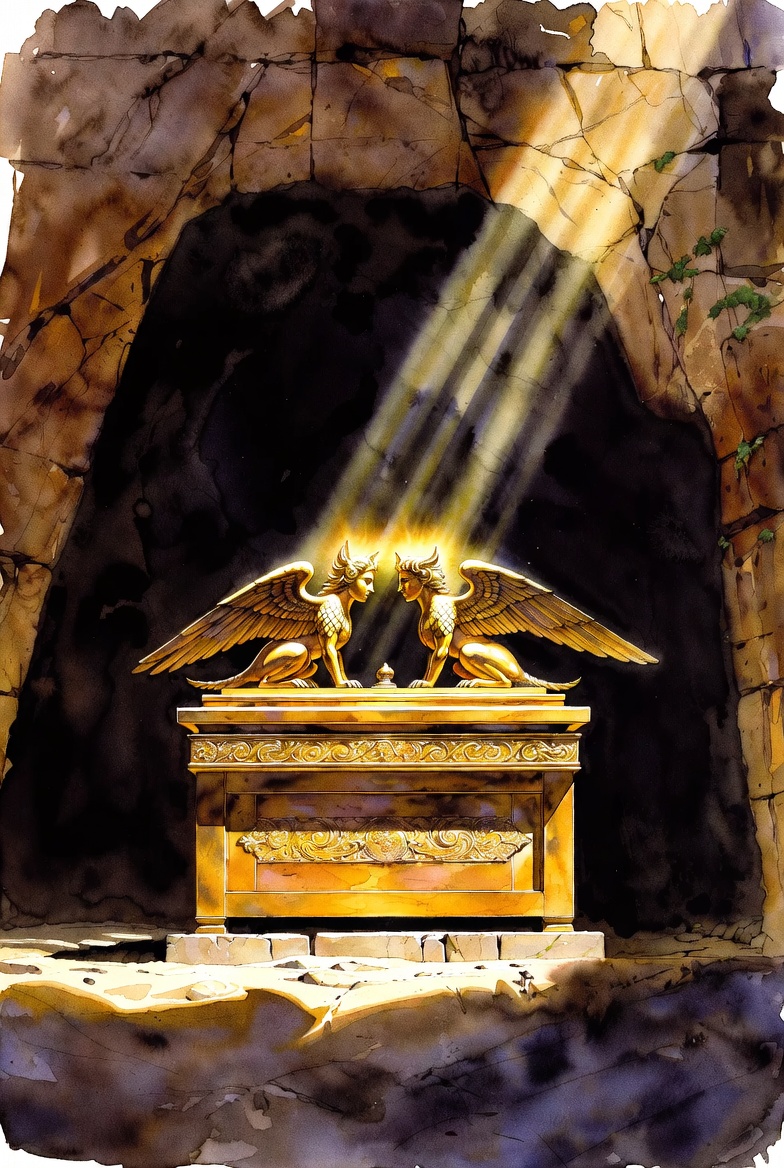
The Talmud (Berakhot 54b, compiled c. 500 CE in Babylonia) records a fact about the Ark of the Covenant that most people have never heard. When the Israelites marched through the desert, the Ark didn't just travel with them. It cleared the road. The Ark of the Covenant from the Talmud Bavli states that the Ark lifted every valley and sank every mountain in Israel's path, flattening the terrain so the people could walk on level ground. The most sacred object in the Bible was, among other things, a bulldozer.
That detail rarely makes it into popular accounts. Neither do the sparks that shot from the Ark and incinerated everything in front of it. Or the cherubim on top whose faces moved depending on whether God was pleased with Israel. Or the fact that when Solomon tried to bring the Ark into the Temple, the doors slammed shut and refused to open. Jewish sources from the Talmud to the Midrash to Legends of the Jews (compiled 1909-1938 by Louis Ginzberg) describe an object far stranger and more dangerous than anything in the popular imagination.
Three Nested Boxes of Gold and Wood
Bezalel, the master craftsman chosen by God, built the Ark. But according to Bezalel Insists on Building the Ark Before the Tent from Legends of the Jews (2,672 texts), Bezalel built it out of order. Moses told him to construct the Tabernacle first, then the Ark. Bezalel pushed back. "What's the point of a house," he asked, "if there's nowhere to put the Torah?" Moses agreed. The Ark came first.
The construction itself was precise. Three nested boxes. A gold one on the outside. A wooden one in the middle. Another gold one on the inside. The Torah scrolls, the two tablets of the Ten Commandments, and the Ineffable Name of God all sat within. Two cherubim perched on the lid. According to The Cherubim With Faces of Boys Atop the Ark from Legends of the Jews, the Talmud (Yoma 54a-b) describes their faces as those of young boys. Each face measured one span. Each wing extended ten spans. The total wingspan of both cherubim came to twenty-two spans, matching the twenty-two letters of the Hebrew alphabet. The Ark wasn't just a container. It was an image of the celestial Throne, and the Zohar (first published c. 1290 CE in Castile, Spain) says it was covered with sky-blue cloth during travel because blue was the color of that Throne.
The Sparks That Burned a Path Through the Desert
The Ark didn't sit passively on its carrying poles. Two sparks shot continuously from the cherubim on top, burning every serpent, scorpion, and thorn that crossed Israel's path. Legends of the Jews records that the smoke from those burning thorns rose in a fragrant column so tall it perfumed the entire world. Other nations saw the smoke and asked the question recorded in (Song of Songs 3:6): "Who is this coming up from the wilderness like pillars of smoke, perfumed with myrrh and frankincense?"
The answer was the Ark. Not the people. Not Moses. The Ark itself, burning a corridor of safety through hostile terrain, leaving behind a trail of fragrant smoke that announced Israel's approach to every nation within sight.
And then there was the terrain-leveling. The Ark of the Covenant from the Talmud states that the Ark miraculously lifted every valley and sank every mountain, smoothing the land so the Israelites could travel without climbing or descending. The most sacred object in the ancient world was also, functionally, Israel's advance force. It went first. It cleared the way. Everything else followed.
Why Carrying the Ark Could Kill You
The sons of Kohath, a clan within the tribe of Levi, had the job of transporting the Ark when the Israelites broke camp. It was the most dangerous assignment in the wilderness. The Deadly Danger of Carrying the Ark of the Covenant from Legends of the Jews records that the same sparks that incinerated enemies sometimes turned inward and killed the bearers themselves.
The result was predictable. Every time it was time to move, the Kohathites tried to avoid being the ones assigned to the Ark. Ginzberg's retelling describes them passing the burden to one another, each hoping someone else would carry it. God wasn't pleased. The half-hearted service angered Him, and many Kohathites died.
But the greatest danger wasn't the sparks. It was looking. Before Aaron intervened, the Kohathites had been sneaking glances at the uncovered Ark before it was properly wrapped for travel. The sight of the Ark's raw holiness killed them instantly. God commanded Aaron and his sons to enter the sanctuary first, dismantle it, and cover the Ark completely before calling in the Kohathites. (Numbers 4:19-20) spells it out: "they shall not go in to see when the holy things are covered, lest they die." The protocol existed because without it, curiosity was a death sentence.
When the Cherubim Turned to Face Each Other
The two cherubim on the Ark's lid didn't always face the same direction. Their default position, according to the Talmud (Bava Batra 99a), was slightly turned away from each other, like a student glancing back at a teacher while walking away. But when Israel was devoted to God, something changed. The faces turned. They looked at each other directly. And then, as The Cherubim With Faces of Boys Atop the Ark describes, they embraced.
During the three pilgrimage festivals, Pesach, Shavuot, and Sukkot, the priests would lift the curtain separating the Holy of Holies from the rest of the Temple. They showed the pilgrims the cherubim locked in their embrace. The Talmud (Yoma 54b) says this was proof of God's love for Israel, made visible in gold and wood. The most intimate moment in the Temple wasn't a prayer or a sacrifice. It was two golden figures turning toward each other because the people outside had turned toward God. Whether the cherubim are facing each other or turned away is, in this tradition, a live question about the present relationship between Israel and God, not a statement about the past.
Why Solomon's Temple Doors Refused to Open
The day Solomon finished building the First Temple in Jerusalem should have been the greatest day in Israelite history. The most magnificent building in the ancient world, ready to receive the most sacred object. Solomon carried the Ark to the Temple gates. And the gates wouldn't open.
When Solomon's Temple Doors Refused to Open for the Ark from Bamidbar Rabbah (3,279 texts) records what happened next. Solomon prayed twenty-four separate prayers. He quoted (II Chronicles 6:18). He recited (Psalms 24:7): "Lift up your heads, O you gates! And be lifted up, you everlasting doors! And the King of glory shall come in." Nothing. The doors stayed shut.
The problem was Solomon himself. He'd declared, "I have built You an exalted house, a place for You to dwell in forever" (I Kings 8:13). The midrash reads this as arrogance. Solomon took credit for building what God had made possible. The text notes that the Temple practically built itself, with stones transporting themselves into place. Solomon was claiming ownership of a miracle.
Only when Solomon stopped invoking his own merit and invoked his father's did the gates respond. "Lord God, do not turn away the face of Your anointed; remember the acts of kindness of David Your servant" (II Chronicles 6:42). The moment he said David's name, the gates flew open. Fire descended from heaven and consumed the offerings. The Ark entered the Holy of Holies. The lesson was built into the architecture: the Temple belonged to God, not to the king who paid for it.
Where Is the Ark Now?
Two traditions compete. Both agree on one point: the Ark was hidden before the Babylonian destruction of the First Temple in 586 BCE. They disagree on where.
Jeremiah Hid the Ark of the Covenant in a Cave from 2 Maccabees (part of the 1,628 texts in our Apocrypha collection) says the prophet Jeremiah took the Ark, the Tabernacle, and the altar of incense and sealed them in a cave before the exile. Some of his companions tried to mark the entrance so they could find it later. Jeremiah rebuked them. "No one will know the location," he said, "until the Lord gathers His people and grants them mercy." The Ark will reappear only when God decides the time is right, accompanied by a manifestation of divine glory like the one Moses saw at Sinai and Solomon saw at the Temple dedication.
Two Arks Traveled With Israel Through the Desert from Legends of the Jews tells a different story. There were actually two arks. One held the intact tablets. The other held the broken tablets that Moses smashed when he saw the Golden Calf. Both made it into Solomon's Temple. Before the Babylonians arrived, the intact-tablet Ark was concealed beneath the floor of the Temple's wood-house. The hiding place held. No enemy found it.
But one day, centuries later, a priest working in the Temple noticed something odd about the floor. A section of pavement was different from the rest. He realized he was standing above the Ark's hiding place. He called out to his colleagues, ready to reveal the location. Before the words left his mouth, he dropped dead.
The secret stayed buried. Legends of the Jews doesn't explain who killed him or why. It doesn't need to. The Ark protects itself. It always has. From the Kohathites who died sneaking a look, to the nations it burned in the wilderness, to the Temple doors that wouldn't open for a proud king, to the priest who got one sentence too close to its hiding place. The Ark isn't lost. It's waiting. And every tradition agrees on who gets to decide when it's found.
Explore the Ark of the Covenant
Our database contains over 95 texts about the Ark of the Covenant across multiple ancient sources. Start with Bezalel Insists on Building the Ark Before the Tent for the Ark's construction and supernatural powers. Read The Cherubim With Faces of Boys Atop the Ark for the moving faces and the embrace that proved God's love. Explore When Solomon's Temple Doors Refused to Open for the Ark for the full account of Solomon's humiliation and triumph.
Browse Legends of the Jews (2,672 texts) for the most detailed retelling of the Ark traditions, Midrash Rabbah (3,279 texts) for the Temple door narrative and the cherubim's deeper symbolism, and Apocrypha (1,628 texts) for the Second Maccabees account of Jeremiah hiding the Ark in a cave. For the Talmudic tradition of the Ark leveling mountains, see The Ark of the Covenant from Berakhot 54b.