Aaron's Staff Became Wood Again and Swallowed the Magicians' Staffs
When Aaron's staff swallowed the staffs of Pharaoh's magicians, the rabbis said the real miracle was not the serpents. It was dead wood consuming dead wood.
Table of Contents
 Click for full size
The Contest in Pharaoh's Court
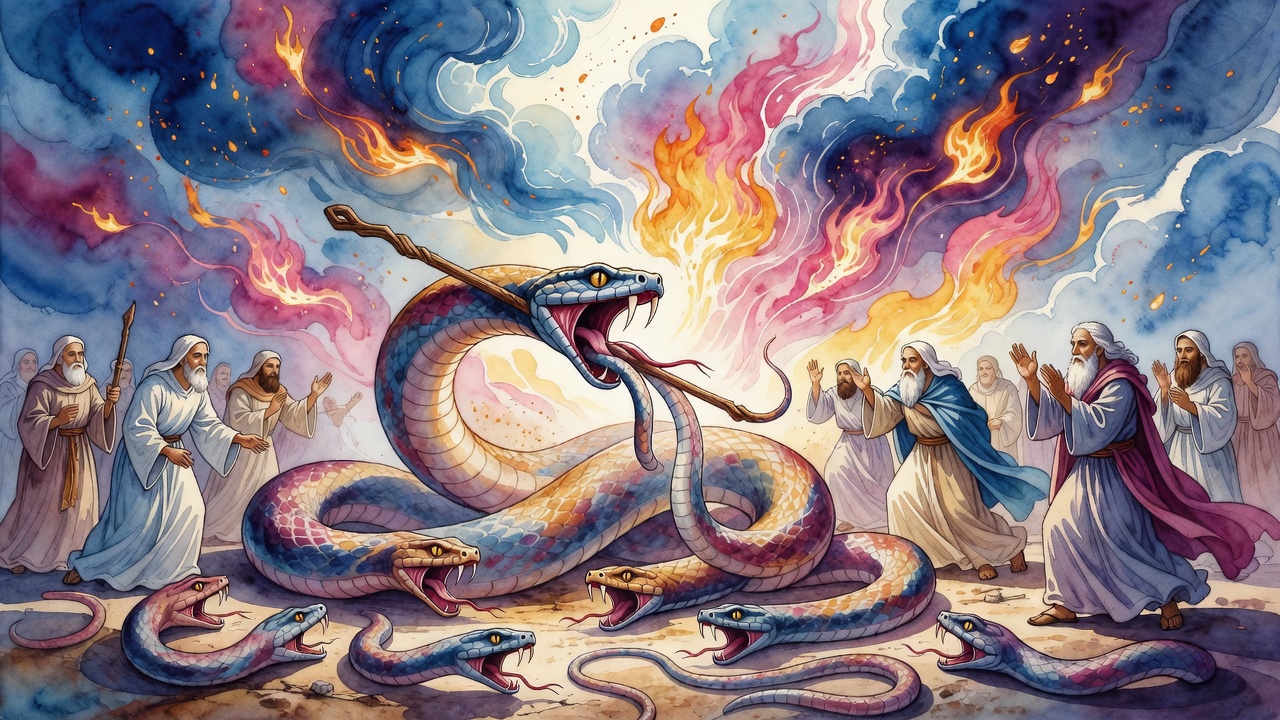
Aaron threw his staff on the floor before Pharaoh and it became a serpent. Pharaoh summoned his magicians, who threw their staffs on the floor and they also became serpents. Then Aaron's serpent swallowed all the magicians' serpents and Aaron's staff returned to being a staff. Pharaoh's heart hardened and he did not let the people go. The Torah moves through this in eight verses. Shemot Rabbah, the midrashic collection on Exodus compiled in the Land of Israel around the ninth to tenth century CE, is not satisfied with eight verses. The rabbis who compiled it asked a question that changes the reading of the entire scene: what actually happened here, and why did it matter?
The first answer seemed obvious. Aaron's serpent beat the Egyptians' serpents. But the rabbis pressed harder. If both sides could produce serpents from sticks, the contest had only demonstrated parity. It had not demonstrated superiority. The swallowing was the point, they said, but not the swallowing of serpent by serpent. That any larger serpent might do. What Shemot Rabbah focuses on is what happened after the serpents swallowed each other: the sticks returned to being sticks, and Aaron's stick swallowed the other sticks. Wood consumed wood. A dead thing consumed other dead things. That was the miracle.
Dead Things That Came Before God and Left With Life
The theological claim Shemot Rabbah makes is precise. When the inanimate object Aaron carried was brought before God and used in God's service, it received a kind of life that the magicians' objects could not match, because the magicians' objects had not been brought before God. The staff of Aaron was wood. The staffs of the Egyptian magicians were also wood. What distinguished them was not material but relationship. Aaron's staff had been placed in the service of the divine mission. It had been before God. Dead things that come before God leave imbued with life, the Midrash says, and the proof is that dead wood consumed other dead wood and the consuming was not destructive magic. It was life outpacing the absence of life.
This reading transforms the contest in Pharaoh's court from a magic competition into a demonstration of a theological principle. Pharaoh's magicians were not frauds. Their serpents were real. Their sticks had genuinely transformed. But the power they were drawing on was human expertise in manipulation, the ability to produce effects through technique. What Aaron was drawing on was something that had passed through the divine presence and come back changed. The competition was real. The result was predetermined by the nature of what was being compared.
The Rod That Bloomed Overnight
Aaron's staff appeared again during Korah's rebellion. Twelve staffs were placed in the Tent of Meeting, one for each tribe, with the tribal leader's name on his staff. The one that bloomed overnight would be the one God had chosen for the priesthood. Aaron's staff bloomed, produced buds, blossomed flowers, and bore ripe almonds, all in a single night, while dry wood sat unchanged around it. The staff that had consumed dead wood in Pharaoh's court now produced living fruit in the sanctuary.
The pattern the tradition establishes across both episodes is consistent. Aaron's rod was not magical in itself. It did not have inherent powers. What it had was a history of being placed before God and used in God's service. That history accumulated. The staff that had been thrown down before Pharaoh and swallowed the competition was the same staff that budded in the Tent of Meeting. Its power was the power of accumulated divine proximity, the record of what it had been used for and in whose presence it had stood.
What the Miracle Was Actually Demonstrating
The contest with the magicians was the opening of the Exodus narrative's argument about the nature of divine power. Every plague that followed was another iteration of the same argument: the forces the Egyptians commanded were real, but they operated at a level that the divine power coming through Moses and Aaron simply exceeded. The magicians could produce lice up to a point and then admitted that the finger of God was in what they were seeing. They reached their ceiling and stopped. Moses and Aaron did not stop because they were not working at the level of technique at all.
Aaron's rod swallowing the magicians' rods is the compressed version of the entire Exodus: something that belongs to God passing through a contest with something that belongs to human expertise, and the outcome never being in doubt, not because the human expertise was fake, but because it was working at a different order of power entirely. Dead wood consuming dead wood was the sign that God had made something out of Aaron's staff that the magicians' staffs had not been and could not become.
← All myths