The Angel of Death Is Covered in Eyes and Carries One Bitter Drop
The scribe opens the ledger at the bedside and counts the days out loud. Nobody has ever won that argument, and only one animal hears the scream.
Table of Contents
 Click for full size
Three of Them Came to the Bed
They arrive together. One to take the soul, one to keep the record, and a third whose whole assignment is to walk with the other two.
"Get up. Your end has come."
The man in the bed knows the answer to that. Everyone does. "I am not getting up. My end has not come."
So the scribe opens the book and starts counting. The years first, then the months inside the years, then the days, out loud, in order, all the way to the one they are standing in. There is no arithmetic in the room to set against it.
Somewhere in the counting the man opens his eyes and looks at who is holding the other end of his life.
Covered From the Soles of His Feet
The thing beside the bed runs from one end of the world to the other.
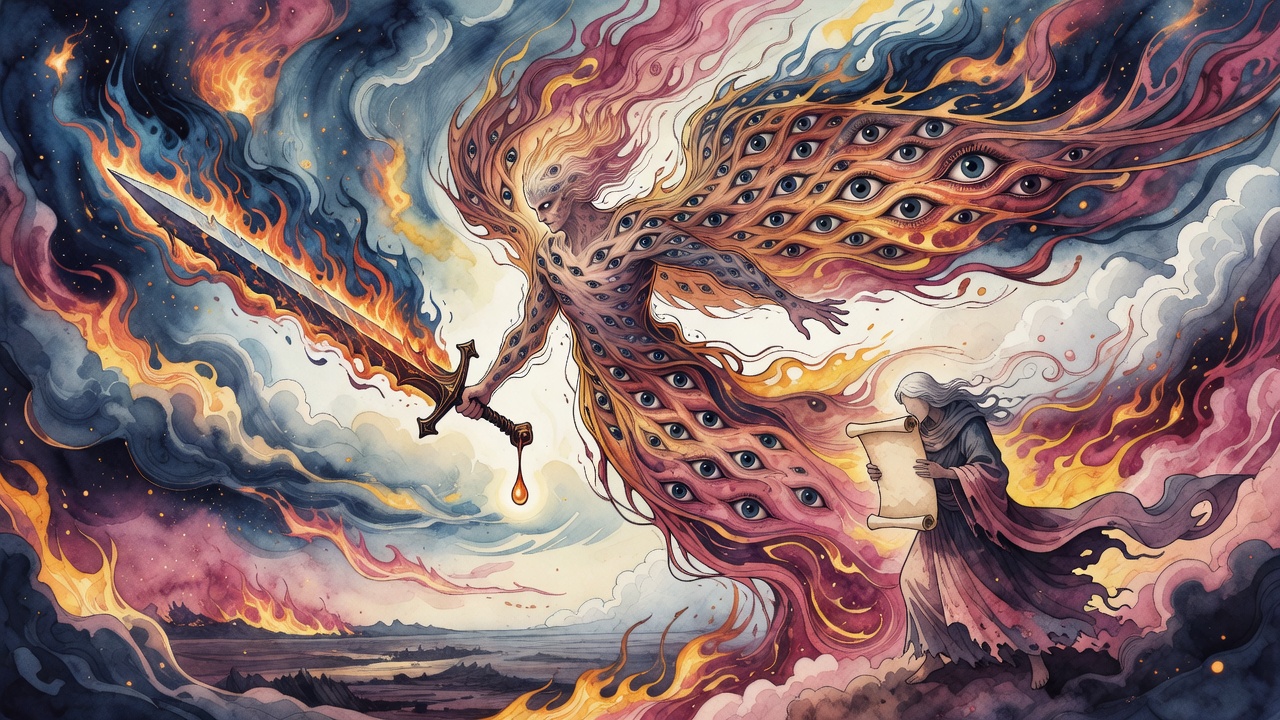
The man shakes so hard the bed shakes with him, and he goes down on his face. When he looks again he sees that from the soles of the feet to the top of the head there is no skin, only eyes, every surface of the body an eye, all of them open. The clothing is fire and the covering under the clothing is fire and there is fire standing around him on every side, and in one hand is a drawn blade, and hanging off the point of the blade is a single drop, bitter, that has not fallen yet.
The angel speaks first, and what he asks is not what a stranger asks.
"Do you recognize me?"
"Yes."
The man has never seen him and knows him anyway, and then comes the only question he has left. "Why today. Why did you not come before."
"To take you out of the world. Your time to leave has arrived."
Then he screams. It is not a sob. It is a sound that goes out to the four corners of the earth and keeps going, and there is not one living creature that hears it except the cock in the yard, who is the only witness the tradition allows him.
Against Your Will You Were Formed
The man argues anyway, the way people argue with a bailiff.
"You took me out of two worlds and you brought me into this one. Now this."
The angel does not soften it. "Did I not tell you that you were formed against your will, and born against your will, and that you would die against your will. And that against your will you would give a full accounting of yourself in front of the Holy One."
Then he tilts the blade. The drop goes into the man's mouth and that is the whole mechanism. The sword does not strike anybody. First the drop kills, then it takes the body apart, then it puts the gray in the face, in that order, and nobody in the world gets out of it any other way. And no one has ever died without seeing God, because the living cannot see Him and the dying can.
His Own Mouth Testifies Against Him
Everything the man has done wrong is cut into his bones. It has been there for years, engraved in him while he walked around, and everything he did right is written on his right hand.
None of it is read out until this hour. Rabbi Joshua ben Levi taught that even a scrap of idle conversation, the sort nobody would call a sin, waits quietly for the day a man dies and then gets mentioned.
What happens next is that the man confesses. Not under pressure. His mouth simply begins listing what he did in the world, all of it, and God writes down what the mouth says.
If the account comes out clean, the soul is handed over to its owner. If the man was thoroughly wicked he does the opposite, stiffens his neck at the end and lets the same drive that ran him all his life run him one last time, and the sages said that is the strangest thing about a wicked death. The evil inclination wins the argument even there.
The escorts differ accordingly. For a righteous man three companies of angels come into the room, and each company has one line to say. The first says that a righteous man has been lost off the earth. The second says let him come in peace and rest on his couch. The third says he goes by the straight road. For a wicked man five angels of destruction come in, and they have one line between them, and it is that the wicked go back to Sheol (the underworld of the dead).
The One Who Made It Cost Something
Moses heard the sentence and did not take it seriously.
His reasoning was sound enough. Israel had sinned in enormous ways and every single time he had asked for mercy on their behalf he had been given it. He had not sinned since he was a boy. If he prayed for himself, surely.
God watched him treat the decree as a matter that could wait and swore by His great name on the spot, and after that there was nothing to pray against.
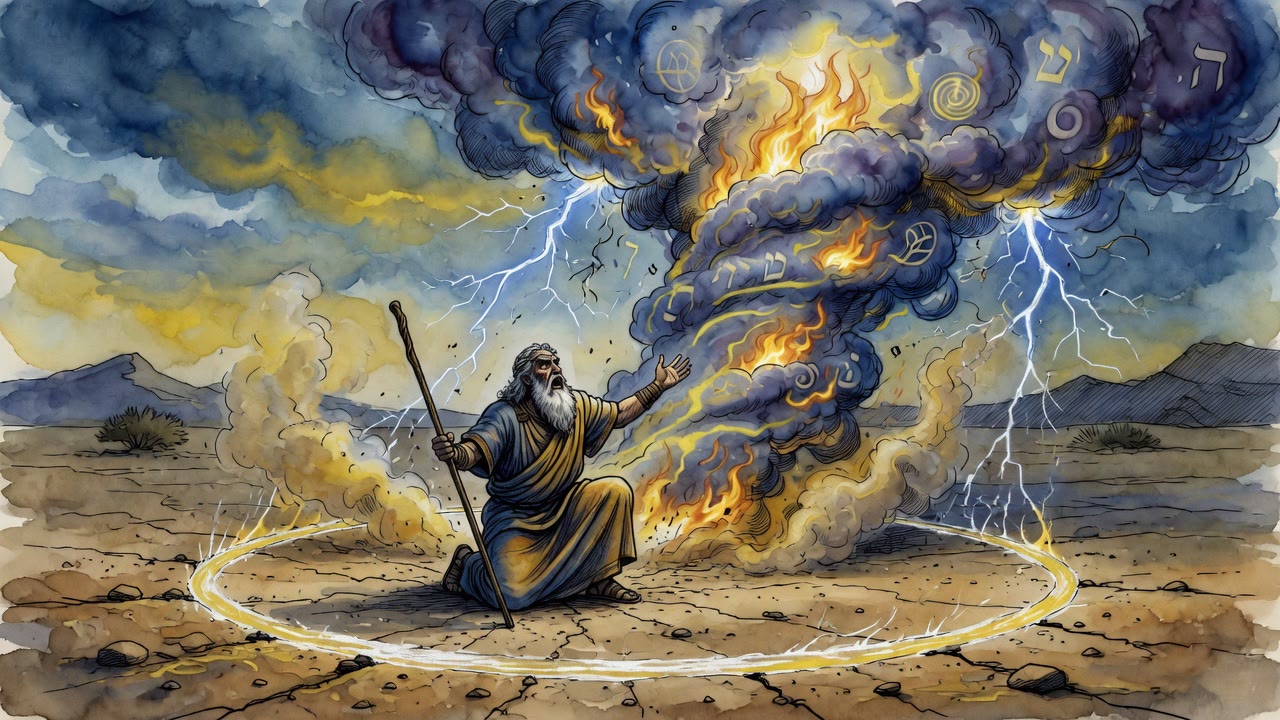
Moses found out too late. He fasted. He drew a circle on the ground and stood inside it. "I am not moving from this spot until that decree is torn up." He put on sackcloth, poured ashes over his head, and prayed until heaven and earth and the whole of creation shifted underfoot and the angels wondered aloud whether God was about to remake the world.
The prayer had an edge on it. He had the Ineffable Name from Zagzagel, who is the scribe of the heavenly host and had been his teacher, and the words went up through the firmaments cutting like a sword and nothing slowed them. So God sent a proclamation to every gate and every door of the Great Tribunal ordering that the prayer not be received, and told the ministering angels to run and shut the gates of heaven for as long as the man kept praying.
The wheels of the chariot and the seraphim of fire watched the gates close on Moses. Then they said the only thing there was to say about it.
"Blessed be the glory of the Lord from His place, who shows no favor to the small or to the great."
The same drop was waiting for him that waits by every other bed.
← All myths