6 min read

The Cherubim and the Turning Sword East of Eden

Two cherubim and a turning sword of fire stand east of Eden. They are not bolting the gate. They are guarding the way to the tree of life.

Curated by Arthur · Told by Maggid ·
Table of Contents
  1. The Word That Sounded Like Divorce
  2. Why a Sealed Door Was Given Sentries
  3. The Keepers He Could Not Name
  4. What the Turning Blade Was For
  5. The Tree He Was Given Instead

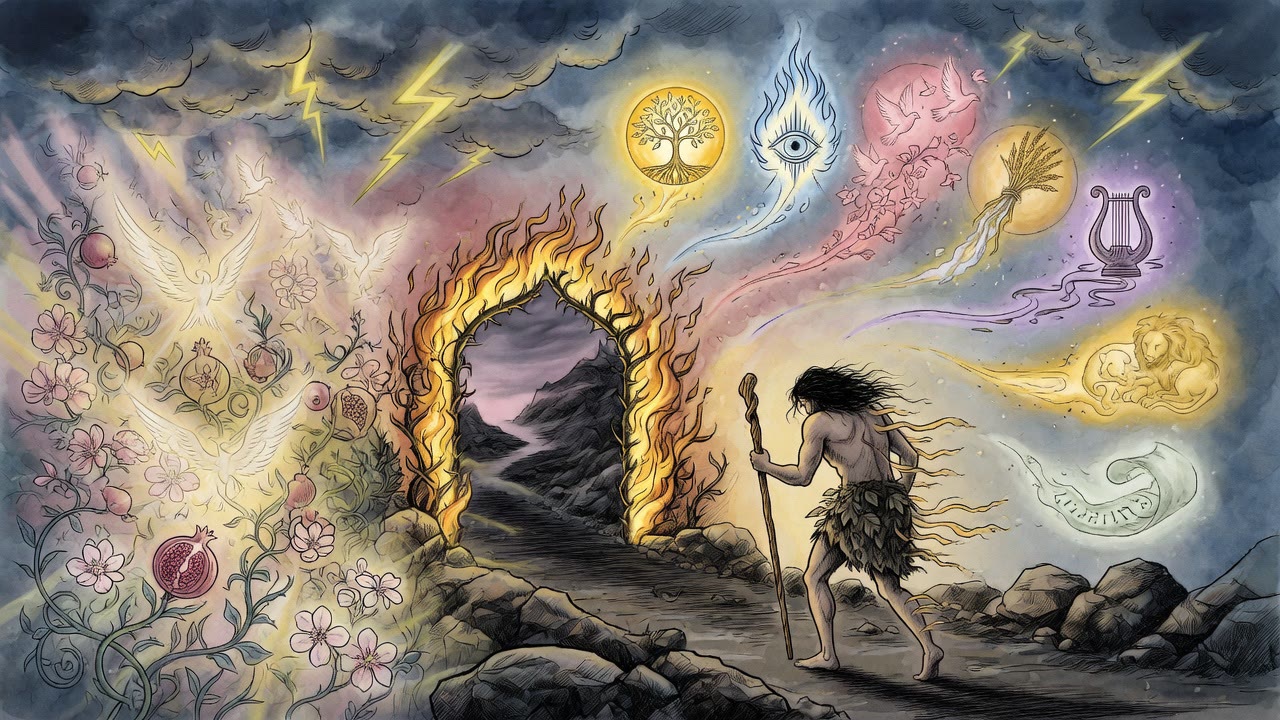
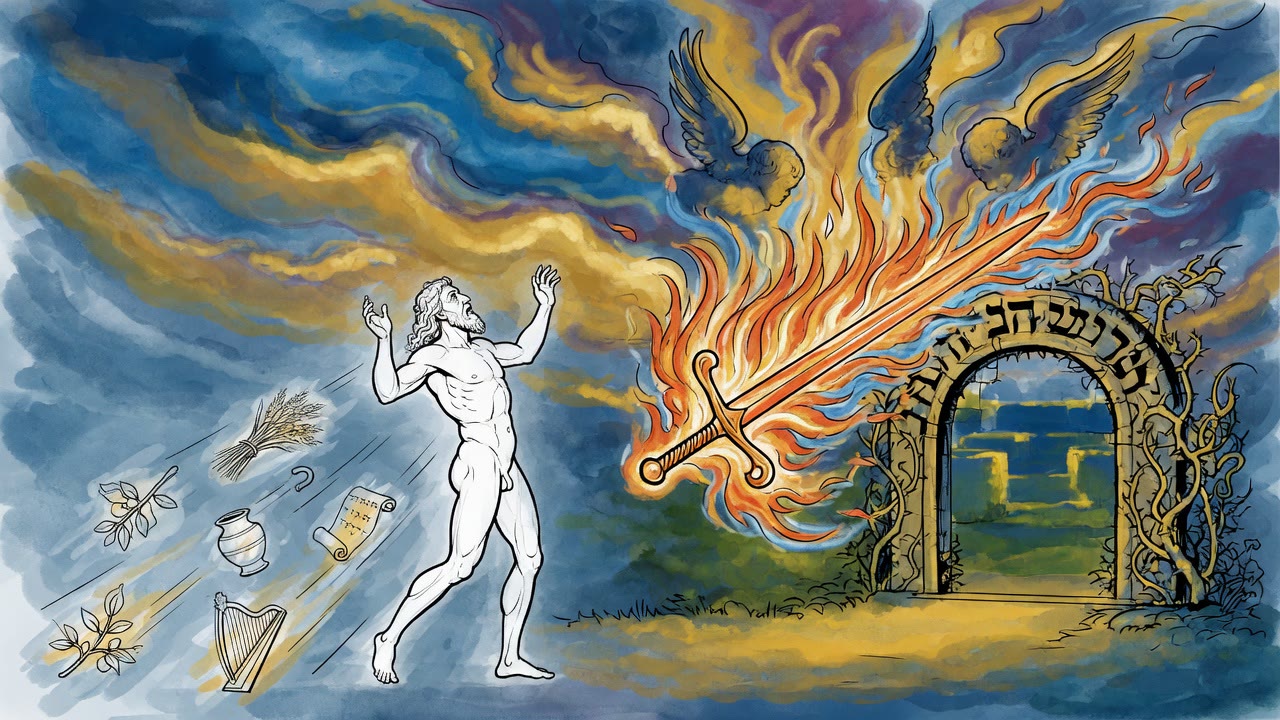
The blade turned in the air without a hand to swing it. Adam stood at the eastern edge of the garden and watched the fire spin, edge over edge over edge, throwing orange across the grass he had named and the trees he had walked beneath that morning while the day was still cool. Behind the fire, two shapes he had no word for. He had named every beast. He had no name for these.
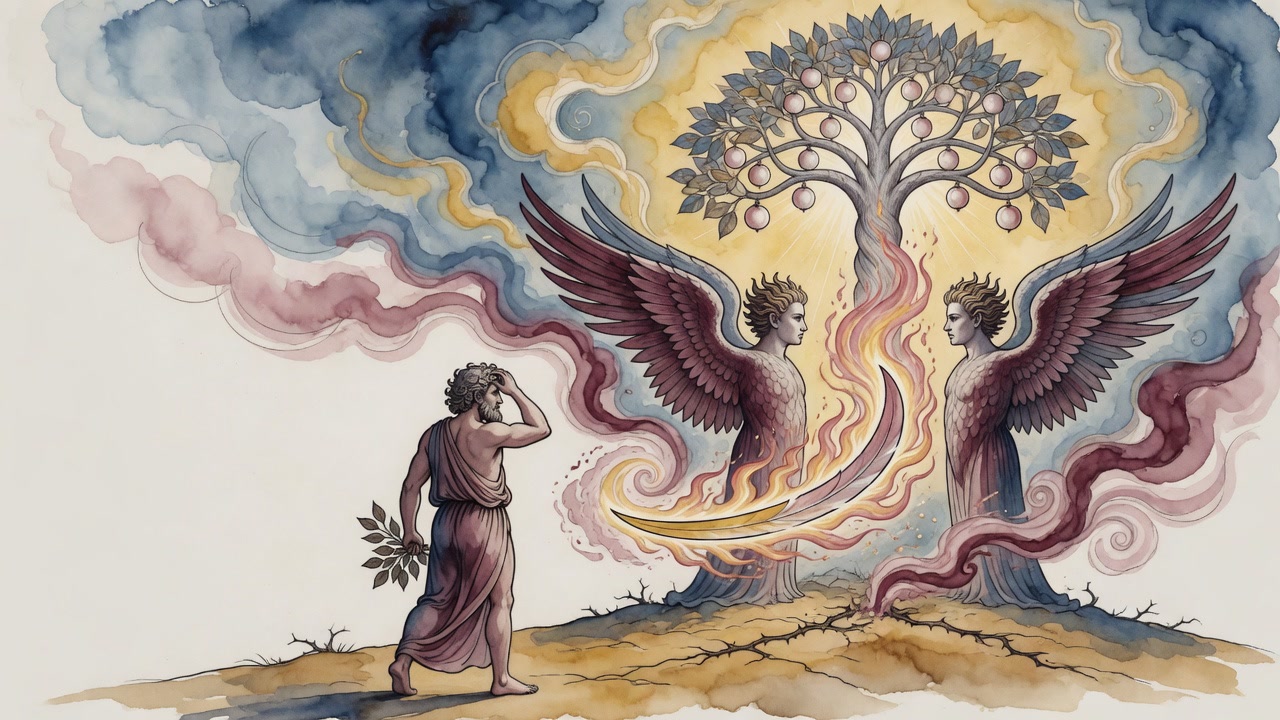
They did not move toward him. They did not move at all, except to breathe, and even their breathing seemed to hold the fire in place. He waited for them to drive him farther. They let him stand.

The Word That Sounded Like Divorce

The thing had been done with a single verb, and the verb had teeth. God drove out the man and placed the cherubim east of the garden of Eden, and the flame of the ever-turning sword, to guard the way to the tree of life (Genesis 3:24).

Drove out. Adam turned the word over and felt how it cut. It was the word a man used when he sent a wife from his house and shut the door so she could never come back. He had eaten, and Eve had eaten, and they had learned what they had not been meant to learn, and now the same breath that once moved through the garden at the breezy time of day had become a separation that ached. This was not a beast wandered off. This was a home broken open, the first one, and he was the one walking out of it.

He expected the door to seal behind him like stone over a tomb. A locked thing needs no watchman. Stone does not require a guard.

Why a Sealed Door Was Given Sentries

And the door was not sealed. Two cherubim stood instead, and the spinning blade, and a guard posted is a strange thing to set on something already shut. Adam looked at it the way a man looks at a fact that refuses to fit. You do not station watchmen over a grave. You station them over something still alive inside, something that might be reached again, someday, by someone permitted to come.

The verse had not said God was guarding the garden. It had said the cherubim guarded the way to the tree of life. Not the orchard. The path. And a path is a thing made to be walked. The fire was not a wall. The fire was a gate left standing, with keepers who held it open and would not let it close.

The Keepers He Could Not Name

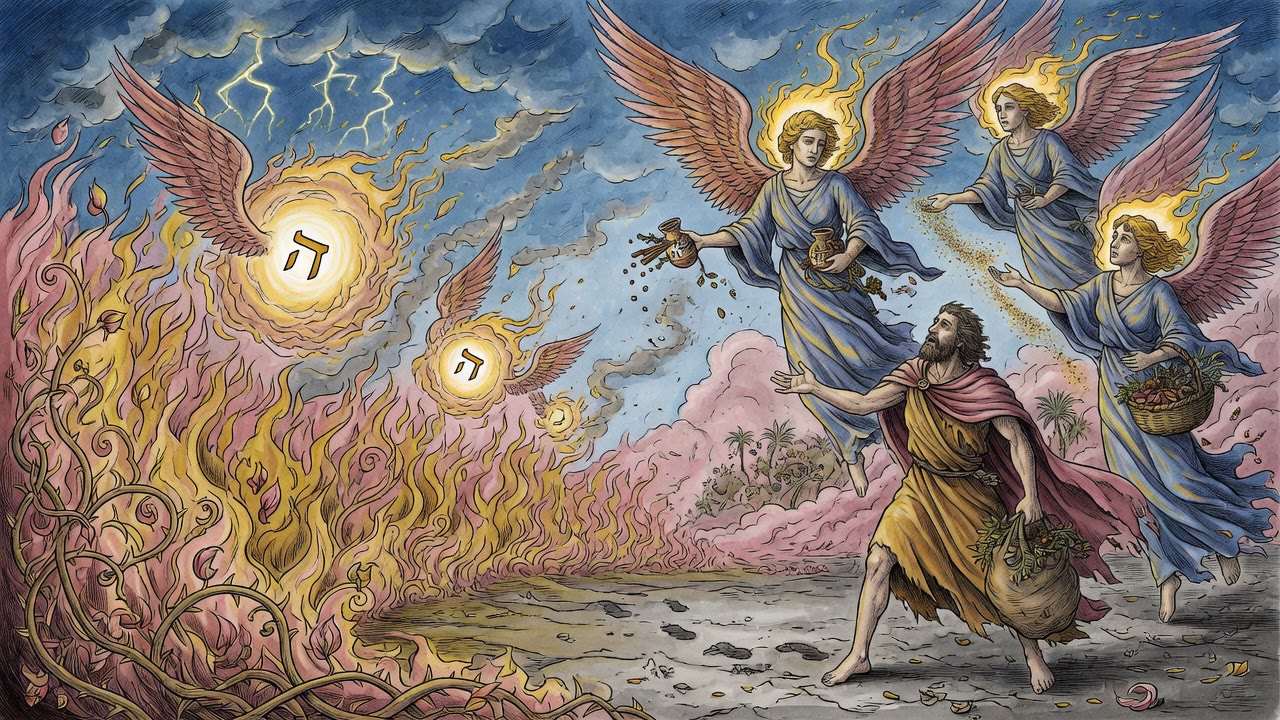
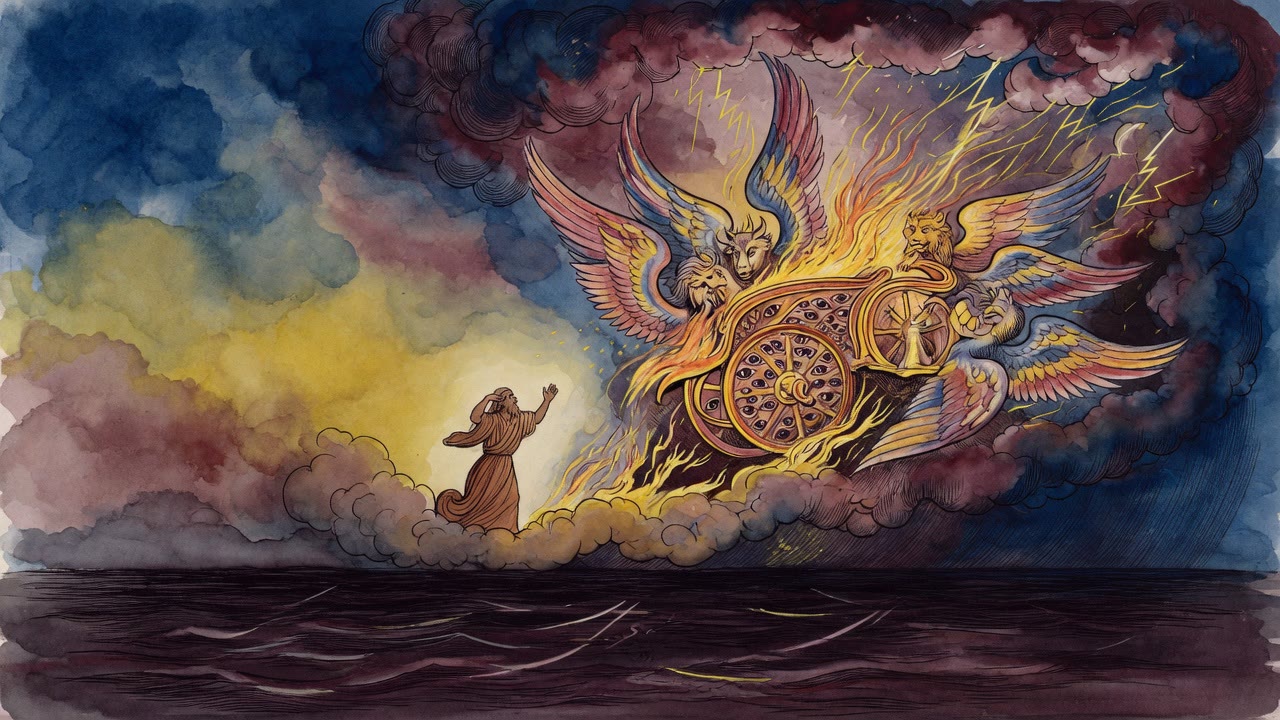
The two shapes were nothing like the soft winged infants that later hands would carve. These were enormous and many, faces turning where he expected one face, wings folding and lifting in an order he could not follow, eyes upon eyes that did not blink and did not look away from him (Ezekiel 1). They could become the sword and the sword could become them. The flame that turned in the air was not separate from the watchers. They shifted as they were needed, fire when fire was needed, form when form was needed, and the boundary between guardian and blade dissolved while he stared.

He understood, watching them, that they were older than the grass under his feet, older than the garden, set in their place before the world had finished being made. They had not been summoned for him. They had been waiting.

What the Turning Blade Was For

The sword was not a random terror swung to frighten him off. The fire in it was the fire of consequence, the burning that waits for anyone who tries to walk back into holiness without first repairing what he broke. A man could not simply stride back to the tree because he wished to. He would have to become someone who could pass the flame.

And the way through had a name. The cherubim guarded the way, and the way was derech eretz, ordinary human decency, the plain conduct of one creature toward another. Before the tree, character. Before any reaching toward what was holy, the small daily kindness that costs everything and looks like nothing. Adam heard the order in it and could not argue. The blade turned. It would keep turning until he was fit to walk beneath it.

The Tree He Was Given Instead

He was not sent into nothing. He was settled to the east, near enough to the garden that he could feel it at his back, close to the source he had lost and not severed from it. And the immortality he had forfeited was not simply taken with nothing put in its place. In the tree's stead he was given the Torah, which is itself a tree of life to those who lay hold of it (Proverbs 3:18), a thing he could hold in his hands and his conduct rather than reach through fire.

Inside, beyond the watchers, the tree of life still stood and still gave off its fragrance, a scent so pure it filled the whole garden and fed the righteous who would one day dwell there, nourishment carried on the air. As the fragrance spread, the leaves of the tree shouted for joy and the garden rejoiced in the presence that walked through it at the cool of the day.

Adam turned east. The fire kept turning behind him, edge over edge, a gate held open by keepers who would not let it shut. The way to the tree of life was guarded. Guarded, he understood at last, is not the same as closed.


← All myths
From the tradition

Sources

4 sources

The texts this telling draws on, in full. Open a card to read inline, or expand it for a wider, quieter read.

Bereshit Rabbah 21:8Bereshit Rabbah

The familiar story is this: they ate the forbidden fruit, gained knowledge, and were banished. But what was the nature of that banishment? Was it a final, crushing blow, or something…else?

Bereshit Rabbah, that magnificent collection of rabbinic interpretations on the Book of Genesis, explores this very question. It all hinges on one little word in the verse: "He banished" (vaygaresh).

The text quotes (Genesis 3:24): "He banished the man; He stationed the cherubs east of the Garden of Eden, and the flame of the ever-turning sword, to guard the path of the tree of life.” Then it immediately dives into a debate between Rabbi Yoḥanan and Reish Lakish.

Rabbi Yoḥanan sees the banishment as utterly final. He compares Adam to the daughter of a priest (kohen) who marries another priest, then gets divorced (nitgarsha). She can never return to her husband, because Jewish law prohibits a priest from marrying a divorcee. Ouch. For Rabbi Yoḥanan, God dealt with Adam harshly.

But Reish Lakish offers a more… hopeful perspective. He compares Adam to the daughter of an Israelite who gets divorced. She can remarry her husband, if they both choose. In this view, God’s banishment wasn’t necessarily permanent. There's a glimmer of possibility, a chance for reconciliation. According to Reish Lakish, God was actually showing mercy.

Which interpretation resonates more with you? A door slammed shut forever, or a door left slightly ajar?

But the Rabbis weren’t done yet. Bereshit Rabbah offers another interpretation, linking Adam's expulsion to the destruction of the Temple in Jerusalem. The text connects "He banished" (vaygaresh) to a similar-sounding word in (Lamentations 3:16): "He has ground (vayagres) my teeth with gravel." This is powerful stuff, suggesting that Adam’s punishment foreshadowed immense future suffering for his descendants.

Rabbi Luleyani bar Tavri, quoting Rabbi Yitzḥak, adds another layer. He says that Adam wasn’t just cast out into nothingness. He was banished to an empty field (migrash) adjacent to Eden. And God posted guards there, to keep him from returning. Rabbi Luleyani connects this to (Isaiah 5:6), which speaks of God commanding the clouds not to rain on a derelict vineyard. The vineyard is a metaphor for Israel, and the lack of rain symbolizes God’s disappointment. It all circles back to that initial disappointment with Adam, and the need for constant vigilance to prevent him from regaining paradise.

So, what are we left with? A complex, many-sided picture of Adam's banishment. Was it merciful? Harsh? A foreshadowing of future tragedy? Maybe it was all of those things at once. The beauty of these ancient texts is that they invite us to confront these questions, to find our own meaning within the stories. They remind us that even in moments of apparent finality, there might still be a seed of hope, a whisper of possibility, just beyond the ever-turning sword.

Full source
Legends of the Jews 2:71Legends of the Jews

God didn't just leave the entrance to Paradise unguarded. Instead, He appointed the cherubim, those powerful, almost indescribable angelic beings, to stand watch. But they weren't alone. They were also called the "ever-turning sword of flames," a pretty intimidating image. This, we learn, is because angels, as the tradition tells us, are able to shift their forms as needed (Ginzberg, Legends of the Jews).

What about the Tree of Life? Did Adam just lose access to immortality forever? Well, instead of the physical tree, God gave Adam something else: the Torah. The Torah, Jewish tradition teaches, is itself a "tree of life to them that lay hold upon her." So, Adam was allowed to settle near Paradise, specifically to the east, where he could, in a way, still be close to that original source of life.

Then came the moment of expulsion. After the sentences were pronounced upon Adam, Eve, and the serpent, God commanded the angels to banish the first couple from Paradise. Can you imagine the scene? Adam and Eve, overcome with grief, weeping and begging for mercy.

Here's where the story takes a fascinating turn. The angels, witnessing their despair, felt pity. They hesitated. They couldn't bring themselves to immediately carry out God's command. Instead, they decided to do something… risky. They delayed. They hoped to petition God, to plead for a more lenient judgment. Imagine the audacity!

But God was resolute. "Was it I that committed a trespass, or did I pronounce a false judgment?" He wouldn't budge. As we find in Midrash Rabbah, God's justice had to be served. Adam's plea for the fruit of the Tree of Life was also denied.

However. And this is crucial, it wasn't a complete and utter rejection. God promised Adam that if he lived a pious life, he would be given the fruit on the day of resurrection, and he would then live forever.

So, what does this all mean? It's a complex picture. There's justice, yes, and consequences for actions. But there's also compassion, even from the angels. And, perhaps most importantly, there's a promise of redemption, a future opportunity to partake in the Tree of Life, reminding us that even after mistakes, hope remains.

Full source
Tanna DeBei Eliyahu Rabbah 1:1Tanna DeBei Eliyahu Rabbah

"And He drove out the man" (Genesis 3:24). This teaches that the Holy One, blessed be He, gave him a divorce like a wife. "And He placed at the east of the garden of Eden the cherubim" (Genesis 3:24). This teaches that the cherubim preceded all the work of creation. "And the flame of the ever-turning sword" (Genesis 3:24), this is Gehinnom. "To guard the way" (Genesis 3:24), this is proper worldly conduct. "The tree of life" (Genesis 3:24). This teaches that proper worldly conduct preceded the tree of life. And "the tree of life" means only Torah, as it is said, "It is a tree of life to those who hold fast to it" (Proverbs 3:18).

Full source
Zohar 1:27aZohar

It's not alone, of course. Nearby, almost like a tempting whisper, is the Etz haDa'at (Knowledge) Tov v'Ra, the Tree of the Knowledge of Good and Evil.

God Himself walks in the garden, joined by the righteous. As (Genesis 3:8) puts it, "They heard the sound of the Lord God moving about in the garden at the breezy time of day." Can you feel the cool breeze?

Then… the fragrance.

The Zohar, that foundational text of Jewish mysticism, hints at the Tree of Life's incredible power. This isn't just any tree. It exudes a fragrance so potent, so pure, that it fills the entire Garden. It's more than just a pleasant smell; it sustains the righteous souls who dwell there. It's their very nourishment. A fragrance that nourishes. It's a beautiful, almost unbelievable image.

As this life-giving scent spreads, something amazing happens: the leaves of the Tree of Life "shout for joy." According to Elliot Ginsburg's Legends of the Jews, the entire garden rejoices in God's presence.

It's a scene of pure harmony and delight. A place where the divine presence is palpable, where even the leaves participate in the eternal song of praise.

What does this tell us? Perhaps it's a reminder that life, in its purest form, is meant to be fragrant, joyful, and sustaining. That even in the face of temptation, represented by the Tree of Knowledge, the true path lies in seeking the nourishment of the Tree of Life. And maybe, just maybe, a little bit of that fragrance can be found even here, in our own world, if we know where to look.

Full source