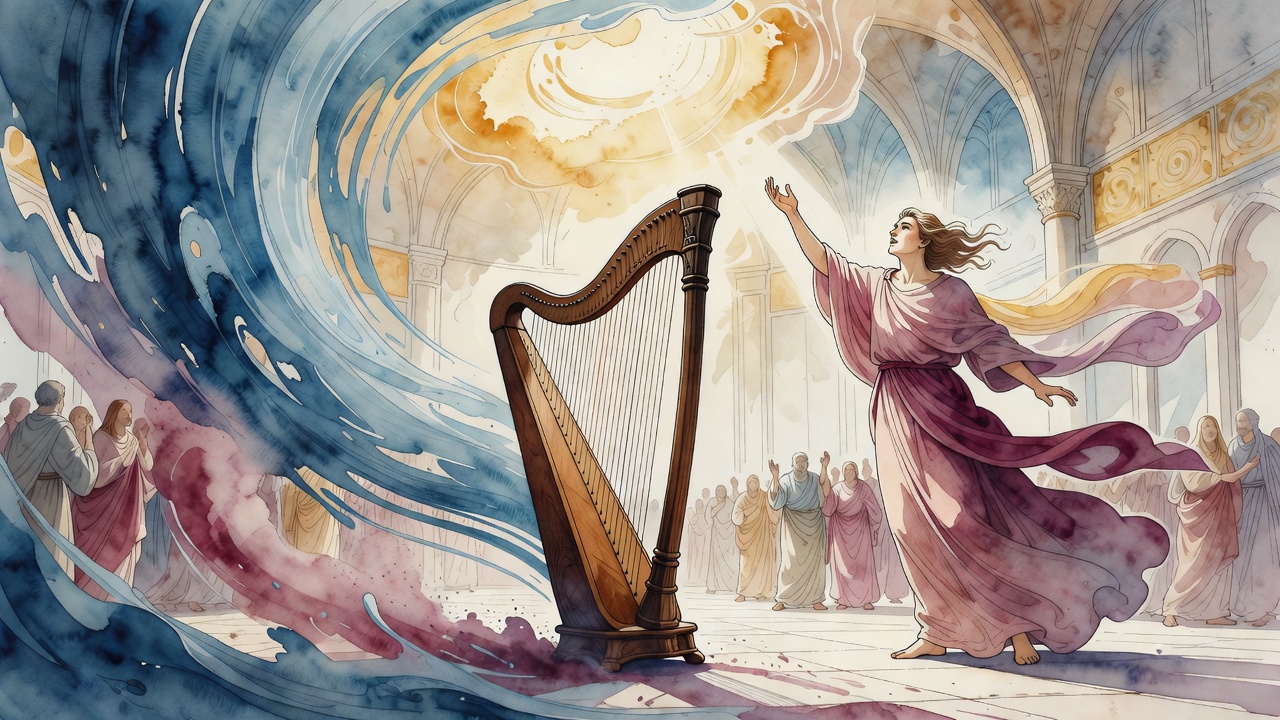
David Built a Harp Out of the Architecture of Heaven
Saul held the spear across his knees and would not sit still. David set the harp down and counted the fourteen bones in his own hand.
Table of Contents
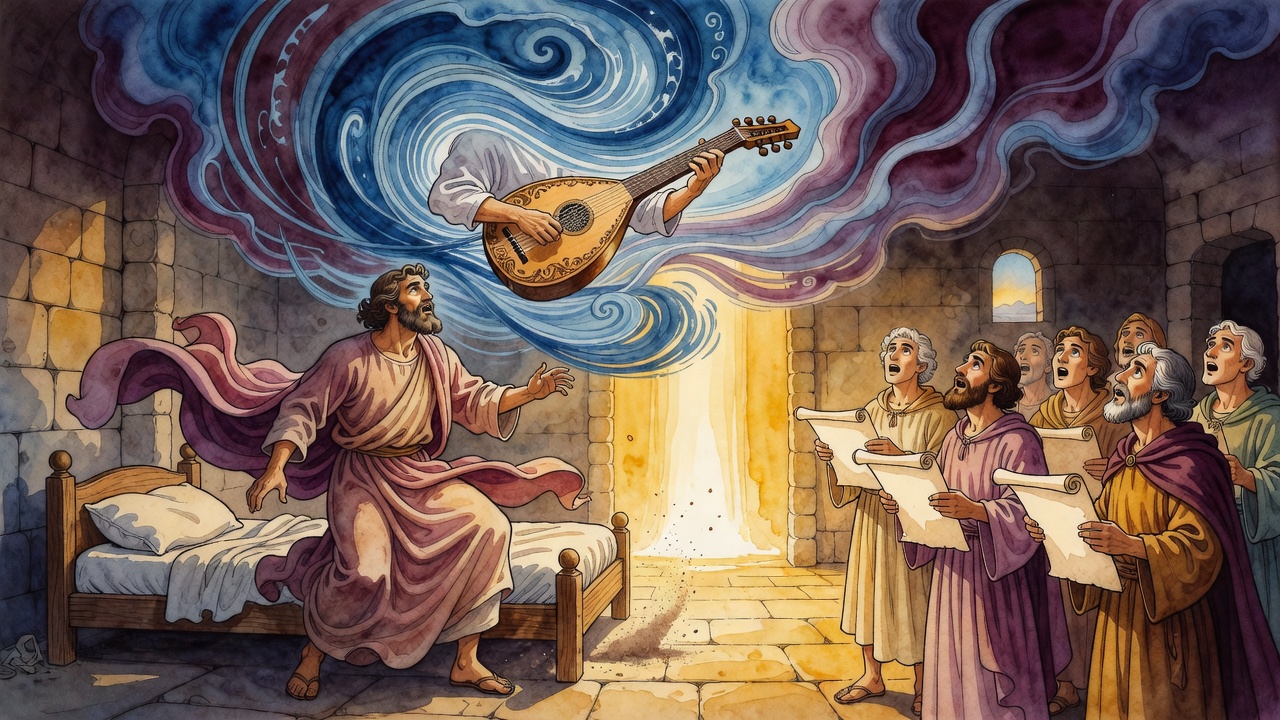
Saul would not sit still. The spear lay across his knees. The servants had learned which of his moods ended with that spear in the wall, so they sent for the boy from Bethlehem and stepped back from the chair.
 Click for full size
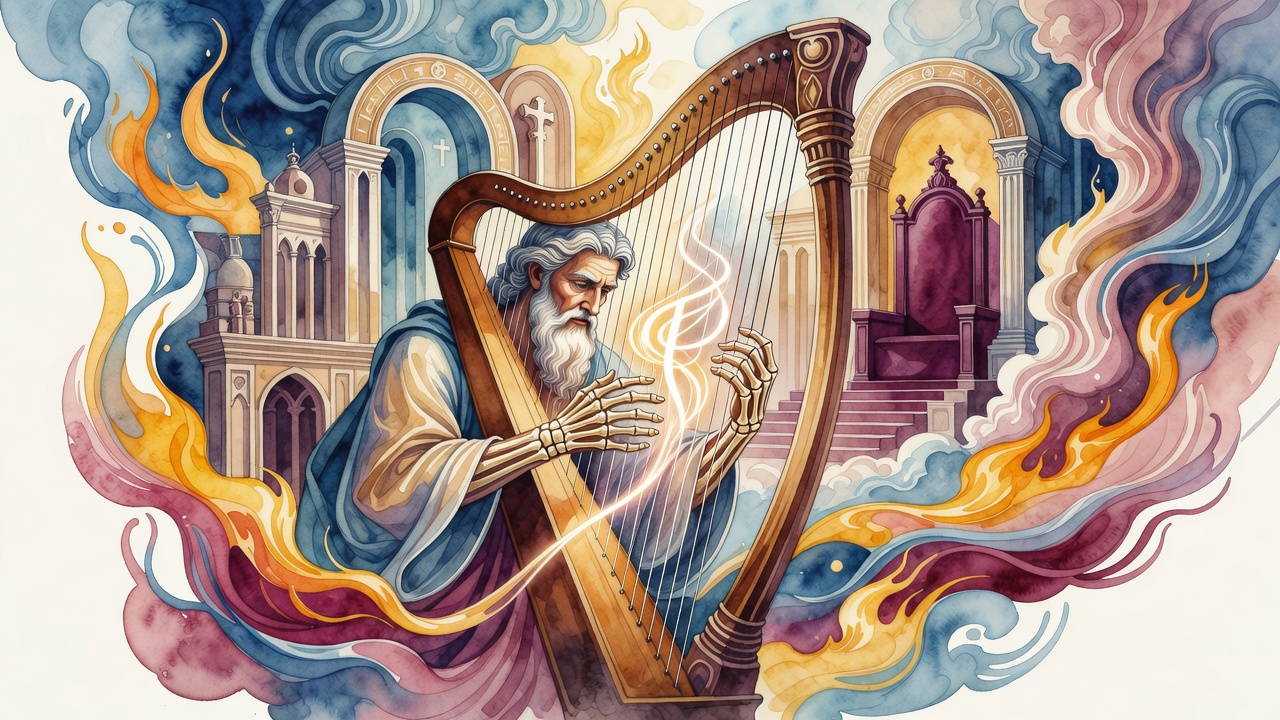
David came in with the harp under his arm. He sat. He did not look at the spear. He set the instrument on his knee and opened his left hand, the one that would work the strings. He looked at it the way a carpenter looks at a tool he already trusts.
The Spear Stayed in Saul's Hand
Fourteen bones. He had counted them in the field, when the only listener was a sheep. Wrist to fingertip, the same count every time. He closed the hand around the neck of the harp and began to play.
The darkness in Saul thinned when a string sounded. It pooled when the court went quiet. David played until the king's shoulders dropped and the spear stayed where it was. Nobody in that room threw a weapon. The court called it talent. David kept working.
A servant by the door let out a breath he had been holding since morning. Saul's eyes were still open, but they were no longer hunting the room.
Fourteen Bones, Fourteen Letters
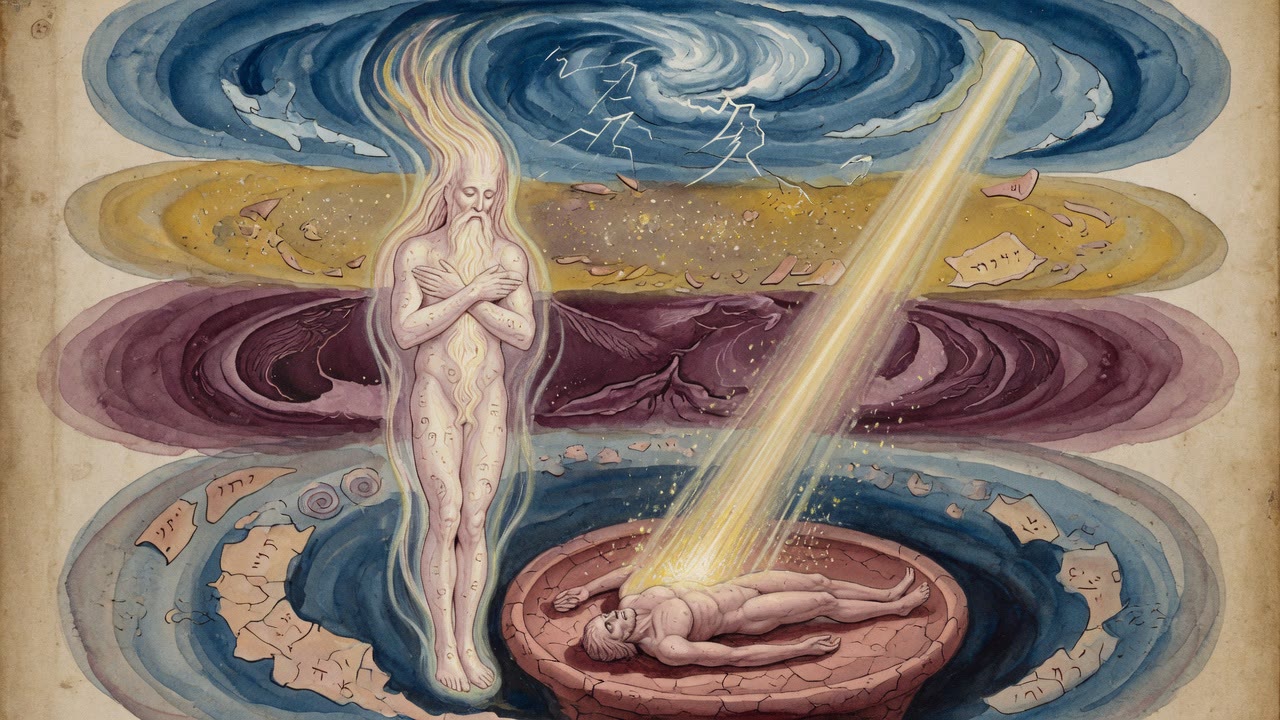
A prophet had seen a golden lamp fed by olive trees through seven pipes and seven more (Zechariah 4:2). Seven and seven is fourteen. Fourteen in Hebrew is yad (יד), hand. The four-letter Name, written out letter by letter, is fourteen letters too.
David did not recite that arithmetic in the throne room. He felt it in the joints. The hand on the harp was already a copy of the Name. Playing by hand was playing with the Name. He pressed a thumb to a string and felt the bone under the pad. The lamp in the vision had pipes. His hand had joints. The music ran through both.
He shifted the harp and the fourteen bones stacked again, wrist to fingertip, as if the Name had sat down in his palm and agreed to be used.
He Aimed Every Note at This
A harp without a target is only noise. David had a word for the place he aimed. Zot (זאת). This.
He had already written it into a psalm. If a camp encamped against him, in this he would trust (Psalm 27:3). Upon this every pious one should pray, at the time of finding (Psalm 32:6). Not wisdom. Not long life. This. The grounded point where heaven touches what a man can see.
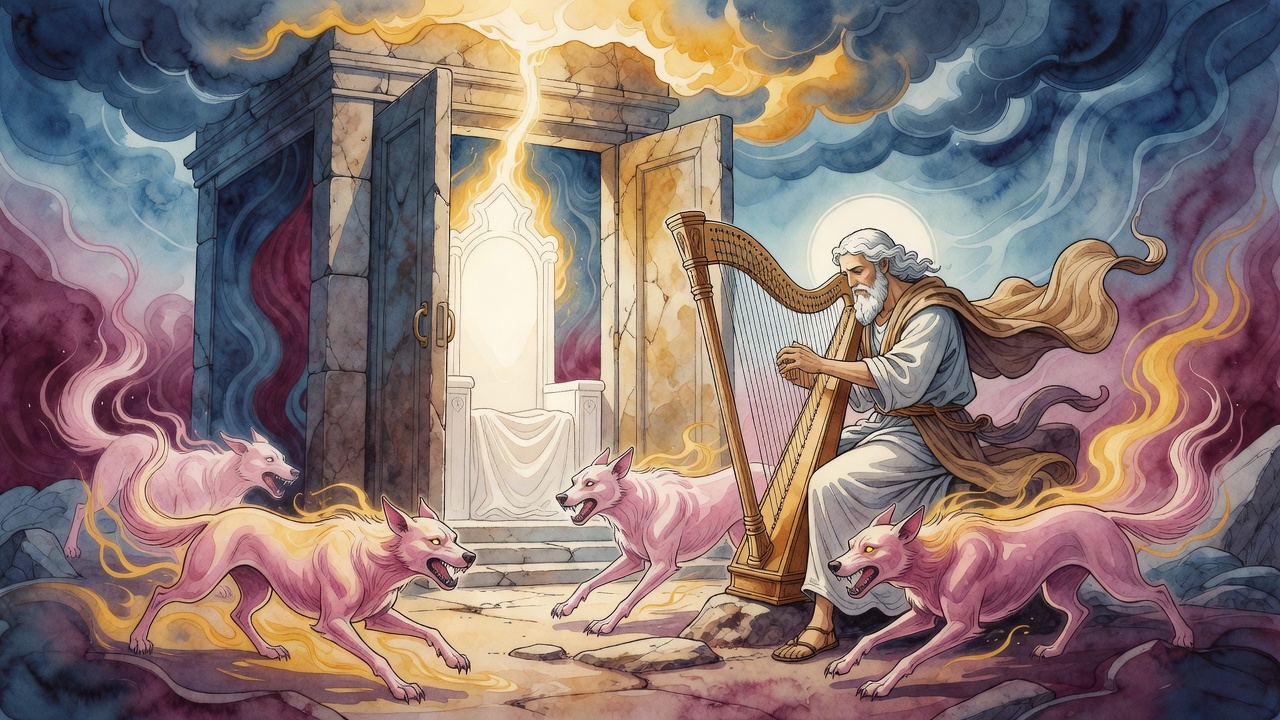
When he sat before Saul, or before the Ark, or alone at night with a wick and a string, he pointed the music at that one place. The fingers did the rest. A wrong aim would have been a pretty sound in a room that stayed dark.
Saul's jaw loosened. David did not change the target. He kept pointing at this.
Seven Strings and One He Could Not Touch
The harp in his lap had seven strings. He knew an eighth was there, one step past the last note he was allowed to play. Seven is this world. Six days and a Sabbath. Eight is the next cycle, the age that has not arrived, pressing against the edge of the one he lived in.
He did not force the eighth string. He left it. The harp that will sound when the dead rise will have eight, and that instrument is not a king's toy in a sick room. Every psalm he made on seven strings was also a drawing for that later music, the way a man draws a house the city has not yet agreed to build.
Saul's breathing slowed. David kept to the seven. His left hand still knew the count. Fourteen. He did not reach for what was not his hour.
The Letters Woke in the Room
Seventy-two letters sleep in three verses that tell how the sea was crossed (Exodus 14:19-21). A man reading those verses aloud does not see them. They sit in the lines the way a tone sits in a room even when no one is listening for it.
When David played, those letters moved. Not carved on the wood. Not spoken aloud. Woken by the playing, the way a struck fork wakes every nearby cup that shares its pitch. Saul's darkness lifted because seventy-two channels opened in that throne room for a few breaths, and the darkness had nowhere left to pool.
The spear stayed on the king's knees. David closed his hand. Fourteen bones. Fourteen letters. He had not built the harp out of wood alone. He had built it out of the architecture of heaven, and then he had sat down in a dangerous room and used it.
← All myths