Elijah Offered Three Brothers a Choice in Their Father's Garden
Two of them named what they wanted and had it before morning. The third asked for a beautiful wife, and Elijah made him walk three nights for her.
Table of Contents
 Click for full size
The Spice Garden and the Night Watch
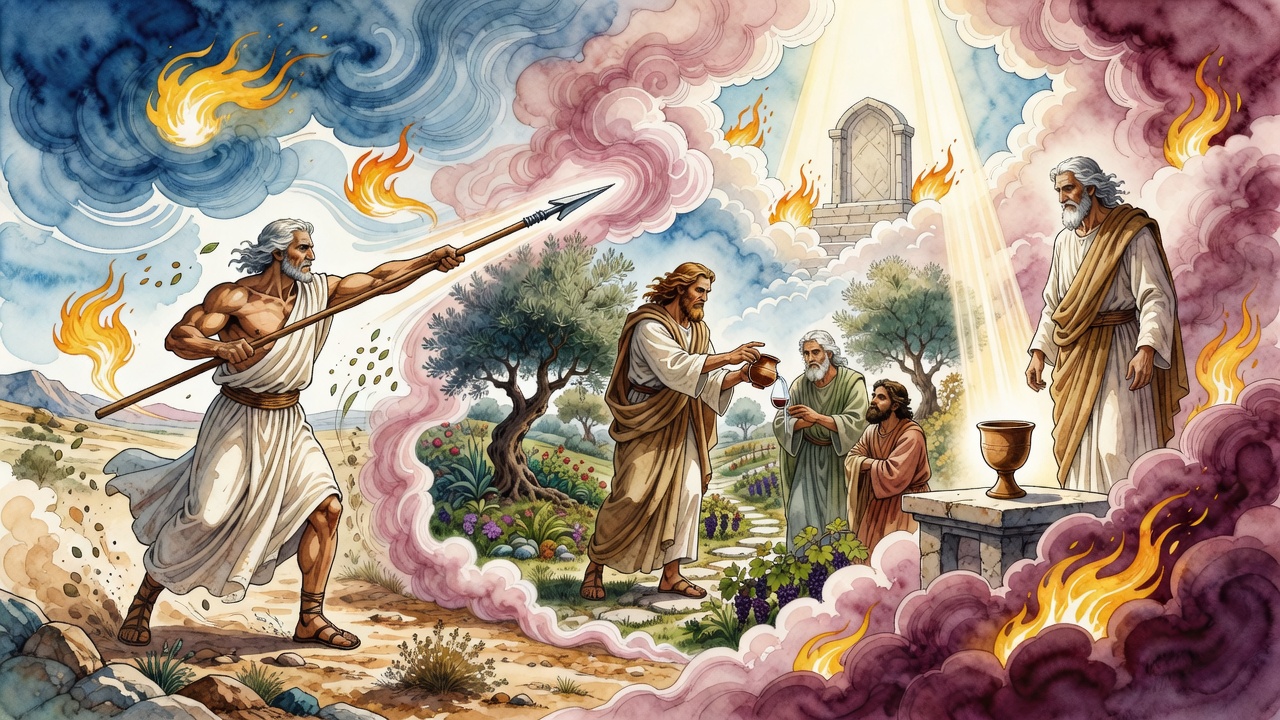
A pious man died and left his three sons a garden of spices. It was worth stealing from, so the brothers split the nights between them, one man awake in the rows while the other two slept.
The eldest took the first watch. Somewhere in the dark, between the beds of cinnamon and whatever else was growing, a stranger was standing in the garden with him.
"My son," said Elijah. "What will you have? Knowledge of Torah, or great wealth, or a beautiful wife?"
The Coin and the Book
The eldest did not need long. Wealth, he said. Great wealth.
Elijah gave him a coin, one coin, and left. By morning the man was rich, and nobody in the family could account for how.
The second brother took the second night, and the same figure came out of the same dark with the same three-part question. That one asked for Torah. Elijah handed him a book, and he knew the whole of it, all at once, the way a man knows his own hands.
The third brother stood his watch on the third night knowing exactly what was coming and having already decided. When the question came he said he wanted a beautiful wife.
Elijah did not give him anything. He told him to come along.
What the Geese Said in the Villain's Yard
They walked. The first night they took lodging in the house of a man with a reputation, a genuine criminal, well known in the district, and the man had a daughter.
The young man slept. Elijah did not. Out in the yard the chickens and the geese were talking to each other, the way they do when a prophet is listening.
"What terrible thing must that young man have done," one of them said, "that he should be destined to marry the daughter of a villain like this?"
In the morning they moved on. The third brother knew nothing about the poultry. The second night was the first night again: another house, another notorious man, another daughter, another verdict delivered in the dark by birds who had no idea they were deciding a life.
The Third House
On the third night they stopped at the house of an ordinary man who had a very pretty daughter.
Elijah lay awake again, waiting to hear the same sentence a third time, and what came through the window was the opposite one.
"How great this young man's merits must be, that he should be privileged to marry a wife so beautiful and so pious."
Elijah got up in the morning and turned matchmaker on the spot. He spoke to the father, he spoke to the girl, and the marriage was made in that house before the travelers left it. The brother who had asked for a beautiful wife went home along the same road with her beside him, and neither of them ever heard about the two houses they had passed through on the way, or about the sentence that had been hanging over him until the third night talked it down.
What Elijah Still Carries
The eldest got a coin. The second got a book. The third got a wedding.
There are three more things in the prophet's hands, and he has not handed them to anybody yet.
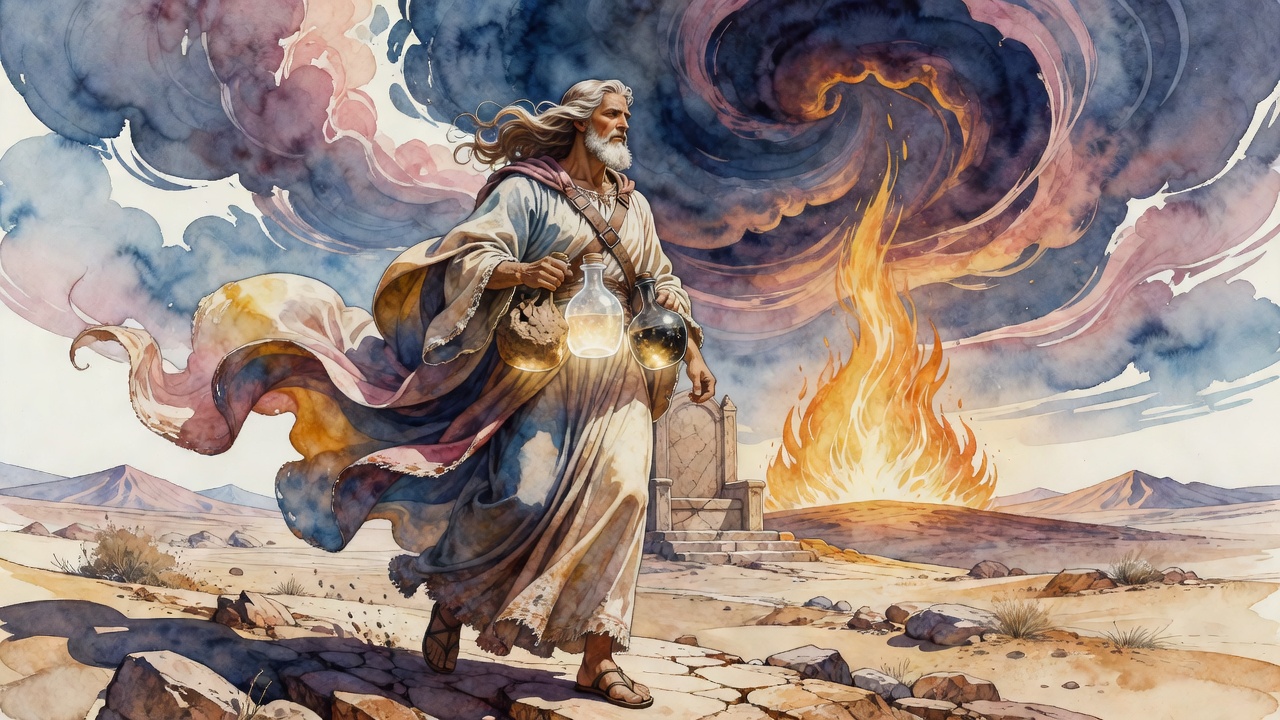
The first is the jar of manna, the one Aaron filled in the wilderness on Moses' instruction and set down in front of the Ark, still holding bread that fell out of the sky for a generation that has been dead for three thousand years.
The second is the flask of the waters of sprinkling, the ash-and-water mixture that lifts the impurity of a corpse off a living person. Without it, a man who has buried his father stays where the burial left him.
The third is the flask of anointing oil, the batch Moses compounded by the formula he was given, the oil that made priests priests and kings kings. Some add a fourth item to the list: the staff of Aaron, still carrying the almonds and the blossoms it grew overnight.
Elijah is to bring all of them out and put them into Israel's hands when he comes. And the Messiah he comes ahead of has seven names in the rabbinic count, one of them Yinnon and one of them Shiloh and one of them David, and the seventh name on the list is Elijah.
← All myths