5 min read

Elisha Saw Metatron Sitting and Lost His Faith

Elisha ben Abuya entered heaven and saw an angel seated on a throne. In heaven, no one sits. His mind drew one conclusion, and it cost him everything.

Curated by Arthur · Told by Maggid ·
Table of Contents
  1. The Angel Who Climbed Higher Than Any Other
  2. Two Powers in Heaven
  3. What the Throne Actually Meant
  4. The Rabbi Who Could Not Come Back

In heaven, nobody sits.

That was the rule. The seraphim stood. The ophanim stood. The four living creatures of Ezekiel's vision stood beneath the wheels and shouted the threefold Holy without ever settling their weight (Isaiah 6:2 and Ezekiel 1:5). Standing was the posture of service. You stand when someone outranks you. You stand when the matter is not yours to settle. The only being in the upper world who had a throne was God, because in the rabbinic imagination sitting is the posture of authority. You sit when no one in the room outranks you. You sit when you are the judge.

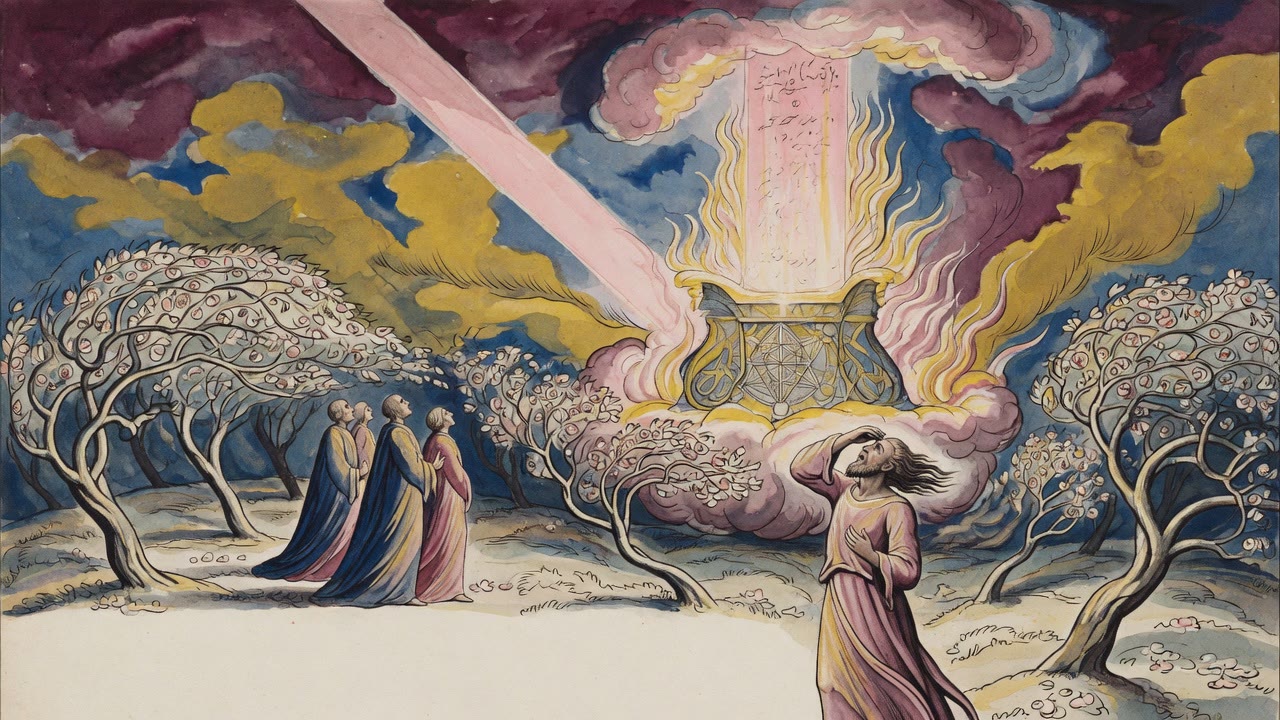
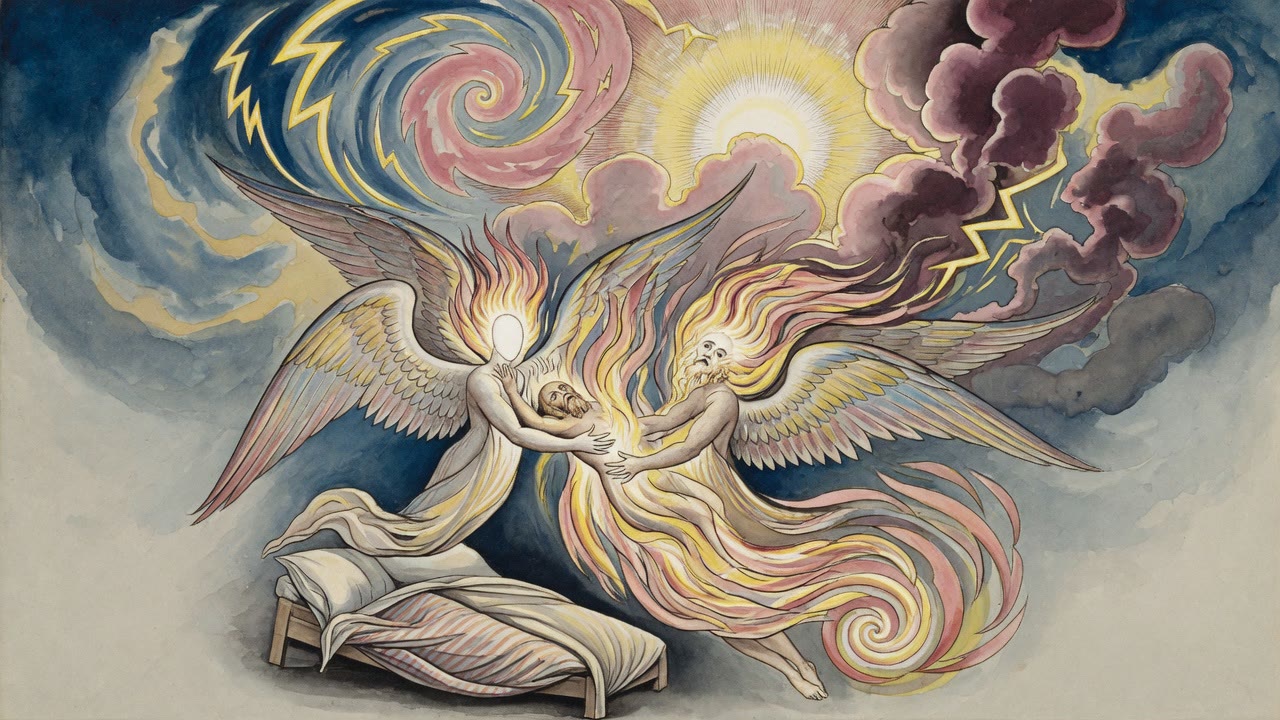
So when a rabbi named Elisha ben Abuya entered the highest chamber of heaven and saw another figure sitting on a throne, his mind cracked down the middle.

The Angel Who Climbed Higher Than Any Other

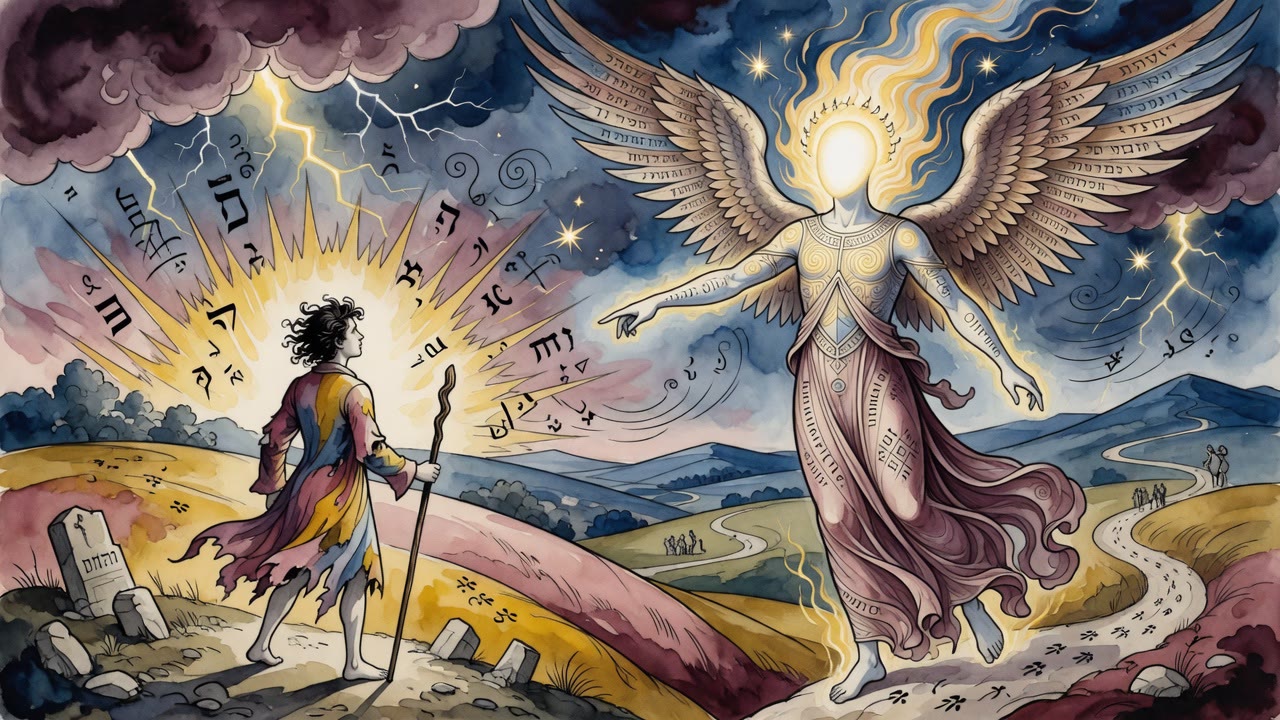
The figure was Metatron.

Metatron was no ordinary angel. The Babylonian Talmud, assembled in sixth-century Babylonia and preserved in Tractate Chagigah 15a, describes him as the heavenly scribe, the recording clerk whose job was to write down the merits of Israel for the final reckoning. He had a name whose letters were a variation on the letters of God's own name. Some mystical traditions gathered in texts like 3 Enoch, also called Sefer Hekhalot, a Hebrew text probably composed between the fifth and seventh centuries CE, went further: Metatron was Enoch, the seventh generation from Adam, who had walked with God and been taken without death (Genesis 5:24), transformed from a human patriarch into the highest of all angels and given a throne beside the divine presence as the lesser prince of the world.

But the Talmud of the Babylonian academies did not present the throne as routine. In Tractate Chagigah 15a, the throne is the problem. Metatron had it. He was sitting. And Elisha ben Abuya saw him sitting, and drew the worst possible conclusion.

Two Powers in Heaven

Elisha said it out loud. The sentence that cost him everything, the sentence that the Talmud records as the reason for his heresy, was this: perhaps there are two powers in heaven.

If an angel can sit like God, perhaps there is a second divine authority. The foundation of Jewish theology, that God alone rules and there is no second sovereign in the universe, seemed to crack before his eyes in the throne room of heaven. He had entered the Pardes, the orchard of mystical inquiry, alongside three other great sages of his generation: Ben Azzai, Ben Zoma, and Rabbi Akiva. The Talmud says that of the four who entered, Ben Azzai looked and died, Ben Zoma looked and was stricken, Elisha ben Abuya looked and cut the shoots, meaning he became a heretic. Only Rabbi Akiva entered and departed in peace.

Elisha's sin was not seeing Metatron seated. The sin was what he concluded from the sight, and the conclusion he drew was unforgivable because it was the exact conclusion that Jewish theology was designed to prevent.

What the Throne Actually Meant

The Talmud immediately offers the correction that Elisha did not wait to hear. God turned to Metatron and said: why did you not rise before him? Why did you let a human being enter heaven and see you seated without standing to honor him? Metatron was punished. He was given sixty lashes of fire, the celestial equivalent of the thirty-nine lashes a human court could administer, and the permission to be seated was rescinded in that moment.

The lashes were not for the throne. Metatron's throne was a gift, a mark of honor that God had granted him for his extraordinary ascent. The lashes were for the failure to rise when a human being walked into the room, which is a different kind of authority. In the Jewish mystical tradition, a human being standing before the divine presence has a claim on angelic deference that runs deeper than rank. Metatron, who had once been human, should have understood this better than any other angel.

But Elisha was already gone. The lashes came too late to change what he had decided.

The Rabbi Who Could Not Come Back

The Talmud calls Elisha ben Abuya by the name Aher, which means the Other. It is the name for a person who has placed themselves outside the community by what they concluded. He continued to study Torah after his break, which is unusual and which the rabbis found troubling. His student, Rabbi Meir, one of the greatest sages of the generation, would not stop learning from him even after the break, which was also troubling. The Talmud records a tradition in which Meir compared Elisha to a pomegranate: you eat the seeds, you discard the peel. The learning inside the broken teacher was still worth having. But Elisha the teacher, Elisha the rabbi, Elisha the man who had entered the Pardes and come out unchanged in the worst possible way, was Aher. The Other. The one who saw the same thing Akiva saw and drew the wrong conclusion.


← All myths
From the tradition

Sources

4 sources

The texts this telling draws on, in full. Open a card to read inline, or expand it for a wider, quieter read.

Chagigah 15aTalmud Bavli, Chagigah

I can engage in intercourse several times without blood. In other words, I can have relations with a woman while leaving her hymen intact. If this is so, it is possible that the assumed virgin had intercourse in this manner and is forbidden to the High Priest. Or, perhaps a person who can act like Shmuel is not common and the halakha is not concerned with this case.

He said to them: One like Shmuel is not common, and we are concerned that she may have conceived in a bath. Perhaps she washed in a bath that contained a man’s semen, from which she became impregnated while remaining a virgin. The Gemara asks: How could she possibly become pregnant in such a manner? Didn’t Shmuel say: Any semen that is not shot like an arrow cannot fertilize?

The Gemara answers: This does not mean that it must be shot like an arrow at the moment of fertilization. Even if initially, when released from the male, it was shot as an arrow, it can also fertilize a woman at a later moment. With regard to the fate of ben Zoma, the Sages taught: There was once an incident with regard to Rabbi Yehoshua ben Ḥananya, who was standing on a step on the Temple Mount, and ben Zoma saw him and did not stand before him to honor him, as he was deep in thought.

Rabbi Yehoshua said to him: From where do you come and where are you going, ben Zoma, i.e., what is on your mind? He said to him: In my thoughts I was looking upon the act of Creation, at the gap between the upper waters and the lower waters, as there is only the breadth of a mere three fingers between them, as it is stated: “And the spirit of God hovered over the face of the waters” (Genesis 1:2), like a dove hovering over its young without touching them.

Rabbi Yehoshua said to his students who had overheard this exchange: Ben Zoma is still outside; he has not yet achieved full understanding of these matters. The Gemara explains: Now, this verse: “And the spirit of God hovered over the face of the waters,” when was it stated? On the first day, whereas the division of the waters occurred on the second day, as it is written: “And let it divide the waters from the waters” (Genesis 1:6).

How, then, could ben Zoma derive a proof from the former verse? The Gemara asks: And how much, in fact, is the gap between them? Rav Aḥa bar Ya’akov said: Like the thickness of a thread; and the Rabbis said: Like the gap between the boards of a bridge. Mar Zutra, and some say it was Rav Asi, said: Like two robes spread one over the other, with a slight gap in between.

And some said: Like two cups placed one upon the other. § The Gemara stated earlier that Aḥer chopped down the saplings, becoming a heretic. With regard to him, the verse states: “Do not let your mouth bring your flesh into guilt” (Ecclesiastes 5:5). The Gemara poses a question: What was it that led him to heresy? He saw the angel Mitatron, who was granted permission to sit and write the merits of Israel.

He said: There is a tradition that in the world above there is no sitting; no competition; no turning one’s back before Him, i.e., all face the Divine Presence; and no lethargy. Seeing that someone other than God was seated above, he said: Perhaps, the Gemara here interjects, Heaven forbid, there are two authorities, and there is another source of power in control of the world in addition to God. Such thoughts led Aḥer to heresy.

The Gemara relates: They removed Mitatron from his place in heaven and smote him with sixty rods [pulsei] of fire, so that others would not make the mistake that Aḥer made. They said to the angel: What is the reason that when you saw Elisha ben Avuya you did not stand before him? Despite this conduct, since Mitatron was personally involved, he was granted permission to erase the merits of Aḥer and cause him to stumble in any manner.

A Divine Voice went forth saying: “Return, rebellious children” (Jeremiah 3:22), apart from Aḥer. Upon hearing this, Elisha ben Avuya said: Since that man, meaning himself, has been banished from that world, let him go out and enjoy this world. Aḥer went astray. He went and found a prostitute and solicited her for intercourse.

She said to him: And are you not Elisha ben Avuya? Shall a person of your stature perform such an act? He uprooted a radish from a patch of radishes on Shabbat and gave it to her, to demonstrate that he no longer observed the Torah. The prostitute said: He is other than he was.

He is not the same Elisha ben Avuya, he is Aḥer, other. The Gemara relates: Aḥer asked Rabbi Meir a question, after he had gone astray. He said to him: What is the meaning of that which is written: “God has made even the one as well as the other” (Ecclesiastes 7:14)? Rabbi Meir said to him: Everything that the Holy One, Blessed be He, created, He created a similar creation corresponding to it.

He created mountains, He created hills; He created seas, He created rivers. Aḥer said to him: Rabbi Akiva, your teacher, did not say so, but explained the verse as follows: Everything has its opposite: He created the righteous, He created the wicked; He created the Garden of Eden, He created Gehenna. Each and every person has two portions, one in the Garden of Eden and one in Gehenna. If he merits it, by becoming righteous, he takes his portion and the portion of his wicked colleague in the Garden of Eden; if he is found culpable by becoming wicked, he takes his portion and the portion of his colleague in Gehenna.

Rav Mesharshiyya said: What is the verse from which it is derived? With regard to the righteous, it is stated: “Therefore in their land they shall possess double” (Isaiah 61:7); whereas with regard to the wicked, it is stated: “And destroy them with double destruction” (Jeremiah 17:18); therefore, each receives a double portion. Aḥer asked Rabbi Meir another question, again after he had gone astray.

What is the meaning of that which is written: “Gold and glass cannot equal it; neither shall its exchange be vessels of fine gold” (Job 28:17)? If it is referring to the praise and honor of the Torah, it should have compared it only to gold, not to glass. He said to him: This is referring to words of Torah, which are as difficult to acquire as gilded vessels and vessels of fine gold but are as easy to lose as glass vessels.

Aḥer said to him: Rabbi Akiva, your teacher, did not say so, but taught as follows: Just as golden vessels and glass vessels have a remedy even when they have broken, as they can be melted down and made into new vessels, so too a Torah scholar, although he has transgressed, has a remedy. Rabbi Meir said to him: If so, you too, return from your ways. He said to him: I have already heard the following declaration behind the dividing curtain, which conceals God from the world: “Return, rebellious children,” (Jeremiah 3:22) apart from Aḥer.

The Gemara cites a related story: The Sages taught: There was once an incident involving Aḥer, who was riding on a horse on Shabbat, and Rabbi Meir was walking behind him to learn Torah from him. After a while, Aḥer said to him: Meir, turn back, for I have already estimated and measured according to the steps of my horse that the Shabbat boundary ends here, and you may therefore venture no further.

Rabbi Meir said to him: You, too, return to the correct path. He said to him: But have I not already told you that I have already heard behind the dividing curtain: “Return, rebellious children,” apart from Aḥer? Nevertheless, Rabbi Meir took hold of him and brought him to the study hall. Aḥer said to a child, by way of divination: Recite your verse that you studied today to me.

He recited the following verse to him: “There is no peace, said the Lord, concerning the wicked” (Isaiah 48:22). He brought him to another study hall. Aḥer said to a child: Recite your verse to me. He recited to him: “For though you wash with niter, and take for you much soap, yet your iniquity is marked before Me” (Jeremiah 2:22). He brought him to another study hall. Aḥer said to

Full source
Legends of the Jews 7:63Legends of the Jews

Sometimes, it takes a little nudge from an unexpected source. Turns out, even the prophet Elijah was in the business of fostering future greatness.

In Ginzberg's retelling in, Legends of the Jews, Elijah wasn't just concerned with the teachings themselves, but also with the well-being of those who dedicated their lives to learning. He understood that scholars needed support, resources, and sometimes, a little guidance.

Take the story of Rabbi Eliezer ben Hyrcanus, for instance. He would later become a massive figure in Jewish scholarship. But early on, when he decided to devote himself to studying the Torah (the first five books of the Hebrew Bible, and more broadly, Jewish law and teaching), it was Elijah who steered him in the right direction. Elijah advised him to go to Jerusalem and learn from Rabban Johanan ben Zakkai, a leading sage of the time.

Elijah's interventions weren't always so straightforward. He also had a knack for calling people out on their excuses. There's this story of him encountering a man who scoffed at the idea of studying. This man planned to claim on Judgment Day that he wasn’t smart enough to study. He lacked the binah (understanding) and chochmah (wisdom), he said.

Elijah, never one to let a flimsy excuse slide, asked the man what he did for a living. "I'm a fisherman," the man replied.

And here's where Elijah gets him. "Well, my son," he asked, "who taught you to take flax, make nets, and throw them into the sea to catch fish?"

The fisherman, a bit perplexed, answered, "Heaven gave me the intelligence and insight for that!"

Elijah pounced: "If you possess intelligence and insight to cast nets and catch fish, why should these qualities desert you when you deal with the Torah, which, you know, is very near to man, that he may do it?"

Ouch.

The fisherman, realizing the truth in Elijah's words, was deeply moved and began to weep. Elijah, ever compassionate, reassured him, saying that his words applied to many others as well.

It makes you think, doesn't it? How often do we underestimate our own potential, hiding behind excuses instead of embracing the challenges of learning and growth? And how often do we need a little prophetic nudge to see the truth about ourselves? Maybe we all need an Elijah in our lives – or perhaps, we can strive to be that Elijah for someone else.

Full source
3 Enoch 16:1-53 Enoch

Four sages entered Paradise, and only Rabbi Akiva came out whole.

One of the most famous of these accounts involves four prominent sages who, according to the Talmud (Hagigah 14b), "entered Paradise" – a term that has come to mean engaging in mystical ascent. Of these four, only one, Rabbi Akiva, entered and left in peace. Others were scarred by the experience.

One of those others was Elisha ben Abuyah.

Elisha was no ordinary man. He was a renowned scholar, a brilliant mind. But his journey took a dark turn. The Talmud hints at his eventual heresy, calling him "Aher" – "the Other One." What went wrong?

Well, the story goes that Elisha ascended on high, seeking to gaze upon the Merkavah – the Divine Chariot, the very throne-chariot of God described in the Book of Ezekiel. Imagine the audacity, the sheer spiritual hunger it must have taken to attempt such a feat!

He made it far, too. According to the account in Tree of Souls (Howard Schwartz), he reached the door of the seventh palace – the highest level of Heaven. And there, he saw something that shattered his faith.

He came into the presence of the angel Metatron.

Now, Metatron is a fascinating figure in Jewish mysticism. Often described as the "lesser YHWH," he is one of the highest-ranking angels, the celestial scribe, the very voice of God. He's a powerful, awe-inspiring being.

But here's the thing: Elisha saw Metatron seated upon a high and lofty throne, wearing a crown. All the princes of the kingdom – the other angels – stood beside him, to his right and to his left. And from his throne, Metatron ruled over all the other heavenly beings.

This is where it all fell apart for Elisha. Why? Because in his eyes, this looked like two powers in Heaven! It smacked of duality, of a second divine being alongside God. This was a complete violation of the core Jewish principle of monotheism – the absolute oneness and uniqueness of God.

As we find in Legends of the Jews (Ginzberg), this vision led Elisha to declare, "There are two powers in Heaven!" This blasphemous thought, born of his mystical experience, led to his downfall, his becoming Aher, the heretic. He could not reconcile what he saw with his understanding of God.

Think about the weight of that moment. Imagine the internal struggle, the cognitive dissonance tearing him apart. He sought to understand the Divine, and the vision he received instead destroyed his belief.

It's a cautionary tale, isn't it? A reminder that even the most learned and devout can be led astray by their own interpretations, by their inability to reconcile the mysteries of the universe with the foundations of their faith. The journey to understand God is fraught with peril, and perhaps, some questions are best left unasked.

Full source
Legends of the Jews 3:74Legends of the Jews

The Tabernacle did more than give Israel a sanctuary in the wilderness. In Ginzberg's Legends of the Jews, its completion answered creation itself. When heavenly fire descended and the people fell in praise, God's joy over the Sanctuary matched the joy of the first creation.

The world had rested on grace before Sinai. At Sinai, Torah entered the world. With the Tabernacle, divine service took its place beside Torah and lovingkindness, and the world stood on all three pillars.

The sages imagined the Tabernacle as the return of the Shekhinah. In Eden, God's presence had been near human beings. After transgression, that presence withdrew upward. The Mishkan brought it back down into the camp of Israel.

The angels feared the loss. If God dwelled below, would heaven be abandoned? God answered that the true dwelling remained on high, but the tradition presses further: earth became the chief abode. Heaven did not lose God; earth regained Him.

Only after the earthly Tabernacle stood did God command the angels to build a heavenly one. There Metatron serves, offering the souls of the righteous before God as atonement for Israel, especially when the earthly Temple lies destroyed.

The Mishkan is therefore not only a tent. It is the hinge between creation and service, heaven and earth, loss and return.

Full source