Parshat Bereshit6 min read

Enoch Walked With God and Became Metatron

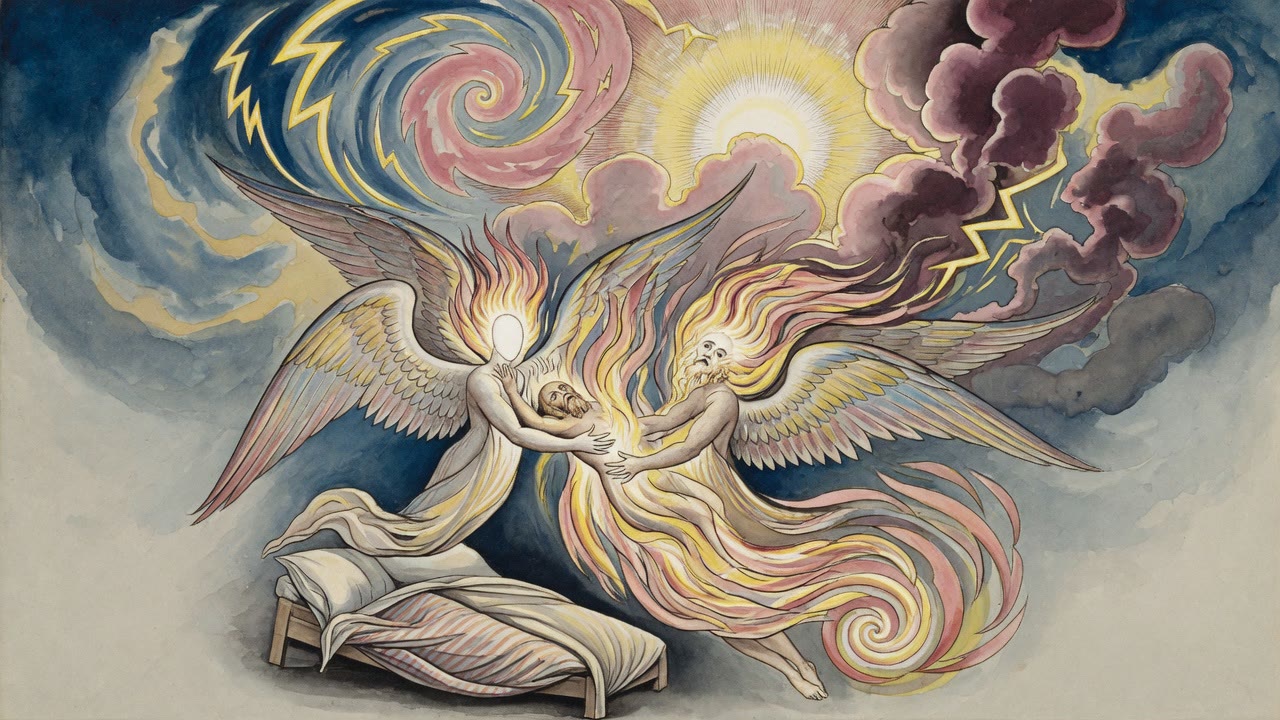
Enoch disappears without a grave. Two blazing angels summon him from his bed, and he returns as the highest angel in heaven.

Curated by Arthur · Told by Maggid ·
Table of Contents
  1. Two Blazing Angels at the Foot of His Bed
  2. The Watchers Who Came Down From Heaven
  3. The Children They Left Behind
  4. Enoch Passed Through Fire Into the Presence of God
  5. The Great Angel at the Throne

Two Blazing Angels at the Foot of His Bed

Enoch was three hundred and sixty-five years old when the visitation came. He was alone in his house, resting on his bed, asleep, when a terrible distress seized his heart without explanation. Something was about to happen that no living man had experienced. Then two figures appeared at the head of his bed. They were enormous, taller than any human who had ever walked the earth. Their faces blazed like the sun. Their eyes burned like living fire. Flames poured from their lips. Their garments shimmered with colors that had no earthly name, and their wings gleamed brighter than gold.

They called him by name. Enoch woke. He saw them clearly, and his spirit failed from dread. The angels told him to rise, come with them, and not be afraid, because God had sent for him and he would stand before the divine face forever. Before he left, Enoch summoned his sons, told them what he had seen in his dreams across three hundred years, and warned them to walk in righteousness. Then the angels lifted him, and he was gone.

The Watchers Who Came Down From Heaven

Before Enoch ascended, the world he left behind was already fracturing. Two hundred angels, called Watchers, had descended to Mount Hermon in the generations before the Flood. They were a high order, beings who never slept, bound by oath to whatever they were about to do together. Their leader was Shemhazai, and his second was Azazel, and from the moment they saw the daughters of men walking on the earth, their resolve dissolved.

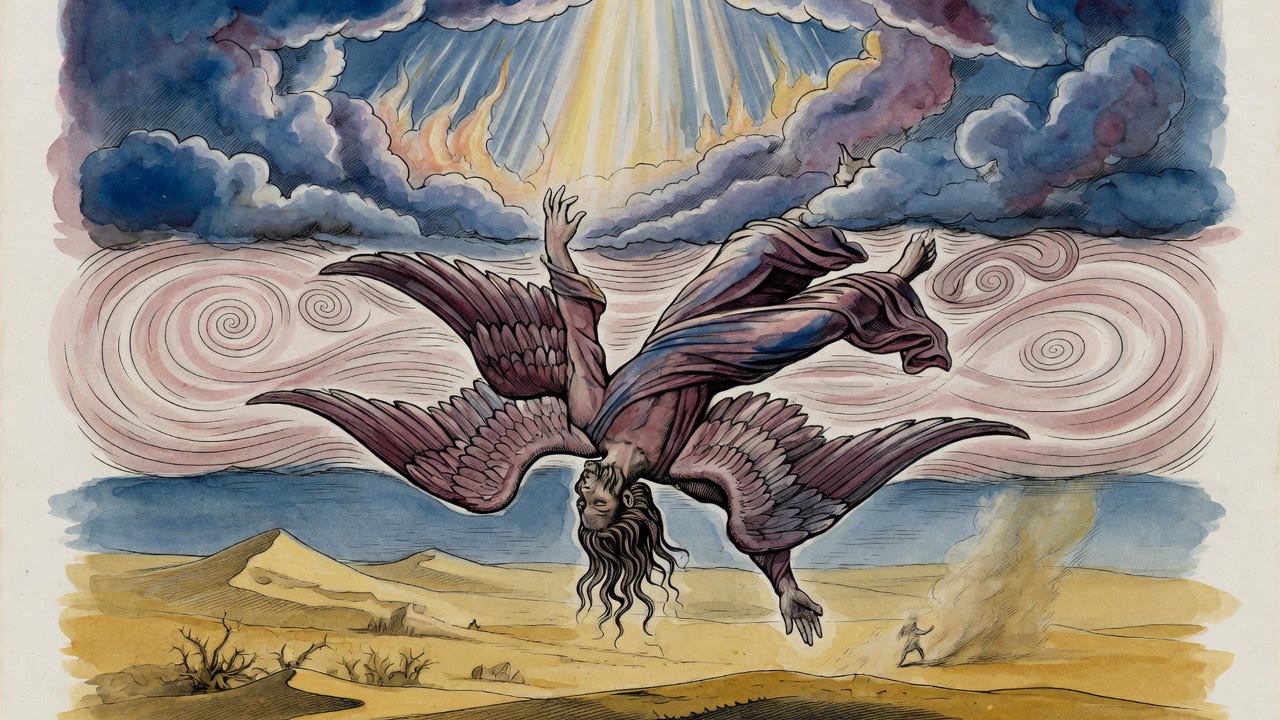
Shemhazai wanted a woman named Estirah and she refused him unless he taught her the Ineffable Name of God. He did. She used the Name to ascend to the stars before he could touch her. Azazel had no such check on him. He taught men how to forge weapons from metal and women how to arouse desire, and the earth filled with bloodshed and corruption. God commanded the angel Raphael to bind Azazel hand and foot and cast him into a desert pit carved out beyond the Mountains of Darkness, where he lay chained and upside down, unrepentant, until the day of judgment.

The Children They Left Behind

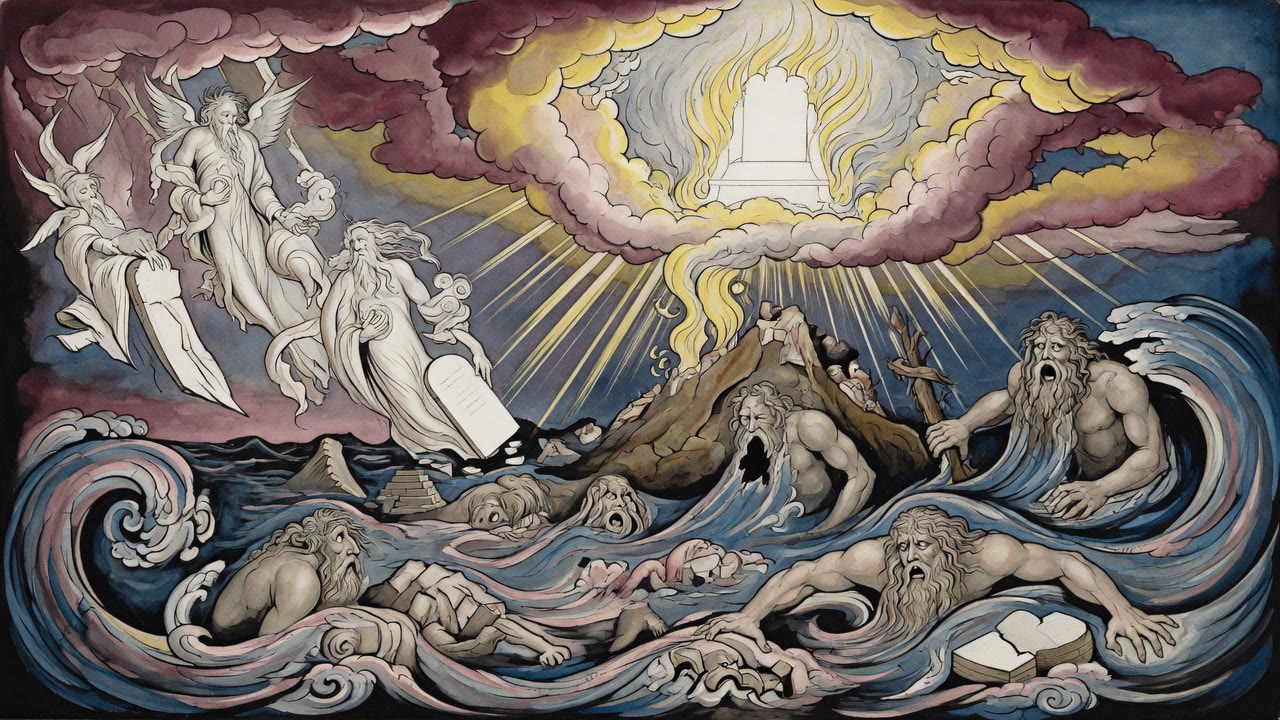
The Watchers fathered children on the women they took, and those children grew into the Nephilim, enormous, unlike anything creation had intended. The Nephilim themselves had children. They were all unlike each other, unlike humanity, unlike the angels who had fathered them. The text in the Book of Jubilees does not soften what followed: they devoured one another. The Giants slew the Nephilim. The Nephilim slew the Elpis. Each generation destroyed the one that came after it in a chain of annihilation. Before the Flood erased them, they had consumed the world.

When Shemhazai saw what had become of his children and the world he had corrupted, something in him broke. He hung himself between heaven and earth, suspended upside down as a kind of penance, condemned to that posture until the world's end. His fellow Azazel felt no such remorse. God decided the Flood was the only answer.

Enoch Passed Through Fire Into the Presence of God

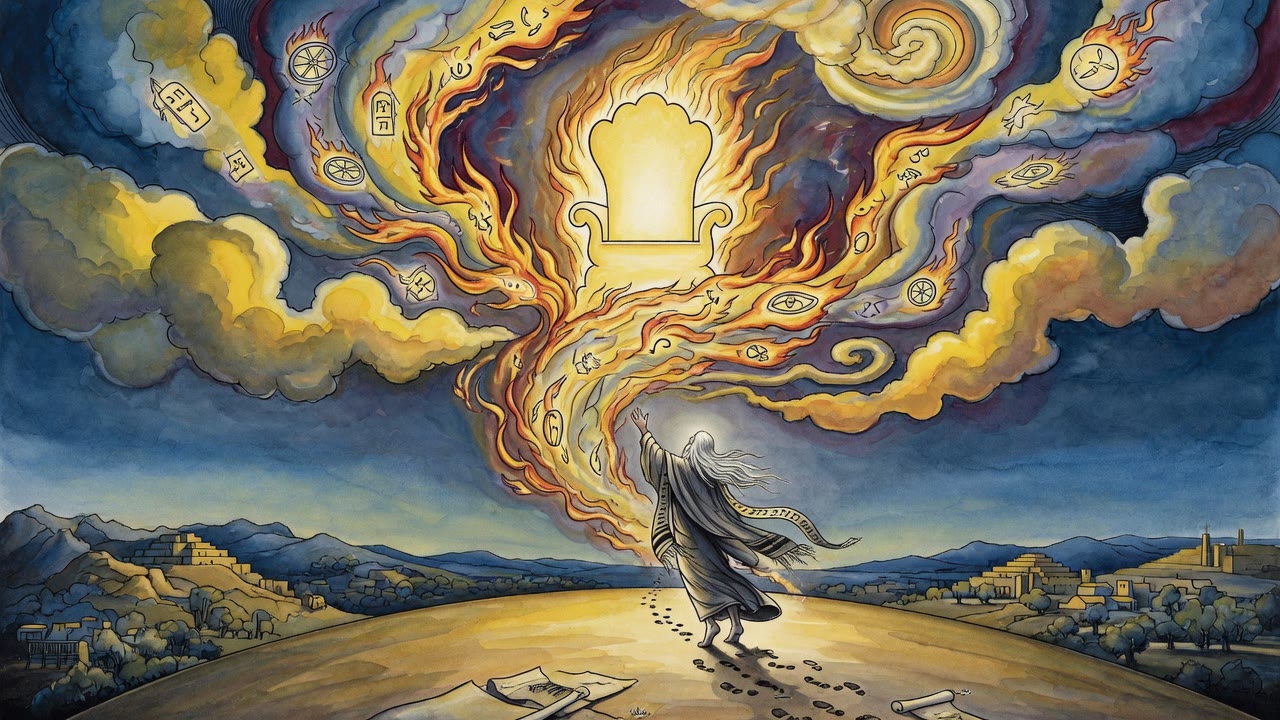
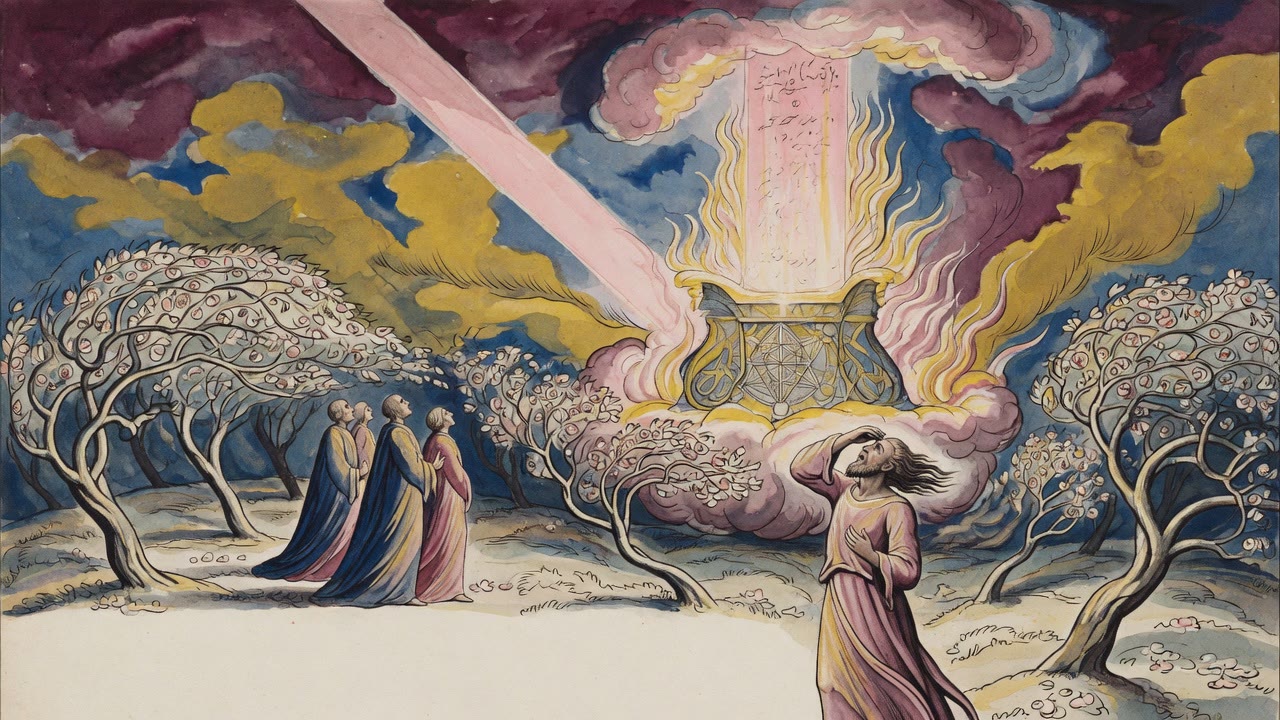
Where the Watchers descended and were destroyed, Enoch ascended and was transformed. A thick mist drew him upward. Stars and flashes of lightning beckoned him forward. The winds swept him higher, past the boundary of the familiar world and into the celestial realms. He came first to a crystal wall shimmering with tongues of fire. He passed through and found a crystal house beyond it, its foundations built of luminous stone, fire dancing around its walls. The ceiling shimmered like the night sky, a river of stars above him.

Inside the house was a greater house still, hotter, more terrifying, built of fire itself. A throne of crystal stood there, its wheels alive with fire and the Cherubim surrounding it. On the throne sat one whose robe shone whiter than snow and whose face blazed like the sun, and from that face poured rivers of fire down to the floor. Enoch fell on his face. He could not look directly at anything he was seeing. The voice from the throne called him righteous and told him he would be a witness, a scribe, an intercessor between heaven and earth for as long as the generations endured.

The Great Angel at the Throne

When the four sages entered Paradise, three of them did not come out whole. One died. One went mad. One became something else entirely. Only Rabbi Akiva entered and left in peace. The one who became something else was Elisha ben Abuyah, a renowned scholar who ascended in mystical ecstasy to gaze on the Merkavah, the divine chariot. What he saw there unmade him.

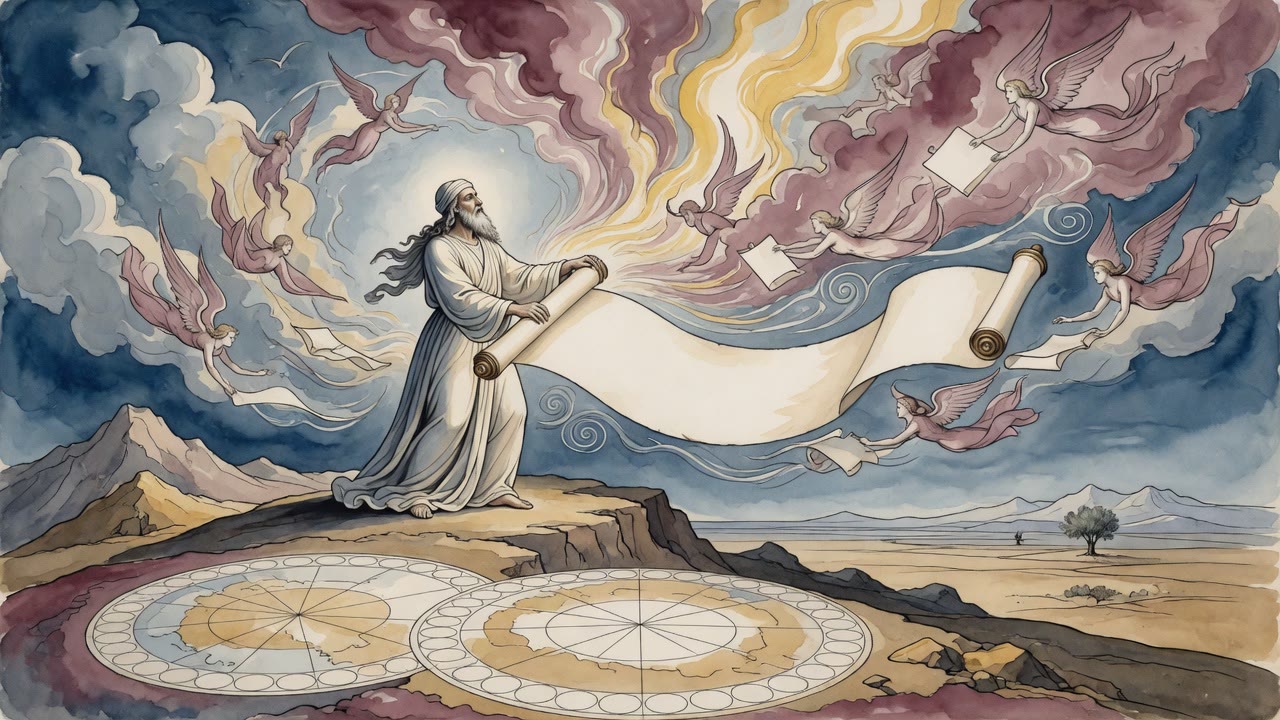
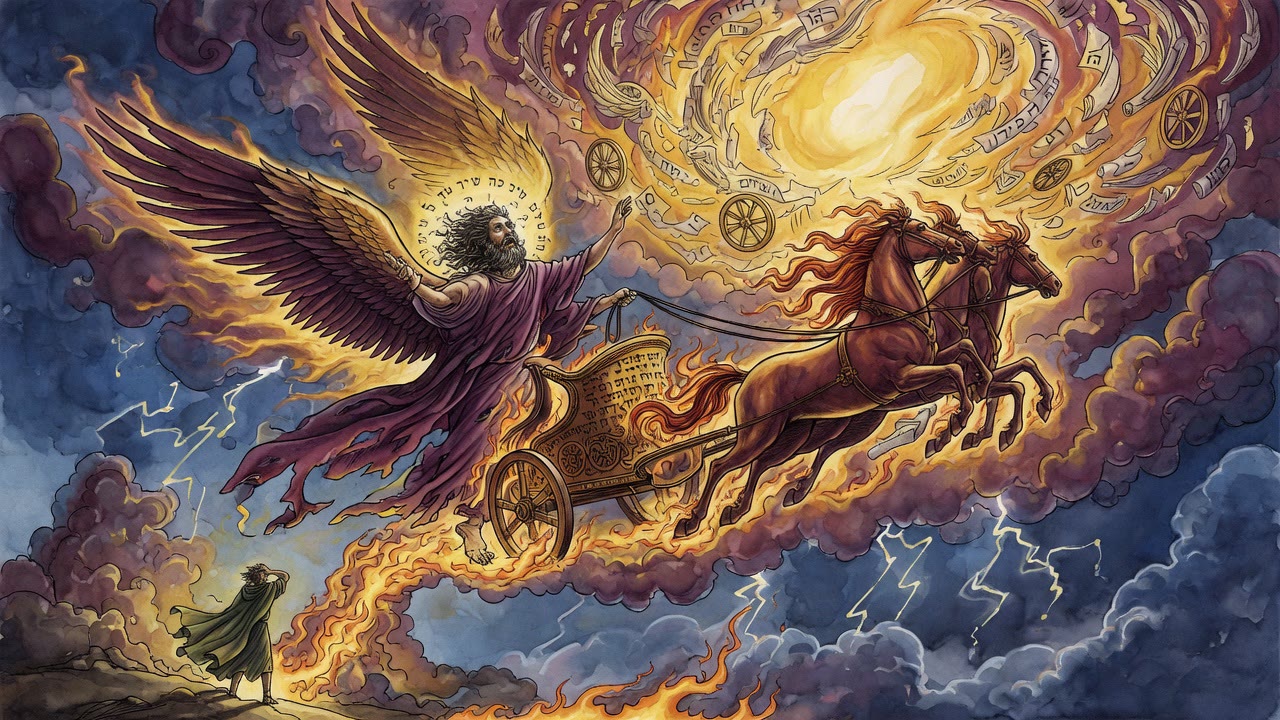
At the edge of the chariot's light stood an enormous figure seated on a throne of its own. Elisha mistook it for a second divine power. He was wrong. What he saw was Metatron, the highest of the angels, the one who had once been the man Enoch. When the angel Enoch was translated, his flesh was turned to flame, his sinews to fire, his bones to glowing coals, his eyes to torches, his eyelashes to lightning bolts, and his limbs to wings. He was given seventy-two names, knowledge of all that was above and below, and a seat at the edge of the divine council. He became the Prince of the Divine Presence, the one through whose eyes God watches the world. He was the man who walked with God and came back as something no man had ever been before.


← All myths

From the tradition

Sources

7 sources

The texts this telling draws on, in full. Open a card to read inline, or expand it for a wider, quieter read.

Jubilees 4:15, 5:1-3, 5:5-7Book of Jubilees

It involves Watchers, forbidden knowledge, and a whole lot of trouble.

This isn't just a story of two rogue angels, Shemhazai and Azazel. According to some accounts, like the one we find in the Book of Enoch, Shemhazai was actually the leader of a whole crew, a posse if you will, of two hundred angels known as the Watchers. These weren’t just any angels,. They were a high order, beings who never even needed to sleep! Imagine the kind of heavenly secrets they held.

The story goes that these Watchers descended to the summit of Mount Hermon. There, they made a solemn oath, binding themselves together in their mission, whatever that was about to become. But something went wrong. Terribly wrong. As the angels fell from their holy state, they were diminished, lessened in both stature and strength. Their very essence changed; their fiery, ethereal forms became flesh, making them susceptible to earthly temptations.

At first, it seems, they had good intentions. The Watchers initially aimed to instruct humanity in the ways of righteousness. But then, they saw the daughters of men. And, well, things took a turn. Lust took hold, and they chose wives from among these women. The result of these unions? Giants. Literal giants roamed the earth, born of angel and human.

But the transgressions didn't stop there. Each of these angels, not just Shemhazai and Azazel, began to reveal secrets of heaven. They taught humanity charms and enchantments, incantations, and the knowledge of how to cut roots for magical purposes. They divulged the secrets of astrology and how to read signs. As we find in the Book of Jubilees (5:1-13) and 1 Enoch (6-14), the world was changing, and not for the better.

They even taught men the art of working metal to make weapons, and, perhaps even more destructively, they taught women how to make themselves desirable to men. It was a complete and utter breakdown of the natural order. And these angels, they sinned with anyone they desired – men, women, beasts, it didn't matter. As a result, everything on earth became corrupted.

Think of it as a kind of ancient, celestial version of the story of Prometheus, who stole fire from the gods. This legend of the Watchers is, in many ways, the primary Promethean myth in Judaism. The angels weren't just divulging dark secrets of heaven; they were revealing secrets of the natural universe, things that God, for whatever reason, had never intended for humans to know!

The situation became so dire that God had to intervene. He ordered these Watchers to be rooted out and bound in chains in the depths of the earth. According to the story, the archangels Uriel and Raphael went to God and reported the sins of the fallen ones. Then, God gave his orders: Raphael was instructed to bind Azazel hand and foot and cast him into a canyon in the desert of Dudael, covering him with darkness until the Day of Judgment, when he would be cast into the fire. And Michael was told to bind Shemhazai and his associates, holding them fast for seventy generations in the valleys of the earth until the Day of Judgment, when they would be led to the fiery abyss and tormented forever.

Now, there are different versions of this tale. Some say that Shemhazai and Azazel alone assumed human form when they descended, with the other Watchers taking the form of he-goats as their mounts. But regardless, the end result is the same: they were all cast into an abyss, where they remain imprisoned until the end of time.

What about the women who went astray with these Watchers? 1 Enoch (19:2) offers a chilling detail: they were transformed into sirens. It's a rare reference in a Jewish text to the sirens of ancient storytelling, those alluring, dangerous creatures of the sea.

This whole episode, according to 1 Enoch (6:6), is said to have taken place in the days of Jared, the father of Enoch. So, this myth of the Watchers is set in the generation just before Enoch, making it an integral part of his own story.

This story, with its themes of forbidden knowledge, lust, and divine punishment, continues to resonate. It makes you wonder about the nature of free will, the dangers of unchecked curiosity, and the price we pay for seeking knowledge that might be beyond our capacity to handle. What do you think? Are there some things humanity is better off not knowing?

Full source
1 Enoch 8-101 Enoch

The story goes that the generation before the Great Flood, the one Noah survived, learned their wicked ways from none other than Azazel. He wasn't just teaching people to be naughty. Oh no. According to the legends, he taught men how to forge deadly weapons and women how to. well, how to "arouse the desires of men." The result? Total corruption.

So, what happened to Azazel? God commanded the angel Raphael to bind him hand and foot and cast him into the darkness. Raphael, as the story goes, carved a hole in the desert of Dudael, beyond the Mountains of Darkness, and threw Azazel there, chained upside down. Can you imagine?

Even in that dark pit, chained and humiliated, Azazel didn’t repent. The Emek ha-Melekh tells us that some traditions even have Azazel chained together with Aza (also known as Shemhazai) in this desert. He was consumed by revenge. He used the power of dreams to find an evil sorcerer and command him to come to him.

This is where the story gets really wild. To reach Azazel, the sorcerer had to journey to the Mountains of Darkness. There, he was met by a demon in the shape of a cat, but with the head of a fiery serpent and two tails! What do you do in a situation like that?

Apparently, you carry around the ashes of a white cock. The sorcerer threw these ashes at the cat-like demon, and it then led him to Azazel's prison. There, he lit incense, stepped on Azazel's chain three times, knelt, and worshipped the Watcher. Only then did Azazel begin to speak, revealing the darkest mysteries for fifty days. The result? A sorcerer with unparalleled mastery of evil.

This sorcerer, guided back out by the serpentine cat, then shared Azazel's location with other sorcerers, who sought him out and learned from him. And that, according to this myth, is how the black arts spread throughout the world.

But there's more to Azazel than just a dark teacher. The myth of Azazel also helps us understand some tricky passages in the Torah. Think about Yom Kippur, the Day of Atonement. In Leviticus, we read about sending a scapegoat to Azazel (Leviticus 16:8, 10, 16). The verse says, "But the goat, on which the lot fell for Azazel, shall be set alive before Yahweh, to make expiation with it and to send it off to the wilderness for Azazel." So, who is this Azazel?

Many identify Azazel with Satan himself. In fact, even today, some Israelis tell someone to "Go to Hell!" by saying "Lekh le-Azazel!" Nachmanides, in his commentary on (Leviticus 16:8), even suggests that the scapegoat is sent to "the prince who rules over places of destruction," a demon or Watcher also known as Samael (the angel of death).

So, is the goat sacrificed to God, or to this… other entity? The idea is that the goat is a bribe to Satan, "the Accuser," to keep him silent on Yom Kippur. It's an offering of the people's sins, in goat form.

Of course, offering a goat to Azazel could be seen as idolatry. Nachmanides gets around this by saying that God, not the Jewish people, gives the scapegoat to Azazel as a reward for ceasing his accusations on Yom Kippur. Hyam Maccoby even suggests the scapegoat is a remnant of paganism, a worship of the desert god.

Some sources, like Zohar 2:157b, interpret the references to "Azazel" in Leviticus as referring to a mountain called Azazel, not a Watcher. This mountain was said to be a great and mighty one, and below it are unimaginable depths. Whatever the "real" Azazel is, the Zohar tells us that the Other Side has unshackled power there.

So, what's the takeaway? This myth, like many others, helps us understand some tricky parts of the Bible. It gives a reason for the corruption of the pre-Flood generation, explains the origin of giants, and even gives us an explanation for the star Istahar (linked to Shemhazai’s upside-down hanging). 1 Enoch 8-10 fleshes out the story of Azazel's punishment in the desert Dudael. It is a tradition of stories that help us wrestle with some of the biggest questions about good, evil, and the choices we make.

Full source
Chronicles of Jerahmeel XXVChronicles of Jerahmeel (Gaster, 1899)

Two angels told God not to create humanity. When the generation of the flood proved them right, Shemhazai and Azael stood before God and reminded Him: "Did we not say, 'Do not create man'?" God answered with a challenge. "If you lived on earth, the evil inclination would sway you just as it sways humans. And you would be even more stubborn." The angels insisted. "Let us descend, and You will see how we sanctify Your name." According to the Chronicles of Jerahmeel, a 12th-century Hebrew chronicle translated by Moses Gaster in 1899, God let them go.

They failed immediately. The moment Shemhazai and Azael beheld the daughters of men, they could not restrain themselves. But one woman outsmarted them. A girl named Estirah refused Shemhazai unless he taught her the Ineffable Name of God. He did. She spoke the Name and ascended straight to heaven. God said, "Since she has departed from sin, set her among the stars." She became the brightest star in the Pleiades.

After that humiliation, both angels took wives and fathered children. Shemhazai's sons, Heyya and Aheyya, were giants, each consumed a thousand camels, a thousand horses, and a thousand oxen daily. Azael became chief over all cosmetics and ornaments used to entice men to sin. When God sent Metatron to warn Shemhazai that a flood was coming, Shemhazai wept for his children.

His sons dreamed prophetic dreams. One saw a great stone tablet covered in writing, and an angel descended to erase everything except one line with four words. The other saw a garden of trees, and an angel chopped them all down except one tree with three branches. Shemhazai interpreted both: the world would be destroyed, leaving only one man and his three sons. He comforted his children with a strange promise, their names would live forever, because whenever people lift heavy burdens, they groan "Heyya! Aheyya!" Shemhazai himself repented and hung suspended between heaven and earth, head downward, too ashamed to face God. Azael never repented. He became the Azazel of the Day of Atonement, the one onto whom Israel's sins were cast.

Full source
Book of Jubilees 7:30Book of Jubilees

Chapter 7 of Jubilees dives right into the chaos following the emergence of the Nâphîlîm, those figures often translated as "giants" or "fallen ones." Think of them as the offspring of a forbidden union, and their existence sets off a chain reaction of violence. The text pulls no punches.

"And they begat sons the Nâphîlîm, and they were all unlike, and they devoured one another." Can you imagine such a fractured, destructive family line? This isn't just sibling rivalry. This is existential conflict at its most brutal. They were "all unlike" – different from each other, different from humanity, different from what creation intended. This difference, this otherness, fueled their destructive tendencies.

Then comes the domino effect. "And the Giants slew the Nâphîl, and the Nâphîl slew the Eljô, and the Eljô mankind, and one man another." It's a horrifying cycle of violence, an escalating chain of death that spreads like wildfire. It’s a stark illustration of unchecked aggression and the disintegration of social order.

It doesn’t stop there. The corruption deepens.

"And every one sold himself to work iniquity and to shed much blood, and the earth was filled with iniquity." People willingly chose evil. It wasn't just a lapse in judgment; it was a conscious decision to embrace wrongdoing. The choice was made to "sell themselves" – a powerful phrase that suggests they gave up their very souls for wickedness. The earth itself became saturated with sin.

And in a particularly disturbing turn, the verse states: "And after this they sinned against the beasts and birds, and all that moveth and walketh on the earth: and much blood was shed on the earth." This isn't just about human-on-human violence anymore. It's a complete disregard for the natural world, a transgression against all living things. It points to a total breakdown of empathy and a loss of respect for God's creation.

Finally, we read, "and every imagination and desire of men imagined vanity and evil continually." This is perhaps the most damning indictment of all. It wasn't just their actions that were corrupt; it was their very thoughts, their innermost desires. Every waking moment was consumed by wickedness. Their minds were incubators of evil, constantly generating new ways to sin.

Reading this passage from the Book of Jubilees, one can't help but wonder: What does it mean to reach such a point of moral decay? What are the warning signs? And how do we prevent ourselves, as individuals and as a society, from sliding down that slippery slope? The flood, in this context, isn't just a divine punishment, but a cosmic reset button, a desperate attempt to cleanse a world drowning in its own depravity. A harsh, but ultimately necessary, measure to allow for a fresh start.

Full source
1 Enoch 14:8-25, 40:1-101 Enoch

Enoch, as we learn from 1 Enoch, wasn't just any man. He was righteous, a figure of immense importance in Jewish tradition. And he was granted something extraordinary: a journey to the heavens. Picture this: a thick mist descends, drawing him in. The stars themselves, along with flashes of lightning, seem to beckon him forward. Then, the winds sweep him up, carrying him higher and higher, beyond the familiar world and into the celestial realms.

What does he see? First, he approaches a crystal wall, shimmering and alive with tongues of fire. He passes through this fiery barrier and finds himself before a crystal house, its very foundations built of these luminous stones. Fire dances around its walls, and the entrances blaze with an intense heat. The ceiling shimmers like the night sky, a pathway of stars and lightning, guarded by fiery cherubim – powerful angelic beings.

Enoch, in this vision, enters the house. Can you imagine the sensation? It's both intensely hot and shockingly cold, a paradox that defies earthly understanding. Overwhelmed, trembling, he falls to his face. But the visions continue.

He sees a second house, even grander than the first. This one is built entirely of flames, its splendor beyond description. The floor and ceiling are fire, and a fiery portal stands open, inviting him in. And there, in the heart of it all, is a throne, lofty and radiant as crystal. Beneath it flow streams of flaming fire, and the wheels of the throne – yes, wheels – shine with the brilliance of the sun.

This is a key element. The vision of God's throne as a chariot, with wheels, places this squarely within the tradition of Merkavah (chariot) mysticism, an early form of Jewish mystical thought. The Merkavah tradition, as explored in texts like the Zohar, focuses on ecstatic visions of God's throne-chariot.

But the most awe-inspiring sight is yet to come. Seated on the throne is the very glory of God. His garment is described as whiter than any snow, and His light is brighter than the sun, the moon, and the stars combined. A flaming fire surrounds Him, and a great fire stands before Him. The intensity is so overwhelming that none can draw near. It's a vision of unimaginable power and majesty, a glimpse into the heart of the Divine. As 1 Enoch 14:8-25 and 40:1-10 recount, it’s an experience that leaves Enoch utterly humbled and transformed.

What does this vision mean for us? It’s a reminder of the sheer, overwhelming power and mystery of the Divine. It's an invitation to contemplate the unseen realms, to seek a connection with something far greater than ourselves. It's a evidence of the enduring power of visionary experience, and the profound impact it can have on those who are chosen to witness it. And perhaps, in our own way, we can all strive to glimpse a bit of that divine light.

Full source
2 Enoch 1-22 Enoch

Enoch was three hundred and sixty-five years old when the visitation came.

He was alone in his house. Resting on his bed. Asleep. And in that sleep, a terrible distress seized his heart, a weeping he could not explain, a dread without name or shape. Something was about to happen that no living man had ever experienced.

Then two figures appeared at the head of his bed.

They were enormous, taller than any human who had ever walked the earth. Their faces blazed like the sun. Their eyes burned like living fire. Flames poured from their lips. Their garments shimmered purple, shifting and singing with colors that had no earthly name. Their wings gleamed brighter than gold. Their hands were white as snow.

They called him by name.

Enoch woke. He saw them clearly, two radiant beings standing before him. And terror seized him. His face changed. His body trembled. But the angels spoke with steady voices:

"Have courage, Enoch. Do not fear. The eternal God has sent us to you. Today you will ascend with us into heaven."

They gave him instructions: tell your sons everything. Tell your household. Let no one search for you until the Lord returns you to them. Then go.

Enoch obeyed immediately. He rose from his bed, went to the doors of his house, and summoned his sons, Methuselah, Regim, and Gaidad. And told them everything the angels had said. The marvels. The command. The departure.

Then he turned to his children one last time.

"Listen to me. I do not know where I am going, or what will happen to me. But I tell you this: turn not from God. Do not worship the vain things that did not make heaven and earth, for those things will perish, and all who worship them. Let the Lord make your hearts steady in the fear of Him. And let no one come looking for me until the Lord brings me back."

The Hebrew Bible records only a single cryptic line about Enoch's fate: "Enoch walked with God, and he was no more, for God took him" (Genesis 5:24). But 2 Enoch, also called the Slavonic Apocalypse of Enoch, tears open that silence and reveals what happened next. Where God took him. What he saw there. And why he was chosen above all other men on earth to witness the architecture of heaven itself.

Full source
3 Enoch 16:1-53 Enoch

Four sages entered Paradise, and only Rabbi Akiva came out whole.

One of the most famous of these accounts involves four prominent sages who, according to the Talmud (Hagigah 14b), "entered Paradise" – a term that has come to mean engaging in mystical ascent. Of these four, only one, Rabbi Akiva, entered and left in peace. Others were scarred by the experience.

One of those others was Elisha ben Abuyah.

Elisha was no ordinary man. He was a renowned scholar, a brilliant mind. But his journey took a dark turn. The Talmud hints at his eventual heresy, calling him "Aher" – "the Other One." What went wrong?

Well, the story goes that Elisha ascended on high, seeking to gaze upon the Merkavah – the Divine Chariot, the very throne-chariot of God described in the Book of Ezekiel. Imagine the audacity, the sheer spiritual hunger it must have taken to attempt such a feat!

He made it far, too. According to the account in Tree of Souls (Howard Schwartz), he reached the door of the seventh palace – the highest level of Heaven. And there, he saw something that shattered his faith.

He came into the presence of the angel Metatron.

Now, Metatron is a fascinating figure in Jewish mysticism. Often described as the "lesser YHWH," he is one of the highest-ranking angels, the celestial scribe, the very voice of God. He's a powerful, awe-inspiring being.

But here's the thing: Elisha saw Metatron seated upon a high and lofty throne, wearing a crown. All the princes of the kingdom – the other angels – stood beside him, to his right and to his left. And from his throne, Metatron ruled over all the other heavenly beings.

This is where it all fell apart for Elisha. Why? Because in his eyes, this looked like two powers in Heaven! It smacked of duality, of a second divine being alongside God. This was a complete violation of the core Jewish principle of monotheism – the absolute oneness and uniqueness of God.

As we find in Legends of the Jews (Ginzberg), this vision led Elisha to declare, "There are two powers in Heaven!" This blasphemous thought, born of his mystical experience, led to his downfall, his becoming Aher, the heretic. He could not reconcile what he saw with his understanding of God.

Think about the weight of that moment. Imagine the internal struggle, the cognitive dissonance tearing him apart. He sought to understand the Divine, and the vision he received instead destroyed his belief.

It's a cautionary tale, isn't it? A reminder that even the most learned and devout can be led astray by their own interpretations, by their inability to reconcile the mysteries of the universe with the foundations of their faith. The journey to understand God is fraught with peril, and perhaps, some questions are best left unasked.

Full source