Kenaz Burned the Guilty and the Books Would Not Burn
A guilty man told Kenaz to question the tribes one at a time so the confessions would be honest. The Amorite books turned up in his own tent.
Table of Contents
 Click for full size
The Lot Fell in Caleb's Tribe
Joshua was dead and nobody would go up.
The people asked who should lead them against the Canaanites the way it had been done before, and the answer came back with a condition attached. If the heart of this people is whole, let Judah go up. If it is not, nobody goes up at all.
They asked how a man is supposed to know the heart of a people. Cast lots, they were told, tribe by tribe, and the lot will tell you. Then they asked for someone to stand over the lots and run them, and the angel said to cast in the tribe of Caleb.
The lot came out on Kenaz.
He took the office and said one thing before he used it. Moses told you not to turn from the road to the right or the left, and Joshua told you the same, and the heart of this people is not with Him. So every tribe comes forward. He looked at them and finished it. "If I am taken, and my house with me, burn us with fire."
They told him he had spoken well.
Six Thousand One Hundred and Ten
The tribes came up one after another and the lot picked men out of them like a hand pulling weeds.
Three hundred and forty-five out of Judah. Five hundred and forty out of Reuben. Three hundred and thirty-five out of Simeon, three hundred and fifty out of Levi, six hundred and sixty-five out of Issachar, five hundred and forty-five out of Zebulun, three hundred and eighty out of Gad, six hundred and sixty-five out of Asher, four hundred and eighty out of Manasseh, four hundred and sixty-eight out of Ephraim. Dan, Naphtali and Benjamin gave up men too.
The count came to six thousand one hundred and ten. They stood apart from their families in a camp that had thought itself clean, and Kenaz put them under guard while he asked what should be done with them.
He prayed with Eleazar the priest and the elders. The answer he got was short. Make them confess what they did. Then burn them.
Ask Us One Tribe at a Time
Kenaz stood in front of six thousand condemned men and told them about Achan, who took what was devoted and was caught by lot and confessed before he died. Confess, he said, and you will stand with the ones God raises when the dead are raised.
One of the guilty answered him. His name was Elah.
"We only die once in this fire," Elah said. "Ask each tribe by itself."
Kenaz put his own tribe first. Judah said they had chosen to make themselves a calf, the way their fathers made one in the desert. Reuben said they had burned offerings to the gods of the nations. Levi said they had wanted to test whether the Tabernacle was really holy. Issachar said they had gone to the idols to ask what would become of them. Zebulun said they had wanted to eat the flesh of their own sons and daughters, to find out whether the Lord loved them.
Dan said they had been teaching their children out of the books of the Amorites, and that the books were buried under Mount Abarim. Kenaz sent men and the books came back.
Then Naphtali said they had done everything the Amorites did, and that their share of it was hidden in the tent of Elah. The man who had told Kenaz how to run an honest interrogation had the contraband under his own bedding. Kenaz sent men there too, and it was where Naphtali said it was.
Gad confessed to their neighbors' wives. Manasseh had broken the Sabbath. Ephraim had put their children through the fire the way the Amorites did. Benjamin said they had wanted to find out whether the law came from God or whether Moses had written it himself.
The Seven Idols Under Shechem
Asher was the one that stopped the room.
They had found seven golden idols, they said, the ones the Amorites called their holy ones, and they had buried them under Mount Shechem rather than hand them in. Send there and you will find them. Kenaz sent, and they were there.
These were not cast by any craftsman. Seven men made them after the Flood, and their names were remembered: Canaan, Put, Shelah, Nimrod, Elah, Diul, Shuah. The stones set in them came from Havilah, where the onyx is, and at night they threw off light like daylight, so that a room with them in it never went dark. An Amorite who had lost his sight could kiss one of them, put his fingers to his own eyes, and see. At set times they told the Amorites what to do, and the Amorites did it.
Kenaz wrote every confession into a book and read the book aloud before the Lord.
The Fire at the Brook
Take the men and everything that belongs to them down to the water of Pishon, he was told, and burn them there, so the people can say out loud what happens to a man who turns his heart away.
Kenaz asked the one question a treasurer asks. The stones are worth more than anything we own. Do we burn them, or do we give them to You?
The answer went through him like a blade. If God would take what has been put under the ban, why should a man not take it too?
Keep the books, He was told. Keep the stones. Hold them until I tell you how they die, because fire will not eat them.
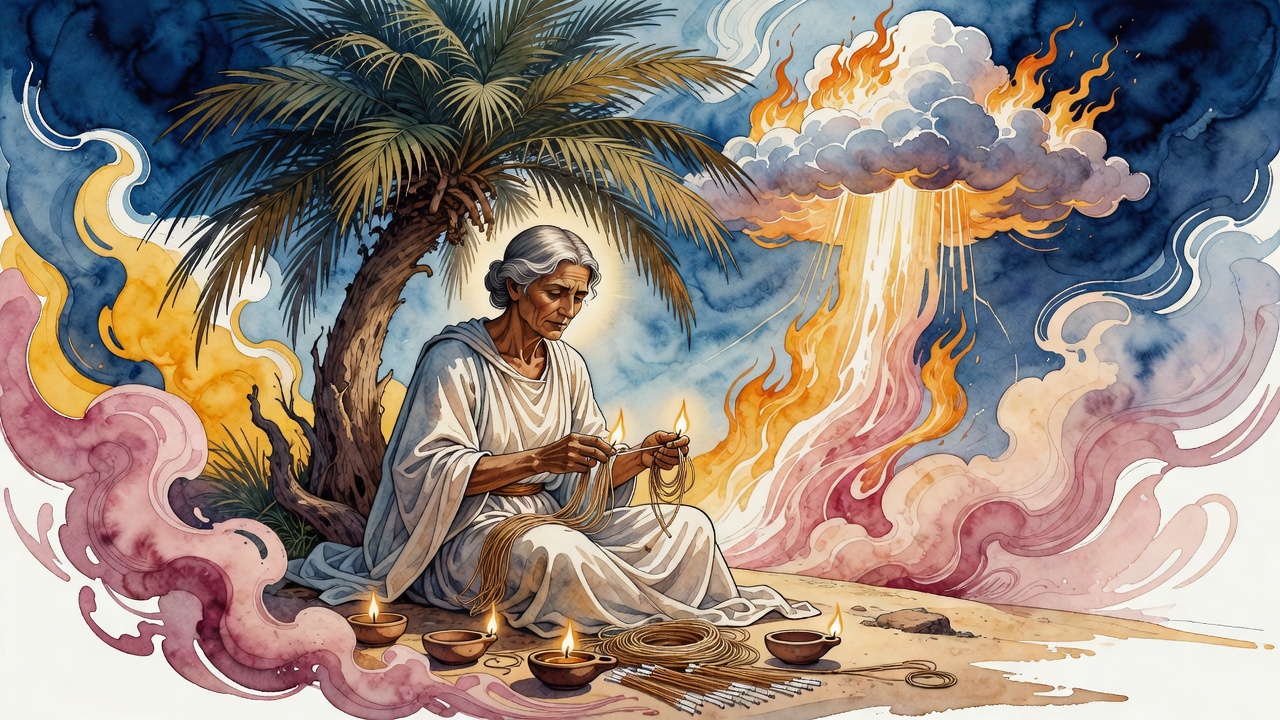
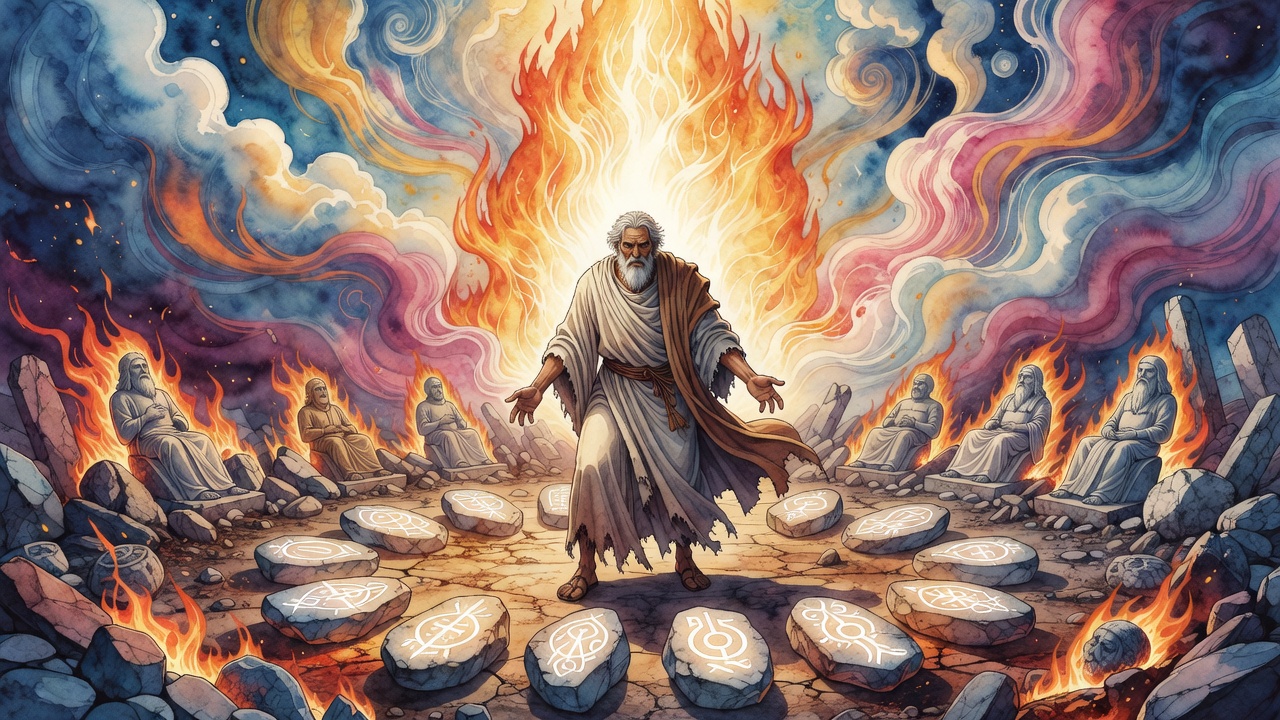
They burned at the brook that day, six thousand one hundred and ten men and everything they owned. When the ash cooled, the Amorite books lay in it unmarked and the seven idols lay in it still shining. Fire would not touch them. Water would not either.
Dew From the Ice of Paradise
Kenaz carried them up a mountain and built an altar. The people brought offerings all day and kept the day as a festival, with the books and the idols lying on the stone in front of them, waiting.
In the night dew rose off the ice of Paradise and came down on the books, and the letters went out of them like breath off a window. An angel came and finished what the dew had started. A second angel picked up the seven glowing idols and dropped them into the deep part of the sea, where nobody has seen them since.
Then another angel came up the mountain carrying twelve stones, and no two of them were alike, and each one had a name cut into it. Reuben on the sardius. Simeon on the topaz. Levi, emerald. Judah, carbuncle. Issachar, sapphire. Zebulun, jasper. Dan, ligure. Naphtali, amethyst. Gad, agate. Asher, chrysolite. Joseph, beryl. Benjamin, onyx.
Those went into the breastplate, and after that a priest walked into the sanctuary wearing the sons of Jacob on his chest, in the place where the Amorites had worn stones that answered questions.
← All myths