4 min read

Moses Arrived in Heaven and the Angels Panicked

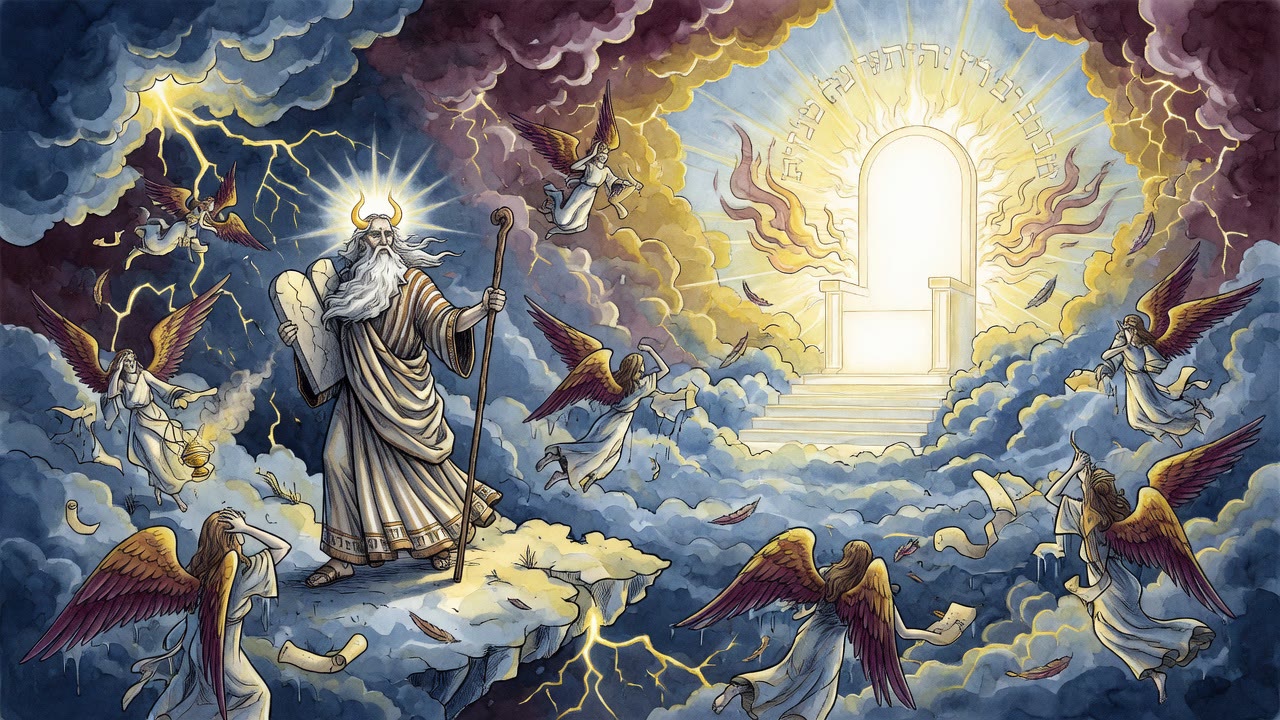
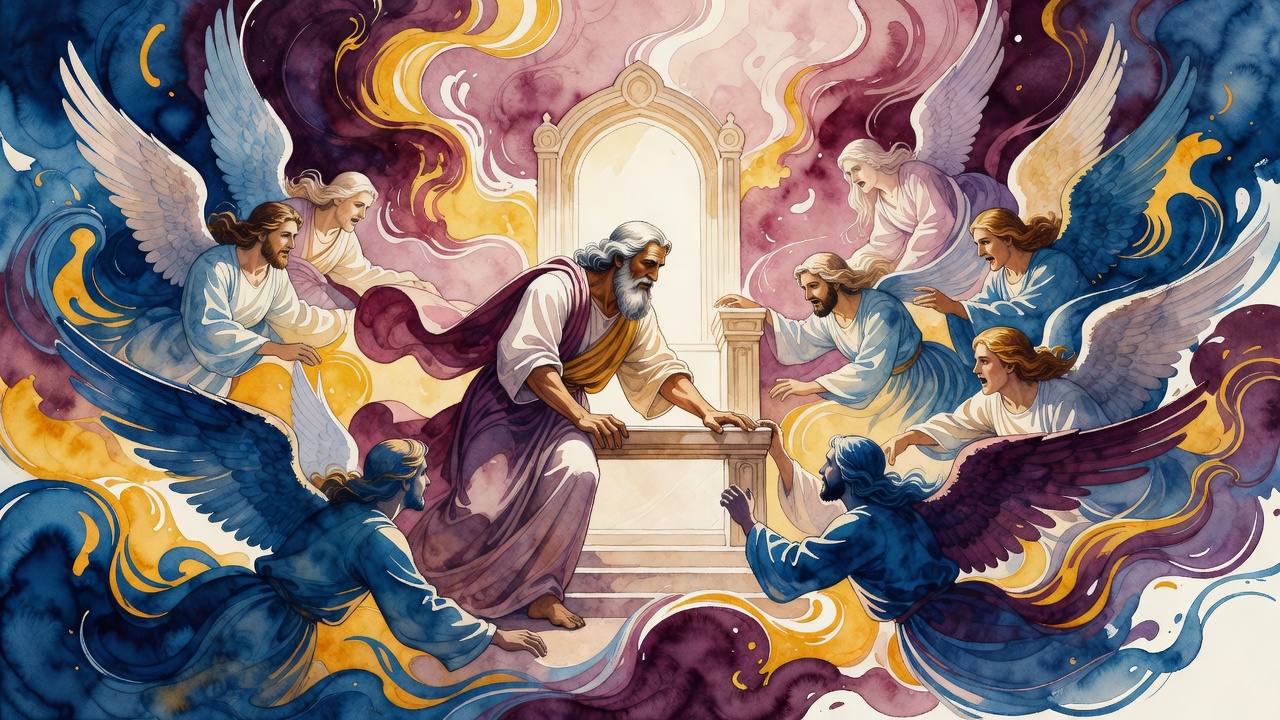
Thirty thousand angels escorted Moses through the heavens to receive the Torah. The escort was not an honor guard. It was crowd control.

Curated by Arthur · Told by Maggid ·
Table of Contents
  1. The Escort No One Wanted to Join
  2. The Fire-Angel of the Third Heaven
  3. When the Angels Tried to Take the Torah
  4. What the Angels Did Instead

The Escort No One Wanted to Join

God commanded Metatron, the angel of the divine presence who had once been the man Enoch, to escort Moses through the heavens. Metatron obeyed. Thirty thousand angels were assigned to the mission, fifteen thousand on Moses's right side, fifteen thousand on his left. They went with him not because his ascent was a celebration but because it was a crisis, and someone needed to contain what was about to happen when the angels of the upper heavens realized a human being had entered their world.

The first heaven was already unsettling. Moses walked through it and saw armies of angels stationed at their posts, formations stretching in every direction, beings made of fire and ice arranged in ranks that had no end. Metatron narrated. Moses looked and tried to hold in his mind what his eyes were receiving.

The Fire-Angel of the Third Heaven

By the third heaven the scale had changed beyond any ordinary measure. Moses encountered an angel whose height was so enormous that a human being walking at full speed would require five hundred years to cover the distance from its feet to its head. Five hundred years of walking, upward, along one being. Moses stood at its base and looked up and understood, for perhaps the first time since Sinai, that he had entirely misjudged what he was moving through.

Metatron gave him the angel's name and function and moved him forward. The tour continued upward. Each heaven added something new to Moses's accumulating disorientation: the stores of rain and snow, the treasuries of dew, the great winds that moved through their appointed chambers, the angels whose task was nothing but singing and the angels whose task was nothing but keeping silence, the fire that never consumed what it burned and the cold that never froze what it touched.

When the Angels Tried to Take the Torah

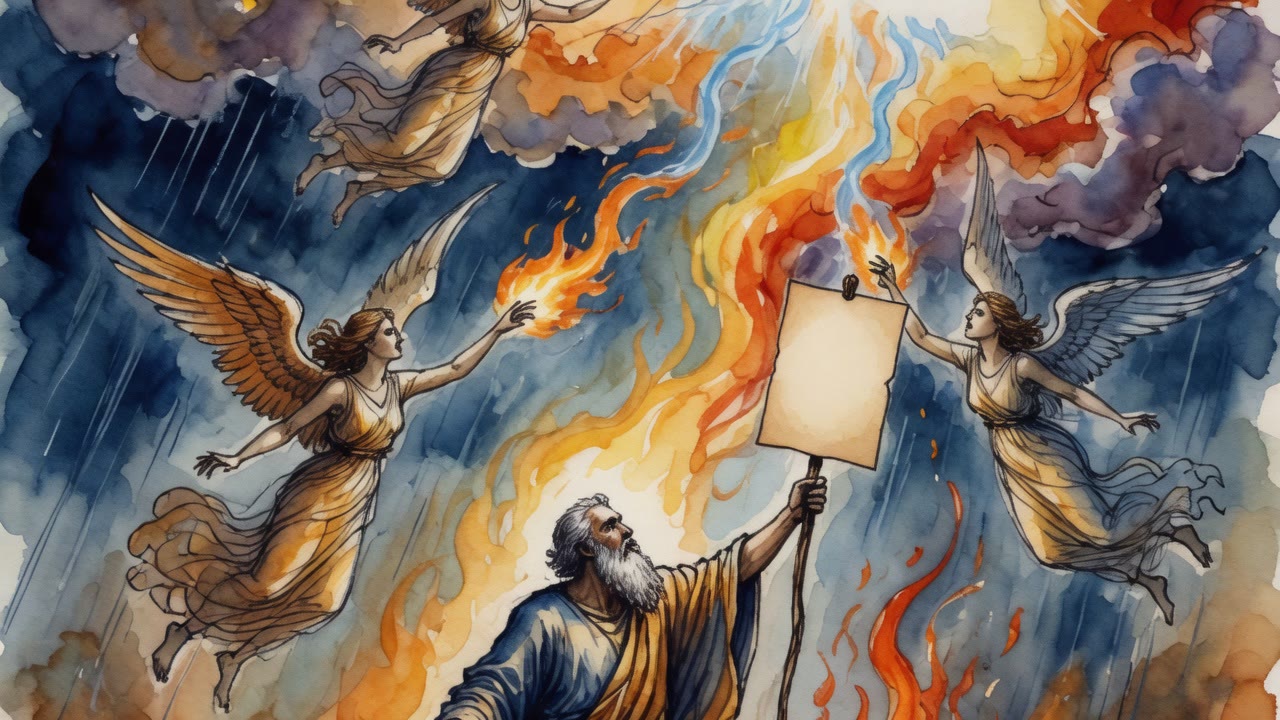
Moses had been in the upper heavens for some days before the angels understood what he was there to receive. When they understood, the mood changed. The Torah, they argued, was too sacred for a human being. It had existed before the world. It was written in black fire on white fire and kept in the divine treasury, and it belonged there. The angels who made this argument were not being bureaucratic. They were terrified of what would happen to a document that had never touched mortality if it passed into mortal hands.

Moses held his ground. God told him to answer them. Moses spoke carefully, he invoked the Torah's specific commandments, the ones about honoring parents, about the sabbath, about refraining from murder and adultery and covetousness, and asked the angels which of these applied to beings who had no parents, who did not labor, who did not want what others had because they had no wants at all. The Torah was not written for them. It was written for humans who needed restraint because they had appetites. The argument landed. The angels went silent.

What the Angels Did Instead

Having lost the debate, some of the angels shifted their response. They offered Moses gifts, each one who had opposed him giving something in reconciliation. The angel of death gave him the secret of stopping a plague. Other angels gave him other knowledge. Moses descended from heaven with the tablets and with an education in divine power that the forty days and forty nights among the angels had deposited into him.

When the people below saw the Tabernacle finished and Moses's face still shining from what the heavens had done to it, they understood, at a level below language, that the man who had gone up and come back down was not quite the same man who had gone up. Something of the upper heavens had stayed in his face. They could not look directly at him without the veil.


← All myths
From the tradition

Sources

5 sources

The texts this telling draws on, in full. Open a card to read inline, or expand it for a wider, quieter read.

Legends of the Jews 4:164Legends of the Jews

Moses did not climb through heaven alone. God sent thirty thousand angels to escort him upward.

Moses, our leader, the one who spoke to God on Mount Sinai, is about to begin a journey unlike any other. God Himself commands Metatron, the Angel of the Face – a powerful angel who stands in God's presence – to escort Moses to the celestial realms. Not only that, but God orders thirty thousand angels to serve as Moses' personal bodyguard! Fifteen thousand to his right, fifteen thousand to his left.

Naturally, Moses is terrified. I mean, wouldn’t you be? Overwhelmed by the sheer magnitude of what's happening, Moses cries out to Metatron, "Who art thou?" And the angel replies with a revelation: "I am Enoch, the son of Jared, thy ancestor, and God has charged me to accompany thee to His throne."

Enoch! As Ginzberg tells us in Legends of the Jews, Enoch, of course, is the biblical figure who "walked with God" and then, mysteriously, "was not, for God took him" (Genesis 5:24). Jewish tradition holds that Enoch was transformed into the angel Metatron. What a family reunion this is turning out to be!

But Moses, understandably, still hesitates. "I am but flesh and blood," he protests, "and I cannot look upon the countenance of an angel." He knows his limitations. He remembers the awe-inspiring power he felt on Sinai. He knows the celestial realm is a whole other level.

This is where the story takes an even more incredible turn. To prepare Moses for this unprecedented encounter, Metatron transforms him. According to this legend, Metatron changes Moses' flesh into torches of fire, his eyes into Merkabah (the Divine Chariot) wheels – those mystical chariot wheels we read about in Ezekiel's vision – his strength into an angel's, and his tongue into a flame.

Wow.

Essentially, Moses is being upgraded, transformed into something beyond human, so he can withstand the intensity of the divine presence. Only then, with a retinue of thirty thousand angels flanking him, does Metatron lead Moses into heaven.

What does this story tell us? It speaks to the incredible potential within each of us, the ability to be transformed, to rise above our limitations, to connect with something greater than ourselves. And it reminds us that even the most righteous among us, like Moses, sometimes need help, guidance, and even a little celestial re-engineering, to reach their full potential.

It's a reminder that the journey towards holiness is rarely a solitary one. We are surrounded by a support system, seen and unseen – angels, ancestors, and perhaps even sparks of divine fire within ourselves – ready to help us ascend.

Full source
Legends of the Jews 4:165Legends of the Jews

Legends of the Jews turns to Moses Toured the First Heaven and Saw Armies of Angels.

Well, according to Legends of the Jews, that incredible compilation by Louis Ginzberg, Moses's heavenly tour was… well, eye-opening is an understatement.

Moses, guided by Metatron, that powerful angel who some even identify with a pre-incarnate form of God (a whole other fascinating discussion for another time!), soaring through the first heaven. And what does he see? Not pearly gates and fluffy clouds, but window upon window, stretching as far as the eye can see. Each window, Ginzberg tells us, is overseen by angels.

These aren't just any windows. These aren't windows to look out of, but windows into the very fabric of existence. Think of them as cosmic portals, each dedicated to a specific aspect of human life and divine will.

Metatron, acting as Moses's celestial tour guide, points them out one by one. There's the window of prayer, of course, where our heartfelt pleas ascend. And next to it, the window of supplication, maybe for those extra urgent requests? But it doesn't stop there. We're talking about the full spectrum of human experience.

Ginzberg, drawing on various midrashic (rabbinic interpretive commentary) sources, paints this incredible picture. There's a window of weeping and a window of joy. A window representing plenitude – that feeling of abundance – and right next to it, a window for starvation. Wealth and poverty get their own windows, too. It's a stark reminder that these contrasting realities exist side-by-side.

War and peace. Conception and birth. Showers and soft rains – the blessings of the natural world aren't forgotten. And then, the heavy stuff: sin and repentance. Life and death. Even pestilence and healing, sickness and health, are all represented by these celestial windows.

Think about the implications of this vision. Everything, absolutely everything, is accounted for. Every joy, every sorrow, every choice, every consequence… it all has its place in the grand cosmic design. It's a powerful image, isn't it? A reminder that even in the midst of chaos, there's an underlying order, a divine architecture at play.

And the text emphasizes "many windows more." What else could be up there? What other aspects of existence are given their own celestial portal? The possibilities are endless, and it leaves us wondering about the true scope and complexity of the heavens.

What does this mean for us, here on Earth? Perhaps it's a reminder to acknowledge the full range of human experience, the good and the bad, the light and the shadow. To understand that everything is interconnected, that even our smallest actions can ripple through the cosmos. Maybe, just maybe, it’s an invitation to look for the divine in the everyday, to recognize the sacred windows that surround us, even here below.

Full source
Legends of the Jews 4:167Legends of the Jews

A breathtaking collection of rabbinic lore compiled by Louis Ginzberg, during his ascent to the third heaven, Moses witnessed something truly extraordinary. Forget your typical angel with wings.

An angel so colossal that it would take a human being five hundred years just to climb to the top of its head! Just let that sink in for a moment. The sheer size is astounding. But it doesn't stop there.

This wasn't just some giant, silent figure. This being, this incredible malach (angel), possessed seventy thousand heads. And each head? You guessed it: each one had seventy thousand mouths, each mouth with its own tongue, and each tongue spouting forth endless praise.

Can you even begin to picture the sound? A harmony of devotion, a chorus of adoration, all emanating from a single being. The text emphasizes the sheer magnitude of the angelic host.

And he wasn't alone. He was surrounded by a suite of seventy thousand myriads of angels, all crafted from white fire. White fire! What an image that conjures.

So, who were these beings? Metatron, the angel who often serves as a guide in these heavenly realms, explained to Moses that they were the Erelim. The Erelim, Metatron tells us, are "appointed over the grass, the trees, the fruits, and the grain." They are the guardians and maintainers of the natural world.

But here’s the kicker: "as soon as they have done the will of their Creator, they return to the place assigned to them, and praise God." Their purpose isn't just to oversee the earthly realm. It's to serve, to obey, and then to return to their source, offering constant, unceasing praise.

It makes you think, doesn't it? These immense, multi-headed angels, whose sole purpose is to serve and praise. What does that tell us about the nature of service, about the power of praise, and about the infinite wonders that lie beyond our everyday perception? It's a story that invites us to consider our own place in the grand scheme of things, and perhaps, to find our own ways to offer praise, in whatever form that may take.

Full source
Legends of the Jews 2:85Legends of the Jews

The familiar picture has him receiving the Torah, the first five books of the Hebrew Bible, in a moment of serene revelation. But Jewish tradition suggests it was a far more intense, even terrifying, experience.

Moses spends forty days in heaven, immersed in divine knowledge, learning the very words of the Torah directly from God. It’s an incredible feat, a moment of unparalleled closeness to the Divine. But when it's time for him to descend, things take a dramatic turn.

As Moses begins his journey back to earth, he encounters hosts of angels – not the gentle, cherubic figures we might imagine, but angels "of terror, angels of trembling, angels of quaking, and angels of horror!" Can you picture it? These aren't your Sunday school angels.

In Legends of the Jews, Moses is so overwhelmed by fear at this sight that he forgets everything he's learned! Everything! All that divine wisdom, just…gone.

What happens next? Well, God intervenes, of course. He calls upon the angel Yefefiyah, described as the "prince of the Torah." Yefefiyah steps in to hand over the Torah to Moses, ensuring it’s "ordered in all things and sure." Think of Yefefiyah as the ultimate divine tutor, making sure Moses gets the material.

But the story doesn't end there. The other angels, witnessing Moses's courage and dedication, become his friends. Each bestows upon him a special gift: a remedy for ailments and the secrets of the Holy Names. These Holy Names, powerful combinations of letters from the Hebrew alphabet, are believed to possess immense spiritual power.

Even the Angel of Death, perhaps the most fearsome of all, offers Moses a remedy against death itself! Think about the implications of that for a moment.

The Holy Names and their applications, which the angels, through Yefefiyah and Metatron, "the prince of the Face," taught him, become a sacred inheritance. According to this tradition, Moses doesn't keep this knowledge to himself. He passes it on to Eleazar, the high priest, who in turn transmits it to his son Phinehas, who is also known as Elijah.

This chain of transmission, from God to Moses to Eleazar to Phinehas/Elijah, highlights the importance of passing down sacred knowledge through generations. It suggests that the wisdom and power contained within the Torah and the Holy Names are not meant to be hoarded, but to be shared and preserved for the benefit of all.

So, what does this tell us? Perhaps it's a reminder that even the greatest figures in our tradition, like Moses, faced moments of fear and doubt. It also emphasizes the idea that knowledge, especially sacred knowledge, is a gift that comes with responsibility, the responsibility to learn, to understand, and to pass it on. And it highlights the incredible power and mystery that surrounds the Torah. It’s more than just a book, it’s a living, breathing source of wisdom and power, guarded by angels and accessible to those who seek it with a pure heart.

Full source
Legends of the Jews 6:150Legends of the Jews

Moses, the great leader, the man who spoke to God face-to-face, had just learned he wouldn't be entering the Promised Land. The people, witnessing this, were devastated. They wept, they mourned, they poured their hearts out in the Mishkan, the Tabernacle, begging God to answer Moses' prayer. Their cries, the Legends of the Jews tells us, rose all the way to the Throne of Glory (Ginzberg, Legends of the Jews, 3:329).

In legend, it wasn't a straight shot to the divine ears. Instead, a veritable army, one hundred and eighty-four myriads, to be precise, of angels, led by the powerful Zakun and Lahash, descended and snatched away the words of the supplicants! Why? To stop them from reaching God.

That for a moment. Your heartfelt prayers, intercepted. It feels almost… dystopian, doesn’t it?

The angel Lahash, bless his heart, seems to have had a change of heart. He tried to restore the prayers, to let them reach their intended destination. He attempted to aid Moses, perhaps understanding the gravity of the situation.

But Samael (the angel of death), often associated with the Adversary, found out. Talk about a workplace dispute gone cosmic! Samael, according to Ginzberg, fettered Lahash with chains of fire and dragged him before God. The punishment? Sixty blows of fire and expulsion from the inner chamber of God. All for trying to help Moses against God's "wish."

The implications of this are heavy. Was it truly against God's will to let the prayers through? Or was this a test, a cosmic drama unfolding with the fate of Moses, and perhaps the entire nation, hanging in the balance?

It makes you wonder, doesn’t it?

The people of Israel, seeing their prayers thwarted, witnessing the harsh treatment of the angel who tried to help, turned to Moses. Their words are heartbreaking: "The angels will not let us pray for thee." (Ginzberg, Legends of the Jews, 3:329). It's a moment of utter despair, a feeling of powerlessness in the face of immense, unseen forces.

This story, found in Legends of the Jews, based on earlier midrashic (rabbinic interpretive commentary) sources, isn't just a strange anecdote. It's a powerful reminder that prayer, even when sincere and heartfelt, can face obstacles, both earthly and… well, heavenly. It forces us to confront the possibility that our pleas might not always be heard, or at least, not in the way we expect.

But perhaps, and this is just a thought, the very act of prayer, the striving to connect with the divine, is what truly matters. Even if there are angels intercepting, even if there are cosmic politics at play, the intention, the vulnerability, the sheer act of reaching out… maybe that’s enough. Maybe that's where the real power lies.

Full source