Parshat Noach5 min read

Noah Was Born Glowing Like an Angel and Died Fighting Demons

Noah's skin shone white as snow at birth and his eyes lit up the room. His father Lamech ran to Methuselah convinced the child was not human.

Curated by Arthur · Told by Maggid ·
Table of Contents
  1. The Birth That Terrified the Father
  2. The Generation That Made Noah Necessary
  3. Building the Ark While the World Laughed
  4. The Demons After the Flood

The Birth That Terrified the Father

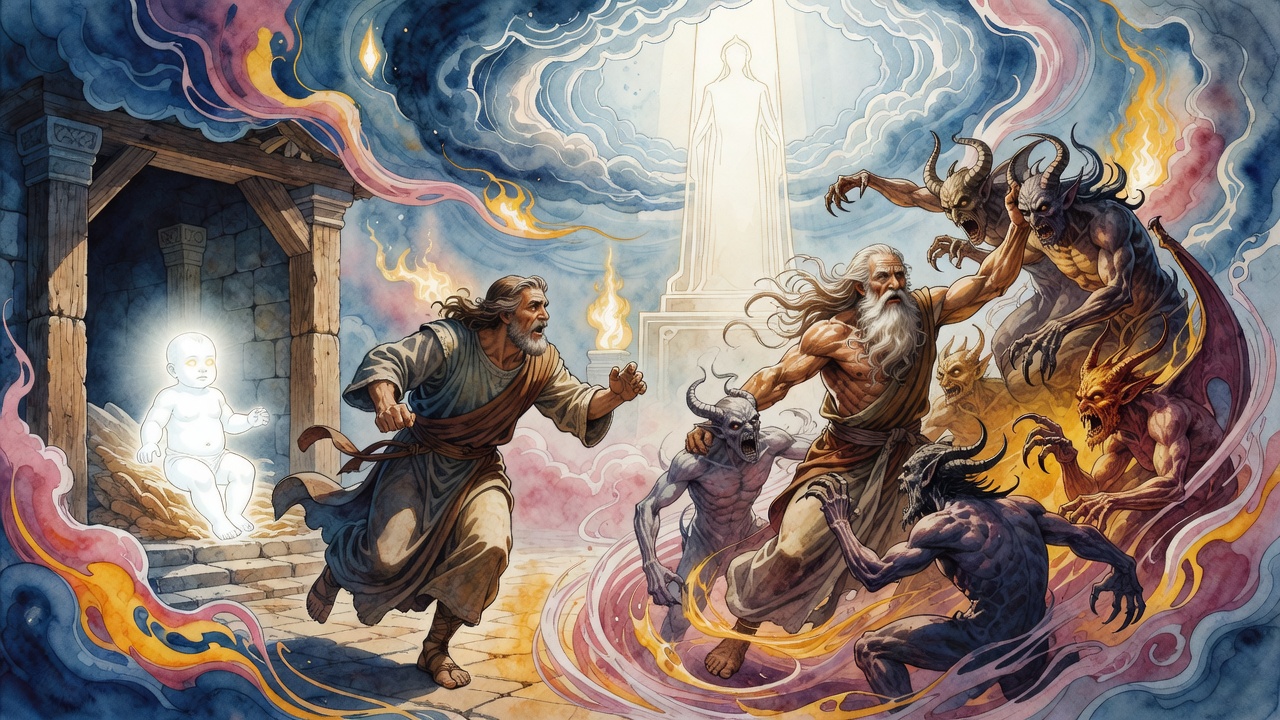
When the baby came out, Lamech ran. Not for help, not for celebration. He ran to his father Methuselah in panic, because the child in his tent did not look like a human baby. The skin was white as snow and red as a rose blooming in midsummer. The hair was white as wool. When the infant opened his eyes for the first time, the room filled with light. The moment he was born, before anyone had spoken to him, before he had been washed or wrapped, he opened his mouth and praised God.

Lamech told Methuselah: "I have begotten a strange son. He does not resemble a human being. He resembles the children of the angels of heaven. His eyes are like rays of the sun. When he opened them, the whole house shone."

Methuselah went to his own father Enoch, who by this point was already in the heavens. Enoch sent back a message through the angelic messenger: "this child is not a demon's offspring. He is your son's son. He will be righteous when all the world is wicked. His name should be Noah, meaning comfort, because through him the earth will receive comfort after what is coming." Lamech went back to his tent, and the glowing child grew up to be a man.

The Generation That Made Noah Necessary

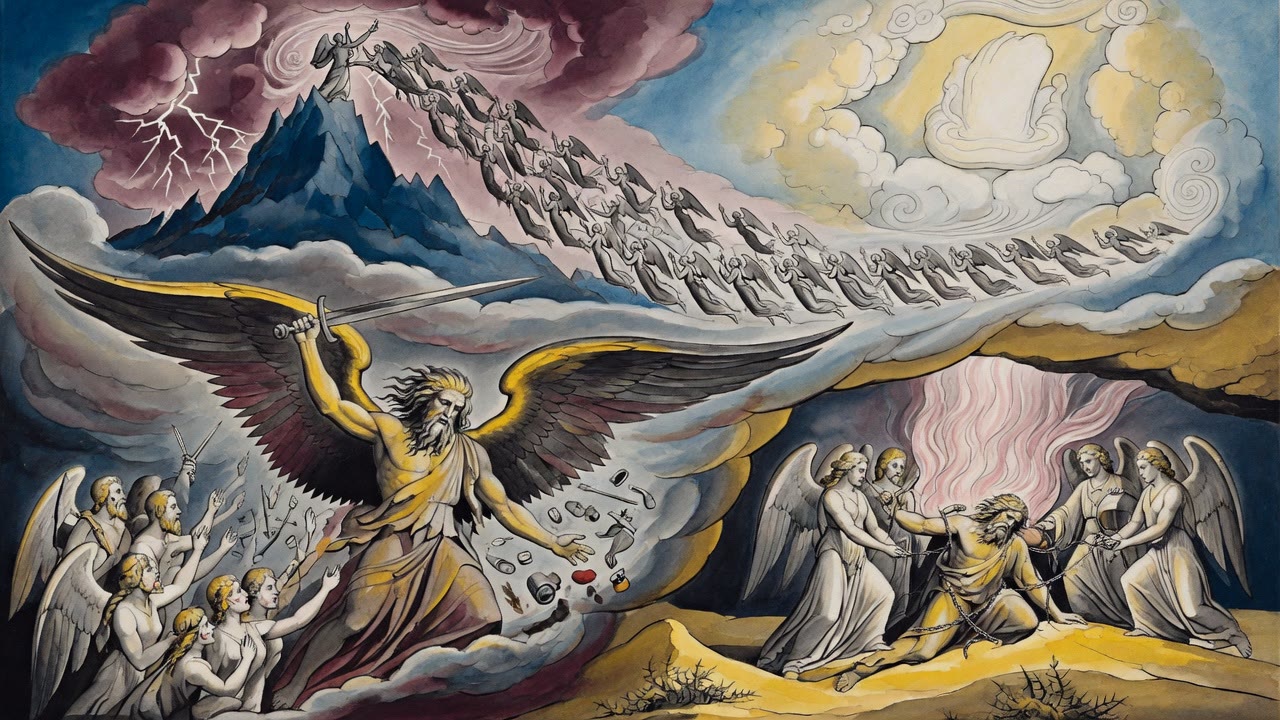
What was coming was the generation of the Flood, and the tradition lingers on what made that generation so dangerous. They were not simply violent. They were the generation that had received the Watchers' gifts: Azazel's weapons, the fallen angels' forbidden knowledge, the techniques of war and seduction that the Watchers had carried down from heaven and distributed through human culture. The earth was full of violence not because human beings were newly wicked but because the wickedness had been systematically taught and equipped by beings from a higher order.

Noah was born into this world glowing like something that did not belong in it. His luminous appearance was not incidental. It was a marker, the same way the Watchers had shone when they descended from heaven, the same way angels appeared as beings of fire when they entered the human realm. Noah was not an angel. But he carried something angelic in his birth, a sign of the divine appointment that had been made before he was born.

Building the Ark While the World Laughed

For one hundred and twenty years, Noah built the ark and warned his neighbors. The tradition records the neighbors' response as consistent contempt. They planted trees near the construction site and sat in the shade to watch the spectacle. They told each other the project would drag on for generations. They told each other nothing would come of it. The man building a boat on dry land was obviously deranged.

Noah carried the full weight of prophet's knowledge and builder's labor together. He knew exactly what was coming, not because he was guessing but because God had told him. He knew the date. He knew the mechanism. He knew that every person laughing at him from under their fig trees was going to drown. And he kept building anyway, kept warning anyway, kept working for one hundred and twenty years on a project the entire world found absurd.

The Demons After the Flood

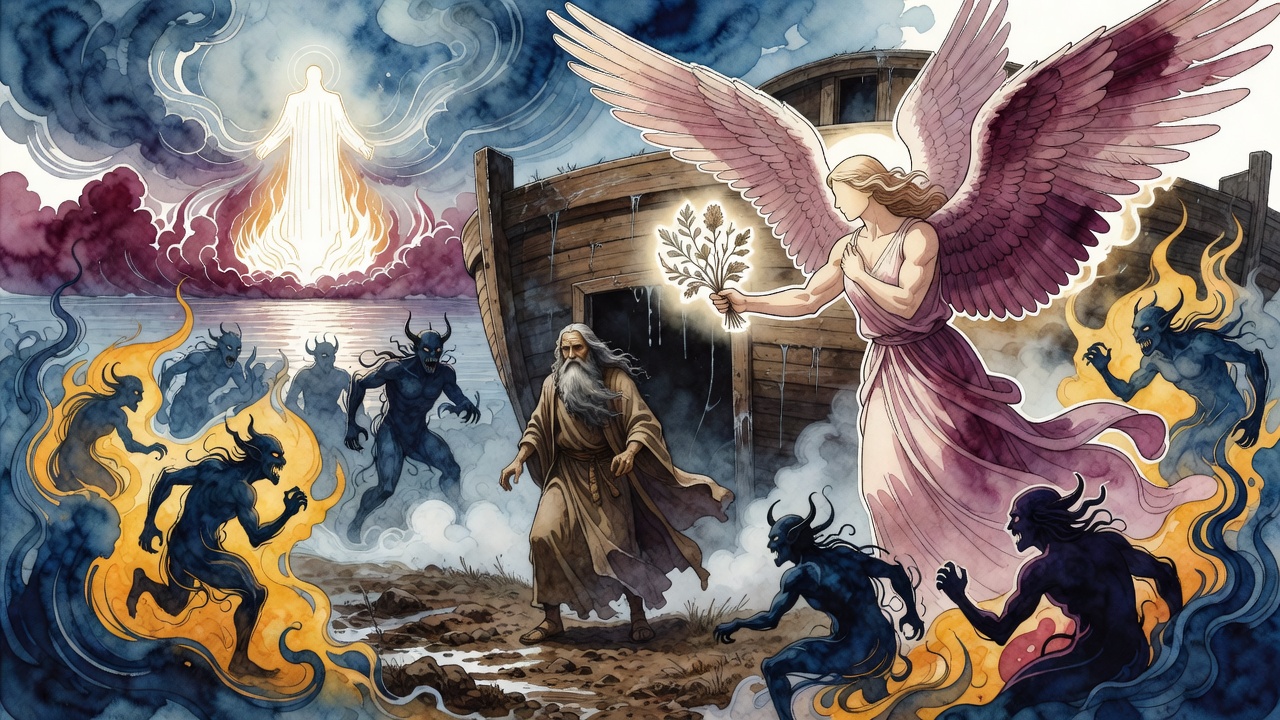
When the waters receded and Noah emerged, he found that the world had not been entirely cleaned. The Flood had killed the Nephilim, the giant offspring of the Watchers, but the spirits of those giants had survived. Disembodied, incorporeal, they roamed the earth afflicting the living with disease and madness, entering livestock and human beings, working the kind of harm that physical violence cannot accomplish. The world after the Flood was quiet of giants but full of their lingering remnants.

Noah appealed to God about the demons and God heard him. Nine-tenths of them were bound and confined to the underworld, sealed away from the living world entirely. One-tenth were left free, under the command of their prince Mastema, to test and afflict human beings in proportion to their sins. Noah had bargained down the population of the spirit world by ninety percent. The tradition makes him the origin of every healing spell, every antidemon procedure: the remedies against evil spirits were taught to Noah's son Shem and recorded by them, passed down through the generations as the medical knowledge of the post-Flood world.


← All myths
From the tradition

Sources

5 sources

The texts this telling draws on, in full. Open a card to read inline, or expand it for a wider, quieter read.

Legends of the Jews, IV. Noah, The Birth Of NoahLegends of the Jews

I’m talking about Noah, the hero of the Ark, the one chosen to rebuild humanity after the Great Flood. But before the ark, before the flood, there was a birth story so extraordinary, it almost sounds like something out of a dream.

In Legends of the Jews, Ginzberg's masterful compilation of rabbinic lore, the birth of Noah was anything but ordinary. Lamech, Methuselah’s son, took a wife, and she bore him a child unlike any other. The baby’s skin was "white as snow and red as a blooming rose," his hair "white as wool," and his eyes shone like the sun. Can you imagine the sight? When he opened his eyes, the house lit up! And get this – the moment he was born, he opened his mouth and praised God!

Lamech, understandably, was freaked out. He ran to his father, Methuselah, exclaiming, "I have begotten a strange son; he is not like a human being, but resembles the children of the angels of heaven!" He feared this child wasn't even his, but rather the offspring of an angel. He worried that this child heralded some terrible event.

Methuselah, sensing his son's distress, journeyed to the ends of the earth to consult with Enoch. Remember Enoch? The one who “walked with God” (Genesis 5:24) and was taken directly into Heaven. Methuselah sought Enoch's wisdom, hoping to understand the meaning of this extraordinary birth.

Enoch reassured Methuselah, revealing that the child was indeed Lamech's son. He foretold a great destruction, a year-long deluge that would wipe out mankind. But, he said, this child, Noah, and his three sons would be saved. "Call his name Noah," Enoch instructed, "for he will be left to you, and he and his children will be saved from the destruction which will come upon the earth."

Methuselah returned home and named the child Noah. The name Noah (נֹחַ) itself suggests "rest" or "comfort." But there’s a twist! According to Legends of the Jews, only Methuselah called him Noah. Lamech and everyone else called him Menahem (מְנַחֵם), meaning “Comforter.” Why the secret name? Because Methuselah feared that if his true name were known, the child might be susceptible to the sorcery prevalent in that generation. So, Noah was also Menahem, a comforter, a beacon of hope.

His very birth was a sign. We learn that Adam cursed the ground, and God said this curse would last "Until a man child shall be born whose conformation is such that the rite of circumcision need not be practiced upon him." Noah was born already circumcised! An extraordinary sign of his unique destiny.

But the wonders didn't stop there. As Ginzberg retells, drawing on various midrashic (rabbinic interpretive commentary) traditions, before Noah's birth, the earth was corrupted. Sow wheat, and oats would sprout. But with Noah’s arrival, the earth bore the crops that were planted. He even invented the plow, the scythe, the hoe – all the tools needed to cultivate the land. Before him, people worked the land with their bare hands! It was also said that before Noah, animals rebelled against humans, and the sea flooded the land. With Noah's birth, order was restored; animals became obedient, and the sea stayed within its bounds. Even a great famine ended with his birth.

So, what does all this tell us? The story of Noah's birth, as recounted in Legends of the Jews and other sources, paints a picture of a world desperately in need of redemption. His arrival wasn't just the birth of a baby; it was a cosmic event, a turning point in history. He was a beacon of hope, a promise of renewal, born into a world teetering on the brink of destruction. It makes you wonder, doesn't it? What "Noah" – what promise of hope and renewal – are we waiting for in our own time?

Full source
Legends of the Jews, IV. Noah, The Generation Of The DelugeLegends of the Jews

It all started with two distinct family lines: the descendants of Cain, known for their sinfulness, and the descendants of Seth, initially known for their piety. Picture this: the Sethites, dwelling peacefully in the mountains near Paradise, while the Cainites occupied the very field where Abel was slain, near Damascus. A stark contrast. But sadly, goodness doesn't always last. At the time of Methuselah, after Adam's death, the Sethites began to stray. They became corrupted, adopting the ways of the Cainites. These two strains, once separate, united in their wickedness, and from their unions came the Nephilim – giants, both physically and spiritually. These Nephilim, in their arrogance, even claimed the same noble lineage as the Sethites!

What fueled this descent into depravity? Well, life was too easy. The conditions were too good. They lived in a world of unprecedented prosperity. A single sowing yielded enough harvest for forty years! They could even use magic to control the sun and moon.

Even childbirth was ridiculously easy! Pregnancies lasted only a few days, and newborns could immediately walk and talk, even helping their mothers cut the umbilical cord. According to legend, one newborn even fought off a demon! The Talmud (Niddah 30b) describes similar extraordinary births. Can you imagine?

This carefree existence, devoid of toil and hardship, gave them ample time to indulge in their wicked ways. They became insolent and rose up against God.

The Zohar tells us that God is patient, but even divine patience has its limits. For a time, God overlooked their iniquities. But when they began to lead unchaste lives, His forbearance ceased. "God is patient with all sins save only an immoral life," as the saying goes. (Ginzberg references the Midrash (rabbinic interpretive commentary) here).

And it wasn't just immorality. They were also incredibly greedy, so cunning in their schemes that the law couldn't touch them. Ginzberg illustrates this with the example of a farmer bringing vegetables to market. They would subtly steal bits at a time, each theft insignificant, but collectively devastating, leaving the farmer with nothing to sell.

Even after God decided to destroy the world, He extended one last act of mercy. He sent Noah to warn them, giving them 120 years to repent. Imagine Noah, preaching about a coming flood, while they scoffed and mocked him.

"What flood?" they sneered. "If it's a fire flood, we know how to protect ourselves. If it's a water flood, we'll cover the earth with iron rods or build defenses against rain!" Noah warned them that the waters would come from beneath their feet, something they couldn't defend against.

They remained stubborn, partly because Noah revealed that the flood wouldn't come as long as the righteous Methuselah was alive. When the 120 years of probation ended and Methuselah died, God, in his compassion, granted them another week – the week of mourning for Methuselah. During this time, nature itself seemed to weep, with the sun rising in the west and setting in the east, a disruption of the natural order as noted in Midrash Rabbah. God even showed them a glimpse of the delights awaiting the righteous in the world to come, to demonstrate what they would be forfeiting.

But it was all in vain. After Methuselah and the other righteous of the generation passed away, God brought the deluge upon the earth. A tragic end to a generation that had been given so much, yet squandered it all.

What does this story tell us? Perhaps it's a warning about the dangers of unchecked prosperity and the importance of humility and gratitude. Maybe it's a reminder that even when things seem perfect, moral decay can creep in. Whatever the interpretation, the story of the Generation of the Deluge serves as a powerful cautionary tale for us today.

Full source
Jubilees 4:15, 5:1-3, 5:5-7Book of Jubilees

It involves Watchers, forbidden knowledge, and a whole lot of trouble.

This isn't just a story of two rogue angels, Shemhazai and Azazel. According to some accounts, like the one we find in the Book of Enoch, Shemhazai was actually the leader of a whole crew, a posse if you will, of two hundred angels known as the Watchers. These weren’t just any angels,. They were a high order, beings who never even needed to sleep! Imagine the kind of heavenly secrets they held.

The story goes that these Watchers descended to the summit of Mount Hermon. There, they made a solemn oath, binding themselves together in their mission, whatever that was about to become. But something went wrong. Terribly wrong. As the angels fell from their holy state, they were diminished, lessened in both stature and strength. Their very essence changed; their fiery, ethereal forms became flesh, making them susceptible to earthly temptations.

At first, it seems, they had good intentions. The Watchers initially aimed to instruct humanity in the ways of righteousness. But then, they saw the daughters of men. And, well, things took a turn. Lust took hold, and they chose wives from among these women. The result of these unions? Giants. Literal giants roamed the earth, born of angel and human.

But the transgressions didn't stop there. Each of these angels, not just Shemhazai and Azazel, began to reveal secrets of heaven. They taught humanity charms and enchantments, incantations, and the knowledge of how to cut roots for magical purposes. They divulged the secrets of astrology and how to read signs. As we find in the Book of Jubilees (5:1-13) and 1 Enoch (6-14), the world was changing, and not for the better.

They even taught men the art of working metal to make weapons, and, perhaps even more destructively, they taught women how to make themselves desirable to men. It was a complete and utter breakdown of the natural order. And these angels, they sinned with anyone they desired – men, women, beasts, it didn't matter. As a result, everything on earth became corrupted.

Think of it as a kind of ancient, celestial version of the story of Prometheus, who stole fire from the gods. This legend of the Watchers is, in many ways, the primary Promethean myth in Judaism. The angels weren't just divulging dark secrets of heaven; they were revealing secrets of the natural universe, things that God, for whatever reason, had never intended for humans to know!

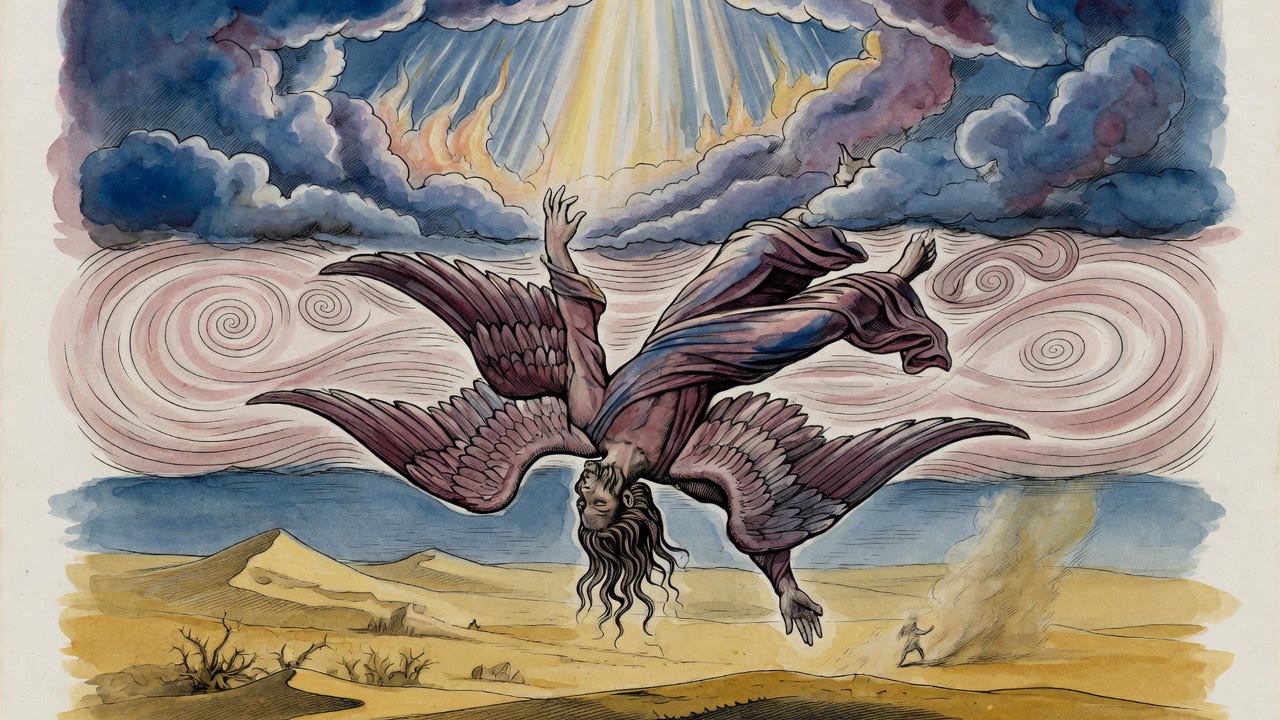
The situation became so dire that God had to intervene. He ordered these Watchers to be rooted out and bound in chains in the depths of the earth. According to the story, the archangels Uriel and Raphael went to God and reported the sins of the fallen ones. Then, God gave his orders: Raphael was instructed to bind Azazel hand and foot and cast him into a canyon in the desert of Dudael, covering him with darkness until the Day of Judgment, when he would be cast into the fire. And Michael was told to bind Shemhazai and his associates, holding them fast for seventy generations in the valleys of the earth until the Day of Judgment, when they would be led to the fiery abyss and tormented forever.

Now, there are different versions of this tale. Some say that Shemhazai and Azazel alone assumed human form when they descended, with the other Watchers taking the form of he-goats as their mounts. But regardless, the end result is the same: they were all cast into an abyss, where they remain imprisoned until the end of time.

What about the women who went astray with these Watchers? 1 Enoch (19:2) offers a chilling detail: they were transformed into sirens. It's a rare reference in a Jewish text to the sirens of ancient storytelling, those alluring, dangerous creatures of the sea.

This whole episode, according to 1 Enoch (6:6), is said to have taken place in the days of Jared, the father of Enoch. So, this myth of the Watchers is set in the generation just before Enoch, making it an integral part of his own story.

This story, with its themes of forbidden knowledge, lust, and divine punishment, continues to resonate. It makes you wonder about the nature of free will, the dangers of unchecked curiosity, and the price we pay for seeking knowledge that might be beyond our capacity to handle. What do you think? Are there some things humanity is better off not knowing?

Full source
Book of Jubilees 10:24Book of Jubilees

The familiar story centers on Noah, the ark, and the animals. But what about the aftermath? What kind of world did Noah and his family rebuild?

The Book of Jubilees, a fascinating text from around the 2nd century BCE, fills in some of those gaps. It offers a unique perspective on the period following the great deluge, particularly in its tenth chapter.

In Jubilees, they were actively prevented from harming Noah's descendants. It makes you wonder what methods were employed! Was there some kind of spiritual quarantine?

Then there's the matter of inheritance. Noah, it seems, wasn't just handing down land or livestock. "He gave all that he had written to Shem, his eldest son; for he loved him exceedingly above all his sons." What was this written material? Was it a record of the flood? Prophecies? Secret teachings? The Book of Jubilees doesn't explicitly say, but it emphasizes the importance of transmitting knowledge and wisdom from one generation to the next. Shem, clearly, was deemed worthy of this sacred trust.

The text then recounts Noah's passing. "And Noah slept with his fathers, and was buried on Mount Lûbâr in the land of Ararat." The phrase "slept with his fathers" is a beautiful, poetic way of saying he died, joining the generations that came before him. And the location, Mount Lûbâr in Ararat, connects us back to the ark's landing place, completing the cycle.

His lifespan is given with remarkable precision: "Nine hundred and fifty years he completed in his life, nineteen jubilees and two weeks and five years." A jubilee is a period of 49 years (seven cycles of seven years, as prescribed in Leviticus). This meticulous accounting highlights the importance of time and chronology in the Book of Jubilees, which aims to provide a detailed historical and legal framework for understanding God's covenant with humanity.

The passage concludes with a powerful statement about Noah's righteousness. "And in his life on earth he excelled the children of men save Enoch because of the righteousness, wherein he was perfect." Noah was considered exceptional, but he still stands second to Enoch. And who was Enoch? "For Enoch's office was ordained for a testimony to the generations of the world, so that he should recount all the deeds of generation unto generation, till the day of judgment."

Enoch, who "walked with God" (Genesis 5:24) and was taken directly into heaven, held a unique position as a celestial scribe and witness. He was responsible for recording the history of humanity and bearing witness to their deeds until the final judgment. The Zohar tells us of the great mysteries surrounding Enoch, who became the angel Metatron.

So, what does all of this tell us? Jubilees 10 gives us a glimpse into a world confronting the consequences of a global catastrophe. It highlights the importance of transmitting knowledge, upholding righteousness, and remembering the past. It's a reminder that even after the most devastating events, the work of rebuilding, both physically and spiritually, must continue. And it leaves us pondering the legacy of Noah, the wisdom of Enoch, and the enduring power of stories to shape our understanding of the world.

Full source
Legends of the Jews 4:83Legends of the Jews

In the year 1569 after creation, Noah himself, guided by an angel, divided the world among his three sons: Shem, Ham, and Japheth. Imagine the scene – a world freshly cleansed, a family gathered, and the fate of nations hanging in the balance.

The method? A lottery, of sorts. Each son reached into Noah's bosom (a somewhat archaic but evocative image!) and drew a slip. And the slip Shem drew? Well, that was something special.

It was inscribed with the "middle of the earth." The middle of the earth! This, the story tells us, became the eternal inheritance of Shem's descendants. It’s a powerful image, isn't it? The very heart of the world belonging to one lineage.

Noah, upon seeing the result, rejoiced. Why? Because, as the story goes, this fulfilled his blessing upon Shem: "And God in the habitation of Shem." (Genesis 9:26). The idea is that God's presence would dwell most strongly within Shem's territory.

But what made this particular patch of land so significant? What made it the "middle of the earth?"

Well, three supremely holy places fell within Shem's designated area. Firstly, there's the Holy of Holies in the Temple in Jerusalem – the innermost sanctuary, the dwelling place of the Divine Presence. Then, there’s Mount Sinai, located at the middle point of the desert, where Moses received the Torah. And finally, Mount Zion, considered the navel – the very center – of the earth. Think of it as an umbilical cord connecting humanity to the divine.

These weren't just arbitrary locations. According to this tradition, they were points of immense spiritual power, all located within the territory of Shem. It’s a powerful assertion about the spiritual centrality of that land and the destiny of Shem’s line.

So next time you think about maps, about borders, about the division of land, remember this ancient story. It's not just about geography; it’s about destiny, blessing, and the enduring quest to find the center – the axis mundi – of our world. A quest that, perhaps, begins within ourselves.

Full source