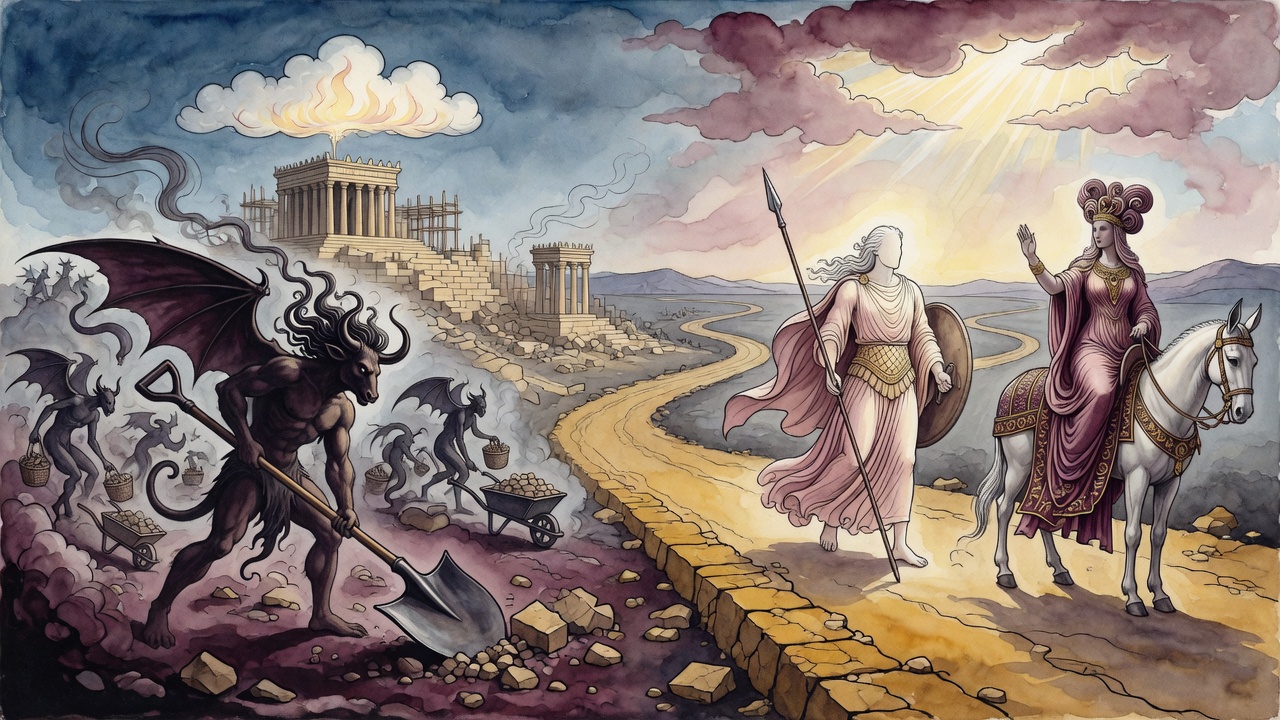
Obyzouth Faced Solomon and Named Raphael as the Angel Who Stops Her
She was a woman's head with no body, hair hanging wild. She told Solomon to wash his hands before he asked her name. He got up and washed.
Table of Contents
 Click for full size
The Boy Who Was Losing His Thumb
The child who ran errands for the master workman on the Temple site was getting thinner every week, and Solomon had grown fond of him.
He called the boy over and asked him straight. "Do I not love you more than any craftsman working on the house of God? Do I not pay you double wages and give you a double ration of food? Why are you thinner by the day and by the hour?"
The boy told him. Every evening after the workers went home and he lay down to sleep, one of the evil spirits came and took half his pay and half his food, then took hold of his right hand and sucked his thumb. "My soul is being pressed out of me," he said. "That is why my body keeps shrinking."
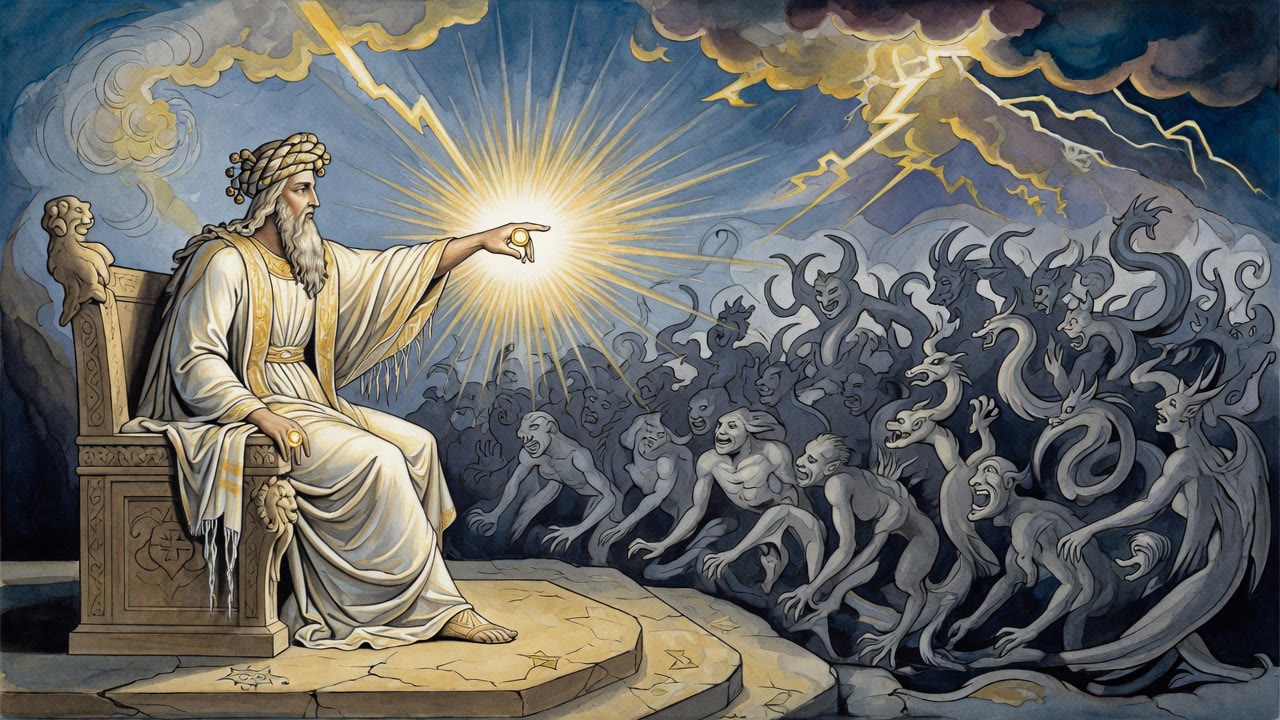
Solomon went into the Temple and prayed night and day for the demon to be handed over. The archangel Michael came with a small ring. Its seal was a cut stone. "Take it," he said. "With this you will lock up every demon on the earth, male and female, and with their labor you will build Jerusalem."
In the morning Solomon gave the ring to the boy. "When the thing comes," he said, "throw this at its chest and say, In the name of God, King Solomon summons you here. Then run to me, and do not be afraid of anything you hear behind you."
The child stood in the dark and waited. The demon Ornias came at him like a fire walking. The boy threw the ring, said the words, and ran. Behind him the demon was shouting after a child. "Take it off me, boy. Take this off me and I will give you the gold of the earth. Only do not lead me to Solomon."
The Demon Who Gave the King an Order
After that they came in one at a time, and the king asked each of them the same three questions. Who are you. What harm do you do. What name stops you.
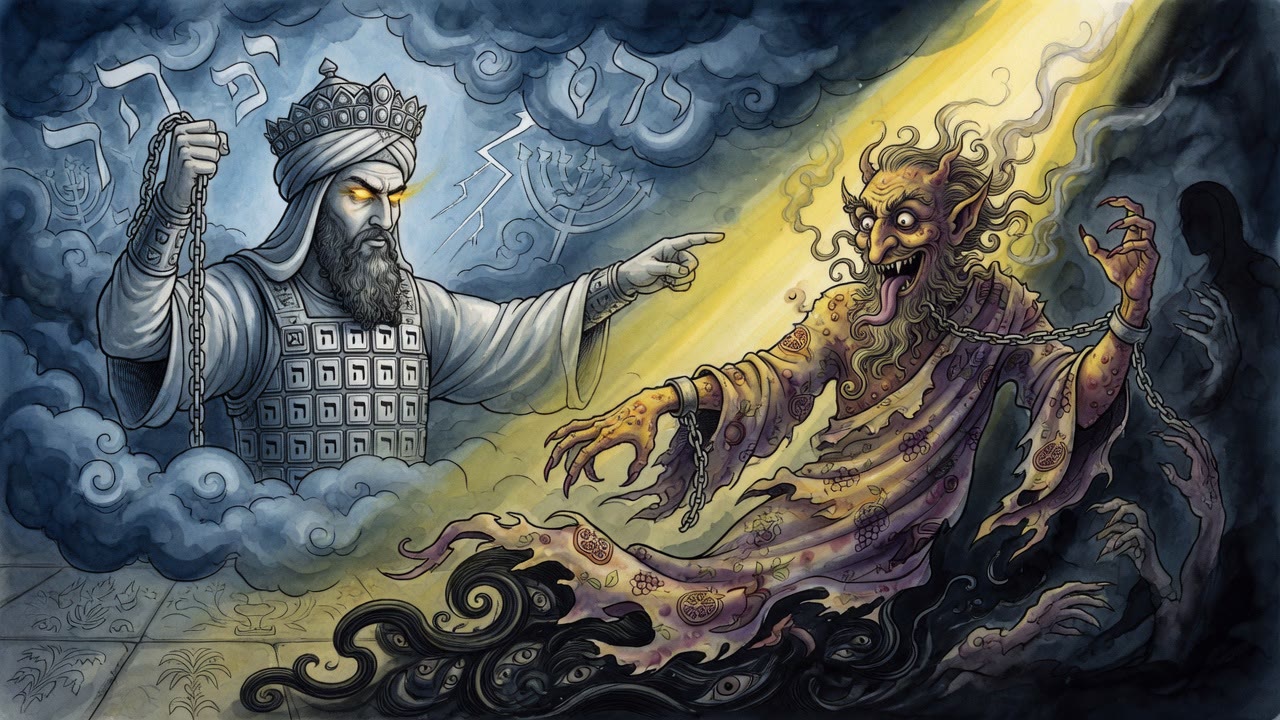
Then a spirit came in that was a woman's head with no body attached, and her hair hung loose and wild around it.
Solomon asked her who she was.
"Who are you," she said. "And why do you want to hear about me? You can see me. I am standing bound in front of your face. Go into your royal storehouses and wash your hands. Then come back and sit down at your tribunal and ask me your questions, and you will learn who I am."
The king of Israel got up. He went to the storehouses. He washed his hands. He came back and sat down.
What She Did at Night
"I am called among men Obyzouth," she said, and faced him. "By night I do not sleep. I go around the whole world and visit women in childbirth. I work out the hour and take my position, and if I am lucky I strangle the child. If I am not, I go on to another house. I cannot let a single night end without success."
The rest of the confession came out flat, the way a workman lists his trade. Ears made deaf. Eyes ruined. Mouths tied shut. Minds broken. Small bodies kept in pain. She had no other occupation and wanted none.
Solomon looked at her while she talked. Her whole body was in darkness and her limbs could not be seen at all. Her stare was bright and green. Her hair moved like a dragon's. Her voice came across the floor to him perfectly clear.
"You have sealed me around with the ring of God," she said, "and you have done nothing at all. I am not standing in front of you. You will not be able to command me."
The Name She Gave Away
So he asked her the third question sideways, the way he had learned to ask it. "By what angel are you frustrated, spirit?"
She answered before she could stop herself.
"By the angel of God called Afarot," she said, "which is to say Raphael. He frustrates me now and he will frustrate me for all time. And if any man knows that name, I cannot get into the room where a woman is in labor."
She had just told the king of Israel the name that keeps her out.
Hung Up Where the Country Could See
Solomon had her hair bound together and had her hung up by it in front of the Temple of God, in the open, where every man and woman going up to the house would walk past her and look.
Then he went back to work. A demon came in that had every limb of a man and a stump where the head should be, and spoke out of nowhere in particular, and said its name was Envy, and that it went about taking heads off men because it wanted one of its own and had never managed to keep one. A great hound came in and turned out to be a scholar who had once held the stars back, and was sent off to show a servant where a green stone lay in the mountains for the ornament of the house. A winged thing with a man's face and hands and the body of a dragon boasted that men had once worshipped it, and was put to sawing marble. Thirty-six spirits came in together with the faces of asses and oxen and birds, and each one named a disease it caused in the human body and the angel whose name puts an end to it.
Every one of them was sealed and set to work on the building.
Obyzouth hung by her hair in the sun in front of the house, and the name she had given away stayed in the king's mouth.
← All myths