Phinehas Hid a Spearhead in His Shirt and Walked Into Zimri's Tent
Zimri asked Moses what was wrong with a Midianite woman, since Moses had married one himself. Moses had no answer. A young priest stood up.
Table of Contents
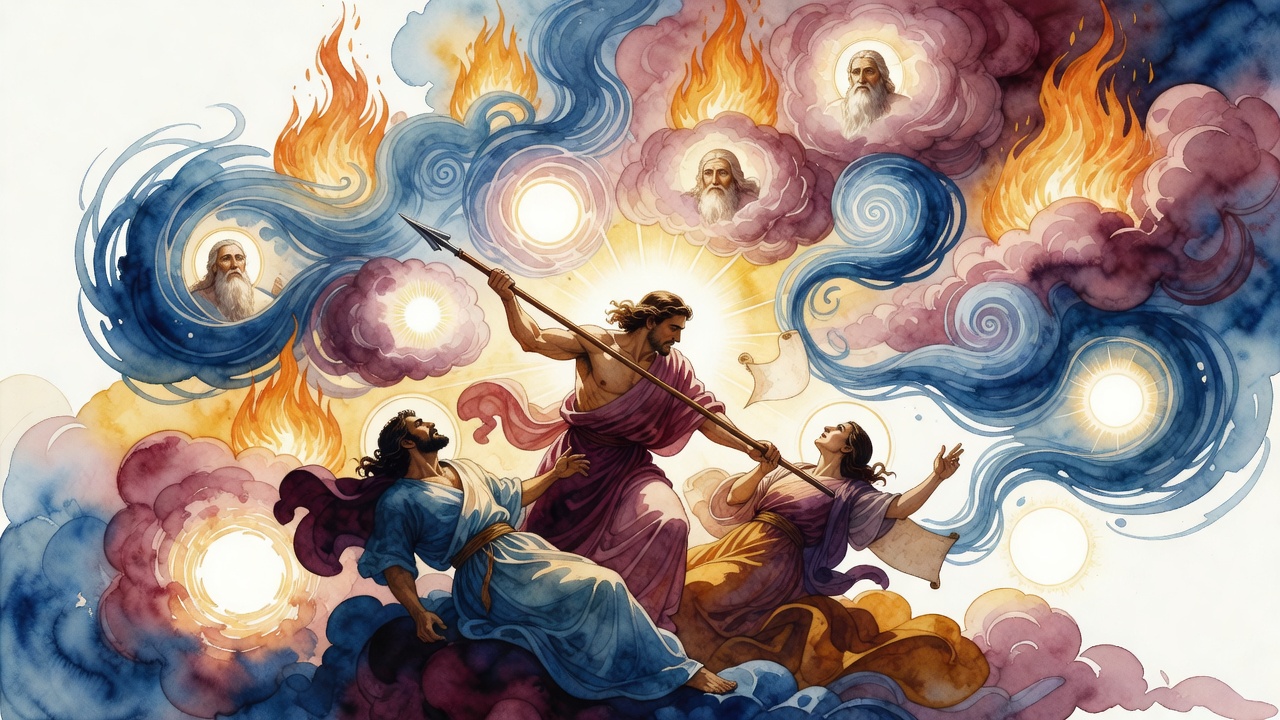 Click for full size
Fastened Like a Nail in a Board
Israel camped at a place called Shittim, and the daughters of Moab came out to meet them with food.
Each woman carried a bundle. Inside the bundle, wrapped and out of sight, was a small image of Peor. She would set out the meal, pour the wine, wait until the man was comfortable, and then bring the thing out and set it in front of him. Bow to it first, she would say. Otherwise nothing.
Men bowed. Then they went to the sacrifices of the Moabite gods and ate there, and by the end of it the camp was fastened to Baal Peor the way a nail is fastened into a board. You do not pull that nail out. You split the board.
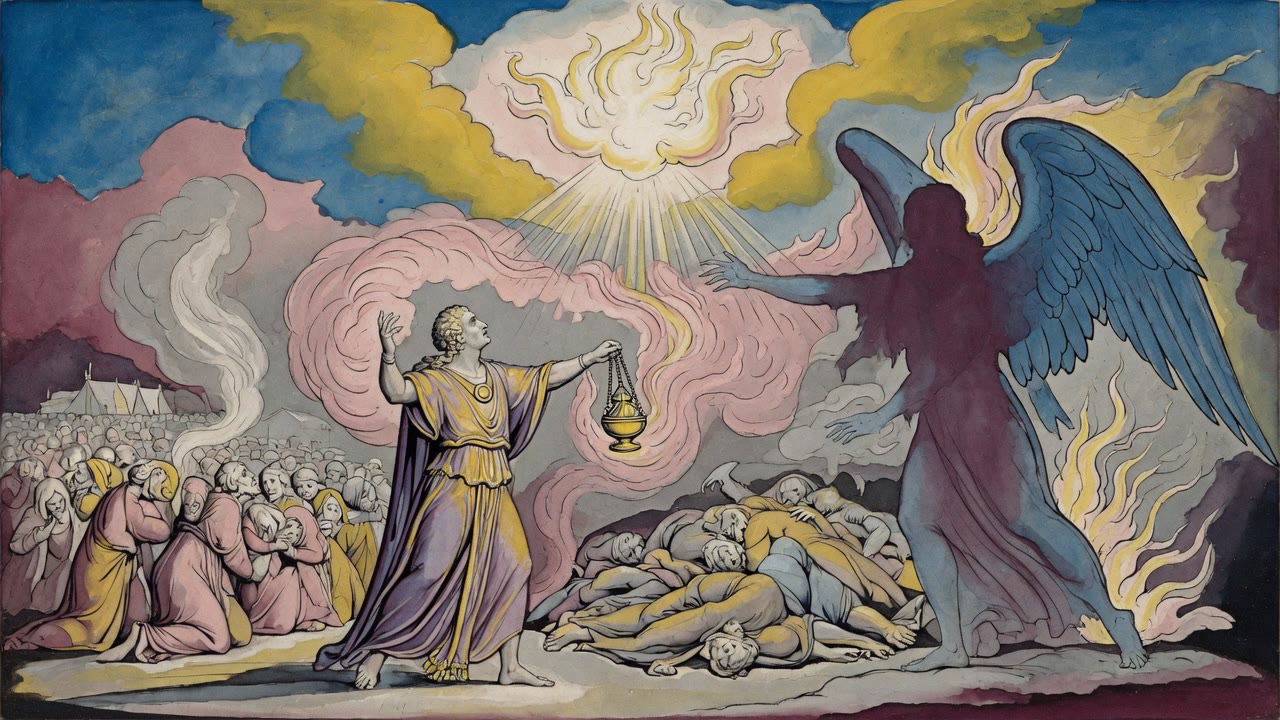
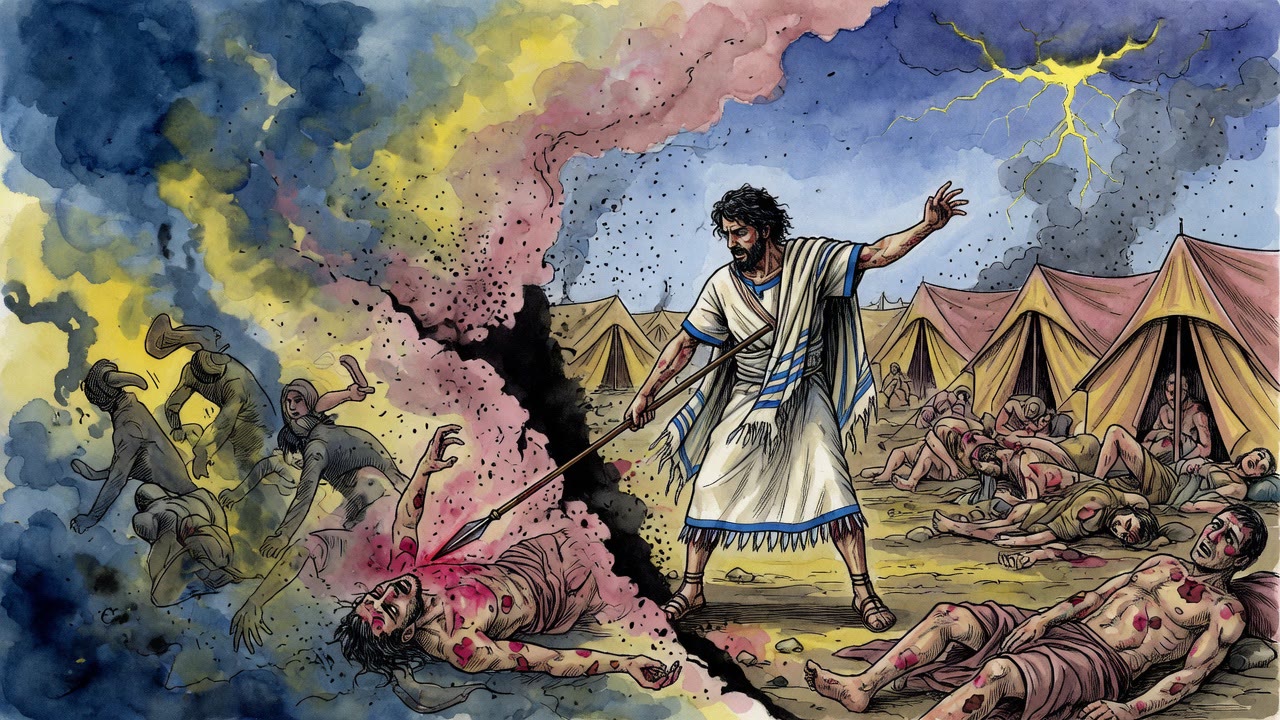
A plague started in the camp and would not stop. Moses called every tribal chief and made them judges and told them to hang the men who had gone after Peor, facing the morning sun, and to cut them down at sunset and bury them, and hope the anger turned.
Zimri Asked Moses About His Own Wife
While the judges were still arguing about who was liable for death, a man walked into the middle of it holding a woman by the hand.
Zimri son of Salu was a prince of the tribe of Simeon, and the woman was Kozbi, daughter of Zur, whose father ruled in Midian. He brought her past the elders, past the weeping crowd at the door of the Tent of Meeting, and stopped in front of Moses.
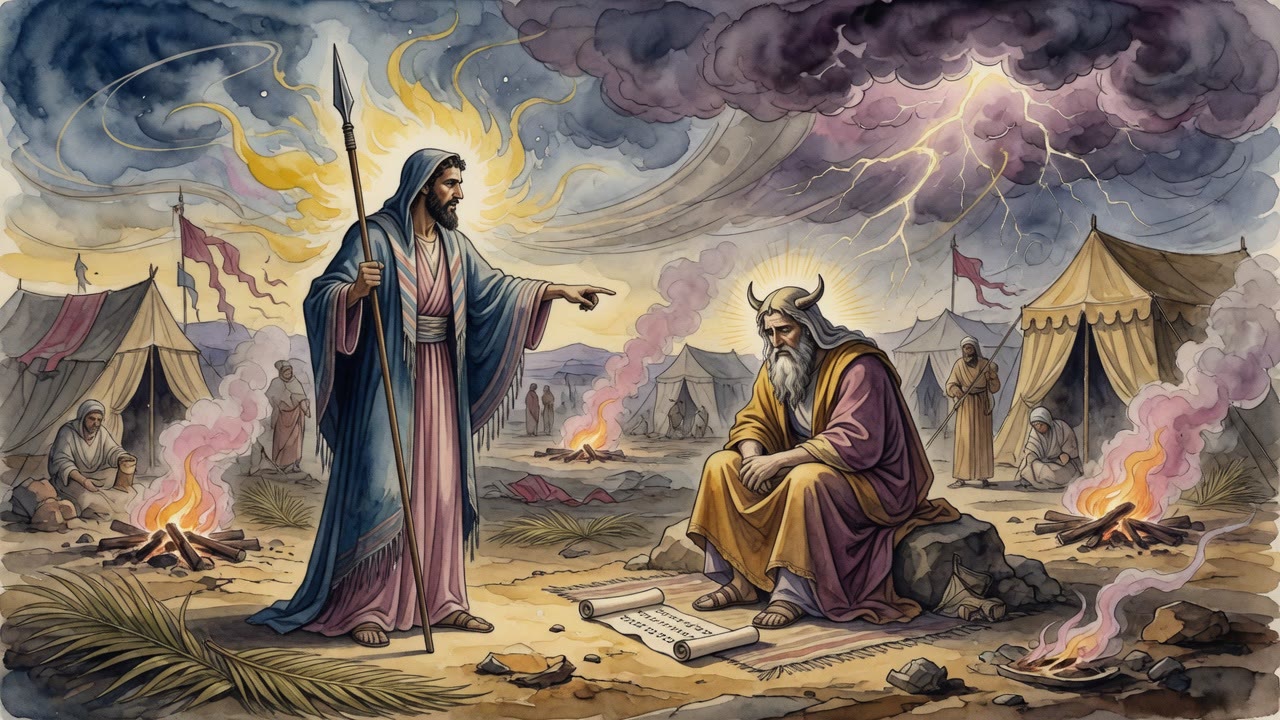
"What exactly is wrong with this one?" he said. "If you tell me she is forbidden, then tell me who you married. Was the daughter of Jethro not a Midianite?"
Moses had nothing. He trembled where he stood and then he fainted, and the elders did not move, and the crowd at the door went on weeping and calling out, and Zimri walked his woman into the inner chamber in front of all of them.
The Spearhead in His Shirt
Phinehas, son of Eleazar, grandson of Aaron, was sitting in the assembly when he watched it happen, and a ruling came back to him that everyone in that room had learned and nobody in that room was saying out loud.
He got to his feet. "Whoever is supposed to do the killing, let him kill," he said. "Where are the lions of Judah?"
Nobody answered. They looked at him and went quiet.
So he went to get a spear, and because no man may carry a weapon into the house of study he pulled the iron head off the shaft and pushed it inside his clothing against his chest. Then he walked out leaning on the bare pole like an old man with a staff, straight toward the tent where Zimri had gone, and the men of Simeon were standing around it in a ring.
"Why have you come?" they said.
"I have needs of my own," Phinehas said.
They laughed and let him through. He fitted the iron back on the wood inside the doorway.
Twelve Things That Should Have Stopped Him
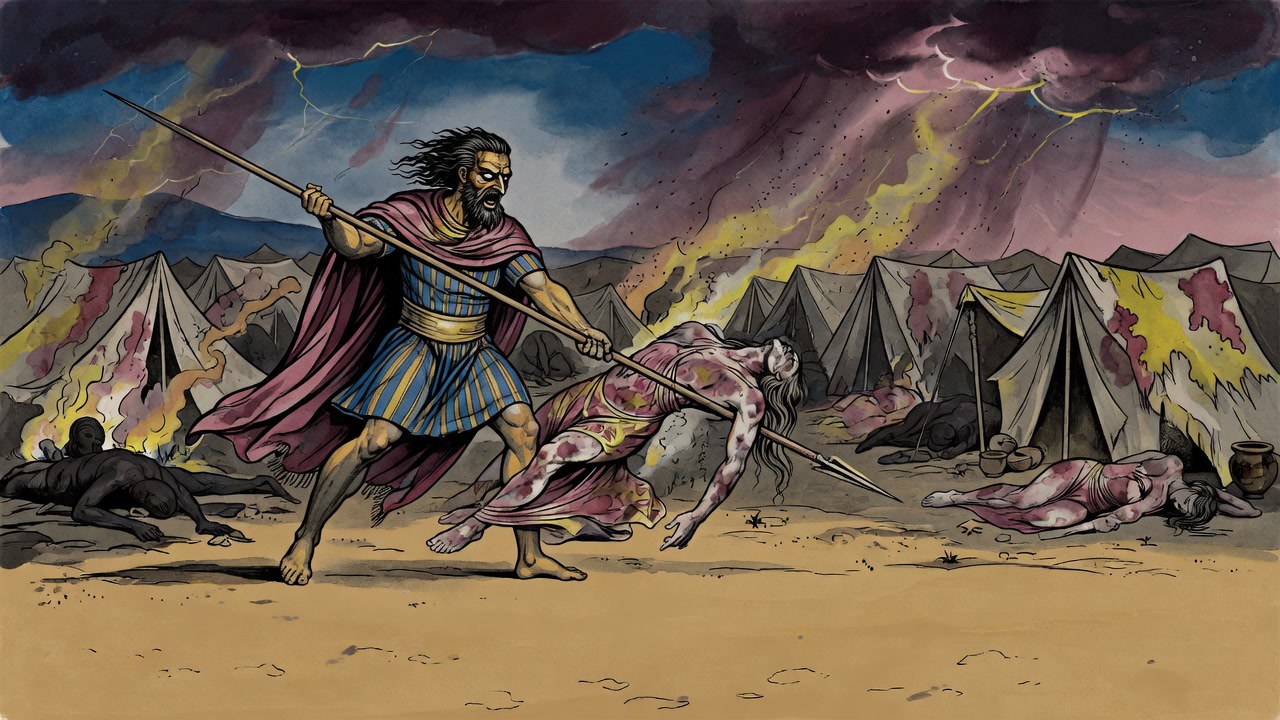
An angel held the two of them together so they could not pull apart and be gone before he reached them. The angel shut their mouths so neither could shout, and one shout would have brought the tribe of Simeon in on top of him. He drove the spear through both bodies at once, through the place where they were joined, so that no one in Israel could stand up afterward and say the priest had killed on a guess.
The iron stretched to take both of them. His arm held. The wooden shaft held. Neither body slid off the point, and neither body died, because a corpse on a priest's spear would have made him unclean before he was out of the camp. Their blood thickened in the wounds and did not run down the pole onto his hands.
Then he lifted them. The lintel of the doorway rose so the two of them, still raised on the shaft, could be carried out into the light, and the angel turned them so that everyone standing there saw exactly what he had walked in on.
He carried them six miles, the whole length of the camp, on one arm, past the tents of Simeon, past every man who had reason to cut him down and no strength in his hands to do it, and he was not tired when he set them down.
Son of Puti
Twenty-four thousand were dead by then. Phinehas stopped in the middle of the camp with the two bodies over his head and shouted at heaven.
"Master of the world. For these two, twenty-four thousand of Israel are going to die?"
Mercy moved. He threw them down and prayed, and the plague stopped where it stood.
What he got for it, first, was a rumor. His mother's line ran back to Jethro, and men in the camp began saying it in the open: look at him, the son of Puti the Midianite, the grandson of a man who fattened calves for idols, and he is the one killing Israelites over a Midianite woman.
God answered the rumor by oath. Phinehas had been zealous with My zeal, and had stood in the breach of the people, and had turned My anger away from them. So he takes the priesthood, and his sons after him, and a covenant of peace forever. He struck with his arm and prayed with his mouth, and for that the priests of Israel eat the shoulder, the cheek and the stomach of every animal brought to the altar.
The oath had one more clause in it. He would not die. He would go on living as an angel of the covenant until the end of days, and it would be his voice announcing that the redemption had come.
← All myths