Rabbi Ishmael Fled Mount Gerizim After Naming Its Buried Idols
A man on Gerizim asked why walk to Jerusalem's ruins. Rabbi Ishmael named the refuse under the mountain, then ran for his life after dark.
Table of Contents
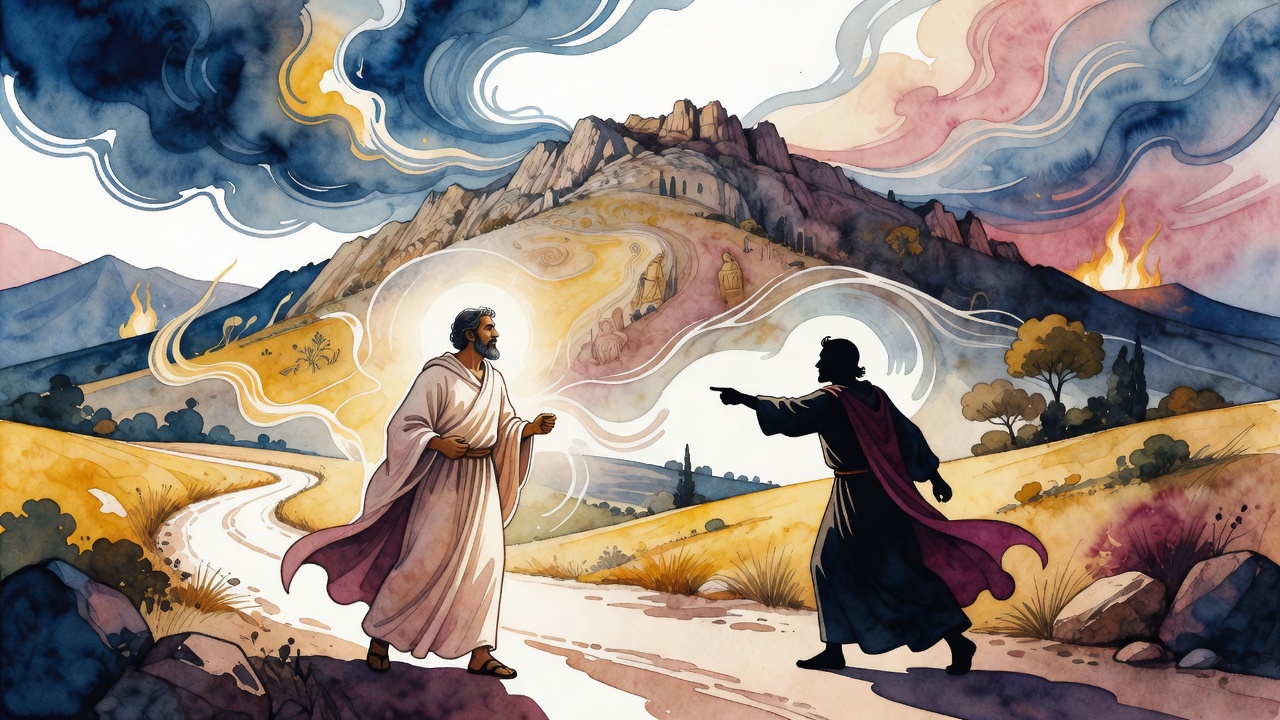
Rabbi Ishmael ben Rabbi Yosei was walking toward Jerusalem to pray when a Samaritan stopped him on the road below Mount Gerizim.
 Click for full size
"Where are you going?" the man said.
"I am going up to pray in Jerusalem."
The Blessed Mountain
The challenge was old. Why walk to ruins when the blessed mountain stands here? Gerizim is the mountain the Torah names for blessing (Deuteronomy 11:29). Jerusalem, in that hour, was rubble. The man pointed up the slope as if geography itself had already ruled.
Rabbi Ishmael did not argue the verse. He argued the dirt.
"I will tell you what you are like," he said. "A dog eager for a carcass. You know idols are buried under this mountain, as it is written, Jacob buried them. That is why you are eager for it."
The road went quiet. A pilgrimage had become an accusation, and the accusation had a patriarch's name on it.
Jacob Stripped the Camp
The dirt he meant was older than the argument. When Jacob came back from Laban's house, he told his household to put away the foreign gods, purify themselves, and change their garments (Genesis 35:2). He was not hunting one statue. He knew idolatry in cloth and in earrings and in small household gods carried out of Mesopotamia through twenty years of work.
Rabbi Yohanan said later that the sages were not expert in the fine points of idol worship the way Jacob was. The mishnah names the sun, the moon, a dragon. Jacob went further. He treated every pictured garment as a risk. He made them change clothes as if the weave itself could be a shrine.
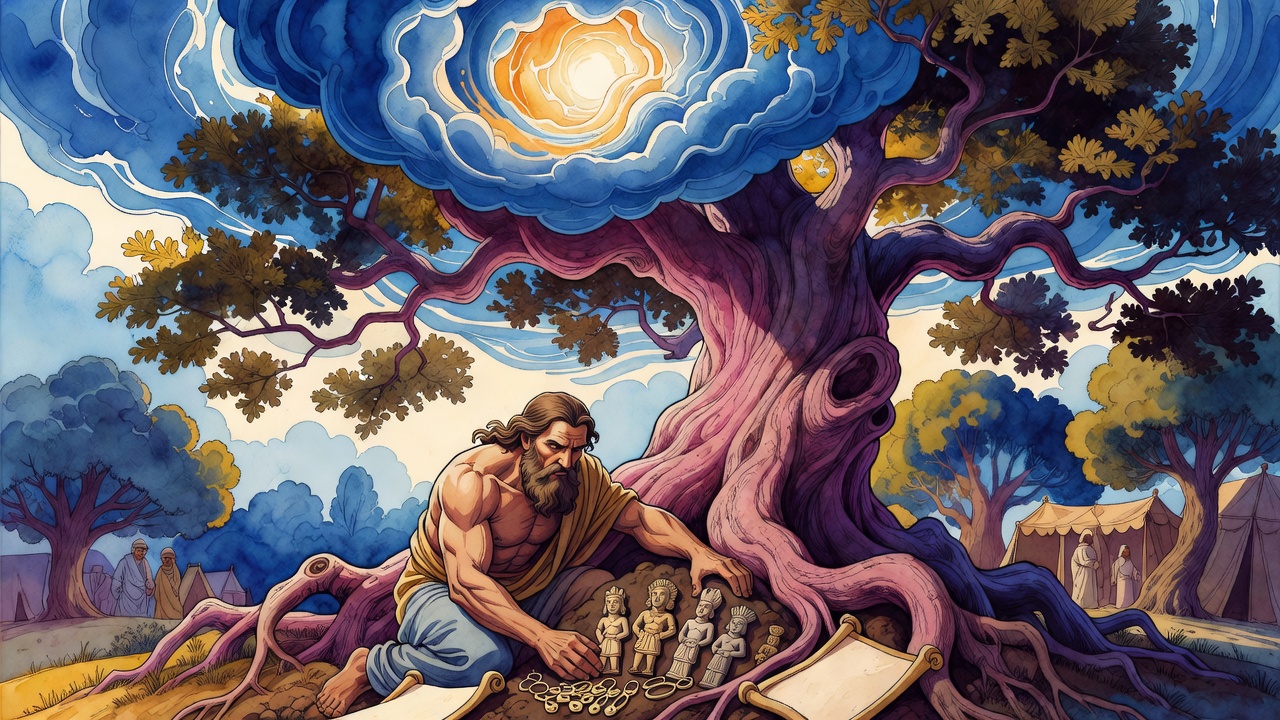
They put into his hands all the foreign gods they had, and the rings from the ears of Shechem, rings cut with the likeness of images, spoil from a city's temple. Jacob took the pile to the terebinth near Shechem and put it in the ground (Genesis 35:4).
He hid what could be hidden. He smashed what could be smashed. The tree marked the line between what he would carry toward Bethel and what he would not bring one step closer to the God he served.
The Dove They Dug Up
One piece did not stay dead.
Among the destroyed idols was a dove. It went into the ground in the shape of a bird. Centuries later, when Samaritans settled the territory of Shechem under Gerizim, they dug. They found it. They worshipped it.
That is the hunger Rabbi Ishmael named on the road. Not a pure old worship sitting on a blessed height. A recovery of what Jacob had thrown away. A mountain of blessing with a refuse pit under it, and a people who had learned to call the pit holy.
Jacob went on to Bethel and built an altar. He set up the stone that had been his pillow on the road to Haran. He sent for his parents. Isaac, who had sat in darkness, saw Levi and Judah and the dark left his eyes, and he blessed the two of them with sanctuary and with rule. The house moved forward. The dove stayed in the dirt until other hands wanted it.
They Reached a Consensus to Kill Him
The men on Gerizim heard Rabbi Ishmael's insult and made a different picture of it. This one seeks to take them, they told one another. He knows where the gods are. He has come as a thief, not as a pilgrim.
They reached a consensus to kill him.
A consensus is quieter than a riot. It is a decision that can walk a man off a road after dark and leave no sermon behind. Rabbi Ishmael felt the temperature of the slope change. The blessed mountain had become a mouth. He did not finish the pilgrimage that afternoon.
He rose and fled at night.
The Road After Dark
Jerusalem was still ahead of him, ruins and all. Gerizim was behind him, still calling itself the better prayer. Between them ran a man who had told the truth about a burial and then had to outrun the people who loved the burial.
Jacob had put the gods under a tree because he could not bring them into the next camp. Rabbi Ishmael had named that tree on a public road, and the naming had been read as a map to treasure. Idolatry, in that hour, was not only a statue. It was a hunger that heard "buried" and thought "ours."
The terebinth kept its silence. The dove, if it still lay anywhere in that ground, did not need to fly. It had already done its work. A mountain had been chosen over a ruined city, and a rabbi had been chased off the road for saying what the mountain sat on.
He ran. The idols stayed. The argument did not end because one man made it to morning.
← All myths