The Two Bloodlines and the Fall of Seth's Children
Seth's descendants lived near Paradise for generations, pious and untouched. Then they looked down at the Cainites and made a choice they could not take back.
Table of Contents
 Click for full size
The Child Born in His Father's Likeness
Adam was one hundred and thirty years old when Seth was born. More than a century had passed since Cain killed Abel and was driven from the family, and in those hundred years Adam and Eve had lived apart, separated by grief and guilt. The reunion that ended that separation produced a son who carried Adam's likeness in a way Cain never had. The rabbis understood this to mean something more than physical resemblance. Seth was the beginning of the righteous line.
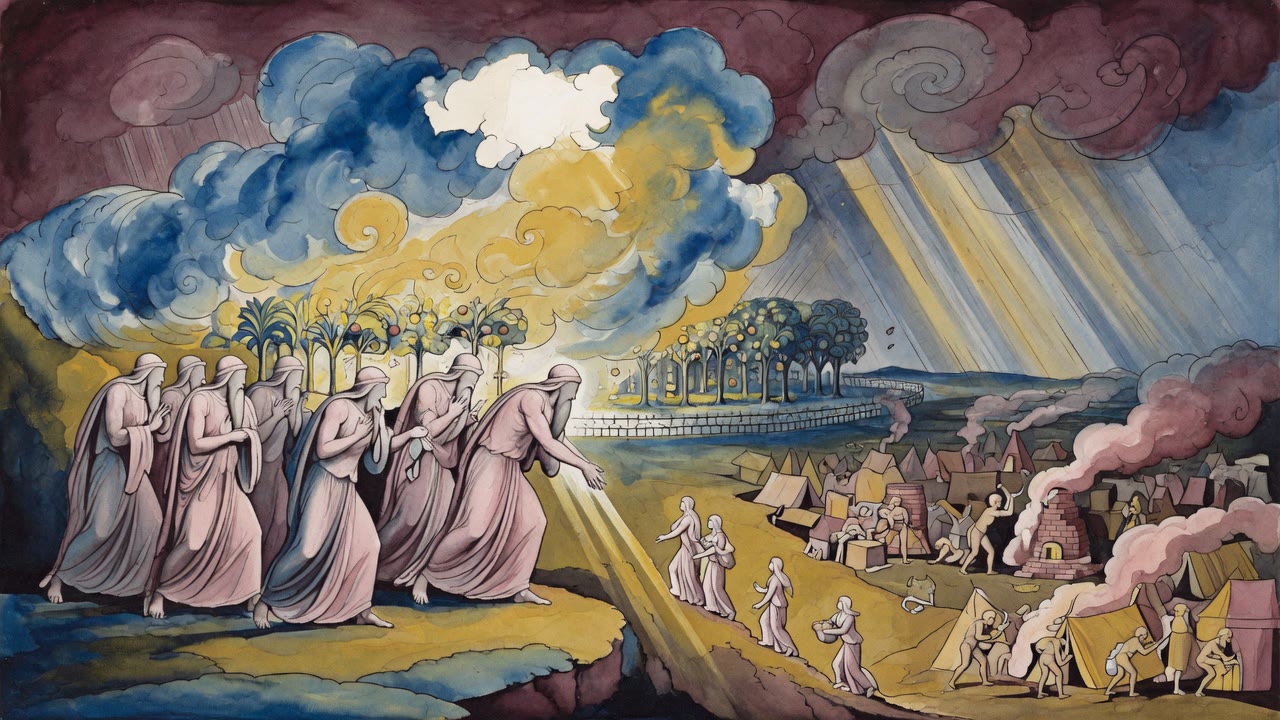
The family that descended from Seth settled on the mountains near Paradise. They could see the gates from where they lived. That nearness was not accidental. It kept them honest. They studied the stars, mapped the movements of the heavens, and inscribed their knowledge on two pillars, one of brick and one of stone, so that what they learned would survive whether the world ended by fire or by flood. They believed both were possible.
The Plain Below and the Mountain Above
Below them, in the lowlands, lived the descendants of Cain. The geography was moral. Cain's people had cities and music and metallurgy. They were inventive and violent and beautiful in the specific way that comes from needing nothing outside yourself. They built downward, into the earth, digging wells and raising walls. They did not look up at the mountains where Seth's children lived.
Seth's descendants looked down. This was the problem. Not immediately, and not all at once, but across generations, the view from the mountain became a temptation. The Cainites had things Seth's people did not have. They had abundance. They had ease. They had daughters who were striking in the particular way the tradition marks with caution, and they had no apparent consequences for anything they did.
The Descent That Could Not Be Undone
The sons of the great men among Seth's descendants, the Nephilim who are the mighty men spoken of in the old texts, looked at the daughters of the Cainites and descended. They took wives from among them. The tradition does not describe this as abduction. It describes it as choice, which is the more damning version. The pious chose to intermarry with the corrupt, and once that choice was made, the division between the two bloodlines collapsed.
What followed came in stages. The first generation brought the practices of the lowlands up into the mountains. Then the mountains became lowlands. The knowledge of the heavens that Seth's children had spent centuries accumulating was turned toward the arts of power and survival that Cain's children had always practiced. The pillars with their inscriptions stood, but the people who had made them were no longer the kind of people who needed what the pillars said.
What Was Lost Before the Flood
The Nephilim, the tradition says, were not monsters. They were the children of the descent, the offspring of the two bloodlines, enormous in body, enormous in appetite, consuming everything the earth produced. The earth could not sustain what they required. They ate the animals, then each other's food, then each other. The violence that preceded the flood was not the sudden cruelty of one generation. It was the accumulated consequence of a choice made generations earlier, when the people who lived in sight of Paradise decided the view was not enough.
By the time Noah was building the ark, the separation between the righteous line and the corrupt one had been erased for so long that no one alive could remember it had ever existed. Only eight people survived the flood. The tradition does not say they were all from Seth's line. It says they were the people God chose. The distinction the mountains had once maintained was gone.
← All myths