The Old Woman Who Told Nimrod He Was Lying
When an old woman told Nimrod to his face that he was a liar who denied God, she was executed. But the people kept following Abraham's teachings anyway.
Table of Contents
 Click for full size
What Reached the King's Ears
Rumors had reached Nimrod that an old woman in the city was openly following Abraham's teachings and repeating them to anyone who would listen. This was the kind of news that required a response. Abraham had survived the furnace, walked out of it in front of nine hundred thousand witnesses, and refused the prostrations of the crowd. The king could not afford to let that become a theology that spread quietly through the empire's population while he did nothing.
He summoned her.
She Called the King a Liar to His Face
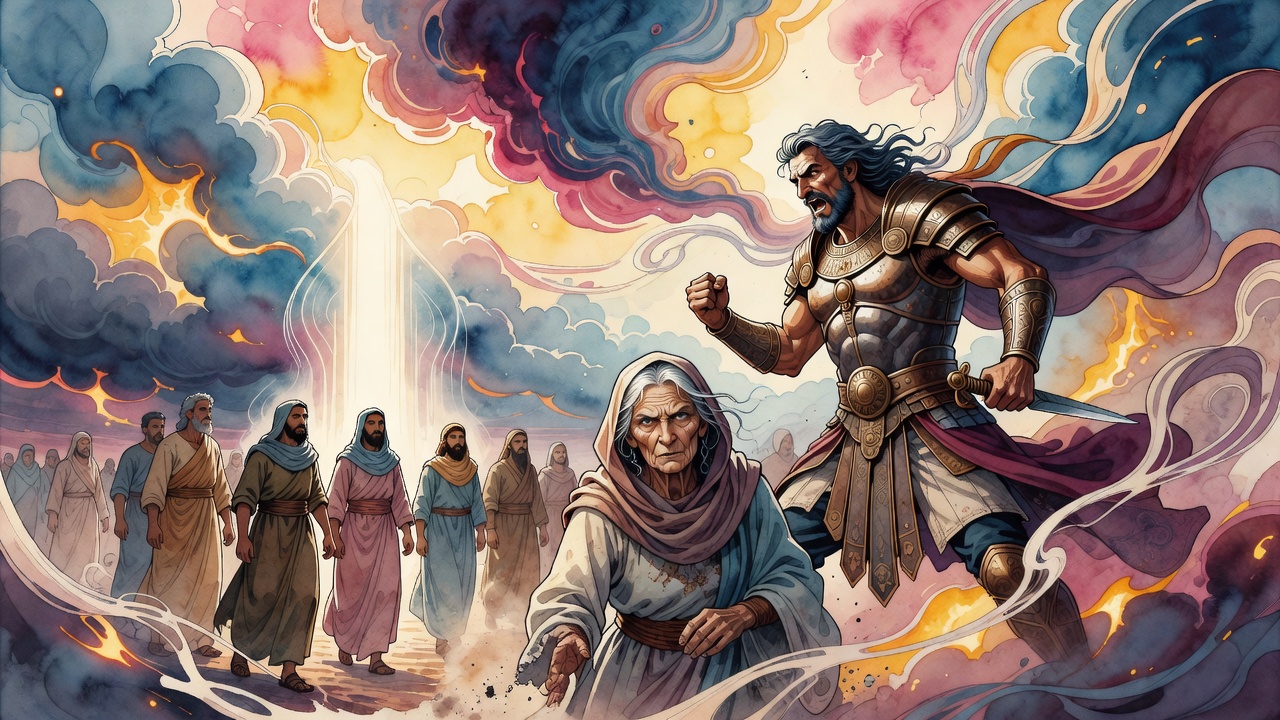
The old woman appeared before Nimrod and he rebuked her immediately: how do you dare serve any god but me?
She said: you are a liar. You deny the one God who is the essence of all faith. You live on His bounty and you worship another. You have repudiated God and Abraham His servant.
These are not hedged words. She did not soften them for the audience. She did not speak in riddles or metaphor that gave the king room to pretend he had misunderstood. She stood in the court of the man who had ordered seventy thousand boys killed to prevent a prophecy from being fulfilled, and she told him he was lying, that his entire theology was a lie, and that the God he denied was the one keeping him alive.
The tradition does not give her a name. It preserves her words and her fate and her namelessness with equal care, which may be its own kind of statement: this is the kind of witness that leaves no record except the act itself.
She Was Executed
What the tradition notes next is not her death in any detail but what followed the death: great fear and terror took possession of Nimrod. Not because of her death specifically. Because of what her death produced, which was more devotion to Abraham's teachings, not less. An old woman had just died in the king's court for proclaiming Abraham's God, and the population was growing more attached to that teaching. The execution had been the wrong response. Martyrdom was not having the intended effect.
This is the precise moment the tradition identifies as the beginning of Nimrod's loss of control over the population. He had been managing Abraham's influence with force: the furnace, the summary execution of followers, the standing policy against anyone who taught monotheism in the empire. But force was producing the opposite of the result he needed. Every person who died for Abraham's God became an argument for the God they had died for.
The Spectacle That Replaced the Violence
Nimrod switched tactics. If violence was making Abraham stronger, perhaps spectacle would make the king stronger. He organized a great feast, a public display of his power and his gods, an event that would remind the population of what the empire offered and what the empire required. He brought out the full magnificence of the court: music, abundance, the presence of the king, the demonstration that the world organized around Nimrod was a world of plenty.
The people came. They always came when the king held a feast, because refusing a royal invitation was its own kind of death sentence, and also because the empire provided real things: food, security, the pleasures that come from organized power. They ate and drank and were present, and then they went home and continued following Abraham.
← All myths