Translation of the source text.Pesikta Rabbati, ed. Meir Friedmann (Ish-Shalom), Vienna 1880 · Public Domain
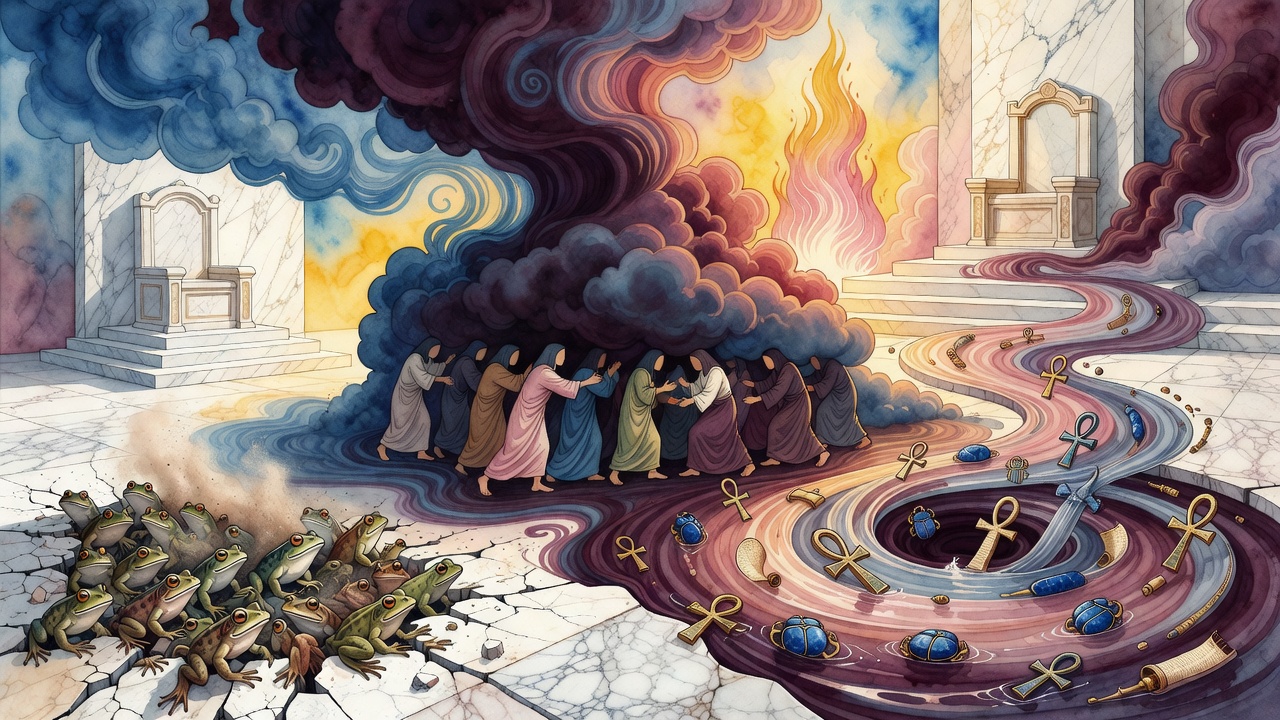
"And it came to pass at midnight [that the LORD struck every firstborn in the land of Egypt, etc.]" (Exodus 12:29). Rabbi Tanchum of Jaffa in the name of Rabbi Mana of Caesarea opened: "When I thought to know this, it was a trouble in my eyes" (Psalm 73:16). David said: No creature can fix exactly upon midnight except the Holy One, blessed be He; but as for me, "it is a trouble in my eyes." And because no creature can fix upon midnight except the Holy One, blessed be He, therefore "And it came to pass at midnight [that the LORD struck, etc.]." Rabbi Acha interpreted: "I am the LORD, that is My name, and My glory I will not give to another, nor My praise to graven images" (Isaiah 42:8). "I am the LORD, that is My name" - Rabbi Acha said: The Holy One, blessed be He, said, "I am the LORD, that is My name, which the first man called Me; that is My name which I stipulated between Myself and Myself; that is My name which I stipulated between Myself and My ministering angels; and My glory I will not give to another." Rabbi Nachman in the name of Rabbi Avun: these are the demons. Rabbi Menachman in the name of Rabbi Mana said: No creature in the world can distinguish between a drop that is of a firstborn and a drop that is not of a firstborn, except the Holy One, blessed be He; but as for me, "it is a trouble in my eyes." And therefore "And it came to pass at midnight [that the LORD struck every firstborn]." It is written, "Who confirms the word of His servant and fulfills the counsel of His messengers; who says of Jerusalem, It shall be inhabited, and of the cities of Judah, They shall be built, and its ruins I will raise up" (Isaiah 44:26). Rabbi Berakhiah in the name of Rabbi Levi: We would not know from "Who confirms the word of His servant and fulfills the counsel of His messengers" that He says of Jerusalem, "It shall be inhabited," and of the cities of Judah, "They shall be built" - but one angel appeared to our father Jacob and said to him, "Your name shall no longer be called Jacob, but Israel, etc." (Genesis 32:29). The Holy One, blessed be He, revealed Himself to confirm the decree of that angel, and said to him, "Your name is Israel, etc." (Genesis 35:10). Jerusalem, about which all the prophets prophesy that it will be built - how much more so! Some say: "Who confirms the word of His servant" - this is Moses: "Not so My servant Moses" (Numbers 12:7); "and fulfills the counsel of His messengers" - this is Moses: "And He sent an angel and brought us out of Egypt" (Numbers 20:16). The Holy One, blessed be He, said to Moses, "Go, say to Israel, And I will pass through the land of Egypt on this night" (Exodus 12:12). Moses went and said to Israel, "Thus says the LORD, About midnight I will go out into the midst of Egypt" (Exodus 11:4). The Holy One, blessed be He, said, "I have already assured Moses and said of him, 'In all My house he is faithful' (Numbers 12:7); shall Moses My servant be as a liar? Rather, what did Moses say? 'About midnight' - so I too will act at midnight." "At midnight I rise to give thanks to You for Your righteous judgments" (Psalm 119:62). Rabbi Pinchas in the name of Rabbi Eliezer bar Rabbi Menachem: What would David do? He would take a harp and a lyre and place them at his head, and rise at midnight and play upon them, and the companions of Israel would hear his voice and say, "If David the king occupies himself with Torah, how much more so we!" And it would turn out that all Israel were occupied with Torah. Rabbi Levi said: There was a window above David's bed open to the north, and the harp was hung opposite it, and the north wind would go forth at midnight and blow upon it, and the harp would play of itself - this is what is written, "As the musician (kenaggen) played" (2 Kings 3:15) - it does not say here 'kemenaggen' (as one plays) but 'kenaggen' - the harp would play of itself, and all Israel would hear it. And this is what David says, "Awake, my glory; awake, O lyre and harp; I will awaken the dawn" (Psalm 57:9) - "Let my glory awaken before the glory of my Creator; my glory is reckoned as nothing before the glory of my Creator; 'I will awaken the dawn' - I awaken the dawn, and the dawn does not awaken me." And his evil inclination would provoke him and say to him, "David, it is the way of kings that the dawn awakens them, and you say 'I will awaken the dawn'; it is the way of kings to sleep until the third hour, and you say 'at midnight'?" And he says, "For Your righteous judgments." [And what is "for Your righteous judgments"?] For the judgments You brought upon Pharaoh and for the righteousness You did with Sarah my grandmother - this is what is written, "And the LORD afflicted Pharaoh and his house with great plagues on account of Sarai, Abram's wife" (Genesis 12:17). Another interpretation: "For Your righteous judgments" - for Your judgments that You brought upon the nations of the world, and for the righteousness You did with my grandfather and with my grandmother; for had she let down upon him a single curse from below, from where would I be standing? But You put in his heart a blessing: "Blessed are you of the LORD, my daughter" (Ruth 3:10). Another interpretation: "Your righteous judgments" - for the judgments You brought upon the Egyptians in Egypt, and for the righteousness You did with our fathers in Egypt, who had in their hands only two commandments - the blood of the Passover and the blood of circumcision - this is what is written, "And I passed by you and saw you wallowing in your blood, and I said to you, In your blood live" (Ezekiel 16:6) - this is the blood of the Passover and the blood of circumcision. ["And it came to pass at midnight, etc."] Rabbi Shimon ben Yochai taught: Moses did not know the seasons of the night, nor its moments, nor its times; therefore he said "about midnight" (Exodus 11:4). But the Holy One, blessed be He, knows its seasons and its moments and its times; therefore He enters into it like a hairsbreadth. And who split it? Rabbi Binyamin bar Yefet in the name of Rabbi Yochanan: the night split of itself; and the Rabbis say: its Former split it, as it says here "at midnight" and there it says, "And the night was divided against them" (Genesis 14:15). Rabbi Tanchuma said: The Holy One, blessed be He, said, "Their father went out at midnight, and I go out with His children at midnight." And the Rabbis say: The Holy One, blessed be He, said, "Their father went out with Me from the eve until midnight, and I go out with His children from midnight until morning." Rabbi Yitzchak said: The prince of Egypt falls only by day; what is the reason? As it is written, "And at Tehaphnehes the day shall be dark, when I break there the yoke-bars of Egypt, and the pride of her strength shall cease in her, etc." (Ezekiel 30:18); and it says, "On that day there shall be five cities in the land of Egypt speaking the language of Canaan and swearing to the LORD of hosts; one shall be called the City of Destruction (Ir ha-Heres), etc." (Isaiah 19:18) - 'Ir ha-Heres' is Ir Shemesh: No (Noa) is Alexandria, Noph (Menpuach) is Memphis, Tahpanhes (Chofiynam), and 'Ir ha-Heres' (Sedakani), and Ir Shemesh (is Heliopolis). Rabbi Yochanan ben Zakkai said: We find that the day and the night are called 'day,' as it is written, "And there was evening and there was morning, one day" (Genesis 1:5). Rabbi Yehoshua bar Nechemiah learned it from this: "Even darkness is not dark to You, but the night shines as the day; the darkness is as the light" (Psalm 139:12) - 'the darkness, which is light before Me, and the night for the use of the creatures.' Thus, on that very day the firstborn of Egypt died. How were they smitten? They were struck with a death-blow from the evening and were convulsing all night and died by day. And what is the reason? It does not say here "we have all died" but "we are all dying" (Exodus 12:33) - dying and going, as you say, "On the day I struck every firstborn" (Numbers 8:17), and there it says, "On the day, etc., I consecrated to Myself every firstborn" (Numbers 3:13). Say then: on the day the firstborn of Egypt died, on that very day I consecrated to Myself every firstborn. "And the LORD struck every firstborn" - firstborn of a man, firstborn of a woman, firstborn of a male, firstborn of a female. How so? One man came to ten women and they bore ten sons, [and likewise ten men came to one woman and she bore ten sons,] and all of them were found to be firstborn men. Suppose for yourself that there was no firstborn there, neither of a man nor of a woman, neither of a male nor of a female - how do I uphold "for there was no house where there was not a dead one" (Exodus 12:30)? Rabbi Abba bar Acha said: the steward of the house would die, as you say, "Shimri the head, for though he was not the firstborn, his father made him head" (1 Chronicles 26:10). Rabbi Nathan taught: On the day that the firstborn of one of them died, he would carve his likeness (icon) inside his house; on that day it would be pounded and ground and crushed, and it would be as hard for him as if on that day they had buried him. Rabbi Yudan said: Because the Egyptians would bury within their houses, and the dogs would enter through the niches and snatch the firstborn from among the niches and toy with them, and it was as hard for them as if on that day they had buried him. "From the firstborn of Pharaoh" - from here that Pharaoh was a firstborn. All the firstborn gathered to their fathers and said to them, "Since Moses said, 'And every firstborn in the land of Egypt shall die' (Exodus 11:5), all that he says about this people comes upon them; so come and let us bring out these Hebrews from among us, and if not, this people will die." They said, "Ten sons belonging to one of us shall die like one of them - and you will not rise up against these Hebrews?" They said, "The conclusion of the matter: let us go to Pharaoh, who is a firstborn; perhaps he will have pity on himself, and these Hebrews will go out from among us." They went to Pharaoh and said to him, "Because Moses said, 'And every firstborn shall die, etc.,' and all that he says about this people comes upon them, arise and bring out these Hebrews from among us, and if not, this people will die." He said, "Go and break the legs of these men! I say my own self, or the selves of the Hebrews? And you say thus?" Immediately the firstborn went out and slew among their fathers six hundred thousand - this is what is written, "To Him who struck Egypt by their firstborn" (Psalm 136:10) - it does not say here "who struck the firstborn in Egypt," but "who struck Egypt by their firstborn" - the firstborn killed six hundred thousand. Rabbi Avun in the name of Rabbi Yudah ben Pazzi said: Bityah daughter of Pharaoh was a firstborn, and by what merit was she saved? By the prayer of Moses, as it is written, "She perceives that her merchandise is good, her lamp does not go out at night (ba-laylah)" (Proverbs 31:18) - it is written 'ba-lel,' as you say, "It is a night of watching (lel shimmurim) for the LORD" (Exodus 12:42). "To the firstborn of the maidservant" (Exodus 11:5) - Rav Huna and Rabbi Acha in the name of Rabbi Eleazar son of Rabbi Yose the Galilean: even the maidservants set to the millstones, who would say, "It is our will that we be in our servitude and Israel in their servitude." Rabbi Yudah ben Pazzi said: from the tradition of aggadah, Serah daughter of Asher went down to Egypt; they set her to the millstones. "And every firstborn of beast" - if man sinned, what did beast sin? Rather, the Egyptians worshipped lambs and would say, "Our deity has brought the punishment upon us; harsh is our deity, that stands by itself, that no punishment came upon it." ["And it came to pass at midnight, etc."] Rabbi Huna and Rabbi Yehoshua bar Avin, son-in-law of Rabbi Levi, in the name of Rabbi Levi: The Master of Mercy does not strike souls first. From whom do you learn it? From Job: "And a messenger came to Job and said, The oxen were plowing and the donkeys were grazing beside them" (Job 1:14). What is "the oxen were plowing and the donkeys were grazing beside them"? Rabbi Chama bar Chanina said: a likeness of the World to Come was made for him, as you say, "The plowman shall overtake the reaper, etc." (Amos 9:13). "And the Sabeans fell upon them and took them, and struck the servants with the edge of the sword" (Job 1:15). Rabbi Abba bar Kahana said: they went out from Kefar Karnayim and went the whole length of the Avalim, and when they reached Migdal Tzevaya, they died there. "And I alone have escaped to tell you" (Job 1:15). Rabbi Acha said: 'rak' (only) is a limiting term - he was broken and stricken. Rabbi Yudan said: "And I alone have escaped to tell you" - he too, once he told his tidings, immediately died - this is what is written, "While this one was yet speaking, another came" (Job 1:16). "And the Chaldeans formed three columns, etc." (Job 1:17). When Job heard this, he began to muster his troops against them for war - this is what is written, "I dreaded the great multitude, and the contempt of families terrified me, so that I kept silence and did not go out of the door" (Job 31:34). Job said, "This nation is the most despised of all nations: 'Behold the land of the Chaldeans - this people that was not, etc.' (Isaiah 23:13). Would that it did not intend to put its terror upon me!" And when he was told, "The fire of God fell from heaven" (Job 1:16), [he said,] "If it is from heaven, what can I do?" Immediately, "and did not go out of the door," and afterward, "And he took a potsherd, etc." (Job 2:8). So too Mahlon and Chilion: first their horses and camels and donkeys died, and afterward he himself - "And Elimelech, Naomi's husband, died" (Ruth 1:3) - and afterward his two sons died, "And the two of them also died, etc." (Ruth 1:5). And so too in the plagues that come upon a person: at first it begins in his house; if he repents, the stones require removal - "and they shall take out the stones" (Leviticus 14:40); if he does not repent, they require demolition - "and he shall break down the house" (Leviticus 14:45). And afterward it begins in his garments; if he repents, they require tearing - "and he shall tear it out of the garment or out of the skin, etc." (Leviticus 13:56); and if he does not repent, they require burning - "and he shall burn the garment" (Leviticus 13:52). And afterward it begins in his body; if he repents - "and he to whom the house belongs shall come" (Leviticus 14:35); and if not - "he shall dwell alone, etc." (Leviticus 13:46). And in Egypt it was so: at first the attribute of justice touched their property - "And He struck their vines and their fig trees" (Psalm 105:33); "And He gave over their cattle to the hail" (Psalm 78:48); and afterward, "And He struck every firstborn in Egypt" (Psalm 78:51). Rabbi Levi bar Zekharyah in the name of Rabbi Berakhiah: with the tactics of kings He came upon them. At first He dammed up their water-channel - blood; and afterward He brought upon them croaking ones - frogs; and afterward He shot arrows at them - lice; and afterward He brought upon them legions - wild beasts; and afterward He gave them grave plagues - the pestilence, a very heavy thing; and afterward He cast among them naphtha - boils; and afterward He hurled ballista-stones - hail; and afterward He set upon them besiegers - locusts; and afterward He imprisoned them in dungeons - darkness; and afterward He brought out the greatest, the greatest of them, and killed them - the plague of the firstborn at midnight. Rabbi Levi son-in-law of Rabbi Zekharyah in the name of Rabbi Berakhiah: "At the report of Egypt they shall be in anguish, as at the report of Tyre" (Isaiah 23:5). Rabbi Eliezer said: every 'Tzor' (Tyre) spelled full in Scripture speaks of the province of Tyre; every 'Tzar' deficient in Scripture speaks of wicked Rome. Rabbi Levi in the name of Rabbi Chama son of Rabbi Chanina: He who exacted from the first will exact from the last. Just as in Egypt - blood, so too Edom: as it is written, "And I will set wonders in the heavens and on the earth, blood and fire" (Joel 3:3). Just as in Egypt - frogs, so too Edom: "A sound of tumult from the city" (Isaiah 66:6). Just as in Egypt - boils, so too Edom: "Their flesh shall rot, etc." (Zechariah 14:12). Just as in Egypt - wild beasts, so too Edom: "And the pelican shall possess it, etc." (Isaiah 34:11). Just as in Egypt - lice, so too Edom: "And its streams shall be turned into pitch" (Isaiah 34:9). Just as in Egypt - pestilence and hail, so too Edom: "And I will enter into judgment with him with pestilence and with blood, and with an overflowing rain and hailstones" (Ezekiel 38:22). Just as in Egypt - locusts, so too Edom: "Say to the birds of every wing, etc." (Ezekiel 39:17). Just as in Egypt - darkness, so too Edom: "And He shall stretch over it the line of chaos" (Isaiah 34:11). Just as in Egypt He took the greatest of them and killed him, so too Edom: "And the wild oxen shall come down with them" (Isaiah 34:7) - the Romans with them. Rabbi Acha bar Kahana said: darkness and gloom served in Egypt three days, but chaos and void (tohu and bohu) have not served in this world. And where are they destined to serve? In the great metropolis of Rome: "And He shall stretch over it the line of chaos and the stones of void" (Isaiah 34:11). And the Rabbis say: of the nations of the world, who did not accept the Torah that was given out of the darkness, of them it says, "For behold, darkness shall cover the earth, and thick darkness the peoples" (Isaiah 60:2); but of Israel, who accepted the Torah that was given out of the darkness, of them it says, "But upon you the LORD shall shine, and His glory shall be seen upon you" (Isaiah 60:2).

 Click for full size