The Throne-Bearers Who Cannot Find Where God Sits
The four living creatures strain forever under the Throne, crying blessed be the glory, and not one of them knows where that glory is.
Table of Contents
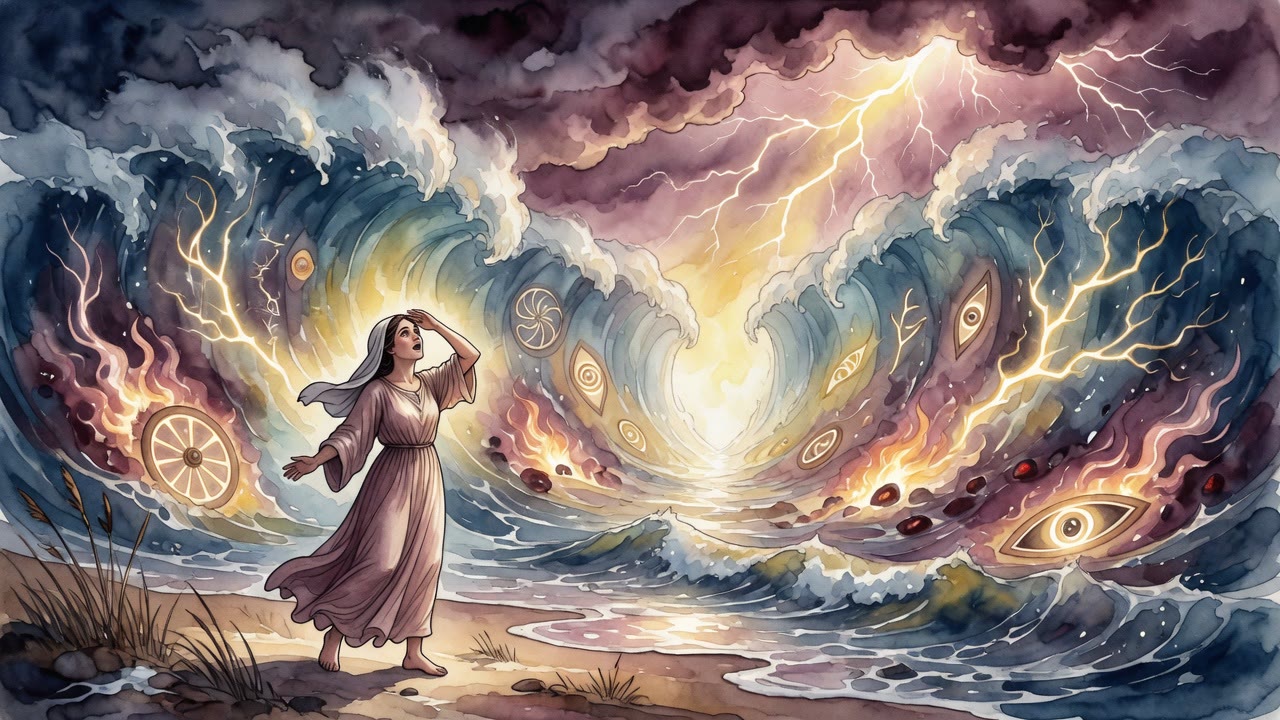
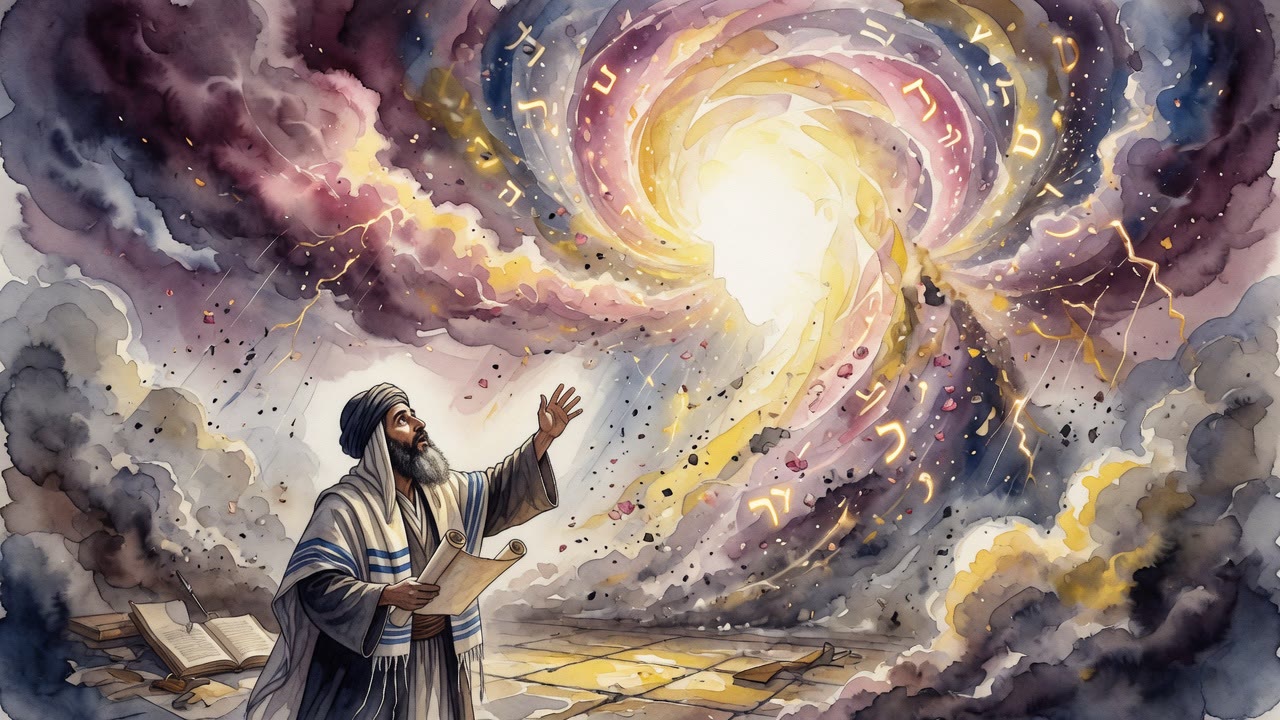
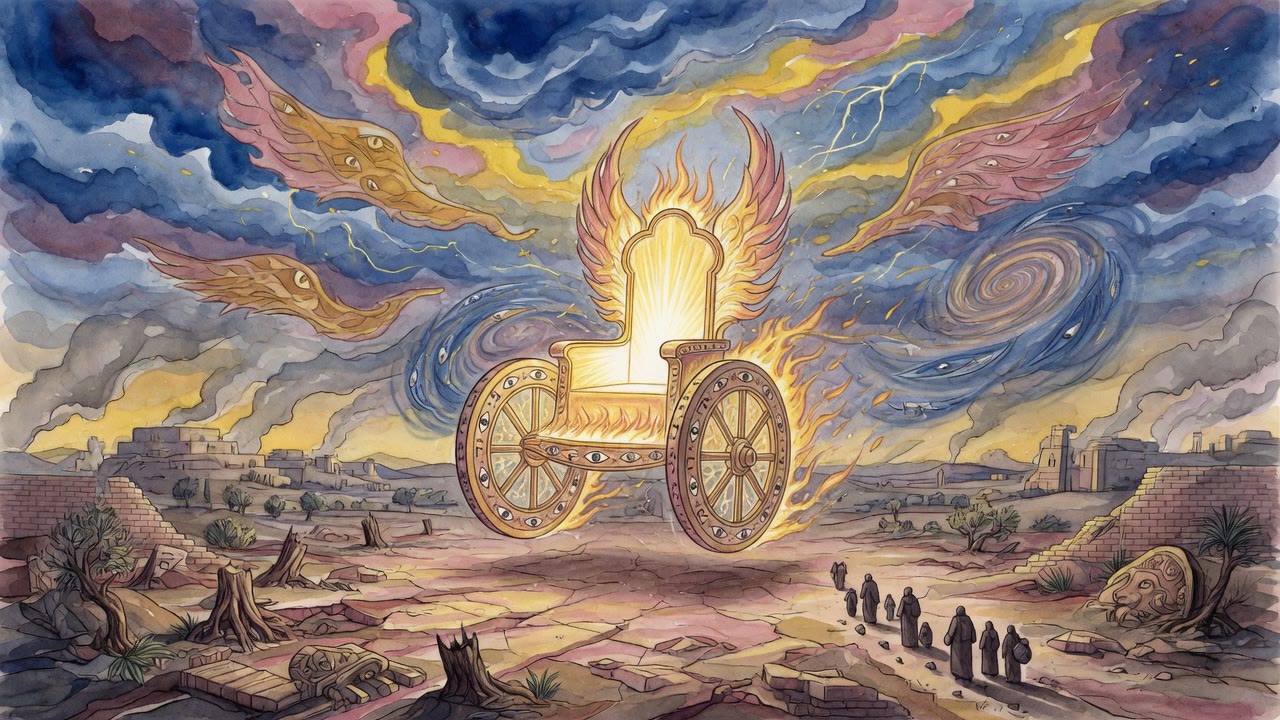
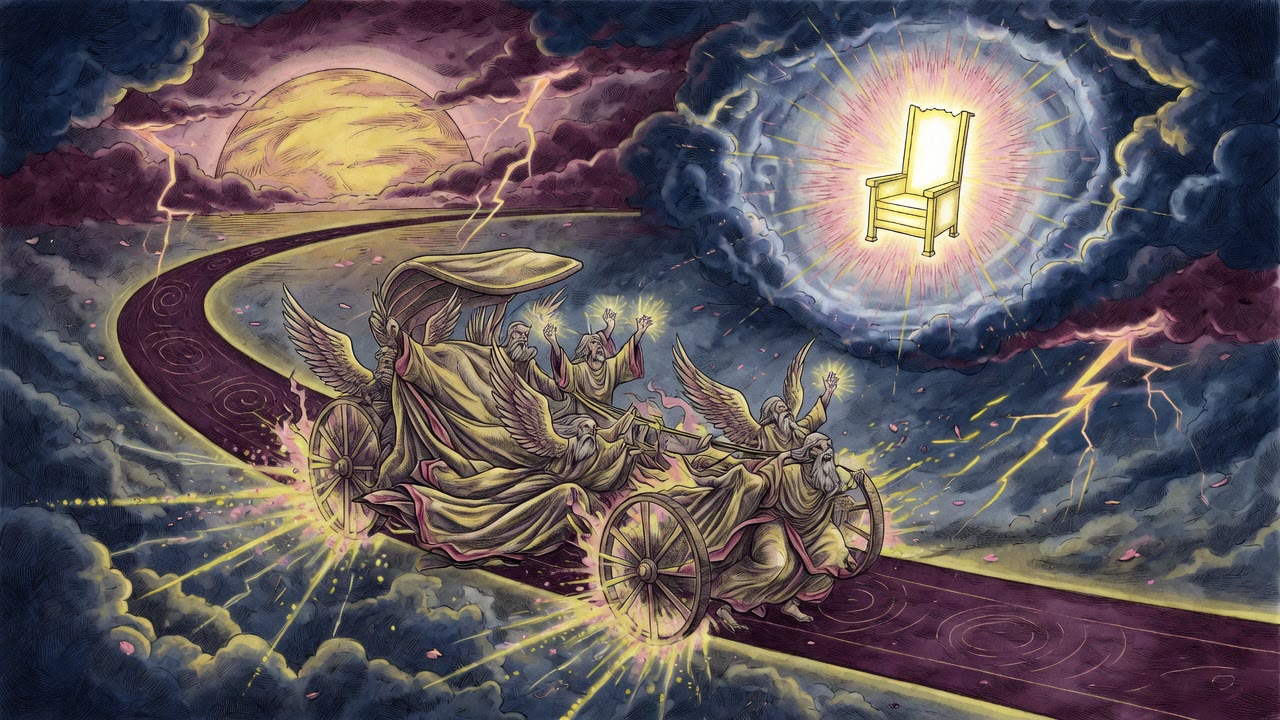
By the river Chebar, where the exiles of Judah sat among reeds and foreign water, the sky split. A storm wind came out of the north, a vast cloud wrapping fire that folded back into itself, and out of the brightness came four shapes that did not belong to any earth Ezekiel had walked. They burned and did not burn up. They went straight forward and never turned. And under them, far up and impossibly high, rode a throne the color of sapphire, and the brightness around it was the color of mercy and terror at once.
 Click for full size
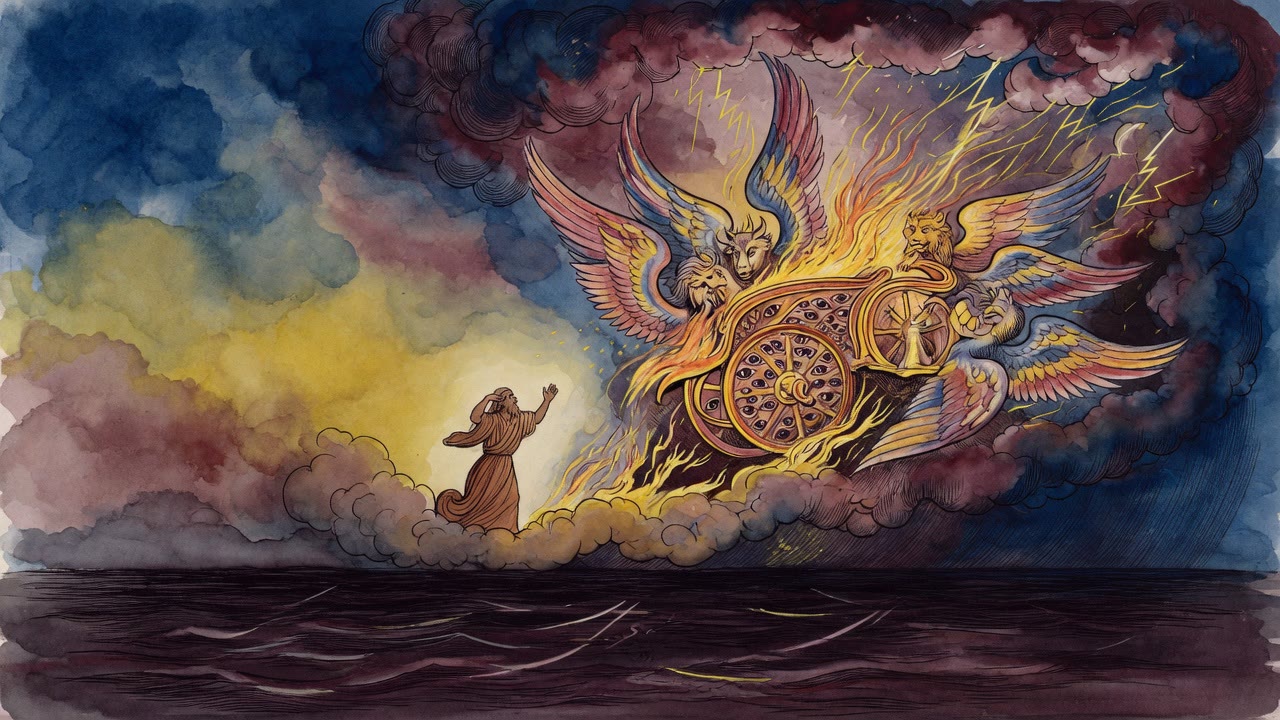
Each of the four had four faces. On the front, the face of a man. On the right, a lion. On the left, an ox. And behind, an eagle. Their legs were straight, their feet like burnished bronze, and beside each ran a wheel within a wheel, the rims so high they were dreadful, and the rims were full of eyes. When the creatures moved, the wheels moved. When the creatures stood, the wheels stood. Whatever the spirit drove them toward, there they went, and they did not swerve.
The Four Kings Harnessed Under the Same Weight
These were not random beasts. Each face was a crown. The lion is the highest of the wild animals, the king that fears nothing in the field. The ox is the highest of the cattle, the strength that breaks the soil. The eagle is the highest of the birds, the eye that owns the sky. And the man is the highest of every created thing, the one set over all the rest.
Take the proudest of each kingdom. Take the four that have nothing above them in their own domain. Then lash them together beneath one chariot and make them carry it.
That was the design. The Holy One, blessed be He, gathered the four exalted ones and fixed them into the Throne of Glory, so that the king of beasts would feel a weight pressing down on his shoulders and know there was a kingdom over him. The lion that bows to nothing in the field bows here. The eagle that answers to no height answers here. The man set over all creation looks up from beneath the chariot and learns that being highest of his kind only means he carries more.
The Cry That Goes Up Without a Direction
So they strain. Forever, they strain. The throne presses on them and the spirit drives them and the wheels full of eyes turn with them, and out of the effort comes a sound. A great rushing, like many waters, like the noise of a vast army, like a voice from the firmament stretched above their heads.
And the words they cry are these: "Blessed be the glory of the LORD from His place."
They lift it again and again, the most exalted creatures in the universe, the ones closest to the sapphire, the ones whose own faces are crowns. And here is the thing that should stop the breath. They do not know the full measure of the glory they praise. They bless it, but they cannot map it. They carry it, and they cannot find its edge.
The Bearers Who Cannot Locate the One They Bear
Read the cry slowly and it bends. "Blessed be the glory of the LORD from His place." From His place. Not here. Not where I stand. From wherever that place is, blessed be it, because the creatures crying it do not know where it is.
This is the dread under the wheels. The four are pressed against the underside of the Throne. They feel its weight on every face, the man and the lion and the ox and the eagle all bowed by the same load. They are nearer to it than any prophet, any angel of the lower ranks, any soul that ever climbed. And still, when they open their mouths, they bless the glory from its place, because His place is not a coordinate they hold. They are the porters of a king whose throne room has no findable floor.
They do not say, "Blessed be the glory here, where we carry it." They cannot. The weight on their backs is real, but the location of the One enthroned slides past them. So they aim the blessing outward, into the unknown, toward a place they trust exists and cannot point to. The most powerful beings beneath heaven praise an address they were never given.
Humility Is the Posture of the Ones Who Know What They Carry
Below them, far below, by the Chebar, a man in exile watched and fell on his face. He had seen the wheels and the eyes and the four faces and the sapphire and the brightness, and he had heard the cry go up from beings that could not find the One they served.
If the king of beasts is harnessed and bowed, what is a captive scribe beside a Babylonian canal? If the eagle that rules the sky cannot locate the place of the glory, what could a man claim to have pinned down? And yet the cry was not despair. The creatures kept moving, kept straining, kept blessing. They did not stop because they could not find Him. They blessed Him precisely there, in the not-finding, in the weight, in the going forward without turning.
Every creature that climbs to the top of its order discovers the same thing the four discovered. Reach the highest place in your kingdom and look up, and there is still a chariot pressing on your shoulders, and the One who rides it is somewhere you cannot name, blessed from His place, wherever His place may be.
← All myths