5 min read

The Watchman, the Widow, and the Body She Gave the Rope

A watchman comforts a weeping widow, a corpse vanishes from his gallows, and to save his life she digs up her own husband to hang in its place.

Curated by Arthur · Told by Maggid ·
Table of Contents
  1. The Man Posted Under the Rope
  2. Comfort in the Field of the Dead
  3. The Empty Rope
  4. The Bargain Over the Grave
  5. What the Wind Carried by Morning

The grave was three days old, and she had not left it.
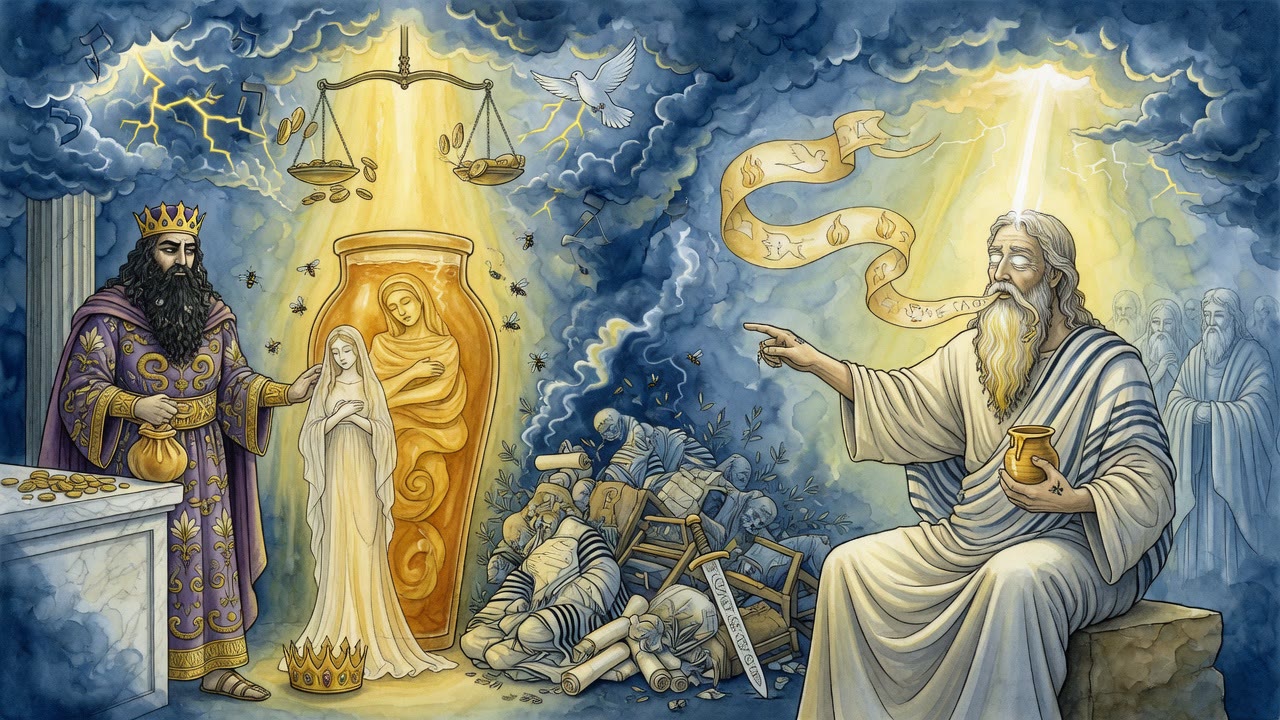
She lay across the turned earth where they had put her husband down, and the soil was still loose enough to take the shape of her hands. By morning the mourners were gone. The meal of comfort had been eaten and the bowls carried home. The neighbor women who had sat with her the first night did not come the second. The widow stayed. She wept until the weeping had no sound left in it, only the rocking, and the dirt pressed dark crescents under her nails.

A short walk off, where the road climbed toward the city wall, stood the king's gallows. A man hung from it.

The Man Posted Under the Rope

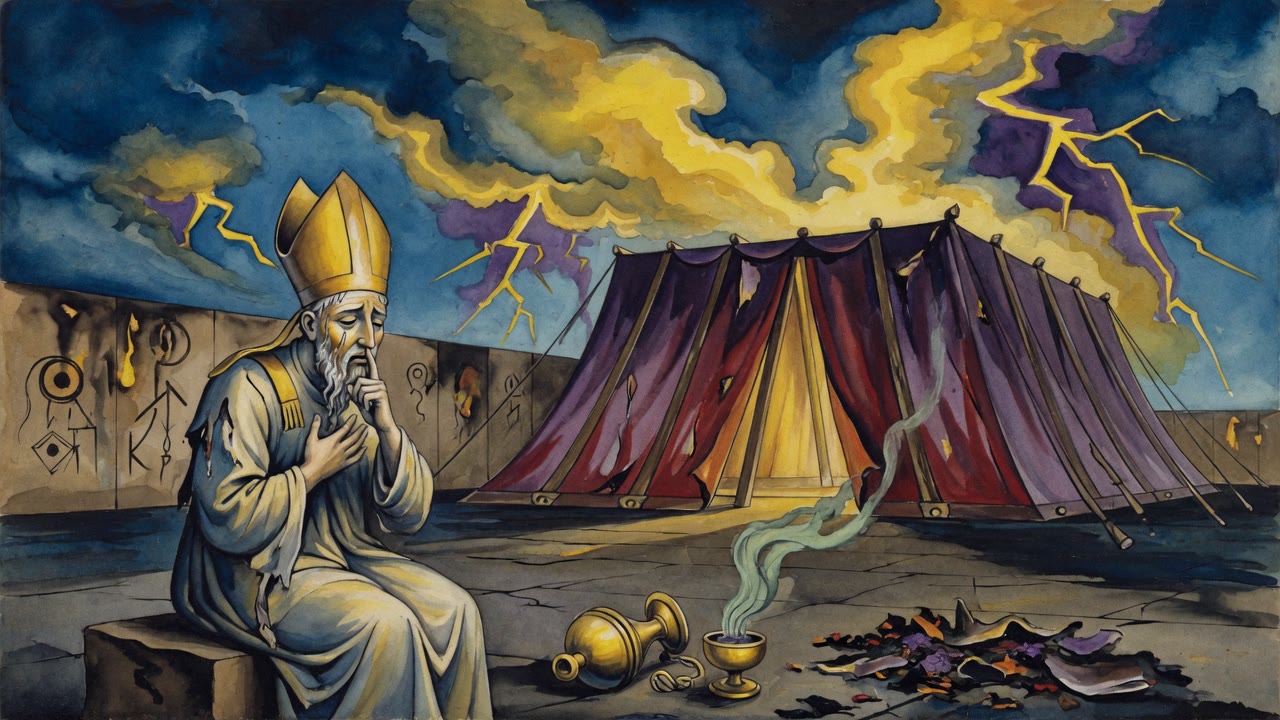
The king had ordered him executed, and ordered worse afterward. The body was to hang where the road passed, swinging in the wind, so every traveler coming in at dusk would read the warning without a word spoken. A watchman was set beneath it. His task was simple and his life rode on it. Thieves came for the bodies of the hanged, and families came in the dark to cut down their own and bury them in secret, and the king had fixed the price of failure: lose the corpse, take its place on the rope.

So the watchman stood his nights with his spear and his back to the dead man, and across the low ground he heard her. The sound carried. Grief in an open field at night carries a long way.

On the third night he went to her.

Comfort in the Field of the Dead

He came to comfort her, and he meant it, the way a man means a kind thing he is also curious about. He spoke low. He told her the dead do not feel the cold she was lying in. He told her she would die out here for nothing if she kept this up. She answered him, and then she answered him again, and the talk warmed, and the field around them was only the two of them and the wind. Grief is a strange door, and it does not always open the way the mourner expects. What had been weeping became something else. They lay down together not thirty paces from her husband's grave, and for a while the watchman forgot the rope, and the road, and the king.

When he remembered, he went back up the rise, and the gallows was empty.

The Empty Rope

The rope swung loose. Whoever had come had come quietly, while his post stood unwatched, and cut the body down and carried it off into the dark. He stood under the bare gibbet and the whole weight of the king's sentence came down on him at once. There was no story he could tell that would save him. A watchman who lost his corpse became the corpse. By the next sunset it would be his own body turning in the wind for travelers to read.

He went back down to her with his hands shaking. He told her everything. He told her he was a dead man.

The Bargain Over the Grave

She did not weep now. The woman who had not lifted her face from the dirt for three days looked at him clearly, and steadied him, and made him a gift.

"Do not be afraid," she said. "Take my husband. Hang him in the other man's place. No one alive saw the difference, and the dead do not complain."

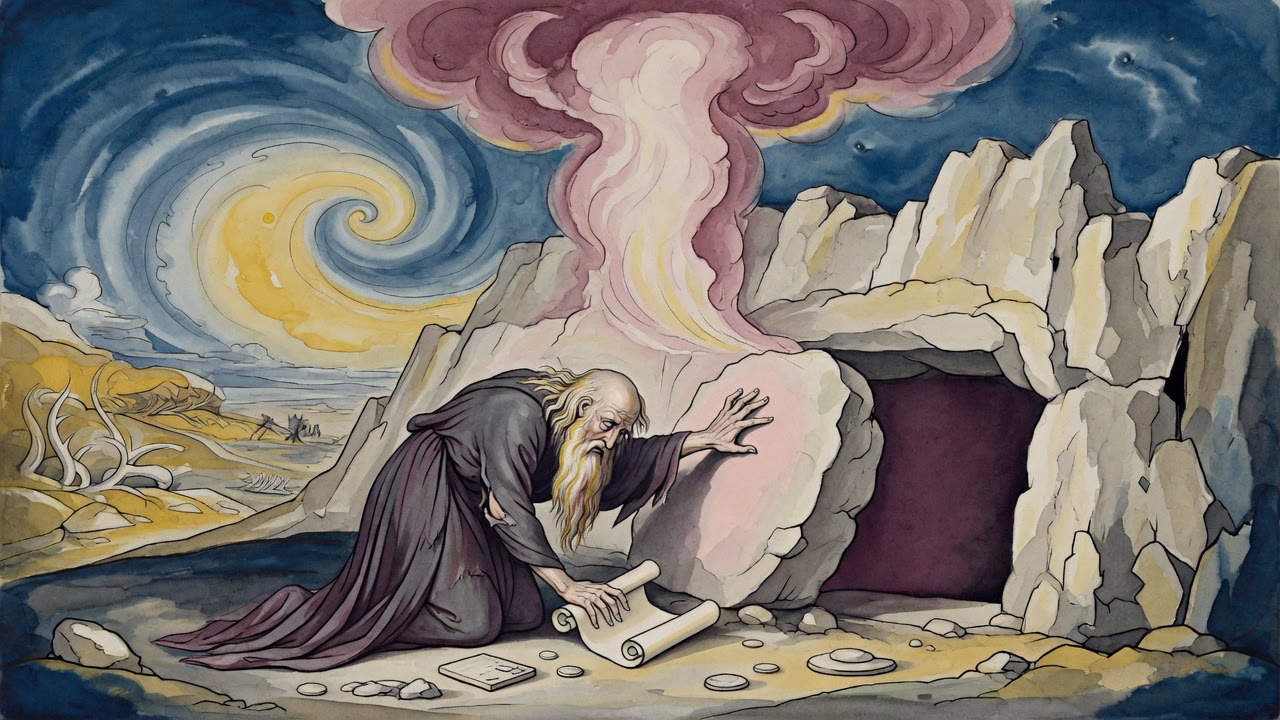
And it was done. She went to the grave she had soaked with three nights of tears and she knelt and clawed the loose earth open with the same hands that had grieved him. She did not let the watchman do it alone. She took her husband by the shoulders and dragged him up out of the ground, and together they carried him to the rise, and they hung him on the king's rope in the stranger's place, and they fixed him so he would swing right in the wind.

Then the road was quiet again. A body hung on the gallows. The watchman kept his life. And the grave she had refused to leave stood open and empty behind her, the tears not yet dry on its broken lip.

What the Wind Carried by Morning

By morning the travelers came in along the road, and they saw a hanged man swinging where a hanged man was supposed to swing, and they read the warning and passed on, and not one of them knew whose body it was or what it had cost to put it there. The widow walked back toward the city beside the watchman. Behind them the open grave caught the first light. Three nights of mourning, and the man she had buried was hanging from the king's rope by her own hand, and the field was as quiet as if nothing had happened at all.


← All myths
From the tradition

Sources

2 sources

The texts this telling draws on, in full. Open a card to read inline, or expand it for a wider, quieter read.

Exempla of the Rabbis, No. 442Exempla of the Rabbis (Gaster, 1924)

A woman was weeping and mourning over the grave of her dead husband for a long time. Close by stood a gallows and a watchman was appointed by the king to see that none of the bodies should be stolen. He saw the woman there, spoke to her and induced her to do his bidding. Whan he returned to the gallows he found that the body had disappeared. So he came back to the woman and told her that he feared for his life, since the king would surely kill him. The woman then told him to take the body of her dead husband and hang it up instead, and she assisted him in dragging the body from the grave.

- 177

443 [Cod. G. 942 f. 15 b]. An emperor once called the Jews together and ordered them to tell him his thoughts in three days on pain of death. The people decreed a fast. On the third day a deaf man was seen walking in the street eating cheese. Rebuked by the people, he asked the cause of the fast and when told, asked them to allow him to answer for them. They came before the emperor. The emperor lifted up two fingers whereupon the deaf man lifted one finger; the emperor then showed an egg whereupon the deaf one pulled out a cheese from his bosom; the emperor then took some corn and scattered it about and the deaf one picked them up and put them in his kerchief. The emperor declared himself satisfied. The Jews afterwards asked the deaf one what it had all meant and he answered, "The emperor pointed with two fingers, meaning to put out my two eyes. I replied that I would do it with one finger. Then the emperor showed me that he had food, whereupon I replied by showing that I had what I wanted. When the emperor scattered the corn, I considered it a sin, so I picked it up and took it away." When asked by the courtiers the meaning of his signs, the emperor replied, "The two fingers meant the duality of God, God and a certain figure. He replied the Jews recognise only one God. I showed him an egg to signify that a certain figure was born not from a man; he replied by showing the cheese, which could not curdle without the sperm, and so a certain figure could not be born otherwise than other human beings. I showed him that God had scattered the Jews as the corn is scattered, and he replied that God would gather them up again."

444 [Cod. G. 274 (Ladino)].

A poor pious man bought flour for 3 silver pieces for his household. As he was carrying it home, the wind blew it out into the sea. The man, therefore, went to David and asked for justice. King David gave him a gold piece and sent him away. At the door he met Solomon who advised him to return the money and insist on a trial. King David

1 2

178,

gave him another gold piece and again sent him away. Again he met Solomon who advised him to insist on his rights. Then David, finding that Solomon was advising him, called the latter and asked him how much he was to give to the man. Solomon replied, “Do not give money but call the wind to justice." David then made a conjuration and the spirit of the wind appeared. Asked why it had blown the poor man's flour into the sea, it replied that a ship on the high seas with many Jews on board, had sprung a leak and was on the point of foundering. The sack of flour would form a dough and stop the leak. The men had vowed a third of their possessions if saved. Six days later the ship came into port and the travellers gave the poor man a third of their possessions which they had vowed as a thank-offering.

445 [Cod. G. 1060 f. 37 a]. An apostate led the king to the synagogue when the people were reading the verse in Deut., “How can one pursue a thousand and two ten thousand?" He told the King that the Jews were boasting that one could kill ten thousand. The king, enraged, called the teacher to explain the meaning. The latter said this referred to those who came out of Egypt. The king then called the wise men and the elders and ordered them as the descendants to prove the truth of the statement. He gave them a year, after which they would either be killed or driven out of the country. After six months of fasting and weeping, a man came and offered to go to the Children of Moses beyond the river Sambatyon and bring one of them who would prove it. They gave him money and he travelled five months and crossed the river on the Sabbath. The people there condemned him to death for breaking the Sabbath; he, however, showed them the letter which he had brought and they then sent a young girl with him, and within one day they were back in the city, thus in time. They told the king they were ready to prove the case and asked him to bring out the army. He gathered all the people in the field and the young girl, dressed as a

- 179 -

man met him. She asked the king to make two heavy millstones, from a big mountain nearby. They were made and weighed 600 tons. She uttered the Ineffable Name of God, the millstones rose on the air and ground the whole army to dust. When the king saw this, he said, “If this can merely be done by word of mouth, how much greater the power when done by hand?” He acknowledged the truth and the Jews rejoiced, after which the girl returned to her people.

446 [Cod. G. 1380 f. 14a]. A man paid 3000 Dinars for these three maxims, at 1000 Dinars each.

Full source
Kiddushin 80bHebraic Literature (1901)

The Talmud (Kiddushin 80b) tells a grim little tale to justify a rule about guarding appearances. Once a woman stood weeping over her husband's fresh grave. Not far off, a guard kept watch over the body of a man the king had ordered executed.

Grief is a strange doorway. In the hours of mourning, an affection sprang up between the guard and the widow. And while they were lost in it, the body he was guarding was stolen away. The guard panicked. The king's decree hung over his head; losing the corpse meant losing his own life.

The widow steadied him. "Do not be afraid," she said. "Exhume my husband. Hang him in the other man's place. No one will know." And it was done.

Rashi and the Tosafot cite this story not to praise it, but to warn: a woman's grief is so quickly repurposed, a grave so quickly reopened, that the sages ruled against leaving a mourning woman alone with a stranger even for an hour.

The dead cannot speak for themselves, so the law must speak for them.

Full source