171 texts · Page 2 of 4
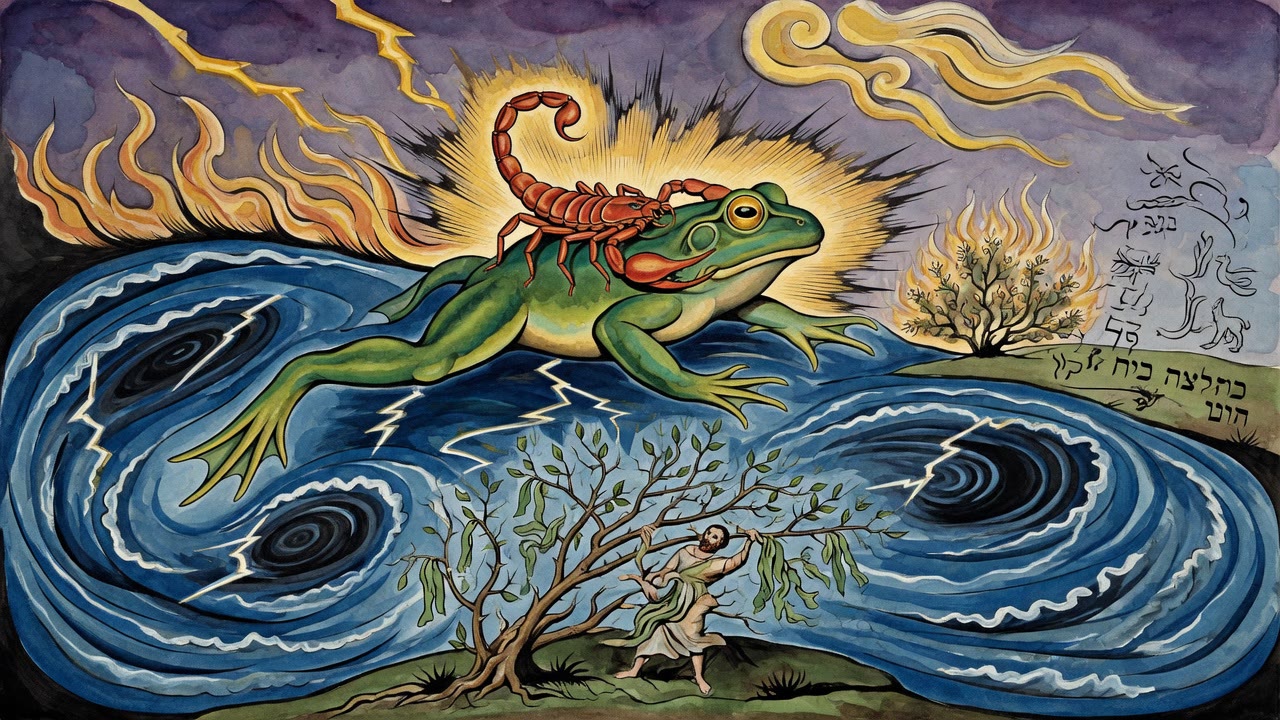
David was one of the four righteous people given a divine hint — and unlike Jacob and Moses, David recognized his and acted on it with confidence. The hint came disguised as a pair...
Once, R. Yochanan b. Zakkai went up to Maon Yehudah, where he saw a young girl picking barley from under the dung of a horse, whereupon he asked (the bystanders): Did you see that ...
The Torah describes God bearing Israel "on eagles' wings" (Exodus 19:4), and the Mekhilta asks a pointed question: why an eagle? What makes the eagle different from every other bir...
"An eye for an eye" — the Mekhilta states flatly that this means money. Monetary compensation, not literal blinding. But the text anticipates resistance to this reading: perhaps an...
"And if an ox gore" — the Torah mentions only an ox. But what about other animals? If a donkey kicks someone, or a camel bites, do the same laws apply? The Mekhilta says yes, and d...
The Torah specifies that a goring ox is put to death by stoning. But what about an ox that kills by biting, kicking, or trampling rather than goring? Are all forms of animal-inflic...
One of Rabbi Yishmael's disciples raised a distinction between different categories of oxen. An ox that has become ritually impure (tamei) is still permitted for deriving benefit —...
Shimon ben Azzai interpreted the phrase "and the owner of the ox is absolved" (Exodus 21:28) as absolution from paying half-kofer — half of the ransom payment owed when an ox kills...
The Torah says the ox gored "a man-servant or a maid-servant." The Mekhilta asks: which kind of servant? This must refer to a Canaanite bondservant, not an Israelite one. The proof...
"and the ox shall be stoned": Why is this stated? (i.e., it was stated already.) For if it were not stated, I would say (otherwise), viz.: Since he is put to death for killing his ...
"and there fall there an ox or an ass": He is liable for each in itself. "an ox": and not an ox and its trappings. "an ass": and not an ass and its trapping. For it would follow (o...
"And there fall there" — the Torah describes an animal falling into an uncovered pit. The Mekhilta specifies: this must happen "in the normal mode of falling." The animal must fall...
(21:35) "And if the ox of a man butt": Included in "goring" is butting, pushing, lying upon, kicking, and biting. These are the words of R. Yoshiyah. Abba Channan says in the name ...
An ox worth two hundred which gored an ox worth two hundred, and the carcass is worth nothing—R. Meir said: Of this it is written "then they shall sell the living ox, etc." R. Yehu...
Rabbi Meir draws a remarkable theological lesson from one of the most unlikely sources: the Torah's laws of livestock theft. His observation reveals how deeply God values honest la...
R. Akiva says: "tachath ('in place of') the ox; "tachath the sheep"—to exclude (from "four and five" payment an animal [as opposed to a beast]). For it would follow (otherwise), vi...
The Mekhilta raises an objection to the theory that the four-and-five payment applies only to animals that are sacrificed on the altar. If that were the rule, then a blemished anim...
The laws of theft in the Torah are not one-size-fits-all. Different stolen objects carry different penalties, and the Mekhilta works through a particularly tricky case: what happen...
The Mekhilta establishes a foundational ruling in the laws of property damage caused by animals. The question is straightforward: when is an animal's owner liable for the destructi...
"Pay shall he pay, the lighter of the fire": Why is this written? From (22:4) "a man," I would know only of a man. Whence do I derive (the same for) a woman, a tumtum (one of indet...
"For every matter of offense"—general. "for an ox, for an ass, for a lamb, for a garment"—particular. General-particular (The rule is:) There is subsumed in the general only what o...
"And it die" — the Torah describes what happens when a deposited animal dies in the guardian's care. The Mekhilta specifies: "at the hands of Heaven." This means natural death — th...
What kind of attack by a wild beast exempts the guardian from payment? The Mekhilta defines the standard: the attack must be by an animal that the guardian could not reasonably be ...
The Mekhilta examines a specific scenario in the laws governing borrowed property. If an animal passes from the domain of a lender to that of a borrower, even for a single moment, ...
The Mekhilta addresses a practical problem. First-born animals that are consecrated cannot be nursed by their consecrated mothers, because the mother's milk has sacred status. But ...
"The ox of your foe" — who is the "foe" the Torah refers to? The Mekhilta records multiple interpretations. In one reading, the idolators of the nations are called "foes" of Israel...
"And it shall be with you" — the Mekhilta interprets this as meaning "in your domain." When you find a lost animal, it must be kept in your care, under your control, until its owne...
"Help shall you help with him" — the Torah commands assisting someone whose animal is struggling. But the Mekhilta distinguishes between two different types of assistance: unloadin...
"And what they leave shall be eaten by the animals of the field" — the Torah establishes that shemitah produce left uneaten by humans may be consumed by wild animals. But the Mekhi...
R. Yoshiyah says: The first was stated first, and "firsts" are not expounded. Why is the second stated? A clean animal confers tumah (uncleanliness) by being carried, and an unclea...
Variantly: whether non-consecrated or consecrated (animals). Rebbi says: Because it is written (in the same context as meat and milk) "the first of the fruits of your land," I migh...
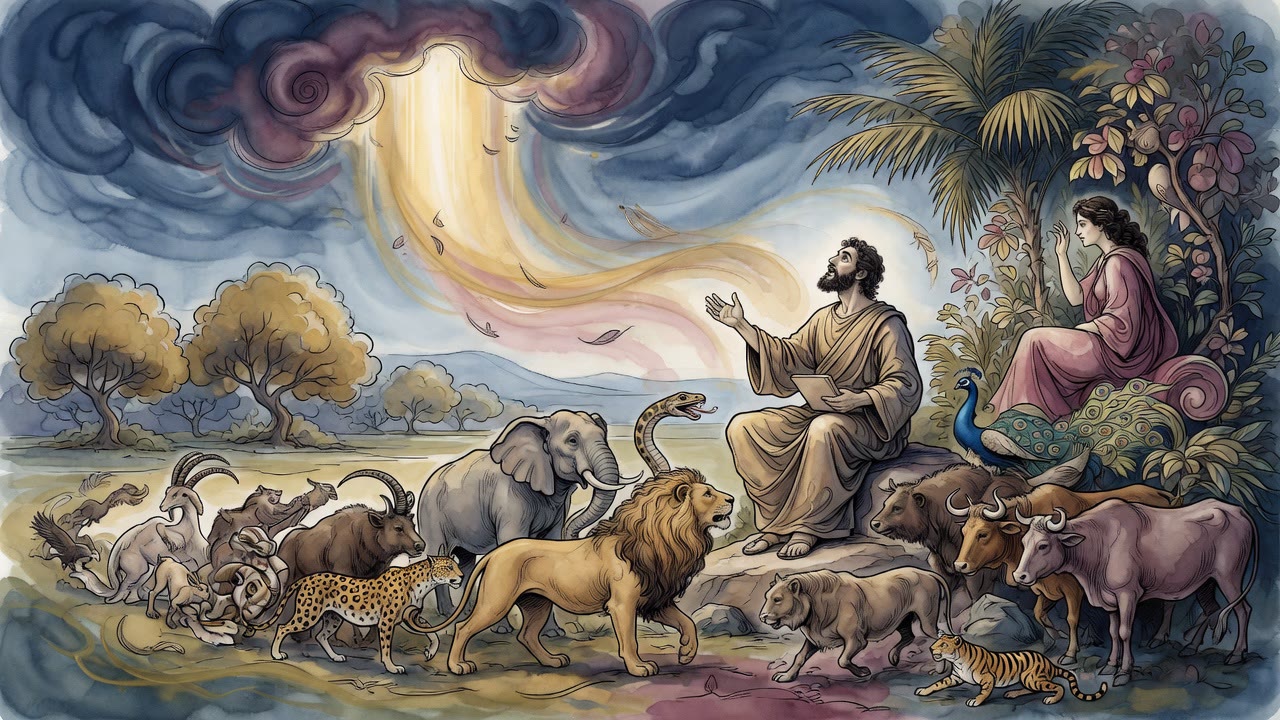
Pirkei DeRabbi Eliezer, a fascinating and imaginative work of Jewish literature, tells us that on the fifth day, God commanded the waters to bring forth all kinds of winged fowl, b...
It feels like the Bible just breezes through it: animals, done! But, of course, there's so much more to the story when you start digging. Imagine the scene. According to Pirkei DeR...
From the majestic lion to the tiniest insect, it's a dizzying array. But did you know that ancient Jewish texts actually categorized these creatures, drawing some pretty fascinatin...
to a fascinating passage from Pirkei DeRabbi Eliezer, a non-canonical yet beloved collection of stories and interpretations of the Torah. Here, Rabbi Joshua offers a powerful insig...
It's fascinating to dig into the details and see what we can uncover. one small corner of that world, focusing on the rules around nesachim, or libations – the pouring out of wine ...
Sometimes, those little asides open up a whole world of understanding. Take this one, from Sifrei Devarim 43, connected to the verse "And I shall give grass in your field to your b...
The Sifrei Devarim (literally "Books of Deuteronomy," a collection of early rabbinic legal interpretations), in section 77, delves into the specifics of responsibility for consecra...
Sometimes, seemingly simple words unlock entire worlds of understanding. Take the word "abomination," for example. What does it really mean in the context of our relationship with ...
We can find some interesting hints in the Sifrei Devarim, a collection of legal interpretations on the Book of Deuteronomy. One thing the Sifrei points out right away: there are mo...
You've got a whole flock – oxen, lambs, sheep, and kids of goats. Which ones do you choose? The Sifrei Devarim guides us, but it's not as straightforward as it seems. The text stat...
In Hebrew, the phrase Sifrei Devarim refers to the book of Deuteronomy. The passage we're looking at tackles a fundamental question: how do we know which animals are forbidden? The...
Our journey begins in Sifrei Devarim, a collection of legal interpretations on the Book of Deuteronomy. We're looking at section 104, a passage attributed to R. Yossi Haglili, a sa...
It's more nuanced than you might think! to a fascinating corner of Jewish law, specifically how we treat animals designated for sacred purposes. Our starting point is a verse that ...
Ever stumble upon something that just feels... wrong? Like a violation of an unspoken rule? Well, Jewish tradition grapples with that feeling in some fascinating ways, especially w...
Sometimes, it's in the seemingly small details that we find the biggest surprises. Take horses, for example. Yes, horses! Deuteronomy, Devarim in Hebrew, chapter 17, verse 16, tell...
to a passage from Sifrei Devarim, a collection of legal interpretations related to the Book of Deuteronomy. The text poses a question about priestly gifts, specifically, whether ch...
The Torah, in its profound wisdom, anticipates this very human dilemma. But it's not just about lost objects; it's about our responsibility to each other and to the land itself. to...