35 texts
That’s where texts like the Book of Jubilees come in. It's a fascinating ancient Jewish work, considered scripture by some, that expands on the Genesis account. to its version of c...
We all know the story of the flood, the animals two-by-two, and the rainbow's promise. But what about the aftermath? What did the world look like when the waters finally receded? T...
Think of it as a kind of expanded, annotated Genesis, written sometime in the Second Temple period. It offers us a glimpse into how some ancient Jews understood their own history. ...
It talks about "upper worlds," spiritual realms beyond our everyday experience. But that begs a question, doesn't it? A pretty fundamental one: Why? Why would God, the ultimate Cre...
That feeling, that yearning... it’s deeply connected to the idea of tikkun (spiritual repair) olam, repairing the world. But what if repairing the world also means repairing oursel...
To understand it, we need to delve into some complex ideas about light, vessels, and a mysterious "partition." Let's start with this partition. Think of it as a veil or a screen th...
Maybe the problem isn't your grasp, but your vessel. In Kabbalah, the Petichah LeChokhmat HaKabbalah, which translates to "An Introduction to the Wisdom of Kabbalah," delves into t...
But in the world of Kabbalah, this idea of rejection as a catalyst for growth is actually central to understanding how we receive divine light. this way: Let's say you're hosting a...
That even when things look bleak, when divine displeasure seems pointed our way, there are forces working on our behalf. But who are these celestial advocates? Heikhalot (the heave...
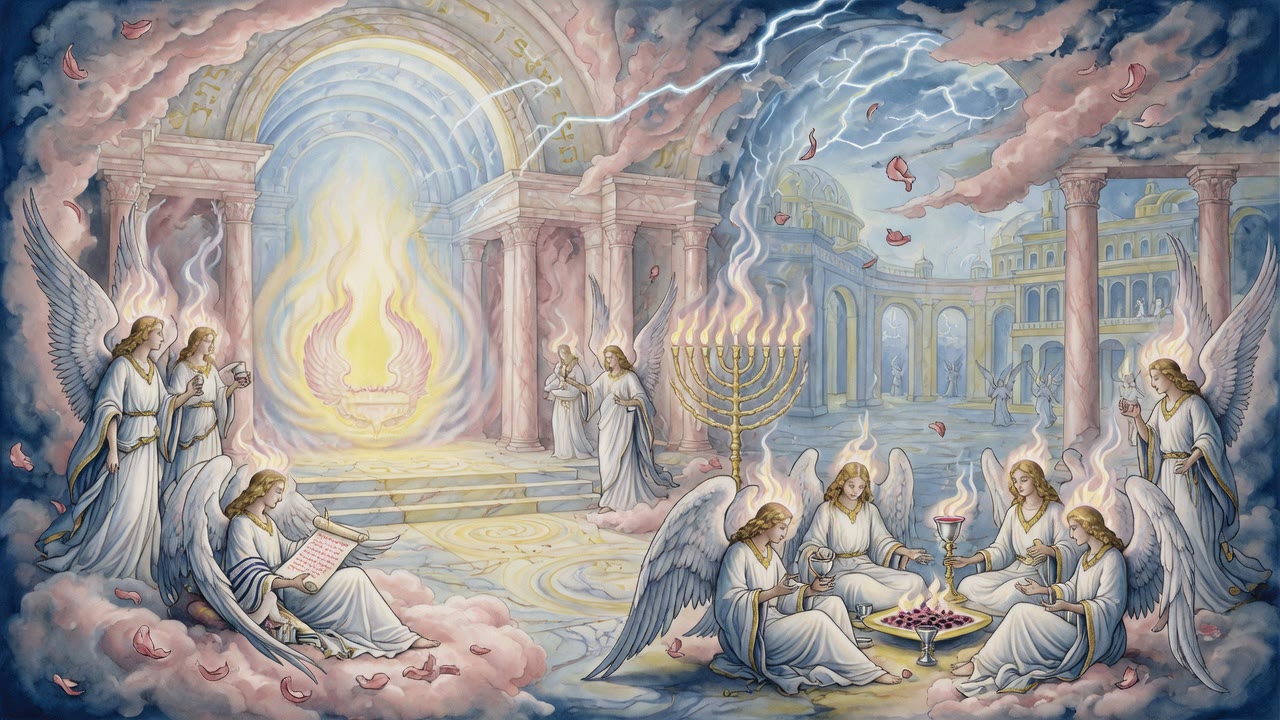
We get glimpses in sacred texts, whispers of other realms. Today, let's peek into the heavenly palaces, or Heikhalot (היכלות), as described in the ancient mystical text, Heikhalot ...
These texts, which date back to late antiquity, describe mystical journeys through the heavenly realms. Today, let's take a peek inside, focusing on the guardians that stand betwee...
Let me tell you, some of the old Jewish mystical texts go there – and then some. Today, we're diving into a particularly vivid passage from Heikhalot (the heavenly palaces) Rabbati...
Heikhalot (the heavenly palaces) Rabbati, a text from the mystical literature of early Judaism, paints a vivid picture of just such a scenario. It details the soul's ascent through...
There’s a special day in the Jewish calendar that invites us to do just that: Tu Bishvat, the 15th of the month of Shevat. It’s often called the New Year for Trees. But why this pa...
In Jewish mysticism, particularly in the Kabbalah, we often grapple with this very feeling when we try to understand the Divine. How can we, finite beings, possibly comprehend the ...
Sefer Raziel HaMalakh organizes the angelic realm into a staggeringly detailed hierarchy. This is not a vague reference to "hosts of heaven." The text names specific angels, assign...
Sefer Raziel HaMalakh contains a detailed cosmological map of the seven heavens—a tradition rooted in early rabbinic literature (Chagigah 12b) and expanded dramatically in the Hekh...
Buried in the middle of Sefer Raziel HaMalakh is a detailed astronomical and calendrical section that reads more like a scientific manual than a mystical text. It catalogs the move...
Harba de-Moshe (חרבא דמשה), the Sword of Moses, is one of the most important Jewish theurgic texts from the Geonic period. First published by Moses Gaster in 1896 from a unique man...
The transmission narrative in Harba de-Moshe (the Sword of Moses) is one of the most elaborate chains of divine authority in all of Jewish literature. It traces a path from God to ...
Sefer HaRazim (ספר הרזים), the Book of Mysteries, is a Jewish theurgic text dating to approximately the 3rd-4th century CE, making it one of the earliest structured works of Jewish...
The second heaven in Sefer HaRazim takes a dark turn. Where the first heaven teems with angels who serve human needs—weather, healing, agriculture—the second heaven is populated by...
The third heaven in Sefer HaRazim is a realm of fire and celestial light—but not the destructive fire of the second heaven. Here, fire is creative and purifying. The angels of the ...
The fourth heaven of Sefer HaRazim is dominated by a single spectacular image—the chariot of the sun, pulled across the sky each day by angels of fire. This is not a metaphor. The ...
The fifth heaven of Sefer HaRazim marks a transition from the functional heavens below—weather, punishment, light, and the sun—to the more abstract and terrifying realms above. Her...
The sixth heaven of Sefer HaRazim is a realm of crystalline purity where the angels exist in a state of perpetual holiness. After the escalating intensity of the lower heavens—from...
The seventh heaven in Sefer HaRazim is where the text's ascending structure reaches its climax—the Kisei HaKavod (כסא הכבוד), the Throne of Glory, where God sits in unapproachable ...
Maaseh Merkavah (מעשה מרכבה), the Work of the Chariot, is a Hekhalot (the heavenly palaces) text that provides a first-person account of the mystic's ascent through the seven heave...
The most dangerous part of the heavenly ascent described in Maaseh Merkavah (the Divine Chariot) is not the destination—it is the journey. At each of the seven gates leading to the...
The climax of Maaseh Merkavah (the Divine Chariot) is the mystic's arrival in the seventh palace—the throne room of God. After passing through six gates, surviving the challenges o...
(The water) covered the firmament over them and darkened the stars over them, viz. (Ezekiel 32:8) "All the lights of the heavens I will darken above you, and I will bring darkness ...
R. Eliezer Hamodai says: "And the dew layer ascended": (homiletically) there arose the prayers of our forefathers who were buried in the earth, on the face of the ground. "and, beh...
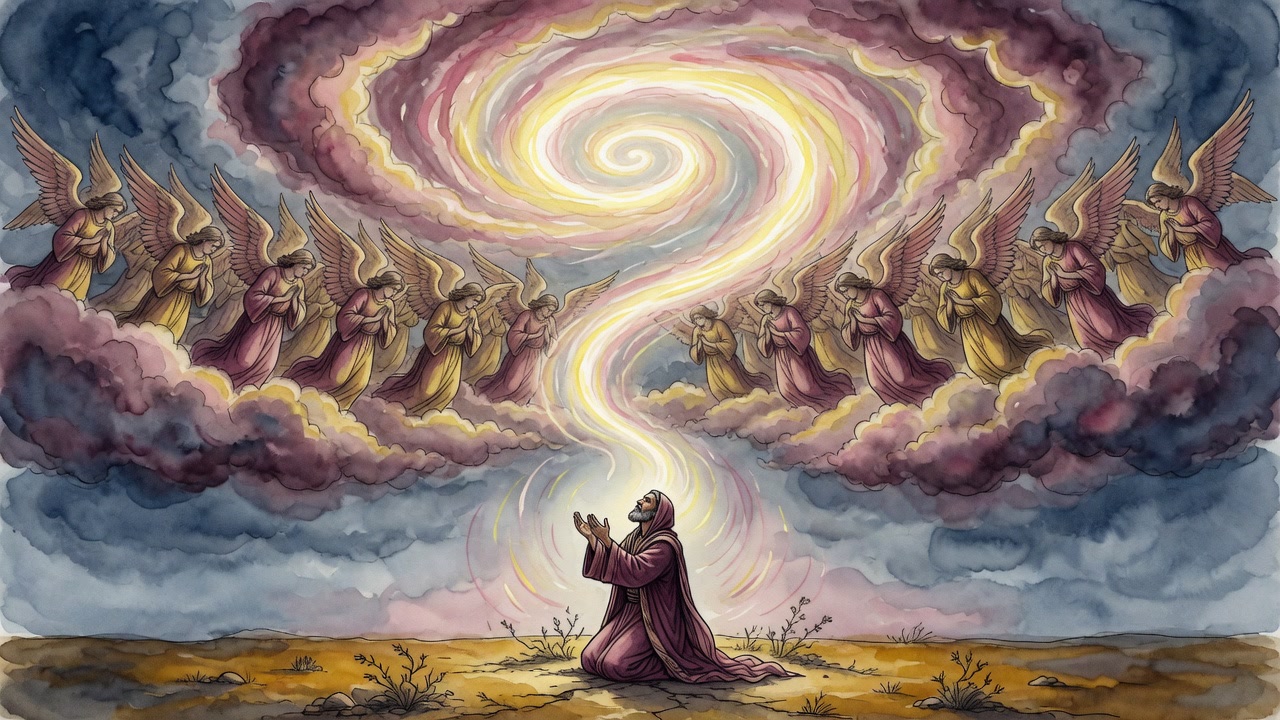
It tells us that the Chajjôth – these powerful, celestial beings that stand beside God’s throne – are constantly declaring, "Blessed be the glory of the Lord from His place" (Ezeki...
Pirkei DeRabbi Eliezer, a fascinating early medieval Jewish text, offers us a peek. It paints a vivid picture, drawing on biblical verses to flesh out the scene. The text brings us...
(Numb. 7:1), “So it came to pass on the day that Moses had finished.” Rav says, “Every place where it is stated, ‘So it came to pass (wayehi),’ [is referring to] something new”; bu...