
God Chose the One Man Who Didn't Want to Be High Priest
When God chose Aaron as High Priest, Aaron didn't want the job. He was a man who shunned distinctions, and Moses had to persuade him to accept.
Table of Contents
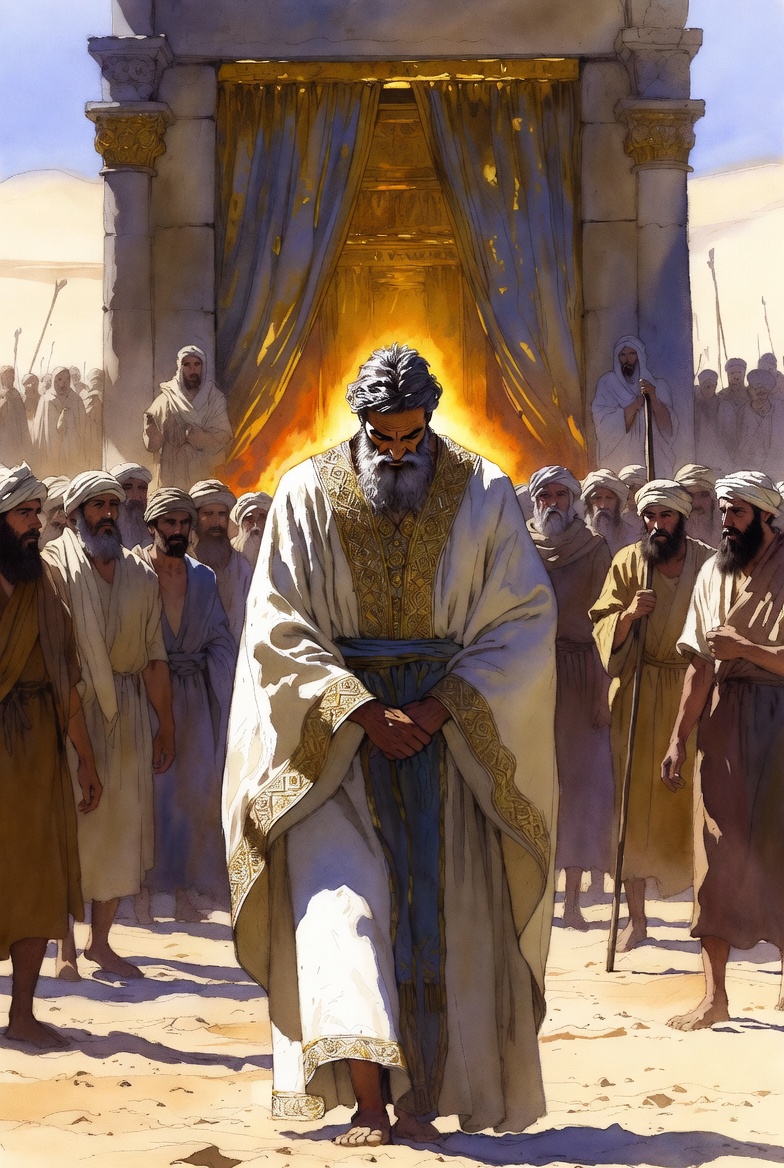
God chose Aaron as the first High Priest of Israel. Then He told Moses to go convince him to take the job.
That detail, tucked inside the consecration narrative that sits at the heart of Parshat Tzav, upends the usual picture of Aaron as Moses's enthusiastic sidekick. According to Legends of the Jews, Louis Ginzberg's 1909 compilation of classical rabbinic sources, God's actual instruction to Moses was: "Go, persuade Aaron to accept his priestly office, for he is a man who shuns distinctions." Aaron had to be talked into the most prestigious religious position in Israel.
Why Aaron Didn't Want It
The text is spare on Aaron's reasons, but the rabbis fill in the silence. Aaron's reputation across the midrashic literature is as a man of genuine humility: not performed modesty, but a real aversion to being placed above others. He was the people's advocate, the man who made peace between neighbors, the brother who wept with joy (not jealousy) when Moses was appointed to lead. A man like that doesn't leap at the chance to be elevated above the entire nation.
There was also the weight of what had happened at the Golden Calf. Aaron had been present when Israel built it. His role in that episode troubled him. The Midrash records that when he finally accepted the priestly office, he wept. Not from relief, but because he felt unworthy. You can trace Aaron's complicated relationship with his own authority through the broader consecration account in Kingdom of Aaron: Moses Consecrates the Priests.
The Problem With the Crowd
God instructed Moses to assemble the entire congregation at the door of the Tabernacle for the ceremony. All of Israel. Sixty myriads of adult men, 600,000, plus the same number of youths.
Moses did the math and raised an objection. The Tabernacle courtyard entrance measured only two seah, a small space. He said to God: "How shall I be able to assemble before the door of the Tabernacle, a space that measures only two seah, sixty myriads of adult men and as many youths?"
It's one of the most human moments in Moses's story. The man who parted the sea, who spoke face to face with God, who led a nation through forty years of wilderness. That man stood at a doorway and said: the crowd won't fit.
What God Said Back
God's answer is worth savoring. "Dost thou marvel at this? Greater miracles than this have I accomplished. The heaven was originally as thin and as small as the retina of the eye, and I caused it to stretch over all the world from one end to the other."
In other words: you're worried about 1.2 million people fitting through a courtyard gate. I once took something the size of a single cell and expanded it to cover everything that exists. This is not a problem.
God then extended the comparison forward: at the Resurrection, when every human being who ever lived will be gathered in Zion, the crowd will be so immense that people will call to each other "the place is too narrow for me, give place to me", and even then, God will expand the holy city to fit them all (Isaiah 49:20). The problem of the crowd at the Tabernacle was not an exception to how God works. It was a small rehearsal for it.
What Happened During the Seven Days
Once Aaron accepted, the consecration wasn't a single ceremony. It was a week. For seven days, Aaron and his sons lived in seclusion beside the Tabernacle. During that entire period, Moses performed all the priestly duties himself. He brought the sacrifices. He sprinkled the blood. He tended the altar. The man who would hand off the priesthood to his brother served as priest himself for seven days while that brother prepared.
It began on the 23rd of Adar, four weeks before the first Passover in the wilderness. The timing places the ordination squarely in the Tzav period, the consecration sequence that culminates in (Leviticus 8) when Moses assembles the congregation exactly as God commanded and performs the anointing. The crowd fit. It always does.
What the Story Reveals About Aaron
The rabbis who preserved this account in the Legends of the Jews, drawing on sources from the Talmudic period, c. 1st-5th century CE, were making a specific argument about what makes a leader worthy of the role. Aaron didn't pursue the priesthood. He had to be found, and then persuaded. God specifically chose a man who shuns distinctions to stand in the most distinguished position in Israelite life.
This pattern recurs throughout the tradition. Moses argued five times against being sent to Pharaoh. The prophets resist their callings. The righteous consistently underestimate themselves. In the rabbinic imagination, the desire for power is itself a disqualification. The reluctance to take it is evidence of fitness for the role.
Aaron had to be talked into the priesthood. That, the rabbis suggest, is exactly why he was right for it. Anyone who has ever watched a reluctant person do a job with care that an eager one would have done carelessly understands what the rabbis were getting at.