
King Solomon — Wisdom, Demons, and the Building of the Temple
In Jewish legend, Solomon commanded 36 demons by name, captured the king of demons to build the Temple, and lost everything when he handed his ring to the wrong being.
Table of Contents
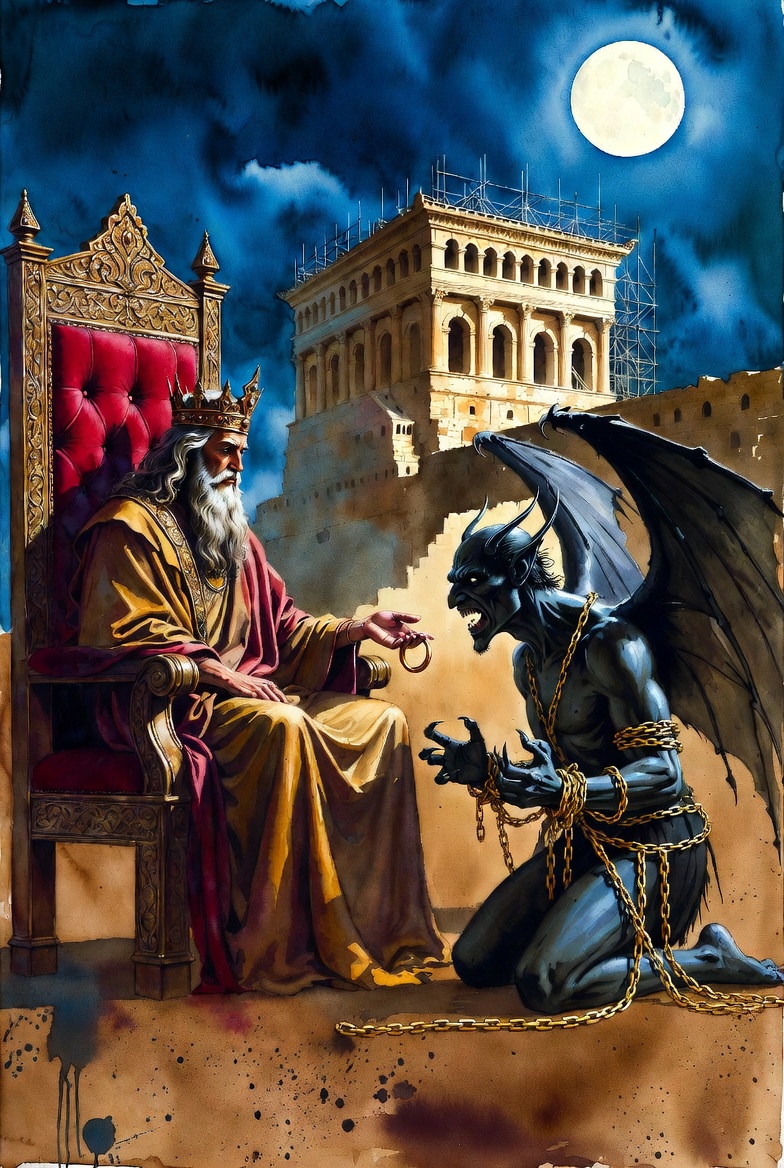
Solomon son of David is the most mythologized king in Jewish tradition. The biblical text presents him as history's wisest ruler, the builder of the First Temple in approximately 957 BCE, and the traditional author of 3 biblical books: Proverbs, Ecclesiastes, and the Song of Songs. In the vast literature of the Talmud (compiled 3rd-6th century CE), the Midrash collections (compiled 4th-12th century CE), and later legend, Solomon becomes something far more extraordinary: a sorcerer-king who spoke with animals, commanded legions of demons, and possessed a magic ring engraved with the ineffable Name of God. Our database contains 1,566 texts tagged with the Solomon theme, spanning every major collection from Midrash Rabbah (1,042 texts) to Legends of the Jews (119 texts) to Kabbalah (53 texts).
The Seal of Solomon
At the center of Solomon's supernatural power stands a single object: a ring, known as the Seal of Solomon. According to Louis Ginzberg's Legends of the Jews (published 1909-1938, drawing on over 700 primary sources) and multiple talmudic and midrashic sources, God gave Solomon a signet ring engraved with the Shem HaMephorash, the explicit, unpronounceable Name of God. This ring granted Solomon dominion over every demon, spirit, and supernatural creature in existence. The motif of the ring appears in at least 12 texts across our collection, from Ramchal's Kalach Pitchei Chokhmah (composed c. 1735 CE) to Kohelet Rabbah (compiled 6th-8th century CE).
The ring did not merely protect Solomon. It made him the absolute master of the spirit world. Demons trembled at the sight of it. With a gesture of his ringed hand, Solomon could bind any spirit to his will, compel it to speak the truth, or imprison it in a vessel of copper or bronze. The Testament of Solomon, a Jewish pseudepigraphical text composed between the 1st and 5th centuries CE in Greek, catalogs 36 demons that Solomon interrogated and bound using this ring, each one forced to reveal its name, its powers, and the angel that could neutralize it. The text names specific demons including Ornias, Onoskelis, and Beelzeboul, and records the precise angel assigned to counter each one.
Solomon and Asmodeus: Capturing the King of Demons
The most famous of all Solomon's encounters with the demonic world is his confrontation with Asmodeus, the king of demons. This story, told at length in the Babylonian Talmud in Gittin 68a-b (compiled c. 500 CE in Babylonia under the editorship of Ravina and Rav Ashi) and elaborated in midrashic literature, is one of the great adventure narratives in Jewish mythology. The Talmud's account in tractate Gittin runs several dense folio pages and was later expanded by Ginzberg across 4 chapters in volume 4 of Legends of the Jews. Five texts in our database feature Asmodeus by name in the title, including Kingdom of Asmodeus and Wisdom of Asmodeus and Solomon.
Solomon needed to build the Temple in Jerusalem, but the Torah forbade the use of iron tools on the altar stones (Deuteronomy 27:5). To cut the massive stones without metal, Solomon required the Shamir, a miraculous worm or stone-cutting creature. Only Asmodeus knew where the Shamir could be found.
Solomon sent his chief general, Benaiahu ben Yehoyada, to capture Asmodeus. Following Solomon's precise instructions, Benaiahu located Asmodeus's well on a remote mountain, drained it, filled it with wine, and waited. Asmodeus, returning to drink, found the wine and, despite his own warnings against intoxication, drank deeply and fell asleep. Benaiahu then bound him with a chain inscribed with God's Name and dragged him back to Jerusalem. The Talmud specifies that Benaiahu carried a chain, a ring engraved with the divine Name, a fleece of wool, and wineskins, each item serving a precise function in the capture.
The imprisoned Asmodeus proved to be a complex figure, not merely a raging demon but a being of sharp intelligence and dark humor. He wept at a wedding because he foresaw the groom's death. He laughed at a man buying shoes meant to last 7 years because the man had only 7 days to live. He straightened a blind man's path and guided a drunk safely home. When asked about these contradictions, Asmodeus revealed a worldview of bitter, penetrating clarity, a vision of hidden knowledge that the Talmud uses to explore the gap between surface appearances and deeper reality.
The Shamir Worm
The Shamir is one of the most unusual objects in Jewish mythology. According to Pirkei Avot 5:6 (compiled c. 200 CE by Rabbi Yehudah HaNasi), the Shamir was 1 of 10 miraculous things created at twilight on the sixth day of creation, along with the mouth of the earth that swallowed Korach, the mouth of Balaam's donkey, the rainbow, the manna, Aaron's staff, the first pair of tongs, and the writing on the tablets. The Shamir was a creature (or stone, depending on the source) that could cut through any material without physical contact. It split rock the way a pen marks paper. Our database contains 10 texts mentioning the Shamir, primarily from Ginzberg's Legends and Midrash Aggadah sources.
According to the Babylonian Talmud in Sotah 48b, the Shamir was no larger than a barley grain, and it could carve the hardest stone. It was kept wrapped in wool inside a lead container filled with barley bran, because it would destroy any other vessel. The Talmud in Gittin 68a explains that the Shamir had been entrusted to the Prince of the Sea, who in turn gave it to the wild rooster (tarnegol bara). Solomon used the Shamir to cut and shape the enormous stones of the Temple without any iron tool touching the sacred building, fulfilling the command of (Deuteronomy 27:5). After the destruction of the First Temple in 586 BCE, the Shamir vanished from the world.
Solomon's Throne
The legends surrounding Solomon's throne rival any description of a seat of power in world mythology. The most detailed account comes from the Targum Sheni to the Book of Esther (composed 7th-8th century CE in Aramaic), with parallel descriptions in Esther Rabbah (compiled 6th century CE) and in Ginzberg's Wisdom of Solomon and the Throne. According to these sources, Solomon's throne was a mechanical marvel constructed of ivory overlaid with gold, set with precious stones, and populated by 12 golden animal figures.
Six steps led up to the throne, each flanked by a pair of golden animals: lions and eagles, oxen and wolves, bears and lambs, 12 figures in total, representing natural enemies placed side by side to symbolize the peace that Solomon's justice brought to the world. As the king ascended, each golden animal extended a limb to support him. A golden eagle placed the crown on his head. A golden dove retrieved the Torah scroll and placed it in his lap. When Solomon sat in judgment, the mechanical animals would roar, shriek, or bellow, intimidating anyone tempted to give false testimony. The Targum Sheni specifies that 72 golden lions lined the stairway, and the throne itself stood beneath a golden canopy supported by 4 pillars.
The throne was said to be so magnificent that no other kingdom could replicate it. Later rulers, including Nebuchadnezzar of Babylon (r. 605-562 BCE) and Pharaoh Necho of Egypt (r. 610-595 BCE), tried to sit on it and were thrown or injured by its mechanisms, which recognized only the rightful king. The Targum Sheni records that 7 foreign kings attempted and failed to sit on the throne after Solomon's death.
Solomon, Master of Animals and Birds
Jewish legend grants Solomon the ability to speak with every living creature. (1 Kings 5:13) states that Solomon "spoke of trees, from the cedar in Lebanon to the hyssop that grows out of the wall; he also spoke of beasts, and of birds, and of creeping things, and of fish." The midrash takes this literally: Kohelet Rabbah (compiled 6th-8th century CE) and Shir HaShirim Rabbah (compiled 6th century CE) present Solomon as a king who understood the languages of all animals, birds, and even plants, a total mastery over the natural world that reflected his divine wisdom.
The most famous animal story involves the hoopoe bird (known in Hebrew as the dukhifat). In the Targum Sheni to Esther (7th-8th century CE), Solomon musters all the birds and notices the hoopoe's absence from the assembly. He threatens to punish it, but the hoopoe returns with an extraordinary report: it has discovered a distant kingdom called Kitor, the land of Sheba, ruled by a queen who worships the sun. Read the full account in Kitor at the Dawn of Creation and Wisdom of Solomon and Sheba. This leads directly to the famous visit of the Queen of Sheba to Jerusalem (1 Kings 10:1-13), an encounter the legends expand into a rich narrative of riddles, tests, and mutual recognition of power. The Targum Sheni records that the Queen brought Solomon 6,000 youths and maidens, all born in the same year and dressed identically, as one of her tests.
Solomon also served as a judge among animals, arbitrating disputes between creatures. Midrash Mishlei (compiled 9th-11th century CE) preserves several such cases, demonstrating that his wisdom extended beyond the human world into the fabric of nature itself.
Solomon's Fall: Hubris and Exile
The most dramatic turn in Solomon's mythological biography is his fall from power. The Babylonian Talmud in Gittin 68b and Louis Ginzberg's Legends of the Jews (vol. 4, ch. 6) tell a devastating story of how the greatest king in Israel's history was reduced to a wandering beggar. The story is also retold in Sanhedrin 20b and in the Midrash Aggadah collection (332 Solomon-tagged texts), which preserves multiple variant traditions about the cause and duration of his exile.
The accounts vary in detail, but the core narrative is this: Asmodeus, still captive in Solomon's court, challenged the king's pride. Solomon, overconfident, removed his ring, the source of all his power, and handed it to the demon. Asmodeus immediately hurled Solomon 400 parasangs (roughly 1,600 kilometers) from Jerusalem, assumed the king's form, and took his place on the throne. The Talmud records a dispute between Rav and Shmuel (two leading 3rd-century Babylonian sages) about whether Solomon was ultimately restored to kingship or remained diminished. Read the full account in Solomon's Vision and Asmodeus.
Solomon, stripped of his ring and his identity, wandered from town to town as a beggar, declaring "I am Koheleth" or "I was king over Israel in Jerusalem" (Ecclesiastes 1:12), and no one believed him. In some versions preserved in Pesikta deRav Kahana (compiled 5th century CE), he spent 3 years in exile, working as a kitchen servant in foreign courts, unrecognized and mocked. The author of Ecclesiastes' refrain, "vanity of vanities, all is vanity", takes on a shattering personal meaning in this context. It is the voice of a man who held absolute power and lost everything.
Eventually, Solomon recovered his ring, the Talmud records that it was found inside a fish served at a meal, a motif scholars have traced to ancient Near Eastern folklore traditions dating back to the Assyrian period (c. 900-600 BCE). He returned to reclaim his throne, banishing Asmodeus back to the demonic realm. But the experience marked him. The rabbis saw in Solomon's fall a lesson about the fragility of power and the danger of hubris, even for the wisest of men.
The Testament of Solomon and Related Texts
Solomon's role as a demon-master generated an entire literary tradition spanning over a millennium. The Testament of Solomon, composed between the 1st and 5th centuries CE in Greek (likely in a Jewish or Jewish-adjacent milieu), presents itself as Solomon's own first-person account of building the Temple with demonic labor. The text names 36 demons that Solomon summons and interrogates, each of whom reveals its name, its specific form of harm to humans, and the angelic power that can defeat it. Among them: Ornias, who strangles boys; Onoskelis, a shape-shifting female demon; and the 7 cosmic spirits bound to the Pleiades constellation. The text reads like a catalog of the invisible forces that the ancient world believed operated behind illness, misfortune, and sin. The earliest surviving manuscript dates to the 15th century CE, but textual analysis places the original composition centuries earlier.
Other texts in this tradition include the Key of Solomon (Clavicula Salomonis, earliest manuscripts from the 14th-15th century CE) and the Sefer HaRazim ("Book of Mysteries," compiled 3rd-4th century CE), which circulated in Jewish communities throughout the medieval period. Rabbi Moses Gaster (1856-1939), the scholar and folklorist, published a critical edition of the Sword of Moses, another Solomonic magical text dating to the geonic period (7th-11th century CE). Solomon's name became synonymous with mastery over the hidden world, a tradition that persisted in Jewish folk magic, amulet-making, and mystical practice for centuries. The Kabbalah collection in our database contains 53 Solomon-tagged texts from works including the Zohar (composed c. 1280 CE by Moses de Leon) and Ramchal's Kalach Pitchei Chokhmah (composed c. 1735 CE by Rabbi Moshe Chaim Luzzatto).
Explore the texts
Solomon's mythological legacy spans the full breadth of Jewish literature, 1,566 texts across 7 categories in our database of over 18,000 ancient Jewish texts. Search for all texts about Solomon, or explore specific threads: Asmodeus and the demons (5 texts by title), the Temple (2,077 tagged texts), or the Queen of Sheba. Browse the Legends of the Jews (2,650 total texts) for Ginzberg's comprehensive treatment, the Midrash Rabbah collection (2,921 texts, 1,042 tagged Solomon), or the Midrash Aggadah collection (3,763 texts) for the richest concentration of Solomon's legends. For the Shamir, start with Solomon: Moses and the Origins of the World and Kingdom of Solomon.