Acher and the Two Men Who Climbed the Trees at Gennesaret
One Sabbath in the valley of Gennesaret, two men climbed trees after birds. One broke the law and lived. One kept it and died.
Table of Contents
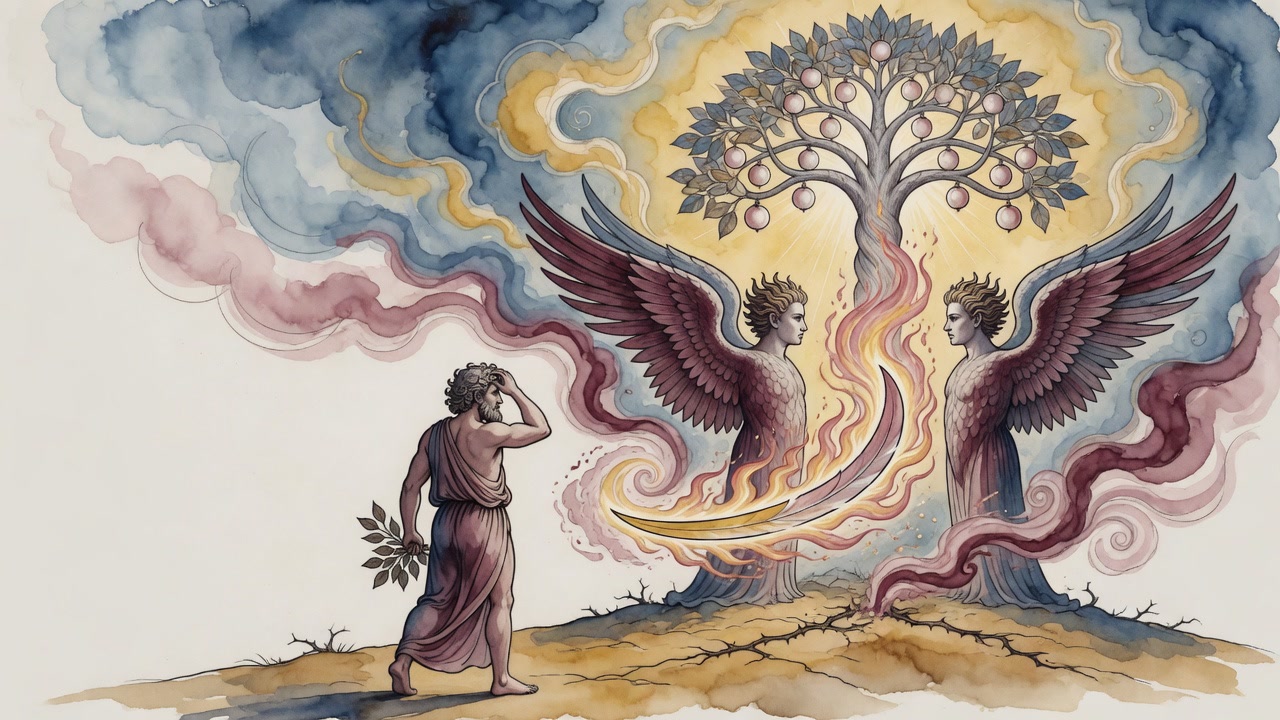
The valley of Gennesaret lay green and still that Sabbath morning, and Elisha ben Abuyah walked through it with the slow tread of a man who had nothing left to prove. He had been one of the great ones once. Students leaned toward him when he spoke. He knew the orchard, the place men only whisper about, where four had gone in and only one had come out whole. He had gone in too, and he had come back, and something in him had been cutting at the roots ever since. So he watched the trees. He could not stop watching the trees.
 Click for full size
The First Climber Takes the Nest
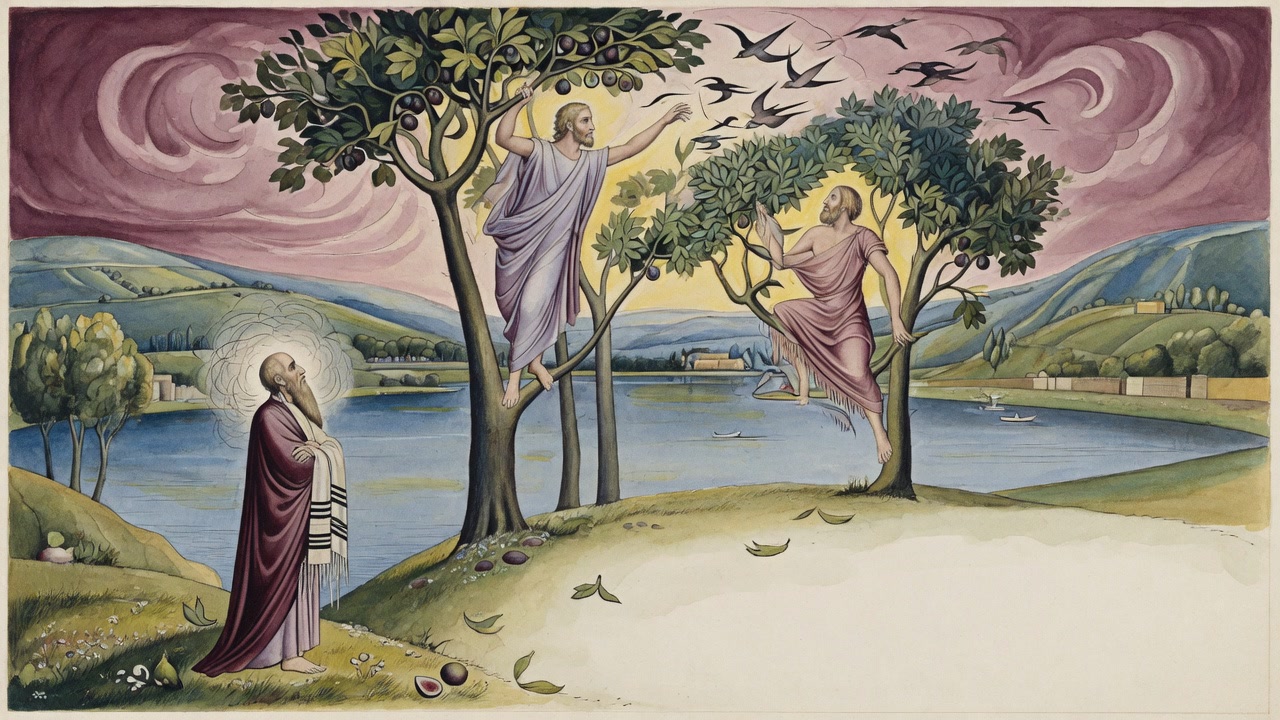
A man came down the slope ahead of him and set his hand to the trunk of a tall tree, and Elisha stopped to watch him climb. Up among the branches sat a nest, the mother bird brooding over her young. The man reached in and took the mother and the chicks together, the whole nest in one greedy fist, though the law says plainly that you must send the mother away before you take the young (Deuteronomy 22:6-7). He had broken it openly, in daylight, on the Sabbath. Elisha waited for the branch to crack, for the fall, for the punishment.
The man came down the tree humming. He stepped onto the grass, brushed the bark from his hands, and walked off unharmed into the bright morning. Elisha stood there with the taste of something cold rising in his throat. Nothing had happened. The sky had not noticed.
The Second Climber Keeps the Law
He told himself it meant nothing. One man, one morning. Then a second man came along the same path and chose a second tree, and this one Elisha knew at a glance for a careful man, the kind who weighs every act against the commandment. He climbed. He found his nest. And he did the thing the Torah asks, the small hard thing the first man had not bothered with. He shooed the mother bird off into the air and watched her fly, and only then did he gather up the young.
This was the very deed the law crowns with a promise. Do this, and it will go well with you, and you will live long. Elisha leaned forward, almost hungry now to see the man rewarded, to see the world hold its shape. The man started down. His foot came to the lowest fork of the branches. And out of a crevice in the bark a snake struck him on the heel, and he died there in the grass before he could cry out, his hands still full of the birds he had been so careful to take rightly.
The Promise Goes Empty
Elisha stood between the two bodies of the morning, the living and the dead, and the arithmetic would not balance. The one who scorned the commandment walked home to his bread. The one who honored it lay cooling in the field, the promise of long life rotting in his hand like fruit left in the sun. He had given his whole life to a covenant, and the covenant had just lied to his face in the plainest terms a man could read.
He thought of his father then. He understood, suddenly and bitterly, that Abuyah had never dedicated him to the Torah out of love of the Torah at all. His father had wanted a learned son the way a man wants a fine cloak, for the pride of being seen in it. A thing begun in vanity does not hold its weight. The root had been rotten from the planting, and Elisha had only now bent low enough to see it.
So he cut. He cut the shoots. He turned from the whole green world of the law so completely that the others could no longer bear to say his name, and they gave him a new one. They called him Acher, the Other, as though he had become a stranger wearing the face of a man they used to love.
The Disciple Who Would Not Let Go
One man would not give him up. Rabbi Meir had been his student, and Rabbi Meir kept coming, kept sitting at the feet of the Other, kept drinking down his teaching as if nothing had changed. The pious were scandalized. How can you learn from a man who has thrown it all away, they demanded, a man the rest of us will not even name?
Rabbi Meir answered them with his hands, the way you would show a stubborn child. When a man finds a pomegranate, he said, he eats the sweet seeds inside and throws away the bitter rind. He does not refuse the fruit because the peel is no good. Acher was a pomegranate. The wisdom packed tight inside him was still worth the eating, even now, even after the rind had gone to leather. So Rabbi Meir ate the seeds, and the seeds were good, and the man who grew them rode farther and farther from the camp of those who loved him, watching the trees, waiting for a punishment that never seemed to come for the right people.
The Other Rides On
That is how the tradition kept him, the brilliant rabbi turned stranger, riding past the houses of study on a day when no one was supposed to ride. They could not pardon him. They could not bury his teaching either. They struck out his name and wrote down his words. They called him the Other and went on quoting the Other for centuries, because the most frightening thing about Elisha ben Abuyah was never that he doubted. It was that he had seen exactly what they had all seen, the same two trees, the same two men, and had simply refused to look away from the body in the grass.
← All myths