4 min read

Ameimar Drew a Line Across the Heretic's Split God

A heretic split Ameimar's body between two gods at the belt; Ameimar answered with one Name and a world that has no second throne.

Curated by Arthur · Told by Maggid ·
Table of Contents
  1. The Belt That Would Not Be a Border
  2. Yetzer Without a Second God
  3. One Source, Two Tastes
  4. What the Heretic Could Not Buy

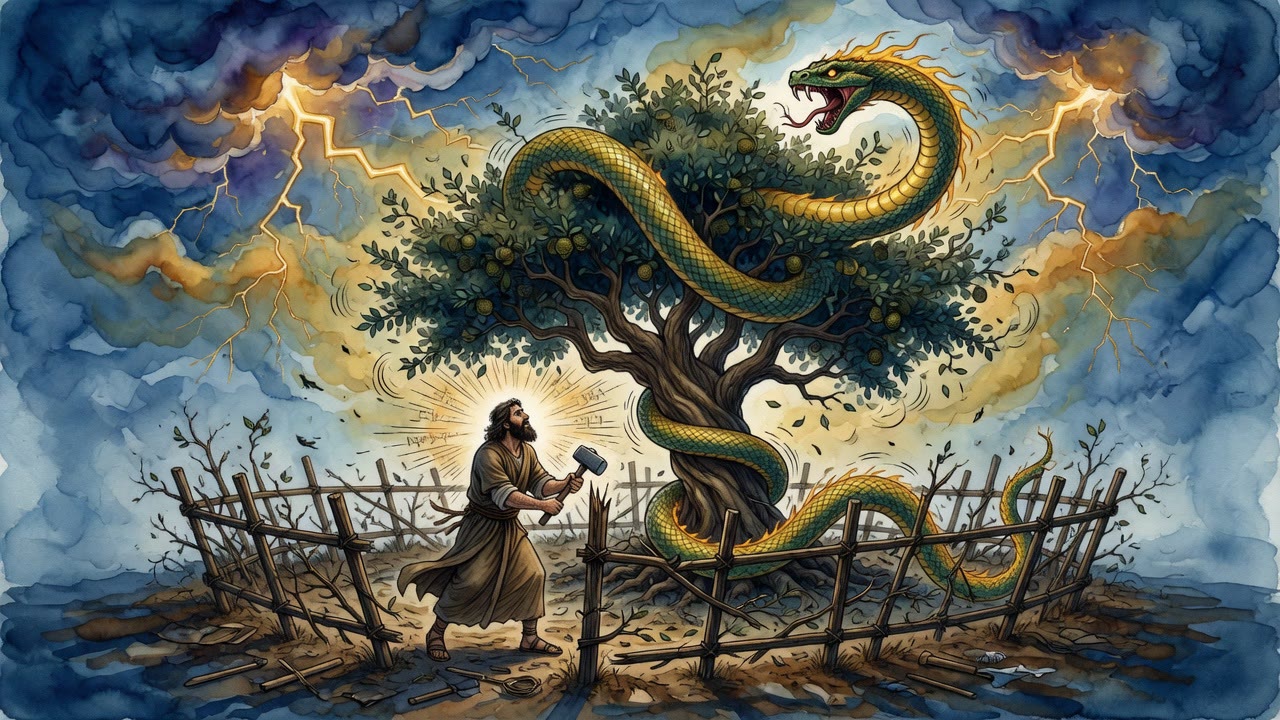
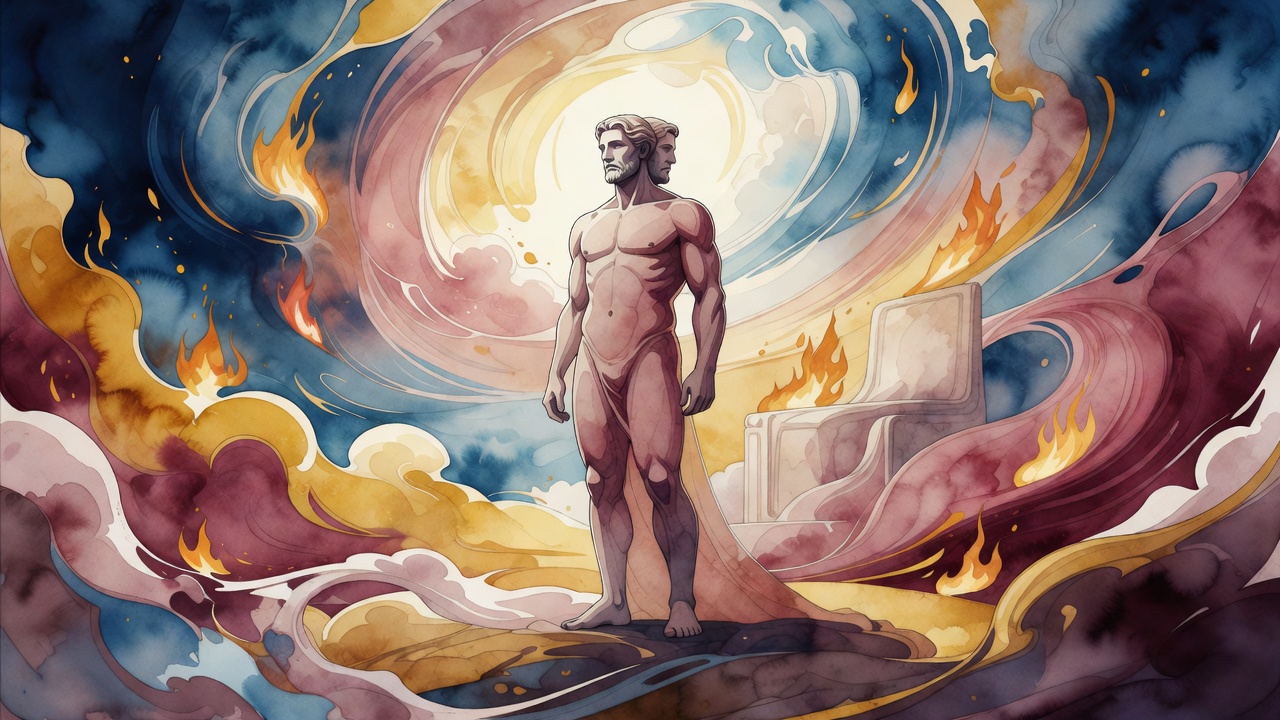
The heretic pointed at Ameimar's belt and drew a line through the air as if a man could be cut into two kingdoms without bleeding. "From your midpoint and up belongs to Hurmiz," he said. "From your midpoint and down belongs to Ahurmiz." The names were foreign gods of light and dark, and the insult was neat: even a Jewish body, he claimed, was a border war.
Ameimar Drew a Line Across the Heretic's Split God Click for full size

The Belt That Would Not Be a Border

Ameimar did not step back. The study hall in Babylonia had heard worse, but neat heresies travel faster than messy ones. A line at the waist is easy to remember. It turns every meal, every desire, every upright prayer into proof of a split cosmos.

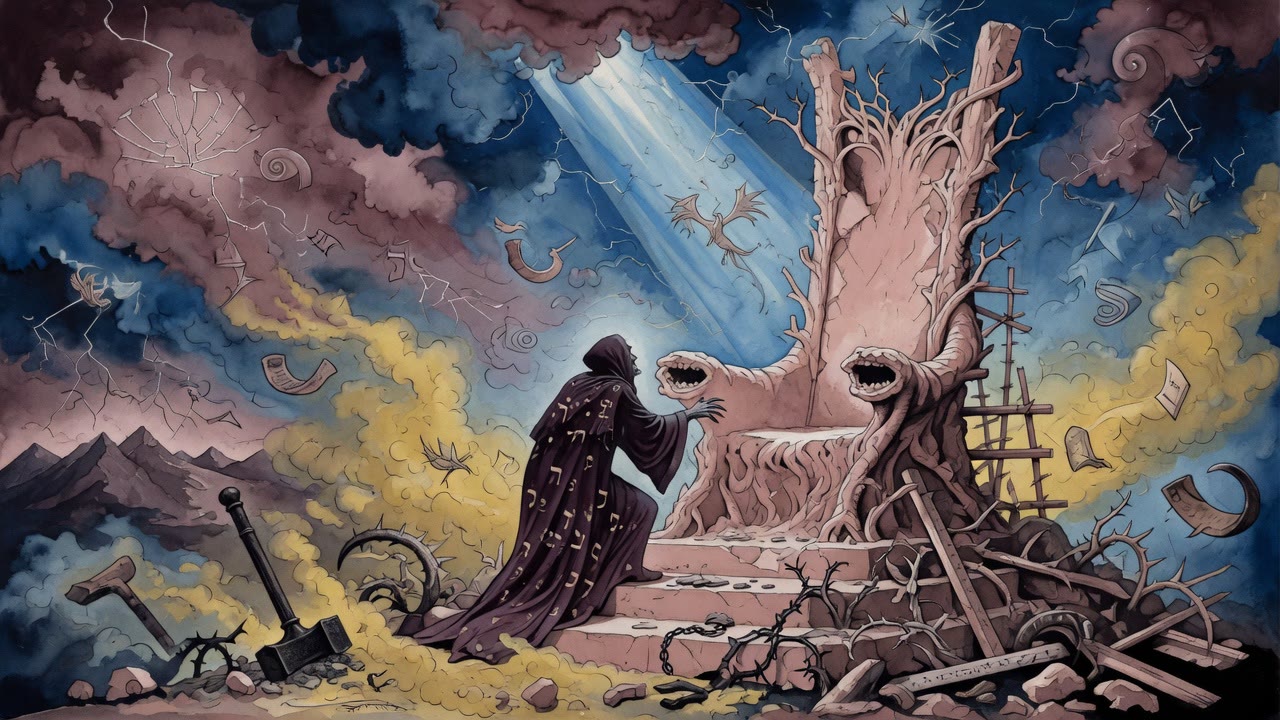
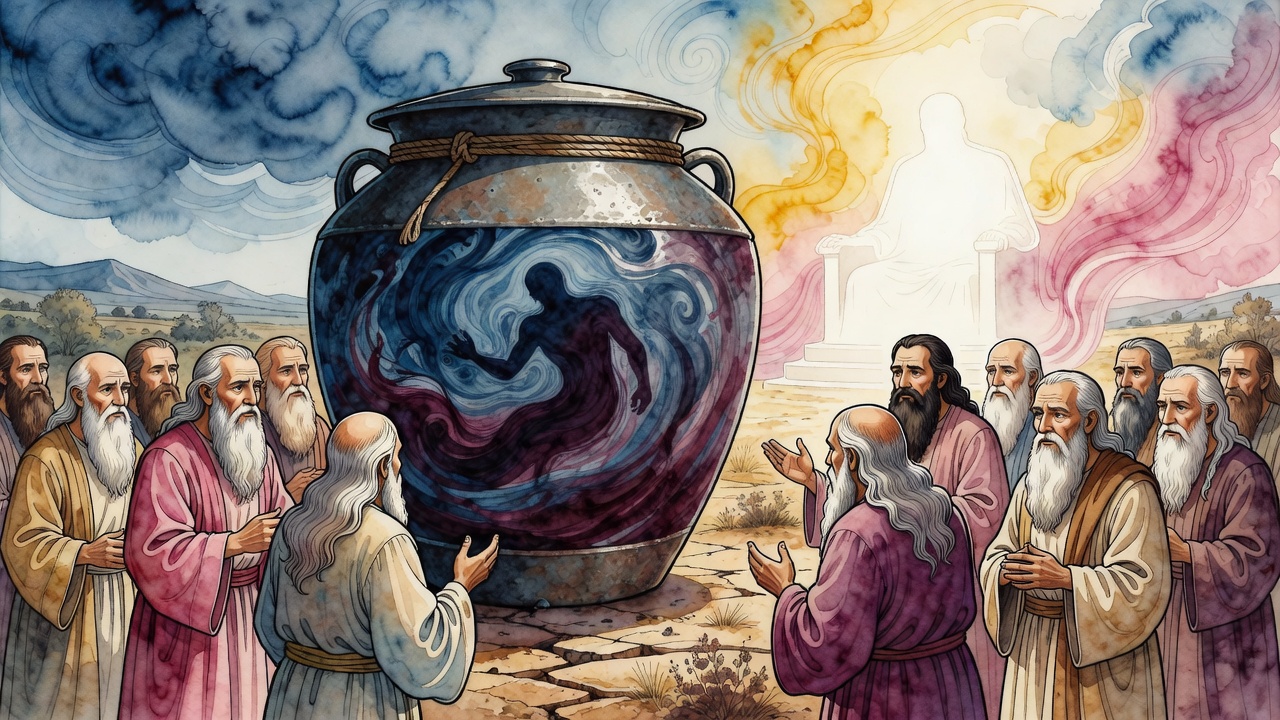
The answer the later masters preserve is not a shrug. It is a refusal of two thrones. God is not the upper half of a man. God is not a committee. If good and harm both arrive in one life, they do not arrive from equal kings. They arrive under one sovereignty that allows contrast without surrendering the crown.

Yetzer Without a Second God

Someone in the circle always asks the next question, even if only in the throat: what of the yetzer hara, the evil inclination? Does it not prove a second power inside the ribs?

No. The inclination is created. It is not a peer. It pushes toward appetite and shortcuts, and it can ruin a life, but it does not sit on a throne opposite the Holy One. The sages of another generation even tell of trapping it, of a day when the inclination was confined like a dangerous animal that still belongs to the owner of the forest. A force you can imprison is not a god.

Darkness, in the stricter philosophical line, is not a substance equal to light. It is light withdrawn. Absence can hurt. Absence is not a rival deity with temples and festivals.

One Source, Two Tastes

Joy and scarcity can sit at the same table. That fact seduces dualists. They love pairs. They want a clean ledger: this from the good god, that from the bad. Jewish teaching spoils the ledger. Both columns run back to one will, even when the will is hidden, even when the taste is bitter.

Ameimar's generation did not need a Persian myth to explain why knees buckle and why mouths sin. They needed a discipline of unity hard enough to survive empire, fever, and the clever missionary at the door. The Shema (Hear O Israel) is short because the claim is absolute. Hear. One. Not one-and-a-half.

What the Heretic Could Not Buy

The heretic wanted Ameimar's body as a diagram. Diagrams convert. Ameimar gave him a wall instead. Above the belt and below the belt, the same Name. Hunger and study, the same Judge. If there is trial, it is not because a dark king won a vote. If there is mercy, it is not because a light king stole a hour from his enemy.

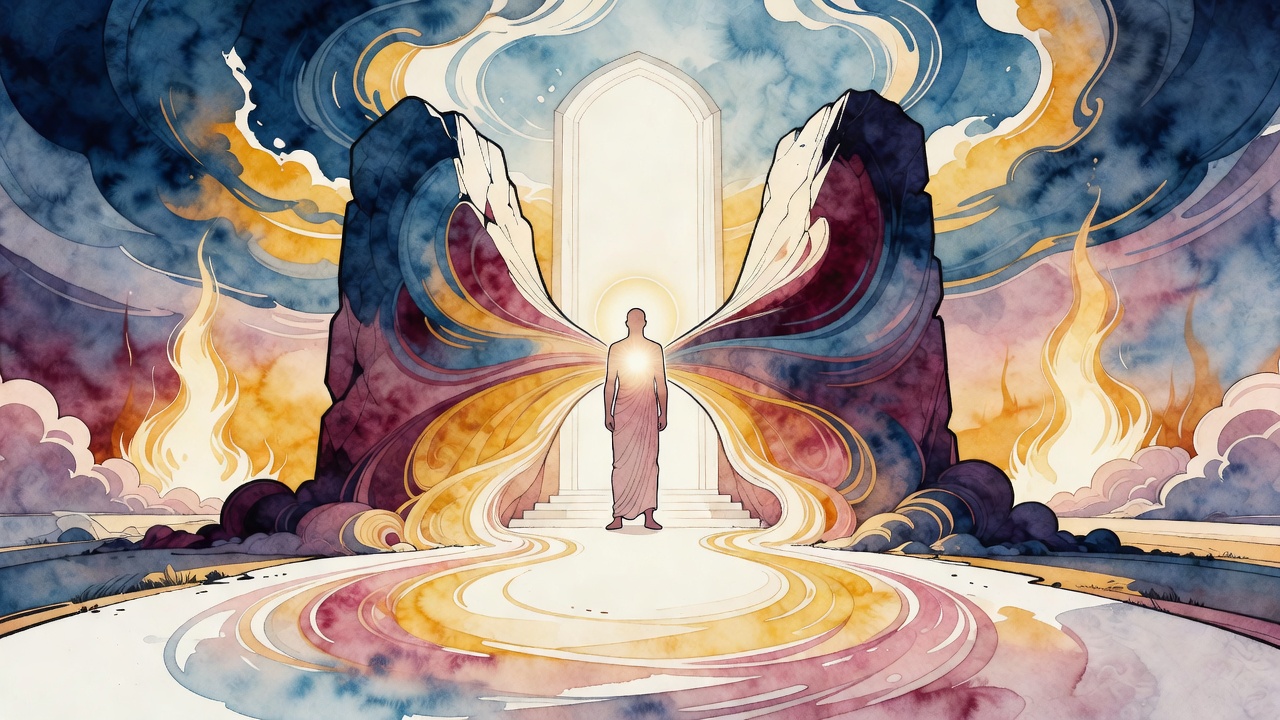
In the end the line in the air stayed in the air. It never landed on the belt. Ameimar walked out of the exchange still one man under one God, which is a poorer story for dualists and a truer one for anyone who has to live in a single skin.

Centuries later, when thinkers wrote dialogues about perfection and the appearance of evil, they still needed this scene. Philosophy can define privation. Ameimar had to answer a finger pointed at his waist. The finger lost.

Dust motes turned in a shaft of light between the two men. The heretic's finger had left the air but the students still saw the line. Imagination is a better missionary than proof sometimes. That is why the answer had to be as simple as a belt that refuses to become a border.

Outside, Babylon did what empires do: tax, parade, forget names. Inside, one scholar kept monotheism from being rented out by the hour. The work looks small. It is not small. Every generation meets a new salesman for two thrones.

He washed his hands before the next page of study as if the argument had left a film. Water and a blessing. Then the page again. Unity is maintained by ordinary repetitions more than by one famous retort.


← All myths

From the tradition

Sources

4 sources

The texts behind this telling. Some cards carry a translation of the source; others are our own retelling of it, and each card says which. Every card links out to the original.

Da'at Tevunot 36:4Da'at Tevunot

Retold in our words. Read the original at the link below.Sefaria Community Translation · CC-BY

Someone suggesting that God, the ultimate good, must have an equal and opposite force of pure evil lurking somewhere. That there are, G-d forbid, two separate domains, one for good and one for evil. That the good things and the bad things that happen in this world spring from these two opposing sources. It's a concept that, thankfully, Judaism soundly rejects.

Where does this idea even come from?

The text from Da'at (Knowledge) Tevunot is addressing just this sort of heretical (and sadly recurring) thought. It points to a passage in the Talmud, specifically Sanhedrin 39a, where a heretic says to Ameimar, a prominent Babylonian Amora (a Jewish scholar of the Talmud), "From your midpoint and up is in the domain of Hurmiz, and from your midpoint and down is in the domain of Ahurmiz." a bit. Hurmiz and Ahurmiz are references to deities of good and evil from an ancient dualistic belief system. This apostate was essentially trying to map a dualistic worldview onto a Jewish framework, claiming that even a person's body is divided between these opposing forces.

Isn’t there a concept of yetzer hara, the evil inclination, in Judaism? Doesn't that suggest a dualistic struggle within us?

Well, yes and no. The yetzer hara certainly represents the impulse towards selfishness, immediate gratification, and actions that are contrary to God's will. However. And this is crucial, it is not an independent, equal force to God. The yetzer hara is a part of God's creation, and ultimately subservient to His will. The Talmud (Yoma 69b) even portrays the sages as eventually overcoming and imprisoning the yetzer hara!

The idea that there is "nothing without its opposite" is itself a twisted understanding. While it's true that the world often presents us with contrasting elements – joy and sorrow, abundance and scarcity – this doesn't necessitate an absolute, evil force opposing God. Rather, these contrasts can serve to highlight the good, to test our faith, and to ultimately lead us towards greater understanding and connection with the Divine.

Consider the writings of the great Jewish philosopher, Maimonides (the Rambam). He argues forcefully against any notion of an independent force of evil. For Maimonides, evil is not a positive entity, but rather an absence of good, a privation. Just as darkness is the absence of light, evil is the absence of God's presence.

So, the next time you find yourself confronting the apparent duality of the world, remember that Judaism teaches us that there is one ultimate source, one ultimate power, and that is God. While challenges and temptations certainly exist, they are not evidence of a cosmic battle between equal forces, but rather opportunities for us to choose good, to grow, and to draw closer to the Divine light.

Full source
Da'at Tevunot 36:1Da'at Tevunot

Retold in our words. Read the original at the link below.Sefaria Community Translation · CC-BY

It all boils down to understanding the true meaning of echad – one.

The familiar version gives us that God is one. The Shema, our central declaration of faith, proclaims, "Hear, O Israel: The Lord our God, the Lord is one" (Deuteronomy 6:4). But what does that oneness really mean? It's more than just saying God is singular, unique. It’s deeper than saying there’s no other Creator, no other being whose existence is necessary.

Da'at (Knowledge) Tevunot, which means "Knowing Wisdom," explores this very question. It argues that understanding God's oneness means recognizing that there is absolutely no other force, no other power, that can rival or even influence Him. It means understanding that God's rule is singular and complete.

As it says in (Deuteronomy 4:39), "You have been shown to know that HaShem [the Name, meaning God] is the G-d; there is none other than He alone." The Rabbis, may their memory be a blessing, even extend this to the realm of magic! As the Talmud (Sanhedrin 67a) teaches us, God's power is so absolute that even sorcery can't supersede His will. for a second.

It's not enough to simply acknowledge God's existence. We have to internalize that there’s no leader or ruler other than Him, no guide to His world or to any creation in His world other than Him. Nothing can hold back His hand or prevent His will.

(Deuteronomy 32:39) echoes this powerfully: "See now that I, I am He, and there is no G-d with me; I bring death and give life; I wound and I heal, and none can be saved from my hand." And the book of Job (23:13) similarly proclaims, "And He is singular, and who can turn Him back? That which He wants, He does." We testify before Him, "When He suddenly takes away, who can turn Him back? Who would say to Him, 'What shall He do?'" (Job 9:12).

Think about the implications of this. If God's control is truly absolute, then everything that happens – even the seemingly random, unfair, and tragic events – are ultimately within His purview. This doesn't mean that God causes suffering (that's a whole other discussion!), but it does mean that nothing happens outside of His awareness and ultimate plan.

Why is this so important? Because, as Da'at Tevunot emphasizes, this understanding is a "great fundamental principle for our certain faith." It's the bedrock upon which we build our relationship with God. Believing in a God who is limited, who is subject to other forces, is fundamentally different from believing in a God whose power is absolute and all-encompassing.

So, the next time you're feeling lost, confused, or like you're at the mercy of forces beyond your control, remember this: God's oneness means His rule is complete. There's nothing that can happen without His knowledge and permission. And while we may not always understand His ways, we can trust that He is ultimately in control.

Full source
Da'at Tevunot 40:2Da'at Tevunot

Retold in our words. Read the original at the link below.Sefaria Community Translation · CC-BY

(Deuteronomy 6:4). But what does that "One" really encompass?

In Da'at (Knowledge) Tevunot, a profound work of Jewish thought, the concept of God's Singularity, or Yichud, is explored in depth. It’s not just about numerical unity; it’s about the negation of anything existing apart from God. Everything, ultimately, flows from and is encompassed by the Divine.

The text explains that when we speak of God's perfection, of aspects that are without limitation, we must understand that in each of these characteristics, there is nothing but Him. There's no opposite, no restriction. It's all part of that encompassing Singularity.

Think of it this way: If God is all-knowing, there isn't a separate sphere of "unknowing" that exists outside of Him. His knowledge is absolute, encompassing everything. This absolute nature, without opposite or limit, is part of what we mean by His Singularity.

Da'at Tevunot highlights two crucial aspects of this concept. First, no other characteristic of God can have an opposite, except for His Singularity. When God wants to reveal His Singularity, it’s a complete and thorough explanation, encompassing all aspects of His attributes. Second, all other characteristics are like details within this complete Singularity. It's a generalization that influences everything. It's a way for us to grasp that within God's endless perfection, the character of Singularity is unique. Nothing is like it, nothing opposes it, and nothing holds it back.

This truth, the text argues, is rooted in the very concept of God's Necessary Existence. This idea, that God must exist, that His existence is not contingent or dependent on anything else, is central to understanding His perfection. It applies to both what we can articulate about God and what remains beyond our understanding. We know that He alone is obligated to exist, and that there is nothing other than Him. This is a simple truth for those with faith.

But it's also a powerful truth. It suggests that everything we perceive, everything we experience, is ultimately a manifestation of this singular, unified Divine essence. The world isn’t a collection of separate, independent things but rather a weaving from the thread of God's Oneness.

So, the next time you say or hear the Shema, take a moment to consider the depth of that single word: Echad – One. It's not just a number; it's a statement about the all-encompassing, limitless nature of God. And within that Oneness, perhaps, we can find a deeper understanding of ourselves and our place in the universe.

Full source
Da'at Tevunot 56:3Da'at Tevunot

Retold in our words. Read the original at the link below.Sefaria Community Translation · CC-BY

The core concept here is Perfection – the ultimate, singular source of all things, which is understood to be haShem (God). Now, if God is perfect, how do we account for the existence of "good" and "negative" – the duality that seems so deeply woven into the fabric of our existence?

Da'at (Knowledge) Tevunot offers a compelling perspective: Even actions that seem to stem from "good" and "negative" ultimately derive from, and revolve back towards, this very Perfection. In other words, even when things seem off-kilter, they're still, in a way, guided by that initial, perfect source.

Here's the catch. That "as long as there is a concealment of [haShem's] singularity," these matters need to unfold according to this order. What does that concealment mean? It suggests that our limited human perception prevents us from fully grasping the unified, perfect nature of reality. Because we don't always see the whole picture, we perceive a world of duality, of contrasting forces.

Therefore, even actions that appear to arise from "good" or "negative" originate from the Singularity itself. According to heavenly will and wisdom, as long as this Singularity is concealed, these actions must emerge from the source of Perfection. It's almost like a divine plan playing out, even in the shadows.

And the ultimate goal? The fruit of the action of Perfection will be the redirection of all behavior towards it entirely. The idea is that eventually, everything – every action, every choice, every consequence – will ultimately circle back to that original state of Perfection.

Now, Da’at Tevunot introduces a crucial intermediary concept here. This is described as a "third issue to differentiate among each characteristic from his characteristics may he be blessed." It is the continuation of the consequences of this characteristic from the strength of the action of Perfection itself. In simpler terms, it's the link between divine Perfection and the specific qualities or attributes that we perceive. This intermediary changes based on the specific characteristic in question and how it is activated by Perfection. It is like a bridge between the absolute and the relative, shaping how Perfection manifests in our world.

You can even differentiate within this intermediary its independent matter and the method of its action. It has its own existence and way of operating, which is further clarified in the text.

What does this all mean for us, here and now? Perhaps it’s an invitation to trust in a bigger picture, even when we can't see it. To believe that even the difficult or challenging aspects of life have a purpose, a way of ultimately contributing to a greater good. It doesn't excuse harmful actions, of course, but it does offer a framework for understanding how even those actions can, in the grand scheme of things, lead us back towards wholeness and Perfection. It invites us to see the world, not as a collection of random events, but as a dynamic process, constantly unfolding towards a unified, harmonious end.

Full source