Parshat Vayera5 min read

Abraham Pressed God Down to Ten Righteous in Sodom

God decides to tell Abraham what he is about to do to Sodom. Abraham recognizes an opening and presses it, bargaining God down from fifty righteous to ten.

Curated by Arthur · Told by Maggid ·
Table of Contents
  1. The Consultation That Did Not Have to Happen
  2. The Argument Abraham Made
  3. Where He Stopped and Why
  4. The Counting That Came Afterward
  5. What the Conversation Meant for How to Pray

The Consultation That Did Not Have to Happen

God did not have to tell Abraham anything. The sentence had been decided. The angels were already walking toward Sodom. But there is a quiet line in Targum Pseudo-Jonathan that changes how the whole episode reads: God speaks, and says, I cannot hide from Abraham what I am about to do. It is right that before I act, I should make it known to him.

Think about the weight of that. The Creator of heaven and earth was saying that a human being had earned the right to be consulted before a divine judgment was carried out. Not because God needed permission. Not because the outcome would necessarily change. But because Abraham had become a person whose opinion on a matter of justice was worth hearing before the act.

Abraham heard the consultation as an opening. He was wrong that God needed his permission. An opening had been offered.

The Argument Abraham Made

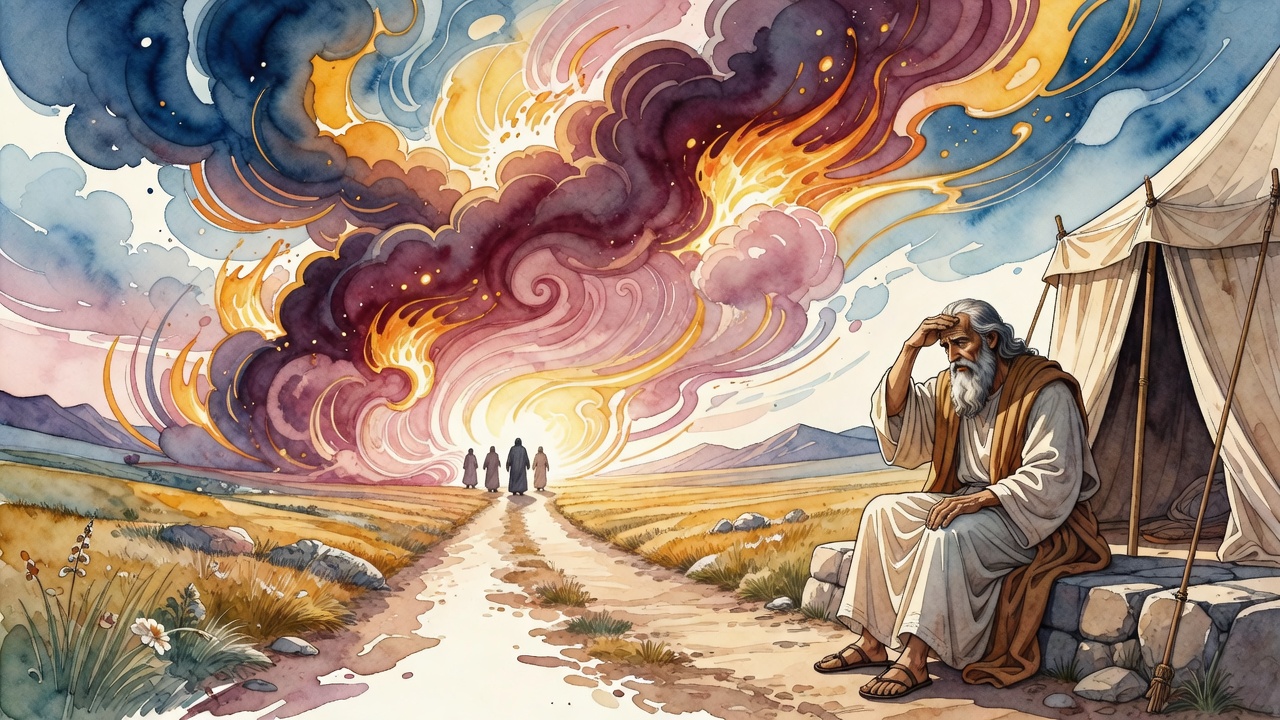
Abraham moved toward God. The text says he drew near, the same word used for a soldier approaching a battle. He knew what he was about to say would require nerve.

"Will you sweep away the righteous with the wicked? What if there are fifty righteous within the city?" He was not asking a rhetorical question. He was presenting a formal objection to a judgment, and he framed it as a matter of God's own consistency. The Judge of all the earth, he said, must act justly. He was holding the divine character to a standard he had been taught to believe in.

God said: if there are fifty righteous, I will spare the whole city for their sake.

Abraham did not stop. He had done the arithmetic and he knew the problem. He pressed down from fifty to forty-five. Then to forty. Then to thirty. Then to twenty. Each time he acknowledged the audacity of what he was doing, a man of dust and ashes arguing with the living God, and each time he pushed further anyway.

Where He Stopped and Why

Abraham stopped at ten. He did not go to nine or eight. The tradition has examined why.

The answer the sages gave has to do with Noah. The flood had destroyed the world, and Noah had survived with his household, eight people in total. If God had been willing to spare the world for eight, why did Abraham not argue down to eight?

Because Abraham remembered what had actually happened. The eight had survived, but the world had not been spared. Noah and his family were rescued while the world was destroyed around them. Abraham did not want a rescue. He wanted the city to be spared, not a handful of people extracted while everyone else drowned. For that, the minimum sustainable community, the smallest group that could constitute a congregation capable of sanctification and moral influence, was ten. Ten is the minimum quorum for communal worship. If there were ten righteous people in Sodom, they were not a remnant. They were a foundation that the city could survive on.

There were not ten.

The Counting That Came Afterward

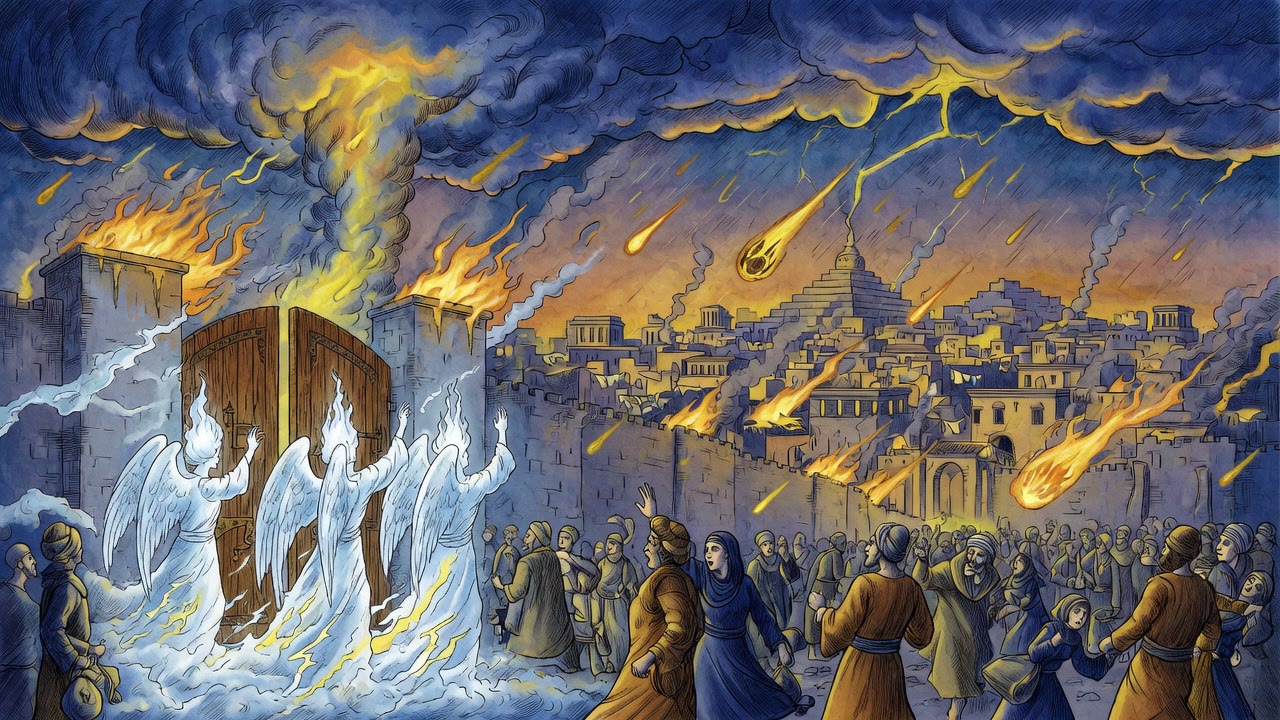
The angels entered Sodom. Lot received them. The men of the city surrounded the house. What followed removed all ambiguity about whether ten could be found. Lot's sons-in-law laughed at his warning. His wife looked back. His daughters survived with him, and that was the end of the count.

Abraham had pressed God down to the number that would have made a difference, and the number was not there. The city was not destroyed because God was not listening. The city was destroyed because Abraham's arithmetic was right: ten righteous people could have saved it, and there were not ten.

The negotiation was not theater. It established exactly what the threshold was and then confirmed that Sodom had not met it. The argument was both an act of mercy and a precise demonstration of its limits.

What the Conversation Meant for How to Pray

The tradition preserved the exchange not only as a narrative about Sodom but as a template. Abraham had argued with God about a specific unjust outcome and had moved the divine response through five rounds of pressing. He had done so with humility and without pretense, acknowledging his own smallness while refusing to stop. He had addressed God directly, framing his objection as a question about divine consistency rather than a demand.

Generations of Jews praying in desperate circumstances carried this precedent with them. It was permissible to argue. It was permissible to press. The God who had told Abraham about Sodom before acting, the God who had said it was right to make it known, was a God who could be engaged with and not merely accepted. Abraham at the gate of Sodom was a model of how to stand before judgment and speak.


← All myths
From the tradition

Sources

9 sources

The texts this telling draws on, in full. Open a card to read inline, or expand it for a wider, quieter read.

Targum Pseudo-Jonathan on Genesis 18:17Targum Pseudo-Jonathan on Genesis

There is a quiet line in Targum Pseudo-Jonathan on (Genesis 18:17) that changes how you read the whole Sodom episode. God speaks, as the Targum puts it, bememra, with His Word. And says: "I cannot hide from Abraham what I am about to do. It is right that before I act, I should make it known to him."

Think about the claim. The Creator of heaven and earth is saying, in effect, that a human being has earned the right to be consulted before a divine judgment is executed. Not because God needs permission. Because Abraham's relationship with Him has become the kind of covenant in which secrets are unfitting.

The rabbis who shaped the Aramaic expansions of the Targum, composed over centuries and finalized sometime between the 4th and 8th centuries CE, were careful to use the phrase "the Word of the Lord" (Memra) as a way of speaking about God's active presence without flattening His transcendence. The Memra talks. The Memra decides. And here the Memra decides that friendship with Abraham obligates disclosure.

This is the seed of everything Abraham will do next in the chapter: the bargaining, the pleading, the refusal to let fifty, forty, thirty, twenty, or ten righteous people die with the guilty. God disclosed the plan precisely because Abraham was the kind of partner who would argue.

The takeaway: true covenant is not silent obedience. It is the relationship in which even the Judge of all the earth will not move without telling you first.

Full source
Bereshit Rabbah 49:9Bereshit Rabbah

"Far be it from You" (Genesis 18:25). Rabbi Yudan said: "Far be it from You" means it is a profane thing for You. Rabbi Acha said: "Far be it, far be it" two times means there is a desecration of the Name of Heaven in the matter. Rabbi Levi said: Two people said the same thing, Abraham and Job. Abraham said: "Far be it from You to do such a thing, to slay the righteous with the wicked" (Genesis 18:25).

Rabbi Yehudah son of Rabbi Simon said: Thus Abraham said to Him: A king of flesh and blood has an appeal hung up for him, from a duke to a prefect, from a prefect to a general; but You, because You have no one to hang up an appeal before for You, will You not do justice?

Rabbi Levi said: "Shall the Judge of all the earth not do justice?" (Genesis 18:25). If You seek a world, there is no strict judgment; and if You seek strict judgment, there is no world. You are holding the rope at both ends: You want a world and You want strict judgment. If You do not give up a little, the world cannot stand.

The Holy One, blessed be He, said to Abraham: "You loved righteousness and hated wickedness" (Psalms 45:8). You loved to justify My creatures, and you hated wickedness, you refused to condemn them; "therefore God, your God, has anointed you with the oil of gladness above your fellows" (Psalms 45:8). What is "above your fellows"? From Noah until you there are ten generations, and of all of them I spoke with none of them but with you.

Full source
Legends of the Jews 5:163Legends of the Jews

The story, as told in Ginzberg’s Legends of the Jews, is a real nail-biter.

The familiar story centers on Sodom and Gomorrah. These cities were, shall we say, not exactly shining examples of moral rectitude. God, understandably, wasn't thrilled. He decided it was time for a reset. But Abraham, ever the advocate, steps in. He knows innocent people are living there. He can’t just stand by.

Abraham approaches God, not with demands, but with humility. "I have taken upon me to speak unto the Lord," he says, "I who would have been turned long since into dust of the ground by Amraphel and into ashes by Nimrod, had it not been for Thy grace." (Legends of the Jews).

Think about the weight of that statement. Abraham acknowledges his own vulnerability, his own dependence on divine grace. He’s basically saying, "I’m nothing without you, but I have to ask…"

He begins his famous negotiation. He starts high: "Peradventure there shall lack five of the fifty righteous for Zoar, the smallest of the five cities. Wilt Thou destroy all the city for lack of five?" Zoar, was the runt of the litter, the smallest of the five cities slated for destruction. Abraham is hoping to save it, at least.

God responds, "I will not destroy it, if I find there forty and five." (Legends of the Jews).

A little wiggle room!

But Abraham doesn’t stop there. He presses on. "Peradventure there be ten pious in each of the four cities, then forgive Zoar in Thy grace, for its sins are not so great in number as the sins of the others." (Legends of the Jews).

He's thinking strategically. He’s hoping that even if the other cities are beyond redemption, Zoar, being smaller and perhaps less steeped in wickedness, can be spared if there are just a few righteous people to tip the scales. Maybe ten good souls in each of the four bigger cities is enough to sway things and save Zoar.

It's a tense moment, isn’t it? You can almost feel the weight of the impending decision. Will Abraham succeed? Will any of the cities be saved?

This passage, brief as it is, captures the essence of Abraham: his courage, his compassion, and his unwavering belief in the power of tzedek (righteousness) and hesed (loving-kindness). It also highlights the dynamic relationship between humanity and the Divine – a relationship where we can question, plead, and even, in a sense, bargain.

What does this ancient story tell us today? Perhaps it's a reminder that even in the face of seemingly insurmountable odds, we have a responsibility to advocate for justice, to seek out the good, and to never give up hope. And maybe, just maybe, a little bit of bargaining with the universe isn’t such a bad thing after all.

Full source
Legends of the Jews 5:164Legends of the Jews

The story of how he pleaded for the people of Sodom and Gomorrah is one of the most powerful examples of intercession in the entire Torah.

Remember the story? God, seeing the wickedness of these cities, decides they must be destroyed. But Abraham, ever the compassionate patriarch, steps in. He doesn't just accept God's decree. He challenges it. He argues. He negotiates.

The initial plea, of course, is famous: "Will you sweep away the righteous with the wicked? What if there are fifty righteous people in the city? Will you really sweep it away and not spare the place for the sake of the fifty righteous people in it?" (Genesis 18:23-24).

God, remarkably, agrees. He says he will spare the city for the sake of fifty righteous people.

But Abraham doesn't stop there. He continues to press, lowering the number again and again. It's almost audacious, isn't it? This human, standing before the Almighty, daring to question, to bargain.

Now, as our text picks up, Abraham, according to Legends of the Jews, continues his desperate plea. He asks whether God would be satisfied if there were just thirty righteous people, ten in each of the three larger cities. Would God pardon the two smaller ones even if they had no righteous people within them – if their merits could somehow be linked to the larger cities? God grants this request, too!

And Abraham persists! He gets God to agree to spare the five cities for the sake of just ten righteous people. Ten people. That's all it would take.

Why did Abraham stop there? Legends of the Jews explains that Abraham knew that eight righteous people, Noah, his wife, their three sons, and their wives, hadn't been enough to save the generation of the Flood. Perhaps a similar calculation was at play here.

He hoped that Lot, his nephew, his wife, and their four daughters, along with their daughters' husbands, would make up the necessary ten. A reasonable hope, wouldn't you think?

But here's the heartbreaking truth: even those considered "righteous" in Sodom and Gomorrah, while better than the rest of the population, were still far from truly good. As the story unfolds, we see just how deeply entrenched the wickedness had become.

The Talmud (Sanhedrin 108a) elaborates on the corruption of Sodom, painting a picture of a society utterly devoid of basic human decency. The Midrash Rabbah (Genesis 49:8) adds further detail about the specific sins that were rampant.

Abraham's fervent prayers, his relentless bargaining. they weren't enough. Not because God was unwilling to listen, but because the people themselves had crossed a point of no return.

The story of Sodom and Gomorrah isn’t just a tale of divine punishment. It's a stark reminder of the power of human choice, the corrosive nature of evil, and the limits, perhaps, even of the most impassioned intercession. It leaves you wondering, doesn't it? What happens when a society's moral compass is so broken that even the best among them aren't good enough?

Full source
Bereshit Rabbah 49:13Bereshit Rabbah

The story of Abraham pleading with God to spare Sodom and Gomorrah is more than just a negotiation; it’s a glimpse into the very nature of divine justice and collective responsibility.

We find ourselves in (Genesis 18:32), where Abraham, ever the bargainer, is trying to save the cities from destruction. "Please, let my Lord not be incensed, and I will speak only this time. Perhaps ten will be found there." And God responds, "I will not destroy for the ten." But why ten? Why did Abraham stop there?

That's the question that Bereshit Rabbah 49 wrestles with. Why not nine? Or five? What's so special about the number ten?

One explanation, the text suggests, is the concept of an "assembly." In Jewish tradition, a group requires at least ten individuals to constitute a minyan, a quorum for communal prayer and other sacred acts. The idea here is that if ten righteous people could be found across those five doomed cities, they would form a kind of holy nucleus, a spiritual force strong enough to tip the scales. A group, the text says, is only called an assembly if it consists of ten individuals.

Another explanation casts our minds back to the Flood. Remember Noah? He and his family – eight souls in total – were spared, but their righteousness wasn't enough to save the rest of the world. So perhaps, the midrash (rabbinic interpretive commentary) suggests, ten represents a threshold, a minimal requirement for collective redemption.

There's also a more personal, almost heartbreaking, reason offered. Perhaps Abraham believed that ten righteous people already existed in Sodom: his nephew Lot, Lot's wife, their four daughters, and their four sons-in-law. He might have thought he was pleading for a group that already existed.

But the most striking interpretation comes from Rabbi Yehuda ben Rabbi Simon and Rabbi Ḥanin, in the name of Rabbi Yoḥanan. They make a distinction between Sodom and Jerusalem. Sodom needed ten. But Jerusalem? It only needed one! As (Jeremiah 5:1) says, "Wander through the streets of Jerusalem…[if you will find [timtze’u] a man, if there is a performer of justice, a seeker of faithfulness, I will forgive it]." And (Ecclesiastes 7:27) echoes, "One for one to find a tally."

Rabbi Yitzḥak takes this idea even further. How much is the minimum [mitzui] amount for one city? Jerusalem, he says. It is even one! As in, if even one righteous person could be found, justice would be deferred. One person. One act of kindness, one moment of truth, one spark of righteousness can be enough to hold back the tide.

What does this all mean for us? Perhaps it's a reminder that even in the darkest of times, individual actions matter. That even when faced with overwhelming negativity, the choice to be righteous, to seek justice, to embody faithfulness can have a profound impact. We may not be able to save the entire world, but maybe, just maybe, we can save our own little corner of it.

Full source
Bereshit Rabbah 49:10Bereshit Rabbah

We'll be looking at Bereshit Rabbah 49, which unpacks Abraham's famous negotiation with God over the fate of Sodom.

Remember the story? God is about to destroy Sodom and Gomorrah because of their wickedness, but Abraham, ever the advocate, pleads for their salvation. He starts by asking, "Will you sweep away the righteous with the wicked? What if there are fifty righteous people in the city? Will you still destroy it?" (Genesis 18:23-24).

Our passage from Bereshit Rabbah focuses on the verse, "If I find in Sodom fifty righteous people within the city, I will forgive the entire place for their sake" (Genesis 18:26). It’s a verse that sparks a profound exploration of divine justice and the power of intercession.

Rabbi Yudan and Rabbi Yehuda ben Rabbi Simon, quoting Rabbi Yehoshua ben Levi, bring in a verse from Job: "For [I speak] of God who said: I have forgiven; I will not bring harm" (Job 34:31). What does this mean? The Rabbis connect God's willingness to forgive Sodom to this declaration of already having forgiven and promising not to cause harm. It’s as if God is saying, "My default is forgiveness. I'm not looking for reasons to punish; I'm looking for reasons to pardon."

The passage then explores the nuances of the Hebrew words used. God says, "I will forgive" (venasati) the entire place. This is juxtaposed with "I will not bring harm" (eḥbol). The Rabbis interpret eḥbol as meaning God won't "take collateral" for their sins, drawing a parallel to the verse in Exodus (22:25) about taking collateral (taḥbol). In other words, God won't hold their sins against them as a debt.

But here’s the twist. The passage immediately adds: "Yet they pile up [ḥovelim] allegations against Me, saying: He does not judge properly.” Even as God extends this offer of forgiveness, the people are, metaphorically, accusing God of injustice! It's a stark reminder of human fallibility and our tendency to question divine judgment.

The text then grapples with a difficult verse from Job (34:32): “What I do not see [biladai eḥeze]…if something is beyond Me…go and examine My judgment. If I am mistaken, 'you teach me.'" This is a radical statement! Is it suggesting that God is open to correction? The Rabbis interpret this as God saying, in effect, "If there's something I haven't seen that leads to a false judgment, examine My judgment. If I am mistaken, you teach me." It's an incredible idea – the openness of God to reevaluation, so to speak.

The passage continues, "If I have performed injustice with the former generations, I will not continue with the latter ones." This reinforces the idea that God learns and grows, or at least, God’s interactions with humanity evolve. There's a sense of continuous refinement in the divine-human relationship.

Then comes a powerful statement: "I am silent for him with his claims [badav]" (Job 41:4). The Rabbis interpret badav as "for you and for the branches [badim] that emerge from you," meaning Abraham's descendants. God is saying to Abraham, "For you and your descendants, I will be silent." Despite the harsh words that Abraham, Moses, Joshua, and David will utter, questioning God's actions, God will remain silent, bearing their complaints. God, the ultimate power, chooses to remain silent in the face of human questioning. It speaks volumes about God's patience and understanding of human doubt and pain.

Finally, the passage concludes with "And his strident speech, and the elegance [ḥin] of his presentation" (Job 41:4), interpreting ḥin as grace (ḥen). Grace was granted to Abraham for his eloquent pleading on behalf of the Sodomites. His willingness to stand up and argue for mercy, even for the seemingly unworthy, was itself an act of grace.

So, what do we take away from all this? This passage from Bereshit Rabbah isn't just about Sodom. It's about the nature of divine justice, the power of human intercession, and the profound mystery of a God who is both all-powerful and surprisingly open to dialogue. It challenges us to consider how we, too, can embody that spirit of grace and advocate for mercy in a world that often seems to demand judgment. It reminds us that even when things seem hopeless, there's always room for dialogue, for questioning, and for the possibility of forgiveness.

Full source
Yalkut Shimoni on Torah 83:12Yalkut Shimoni on Torah

Another interpretation. Why ten? Because [Abraham] reasoned: surely there in Sodom are Lot and his wife and his four daughters and his four sons-in-law [making ten, enough to save the city]. Rabbi Yehudah ben Rabbi Simon and Rabbi Chanin in the name of Rabbi Yochanan said: here [in Sodom it took] ten, but in Jerusalem even one [would suffice], as it is written, "Roam through the streets of Jerusalem... [and see now, and know, and seek in her open places, if you can find a man, if there be any that does justice, that seeks truth, and I will pardon her]" (Jeremiah 5:1).

Full source
Legends of the Jews 5:159Legends of the Jews

Abraham, like a loving father, couldn’t bear the thought of people suffering. He pleaded with God, interceding on behalf of the sinners of Sodom. It wasn't just a polite request; it was a full-blown argument! According to Legends of the Jews, a compilation of Jewish folklore by Louis Ginzberg, Abraham challenged God directly.

He reminded God of His oath, the one made after the flood, promising never again to destroy all flesh with water. "Are you going to sidestep Your own promise and destroy cities with fire?" Abraham asked, essentially saying, "Is that really fair?"

Abraham went on, "Shall the Judge of all the earth not do right Himself?" It's a powerful question, isn't it? He was essentially telling God that if He wanted to preserve the world, He couldn’t just stick to strict justice. He had to temper it with mercy. As the Zohar, a central text of Kabbalah, often reminds us, divine justice must always be balanced with divine mercy.

God, in turn, acknowledged Abraham's unique quality. "You delight in defending My creatures," God said, "and you refuse to condemn them outright. That's why I haven't spoken to anyone else like this since Noah." In ten generations, Abraham was the only one willing to stand up and argue for the sake of humanity.

But Abraham didn't stop there. Oh no, he pressed further! He wanted to ensure that even the wicked wouldn't be unfairly swept away with the righteous. "Far be it from You," Abraham declared, "to slay the righteous with the wicked!" He worried about God's reputation, imagining what people would say: "It's His mishigas, His obsession, to destroy generations in a cruel manner! First the generation of Enosh, then the flood, then the Tower of Babel… He just keeps destroying!" As we find in Midrash Rabbah, the rabbis often grappled with questions of divine justice and how it aligns with God's compassion.

Abraham's argument wasn't just about saving Sodom and Gomorrah. It was about the very nature of divine justice and mercy. Could God temper justice with compassion? Could a single person's plea change the course of divine judgment?

This story isn't just ancient history; it’s a lesson for us today. It reminds us of the power of empathy, the importance of standing up for what's right, and the possibility, however audacious it may seem, of influencing even the most powerful forces in the universe with compassion and courage. What if we all dared to argue for a more merciful world? What kind of world could we create?

Full source
Targum Pseudo-Jonathan on Genesis 18:32Targum Pseudo-Jonathan on Genesis

Here is where the bargain ends, and here is where Targum Pseudo-Jonathan slips in the detail most English readers miss.

"I implore mercy before Thee! Let not the anger of the Lord, the Lord of all the world, grow strong, and I will speak only this time. Perhaps ten may be found there; and I and they will pray for mercy upon all the land, and Thou wilt forgive them" (Genesis 18:32).

The Hebrew text has Abraham asking about ten. The Aramaic Targum has him volunteering to be the eleventh. He is not standing outside the minyan, pricing their merit. He is joining them. "I and they will pray for mercy."

This changes the entire posture of the bargain. Abraham is not merely a lawyer arguing for acquittal. He is a member of the jury, a co-petitioner, a man prepared to carry his share of the prayer for a city in which his own name does not yet live.

Ten, incidentally, is the number the rabbis later codified as the threshold for communal prayer, the minyan, throughout the Talmud. Below ten, certain sacred texts are not recited, certain blessings are not spoken. At ten, the Shekhinah (Divine Presence) is understood to dwell in the room.

Abraham stops at ten because below ten, there is no community to save. And he offers himself as the quorum-maker.

The takeaway: the highest form of prayer is not praying for others. It is praying with them.

Full source