Dagon Falls Headless Before the Captured Ark at Ashdod
The Philistines locked Israel's captured Ark beside Dagon as a trophy, and by the second dawn their god lay headless and handless on his own threshold.
Table of Contents
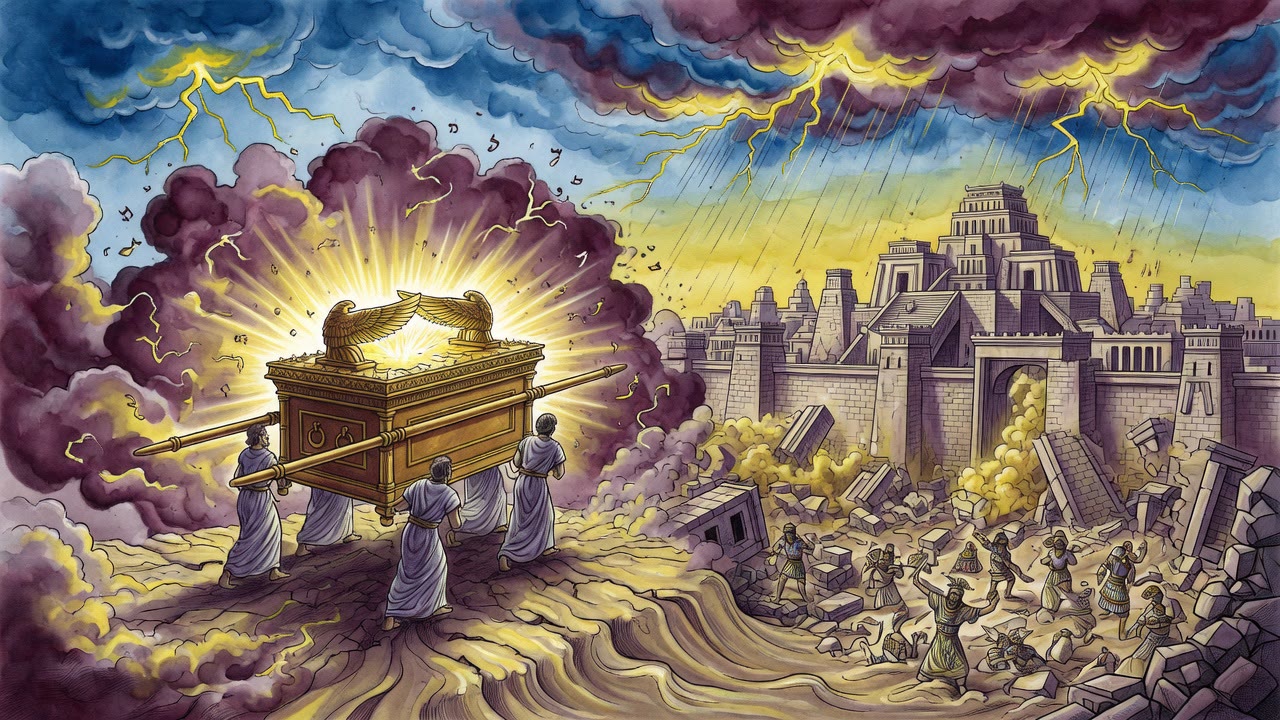
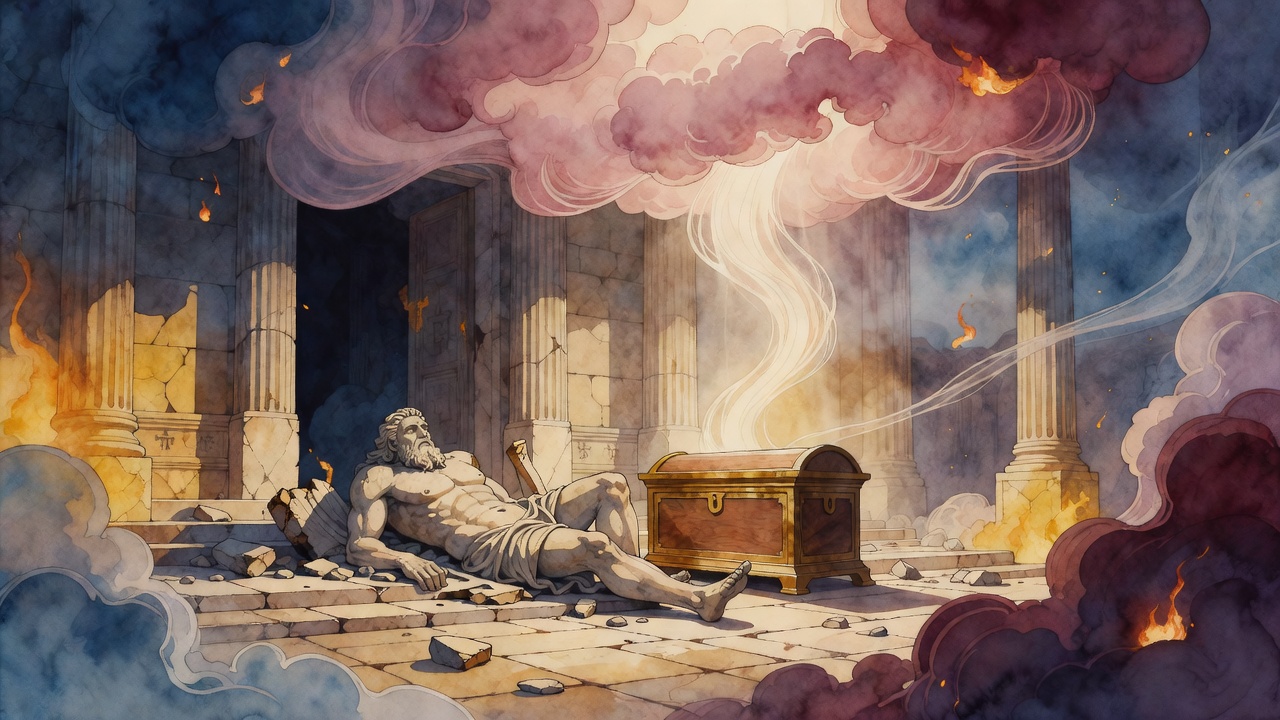
They carried it in on poles, the captured box of Israel, and set it down in the dark of the great house at Ashdod, beside the feet of Dagon. The lords had taken it on the field, where the line of Israel broke and the priests Hophni and Phinehas fell in the rout. Now it sat as a trophy, a god's spoil laid at a god's feet. The doors were barred. The lamps were carried out. Smoke from the evening offering still hung in the rafters, and the wide stone threshold at the entrance gleamed where ten thousand sandals had crossed it.
 Click for full size
The Trophy Set Beside the Idol
Dagon stood as he had always stood, broad and heavy, fish below and man above, his carved hands open over the offerings. The priests of Ashdod knew the shape of victory. A defeated people's god comes to the temple of the victor's god and waits there, mute, while the smoke of his conqueror rises around him. So they reasoned, and so they left the Ark on the floor of the inner room and went out into the night well satisfied, certain they had locked one power inside the house of another.
No army marched in after them. No fire fell. The Holy One did not break the doors or topple the roof. He had a slower, colder appetite for this. He was not scalded by lukewarm water. Only boiling water burns.
Found Face Down at Dawn
The Ashdodites rose early, as men do when they are uneasy about what they have left in the dark. They unbarred the doors. The lamps went in ahead of them. And there was Dagon, flat on his face on the ground before the Ark of the God of Israel, fish-tail in the air, carved hands flung out toward the box as if he had thrown himself down in worship.
They did not cry out. They lifted him. Stone is heavy, and a god is heavier than other stone, and they set him back in his place and braced him and smoothed the offerings he had scattered and told one another it was nothing, a settling of the floor, a fault in the base. They went out again. They barred the doors again. The water was still only warm.
The Threshold and the Severed Hands
The second dawn they came slower. The doors opened on the same posture, Dagon thrown down before the Ark. But this time the head of Dagon lay cut off on the threshold, and the two palms of his hands lay cut off on the threshold, each where a man's foot would fall as he stepped into the house. Only the trunk of Dagon was left, the torso alone, faceless and handless, fallen in the middle of the room. The head that had looked out over Ashdod could no longer look. The hands that had taken the offerings could no longer take. They lay on the cold stone of the doorway, and no one had heard a sound in the night.
From that day the priests of Dagon would not set a foot on the threshold of Dagon at Ashdod. They stepped over it. They leaped across it, every man who entered, because the stone where their god's head had fallen had become a place no sole would touch. Israel, the sages noted, was stricter than the nations even in this. Of Israel it is written that the Holy One would punish all who merely leap over a threshold, while the Ashdodites built a whole rite of leaping out of one broken idol and felt holy doing it.
Five Scepters Could Not Hold One Box
This was the work of all the gods of Philistia, not Ashdod alone. There were five lords of the Philistines, five scepters held over the cities of the coast, five rulers who counted their gods and their se*rons and thought themselves a wall against the south. But when their peoples were reckoned, they came to six. A sixth dwelt among them in the villages, the Avvim, and of the Avvim the elders told strange things. Some said they had come up out of Teiman, the parched south, and ruined every place they settled, so that their very name meant ruin. Some said they were called Avvim because they craved many gods, more gods, an appetite for gods that no number of idols could fill. And some said that whoever looked on a single one of them was seized by a shaking he could not stop, for each of them carried sixteen rows of teeth in his mouth.
Five scepters and a nation of devouring mouths, and not one of them stirred in the night the head of Dagon came off. The box stayed where it sat. It did not need them propped or braced or carried. The trophy had quietly become the captor.
An Idol Despised in Its Own House
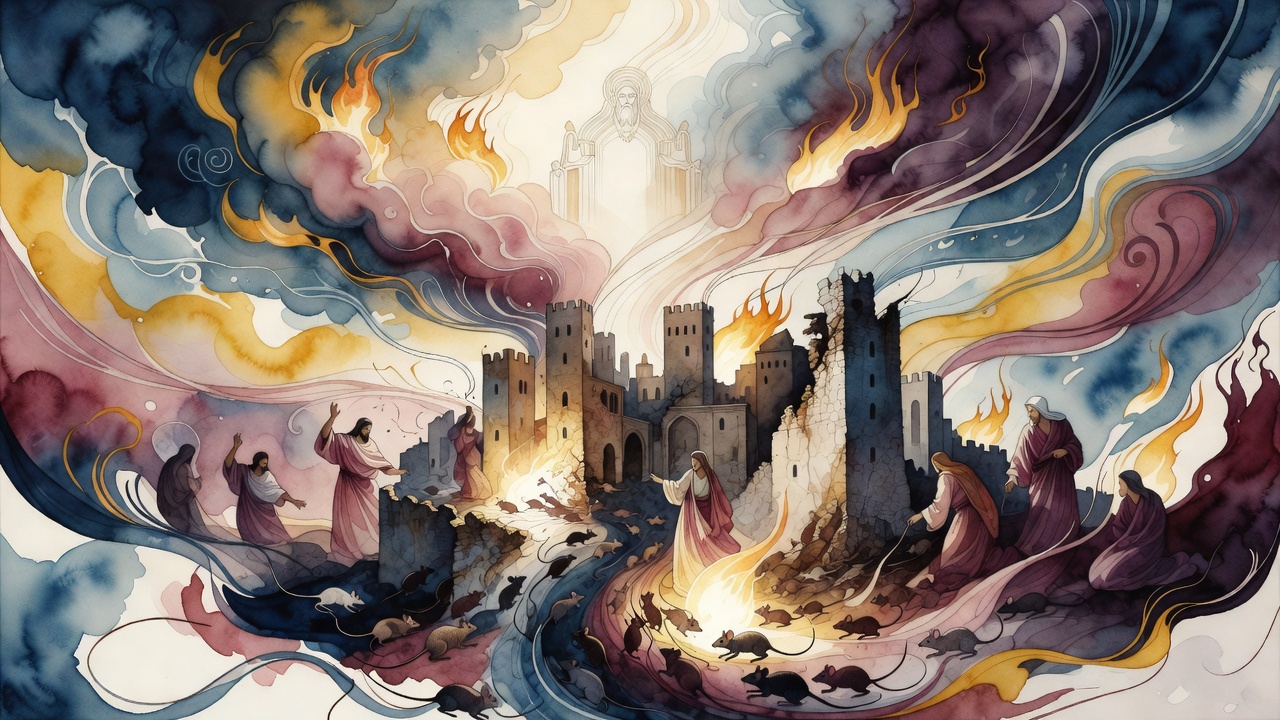
Then the hand of the Holy One grew heavy on Ashdod itself. The men of the city broke out in tumors, and a dread came over them, and they gathered in the open square away from the house where the headless trunk lay. They looked at what was left of Dagon, faceless on his own floor, and something in them turned. A god you still bow to is one thing. A god you have seen thrown down twice and chopped apart on his own doorstep is another. Some among them would not so much as profit from his broken stone. Others, harder, said the stone was only stone now, despised, finished, free to be carried off and used like any rubble.
Either way the worship was over. Whether they forbade his shattered body or sold it for gravel, no one in Ashdod knelt to Dagon again. "Send away the Ark of the God of Israel," they said at last, "and let it return to its own place, that it slay us not, and our people." They had set out to keep a captured god in the dark. They ended by begging that captured god to leave.
← All myths