5 min read

The Ark That Destroyed Every City That Held It

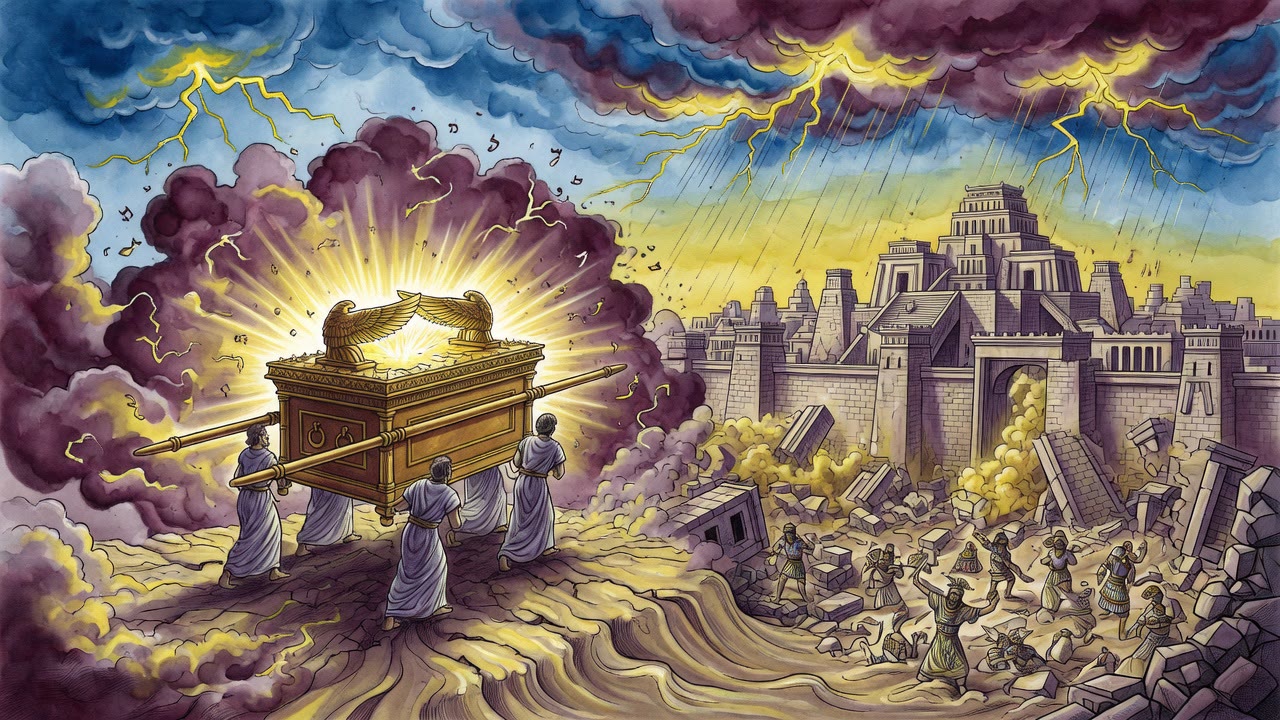
The Philistines capture the Ark and set it beside their idol Dagon, who falls prostrate twice before dawn and is found shattered and headless on the floor.

Curated by Arthur · Told by Maggid ·
Table of Contents
  1. The Battlefield Decision
  2. Dagon Falls Twice
  3. City by City
  4. The Cows That Knew the Way

The Battlefield Decision

The elders of Israel gathered after their first defeat at Aphek and made a desperate decision. Four thousand men were dead, the rest driven back to camp, and no one had a good explanation for why God had allowed it. Someone suggested sending to Shiloh for the Ark of the Covenant, the gold-plated chest that held the stone tablets, the place where the divine presence resided. Bring the Ark to the battle, they said, and we cannot lose.

The two sons of Eli, Hophni and Phinehas, carried it out of the sanctuary. When the Ark entered the Israelite camp, the shout that went up was so loud the earth shook. The Philistines heard it and understood what had arrived on the other side of the field. They said to each other: God has come into their camp. We are undone. The same God who struck Egypt with every plague. Who will save us from this?

Then they said: be strong. Fight. Otherwise we will become their servants.

Dagon Falls Twice

The Philistines fought and won. Thirty thousand Israelites fell. Hophni and Phinehas were killed. The Ark was captured. When the news reached Eli at Shiloh, sitting by the gate waiting, the word about his sons hit him hard enough to absorb, but when the messenger added that the Ark was taken, Eli fell backward from his seat and broke his neck at the threshold. He was old. He was heavy. He had served as judge and priest for forty years.

The Philistines brought the Ark to Ashdod and placed it in the temple of their god Dagon, setting it beside the idol like a military trophy. They left for the night. When they came back in the morning, Dagon was face down on the floor in front of the Ark. The posture was unmistakable: not toppled sideways, not knocked over, but prostrate, in the position of a worshipper before something greater than itself. They propped Dagon back onto its pedestal and left again.

The next morning Dagon was on the floor again. This time both hands had broken off at the threshold. The head had broken off. What remained on the pedestal was a stump. The priests of Ashdod stopped walking across the temple threshold from that day forward, afraid to touch the place where their god had shattered itself.

City by City

The plague came next. Tumors. Mice devouring the grain. People dying before they could cry out. The men of Ashdod looked at the Ark and said: we cannot keep this. They sent it to Gath. Gath developed the same plague. They sent it to Ekron. The men of Ekron did not want it at all. They said: they have brought the Ark of the God of Israel here to kill us and all our people.

Seven months the Ark moved through Philistine cities, and behind it left devastation. The Philistines called their priests and diviners and asked what to do. Return it, the priests said, but not empty. Send a guilt offering. Five golden tumors. Five golden mice. One for each of the five Philistine lords. Do not harden your heart the way Egypt hardened its heart. Look what happened to Egypt.

The Cows That Knew the Way

The priests designed a test. Take two cows that have never been yoked, that have nursing calves still in the pen. Hitch them to the cart carrying the Ark. If they go straight toward Beth-shemesh, heading into Israelite territory against every maternal instinct pulling them back to their calves, then you will know it was God's hand at work. If they turn aside and wander, it was chance.

The cows went straight, lowing as they walked, without turning to the right or left. The Philistine lords followed behind to watch. The cows went all the way to Beth-shemesh and stopped in the field of a man named Joshua. The men of Beth-shemesh were reaping wheat in the valley and looked up and saw the Ark coming.

The Ark had found its way home without a guide, carried by two animals that went against their own nature to return it.


← All myths

From the tradition

Sources

5 sources

The texts this telling draws on, in full. Open a card to read inline, or expand it for a wider, quieter read.

Antiquities VI.1-2Antiquities of the Jews (Josephus)

The Philistines captured the Ark of God and dragged it into the temple of their idol Dagon at Ashdod. They set it beside their god like a trophy. But the next morning, they found Dagon flat on his face before the Ark, prostrate, as if worshipping it. They propped him back up. He fell again. Then God struck the entire city with a plague so violent that people died before they could even cry out, their bodies destroyed from the inside. Swarms of mice devoured the crops. The land itself turned against its inhabitants.

So the Philistines passed the Ark from city to city. Ashdod to Ashkelon, Ashkelon to Gath, Gath to Ekron. And every city that received it suffered the same devastation. Five cities. Five plagues. The Ark exacted tribute from each one, as Josephus puts it, like a tax levied on those foolish enough to hold what did not belong to them.

Their wisest advisors finally suggested a plan: build a new cart, yoke two nursing cows to it, and lock their calves away. Place five golden images and five golden mice on the cart as guilt offerings. Then release the cows at a crossroads. If they walked toward Israelite territory on their own, abandoning their calves, defying every instinct, that would prove God's hand was behind the suffering. The cows walked straight to the Israelite village of Beth Shemesh, never turning aside.

The Israelites there rejoiced, sacrificed the cows, and placed the Ark on a great stone. But seventy men of Beth Shemesh approached the Ark without authorization, they were not priests. And God struck them dead. The people wept, sent word to the national council, and the Ark was moved to the house of Abinadab the Levite in Kiriath-Jearim, where it remained for twenty years.

During those decades, Samuel the prophet rallied the people. He gathered Israel at Mizpah, where they fasted and poured out water before God. The Philistines attacked. Samuel sacrificed a lamb and prayed. God answered with an earthquake that split the ground beneath the Philistine army, thunder that shattered their formations, and lightning that burned their faces. Their weapons flew from their hands. Israel pursued them all the way to Beth Car, and Samuel set up a stone monument he called Even Ha-Ezer, the Stone of Power, to mark where God had broken the enemy.

Full source
Antiquities V.11Antiquities of the Jews (Josephus)

The Ark of the Covenant, the holiest object in Israel, fell into enemy hands. And the man responsible for guarding it died the moment he heard the news.

The Philistines launched a major assault against Israel, setting up camp at the city of Aphek. The first battle was a disaster: over four thousand Israelite soldiers killed, the rest driven back to their camp in panic. The elders made a desperate decision. They sent to Shiloh for the Ark of God, believing its physical presence on the battlefield would turn the tide. Hophni and Phinehas, the corrupt sons of the high priest Eli, carried it to the front lines.

Their father gave them one final instruction: if you survive and the Ark is taken, do not come home. Eli already knew what God had decreed.

When the Ark arrived, the Israelites roared with confidence. The Philistines trembled, they had heard what this Ark had done in Egypt. But the battle turned anyway. Israel suffered a catastrophic defeat: thirty thousand dead, including both of Eli's sons. And the Ark was captured (1 Samuel 4:11).

Josephus makes the theological point razor-sharp. The Israelites had confused the container for the power it represented. They trusted in the Ark instead of in God Himself, the same God who had condemned them to this defeat in the first place. The Ark could not save a people that God had already judged.

A young Benjaminite soldier escaped the slaughter and ran to Shiloh with the news. The whole city erupted in wailing. Eli, now ninety-eight years old, sat on a high seat by the gate. He had already made peace with the death of his sons, divine revelation had prepared him for that. But when the messenger told him the Ark had been taken, something broke. He fell from his throne and died on the spot (1 Samuel 4:18). He had led Israel for forty years.

On that same day, Phinehas's wife went into premature labor when she heard her husband was dead. She gave birth to a son at seven months, then died. They named the boy Ichabod, meaning "the glory has departed", because the Ark of God had left Israel. It was the end of an era: the house of Eli was finished, and the priesthood would eventually return to the line of Eleazar, as God had always intended.

Full source
Legends of the Jews 3:14Legends of the Jews

The story of Eli and his sons in the Bible is a stark reminder. It's more than just a tale; it's a cautionary legend about leadership, faith, and consequences, retold and amplified throughout Jewish tradition.

The sons of Eli, Hophni and Phinehas, were priests, but they were corrupt. Their actions brought misfortune not just upon themselves, but upon all of Israel. As Legends of the Jews (Ginzberg) tells us, their sins, and the people's willingness to overlook them, were directly linked to the disastrous war with the Philistines.

Think about this: the Israelites even brought the Aron Hakodesh, the Holy Ark, into battle! This wasn’t just any box; it held the broken tablets of the Ten Commandments, a symbol of God's covenant. You'd think bringing that into battle would guarantee victory. But it didn't.

Eli, aware of his sons' wickedness, had warned them not to return to him alive if the Ark were captured. And tragically, that's exactly what happened. They perished on the battlefield, and the Ark fell into Philistine hands.

But hold on, the Philistines didn't exactly have a victory parade. As Legends of the Jews continues, they paid a heavy price for their triumph. Especially those who dared to mock God when the Ark appeared in the Israelite camp! They scoffed, claiming that the Israelite God was all out of plagues, having used them all on Egypt. Big mistake.

God, it is said, declared, "Just you wait!" And wait they did. A new plague descended upon them. According to the legends, mice emerged from the earth, wreaking havoc and causing unspeakable suffering. Imagine these creatures, not just nibbling cheese, but causing internal torment. If the Philistines tried to protect themselves with brass vessels, the vessels shattered at the touch of the mice! Talk about a divine pest control problem.

After months of agony, and realizing their god Dagon was helpless against the Ark, the Philistines decided to return it. But even then, some remained skeptical. They devised a test, using milk cows that had never been yoked. These cows were attached to a cart carrying the Ark. The idea? If God was truly behind all this, the cows would miraculously know where to go.

And what happened? The cows, untrained and without guidance, began to pull the cart directly toward Israelite territory. And according to the legend, they began to sing. It was a conclusive sign.

What can we take away from this story? It's a multi-layered narrative, isn't it? It's about the dangers of corrupt leadership, the consequences of disrespecting the sacred, and the enduring power of faith. It reminds us that even symbols, like the Ark, are only as powerful as the integrity behind them. And sometimes, the most unexpected messengers – even singing cows – can deliver the most profound truths.

Full source
Midrash Shmuel 11:2Midrash Shmuel

"And when he came, lo, Eli etc." (1 Samuel 4:13); "And the messenger answered and said, Israel is fled etc." (1 Samuel 4:17); "and the ark of God is taken" (1 Samuel 4:17), the attribute of justice grew weak, like a female [for Scripture says nilkachah, "is taken," in the feminine, though the Ark is masculine]. "And it came to pass, when he made mention of the ark of God, etc." (1 Samuel 4:18). Rabbi Yehoshua bar Rabbi Nechemiah said: Was it so [that he merely fell of his own weight]? Did he not have five fingernails or five spikes [to grip with and save himself]? Rather, his neck was broken over the Ark.

Full source
Midrash Shmuel 12:3Midrash Shmuel

"And the cows went straight" (I Samuel 6:12), they went straight and they walked, walking in beauty. They would turn their faces toward the acacia-wood (Ark) and recite song. Which song did they recite? Rabbi Meir says: they recited the Song of the Sea. This is what is written, "They went along one highway, lowing as they went" (ibid.), and it is written, "I will sing to the LORD, for He has triumphed gloriously" (Exodus 15:1). Rabbi Yochanan said: "Sing to the LORD a new song" (Psalms 98:1). Rabbi Shimon ben Lakish said: "Give thanks to the LORD, call upon His name" (Psalms 105:1). Rabbi Elazar said: "The LORD reigns, let the peoples tremble" (Psalms 99:1). And the Rabbis say: "The LORD reigns, let the earth rejoice" (Psalms 97:1). Rabbi Shmuel bar Rav Yitzchak said: the Holy One, blessed be He, said to Israel: If one of you had lost his hen, would he not search after it through how many alleyways until he brought it back? Yet My Ark wanders about in the field of the Philistines, and you do not concern yourselves over it! Even so, "His right hand and His holy arm have wrought salvation for Him" (Psalms 98:1). Elijah taught: Rise up, rise up, O acacia! Wave aloft, wave aloft in the abundance of your splendor, you who are inlaid with embroidered gold, you who are praised with a neck-chain and a palace, you who are glorified with the two cherubim. Rabbi Shmuel bar Nachman said: How greatly did the son of Amram (Moses) toil until he taught the Levites song, and you recite song of your own accord! May your strength be made firm.

Full source