Parshat Bereshit6 min read

Down Through Seven Earths to the Coiled Leviathan

God pressed the risen waters down beneath seven stacked earths and chained a monster in the last deep, salting it whole for a banquet at the end of days.

Curated by Arthur · Told by Maggid ·
Table of Contents
  1. The Hand That Pressed the Waters Down
  2. Down Past the Chasm of Tohu and Bohu
  3. The Beast Coiled in the Lowest Deep
  4. The One Flaw the Deep Was Built to Hold
  5. Salted and Waiting for the End of Days
Down Through Seven Earths to the Coiled Leviathan Click for full size

The Hand That Pressed the Waters Down

The waters had already filled everything when they were told to go down. There was no room left for them anywhere. They lay over the face of the deep, one water pressed against another, with nowhere left to rise.

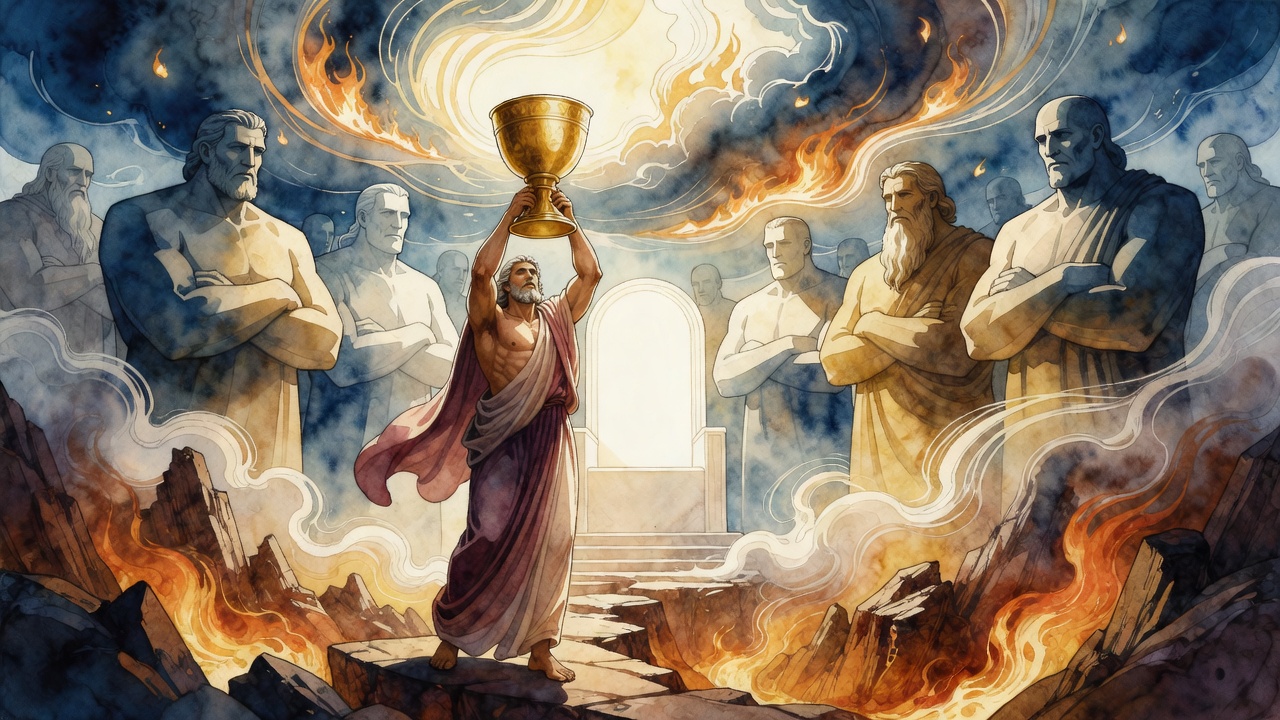
Then the hand of God opened above them, the same hand that will one day open over the graves and call the dead up out of the dust, and the waters fled. They fell away from the light. They went down past the ground men would one day walk, and down past the ground beneath that, and kept falling, because a boundary had been set and the water had to find its floor.

Down Past the Chasm of Tohu and Bohu

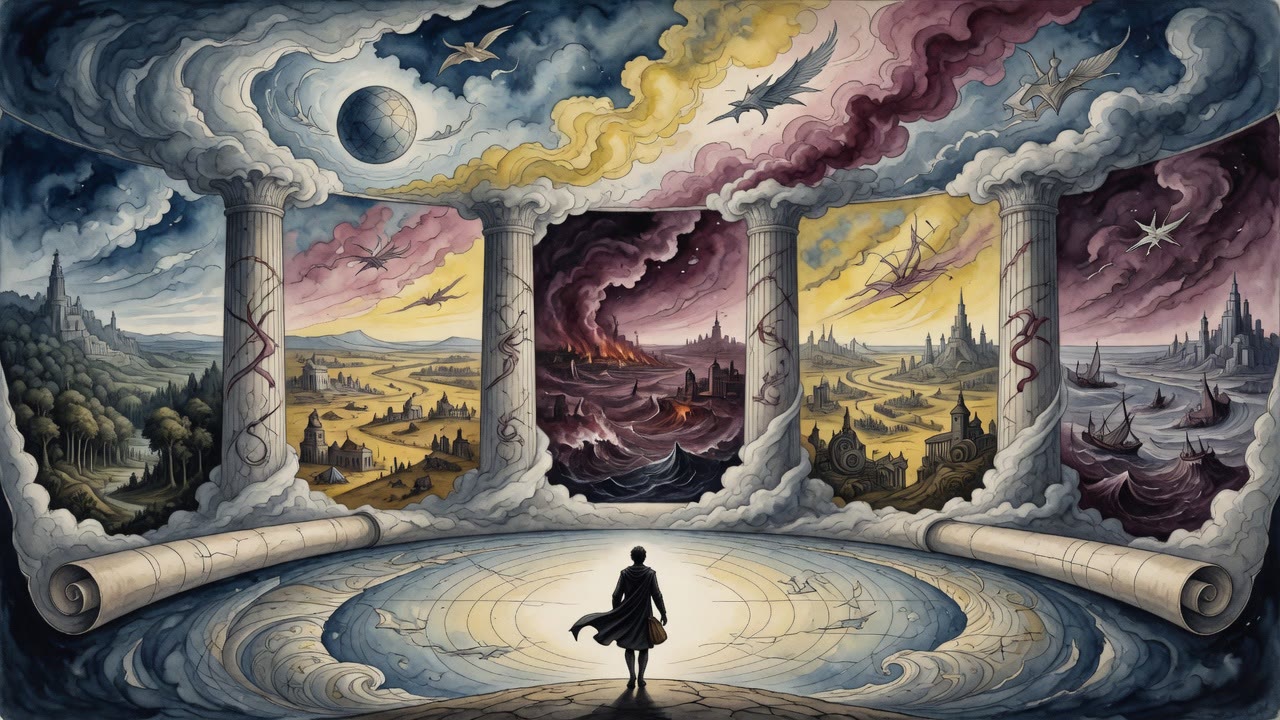
They passed the earth where men would walk. Its name is Heled, and it does not know it is only the top of a stack. Below it gapes a chasm, and the chasm carries a name older than any ground: Tohu and Bohu, the emptiness and the waste, the unformed dark that was there before anything was shaped. On the far side of that void lies another earth, Tebel, with its own creatures and its own rules, and past Tebel stretch seas no eye has ever measured.

Seven earths in all, one riding above the next, each with its own character and its own work, and over the whole tower vault seven heavens, the highest of them fastened to the very arm of God. The waters fell through the tiers of this hidden house, past shelf after shelf of world, until they reached the last floor, the deepest and darkest, where the light of the seventh heaven never comes. There they pooled. There they were bound. And there something was already waiting for them.

The Beast Coiled in the Lowest Deep

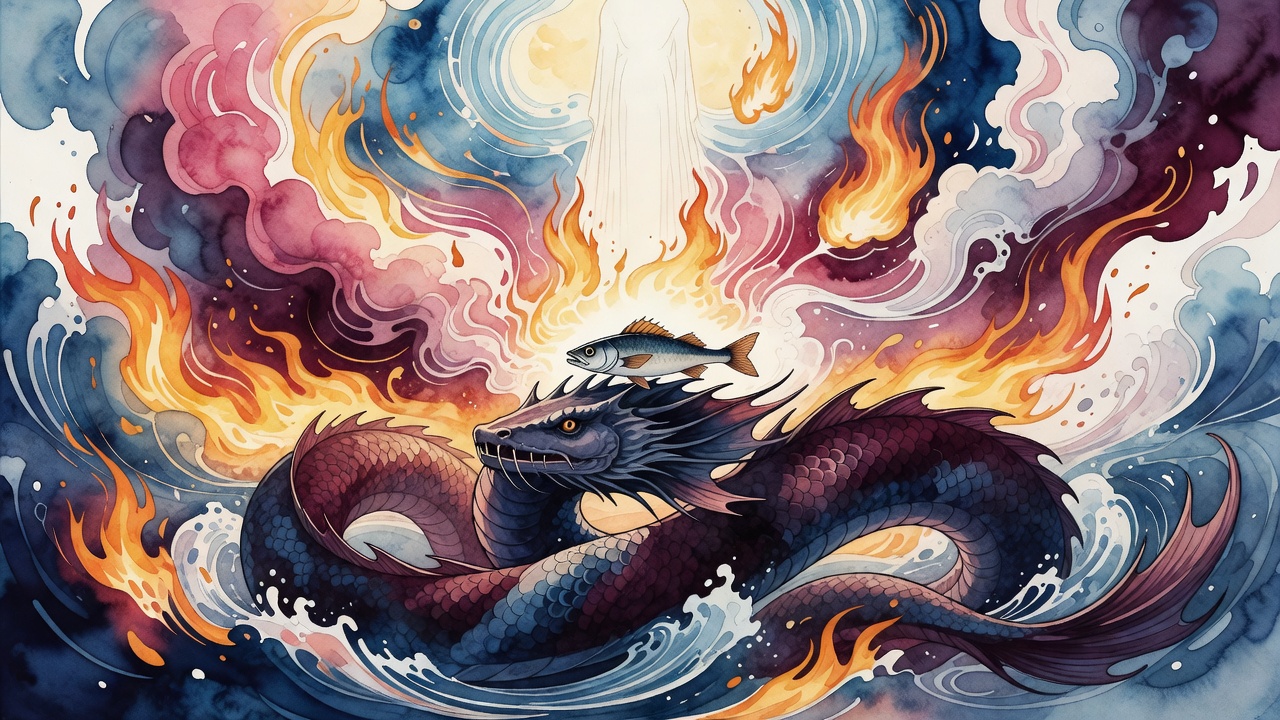
At the bottom of everything coils Leviathan.

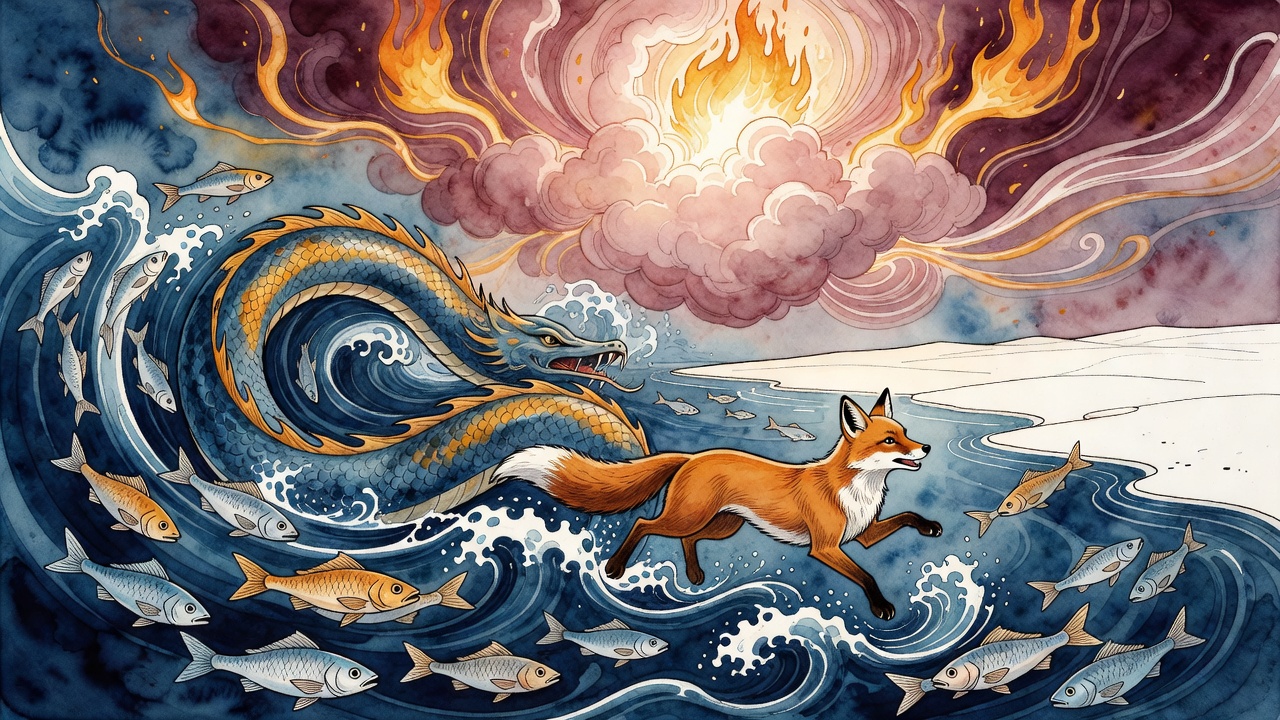
It is not a fish and not a serpent, though it wears the shape of both. It is a primordial beast so vast that the lowest sea is only its bed, and when it shifts, the waters shudder up through all seven earths. Its scales lie across its back like overlapping shields, and no metal ever forged will bite them. It has waited in the dark since the fifth day, when the deep was still young, and it has never once seen the sun.

The One Flaw the Deep Was Built to Hold

A creature that size, in a world that neatly ordered, should be the whole of the story. But Leviathan carries one flaw, and that flaw is why the deep was dug so deep.

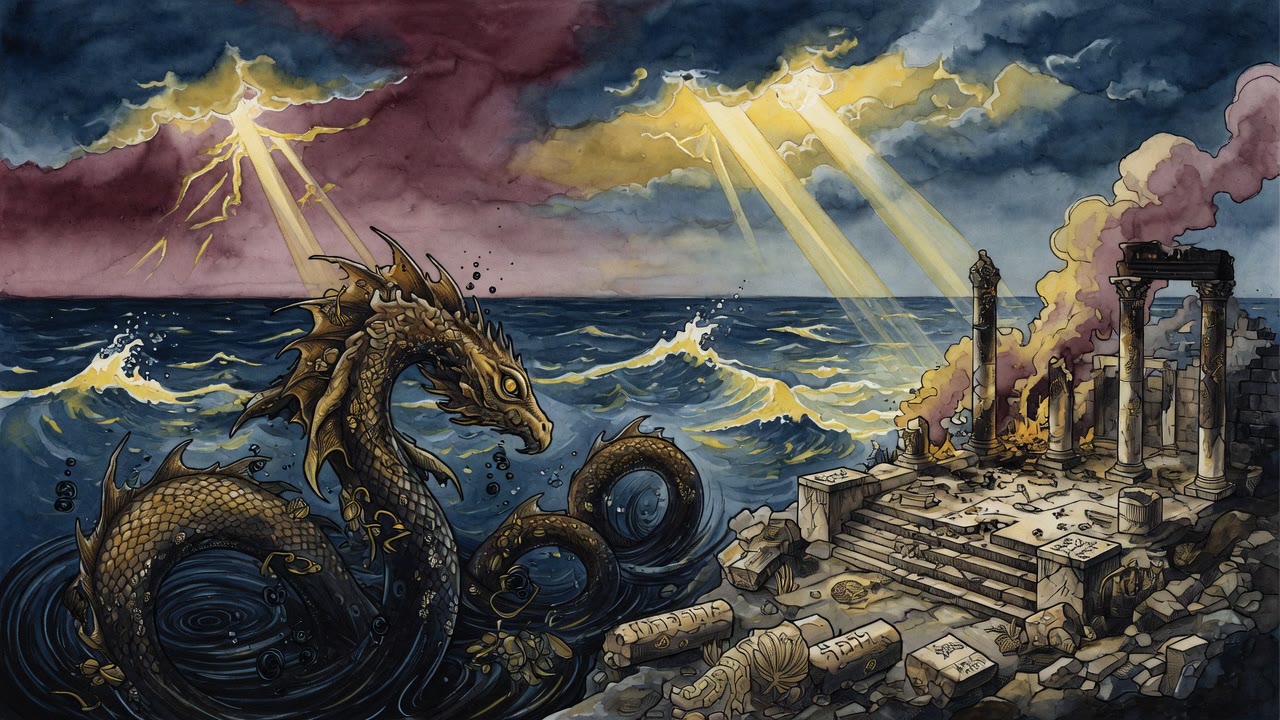
It stinks. The smell that lifts off the beast is so foul that were it ever to reach the gardens of the righteous, were a single breath of it to drift into Paradise, the whole place would turn unlivable and the blessed would have to flee their own reward. All the sweetness of the world to come could be spoiled by the reek of one monster. So the beast is held where its stench can ruin nothing, sealed under the seven earths, walled behind the waters, chained in the one place far enough down that its breath never rises to foul the living or the saved.

The same hand that shut the waters in the deep opens again over the world above, and when it does the rain comes down. The sages weighed that falling rain and found it as heavy as the raising of the dead, for the rain is poured out for man and beast together, for Israel and for the nations, and even the wild animals of the field lift their heads when they hear it and go searching for what it brings. Water that buries a monster in the dark also feeds the living, and the hand that does both is the hand that will one day open the graves.

Salted and Waiting for the End of Days

Because there is an end coming, and the beast has a part in it.

The female Leviathan is already dead. She was killed long ago and salted at once, brined and packed away, kept fresh in the deep for a feast that has not yet been served. The male still lives, coiled and waiting. When the last days arrive, God will call the angels down to kill him. They will come armed, and the moment the beast turns its eyes on them they will scatter. They will try again with swords, and the swords will turn to straw against its hide. They will throw darts and stones, and every one will bounce away. In the end the angels will give up and climb back out of the dark.

So God will set two monsters against each other. Behemot, the great land-beast, will be brought down to face Leviathan, and the two will tear into one another until both lie still. Behemot will fall to a single blow of the sea-beast's fin. Leviathan will die from one lash of Behemot's tail. And then the reek that harmed nothing while the beast was chained will matter no longer, because now the flesh is wanted.

The righteous will sit down to eat it. God will stretch the monster's skin into tents to shelter them while they feast, and each will receive a portion measured to his merit, and no one will envy his neighbor, because no one will be handed less than he earned. Whatever skin is left will be pulled taut over Jerusalem like a canopy, and it will shine, and its light will reach the ends of the earth. Whatever flesh remains will be given out among the rest of the world and sold in its markets. The monster hidden at the bottom of creation, salted in the dark so its stench would spoil nothing, becomes at the last the meal that feeds everyone.


← All myths
From the tradition

Sources

3 sources

The texts behind this telling. Some cards carry a translation of the source; others are our own retelling of it, and each card says which. Every card links out to the original.

Legends of the Jews 1:20Legends of the Jews

Retold in our words. Read the original at the link below.The Legends of the Jews by Louis Ginzberg (1909) · Public Domain

It speaks of layers, of hidden realms stacked one upon the other, a veritable celestial sandwich with us right in the middle. We call our earth Heled. According to the ancient texts, it’s not alone. It’s separated from the Tebel – another earth, another realm – by a chasm, a void known as the Tohu and the Bohu. These Hebrew words evoke emptiness, chaos, a primordial soup from which creation arose. And beyond that? Seas and waters, vast and unknowable.

The layering doesn't stop there.

Above these seven earths? Seven heavens! According to the lore, they vault over the earths, each heaven subtly different from the last, until the seventh, the highest of them all, is finally – get this – attached to the very arm of God.

The universe, quite literally, resting in the hands of the Divine.

Now, here's where it gets even more fascinating. The seven heavens, we're told, form a unity. The seven earths? They also form a unity. And ultimately, the heavens and the earth, together, create a single, interconnected whole.

It's a beautiful concept of wholeness and interconnectedness, echoed in many mystical traditions.

But wait, there's more! The creation story doesn't end with just our heavens and our earth. According to some traditions, as recounted in Legends of the Jews by Louis Ginzberg, when God made our present heavens and our present earth, "the new heavens and the new earth" were also brought forth.

And beyond that? A staggering number: one hundred and ninety-six thousand worlds created solely for God’s glory! Whoa. That's a lot of real estate in the cosmos.

So, what does it all mean? Maybe it’s a reminder that our world, our reality, is just one small piece of an infinitely larger puzzle. Maybe it encourages us to look beyond the immediate, to consider the unseen, and to appreciate the sheer, overwhelming grandeur of creation.

The Zohar, a central text of Kabbalah, explores these themes extensively, inviting us to contemplate the hidden dimensions of reality. Midrash Rabbah, a collection of rabbinic interpretations of the Hebrew Bible, also touches upon the multiplicity of worlds and the divine glory manifested within them.

Next time you look up at the night sky, remember the layers, the connections, the sheer, breathtaking scope of it all. Maybe, just maybe, there's a whole lot more going on than we can possibly imagine.

Full source
Bereshit Rabbah 13:6Bereshit Rabbah

Translation of the source text.Midrash Rabbah -- TE · Public Domain

Rabbi Hiyya bar Abba said: And it is weighed as equal to the resurrection of the dead. Rabbi Abba and Rabbi Hiyya in the name of Rabbi Abba said: The Sages too set it within the blessing of the resurrection of the dead. In this one a hand is mentioned and in that one a hand is mentioned; in this one an opening and in that one an opening. In this one a hand, as it is stated: "The hand of the LORD was upon me" and so forth (Ezekiel 37:1); and in that one a hand: "You open Your hand" (Psalms 145:16).

In this one an opening: "The LORD will open for you" (Deuteronomy 28:12); and in that one an opening: "Behold, I am opening your graves" and so forth (Ezekiel 37:12). Rabbi Yudan in the name of Rabbi Elazar bar Avina said: In this one song and in that one song. In this one song: "Let the inhabitants of the rock sing aloud" (Isaiah 42:11); and in that one song: "They shout for joy, they also sing" (Psalms 65:14).

Rabbi Hiyya bar Abba said: And it is greater than the resurrection of the dead, for the resurrection of the dead is for man, whereas this is for man and for beast. The resurrection of the dead is for Israel, whereas this is for Israel and for the worshippers of stars. A worshipper of stars once asked Rabbi Yehoshua ben Korha. He said to him: You have festivals and we have festivals; when you rejoice we do not rejoice, and when we rejoice you do not rejoice. And when do we and you rejoice together? At the falling of the rains.

Rabbi Yehoshua ben Levi said: When the rain falls the beast seeks its appointed need. What is the reason? "The meadows are clothed with flocks" (Psalms 65:14), meaning, the rams clothe the flock, in refined language.

Full source
Legends of the Jews 1:50Legends of the Jews

Retold in our words. Read the original at the link below.The Legends of the Jews by Louis Ginzberg (1909) · Public Domain

The Jewish tradition has some pretty wild answers, especially when it comes to LEVIATHAN.

Leviathan. This is a primordial beast, a monster of the deep so immense its very existence shakes the cosmos. But, according to some stories, even such a magnificent creature has its drawbacks. The Legends of the Jews tells us there's one rather unfortunate thing about Leviathan: its absolutely terrible smell. So potent, in fact, that were it to waft into Paradise, it would make the whole place uninhabitable! Who knew cosmic beasts could have such… fragrance issues?

Don't let that put you off your celestial appetite! Because here’s the real kicker: the ultimate purpose of Leviathan is to be served as a delectable treat to the pious in the world to come. A cosmic surf-and-turf, if you will.

In legends, the female Leviathan was immediately salted away after her demise, brined and preserved, patiently awaiting the grand banquet. And the male? He’s destined to be a sight to behold, a magnificent spectacle before becoming dinner.

So, how does this cosmic catering come about? Well, when Leviathan’s time is at hand, God calls upon the angels to battle the beast. But, as Ginzberg's Legends of the Jews describes it, the moment Leviathan casts its gaze upon the angels, they scatter in fear! They try again, armed with swords, but Leviathan's scales are impervious, turning steel to straw. Darts and stones? They just bounce right off.

Discouraged, the angels give up. That's when God steps in and commands Leviathan and BEHEMOT – another colossal beast, this one terrestrial – to fight each other. Think Godzilla vs. King Kong, but with divine implications.

The result? A double knockout. Behemot is slain by a blow from Leviathan's fin, while Leviathan succumbs to a lash from Behemot's tail. Talk about a dramatic end!

But death is not the end of the story. According to the legends, God will then use Leviathan's skin to create tents, shelters for the righteous as they feast on the creature's flesh. The Zohar tells us how important this is. Each person receives a portion according to their merit, and no one feels envy, because everyone gets what they deserve.

And the leftovers? The remaining skin will be stretched over Jerusalem, becoming a radiant canopy, its light illuminating the entire world! As for the leftover flesh, it will be distributed amongst the rest of humanity, becoming a commodity for trade, as we find in Midrash Rabbah. A cosmic economy fueled by monster meat!

These legends, so vivid and strange, offer us a glimpse into a world where the boundaries between the physical and the spiritual blur. What unexpected feasts and unimaginable sights are in store? And maybe, just maybe, what part do we play in preparing for that ultimate banquet?

Full source