5 min read

Leviathan, the Stickleback, and the Final Feast

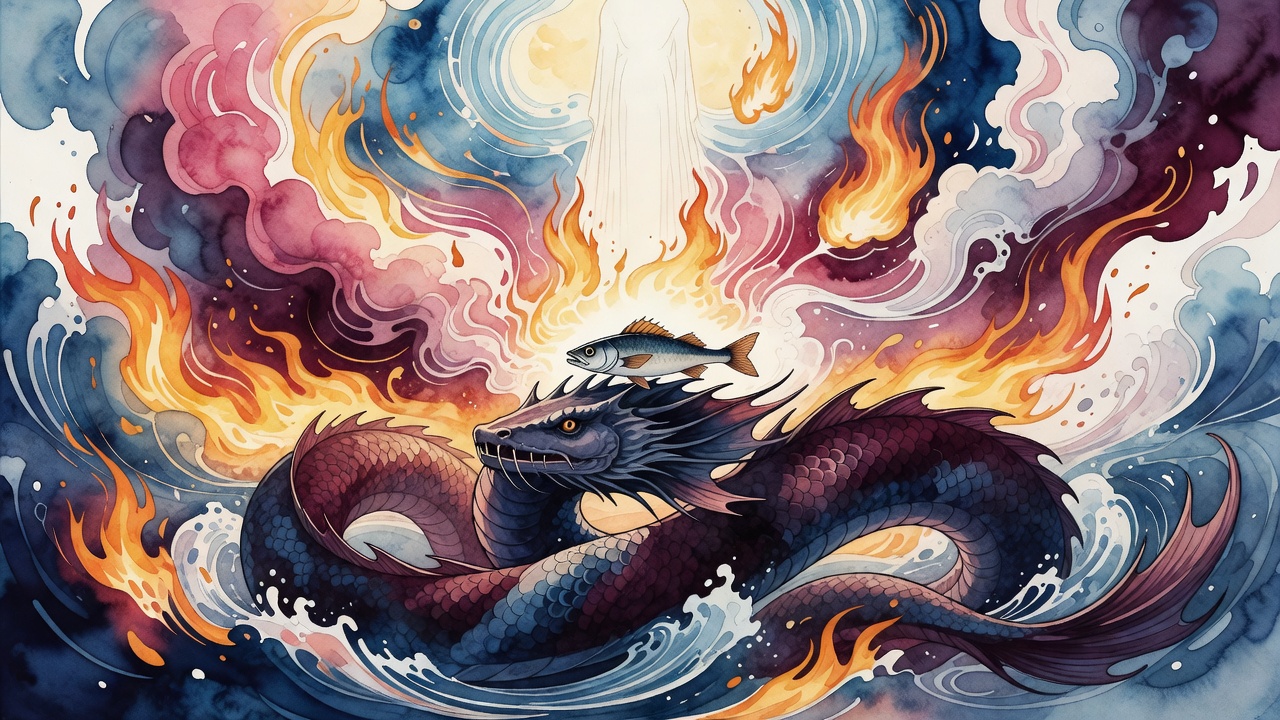
God made the sea from fire and water, then set one tiny fish over Leviathan so creation would not drown beneath its own power.

Curated by Arthur · Told by Maggid ·
Table of Contents
  1. Fire Took Flesh in the Water
  2. The Beast Whose Sip Was a River
  3. The Pair God Would Not Leave Alone
  4. The Small Fish at the Edge of the Deep
  5. The Holy Serpent Keeps the Sea
  6. The Table Set in Eden

Fire and water should have destroyed each other. On the fifth day, God joined them anyway, and the sea began to live.
Fire Took Flesh in the Water

The deep did not fill slowly. It burst. Fins, scales, mouths, tails, flashing backs, soft bellies, creatures with eyes like beads and creatures too dark to name moved through the water as if the ocean had been waiting for them since the first darkness.

Almost every shape on land had an answer below. There were sea-creatures that mirrored beasts in the fields and crawling things on the earth. Only the weasel stood alone, without a watery double. The rest of creation seemed to throw reflections into the deep, as if the sea could not bear to leave any form unmade.

The Beast Whose Sip Was a River

Above them all moved Leviathan. Not a large fish. Not a serpent that frightened sailors. A ruler. When it opened its mouth, the Jordan in full flow was no more than a drink. When hunger passed through its body, its breath could boil the sea. When its eyes opened wide, light ran through the ocean.

The fins were worse. They burned with a radiance fierce enough to make the sun lose its claim over the day. Smaller creatures fled into cracks and weeds. The deep, which had seemed measureless a moment before, suddenly felt like a bowl with one creature pressing against every side.

Everything else in the water had to learn its place around that body. Schools turned as one when Leviathan passed. Reefs became hiding places. The sea itself seemed to hold its breath, not because Leviathan had rebelled, but because creation had produced a creature whose mere appetite could make order tremble.

The Pair God Would Not Leave Alone

Leviathan was not made alone. Male and female came into the water, as the other living beings did, carrying the terrible promise of increase. A single Leviathan strained the borders of the world. A brood of them would have turned creation into wreckage.

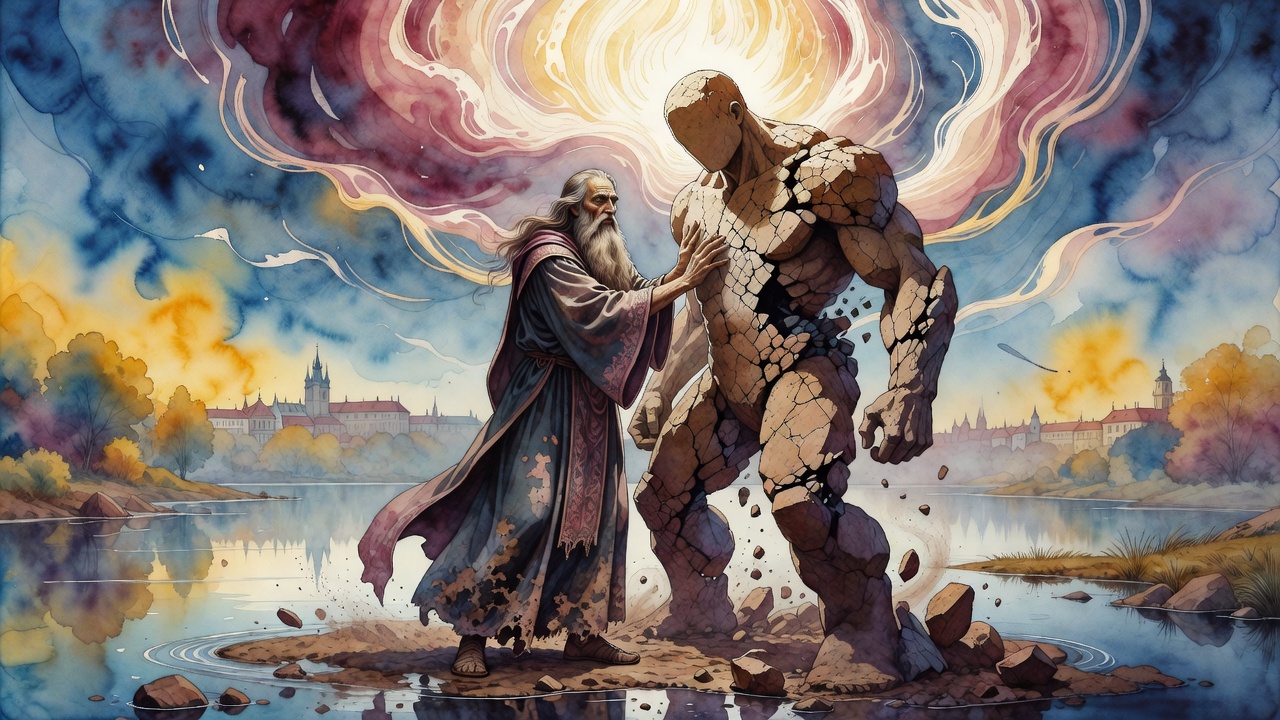
So God stopped the danger at its root. The female did not roam the sea beside the male. Her flesh was preserved in salt, hidden away for the feast at the end of days. Power was not erased. It was stored. The sea kept its king, but not a dynasty that would crush mountains beneath waves.

The Small Fish at the Edge of the Deep

Then came the strangest mercy: a warden no one would have chosen.

The stickleback was small, spiny, and almost absurd beside the beast it guarded. No thunder gathered around it. No river disappeared into its throat. It carried no blazing fins. It was the kind of fish a child could imagine cupping in two hands, if its spines did not warn the hand away.

Leviathan honored it. The sea-monster whose hunger heated the waters held the little fish in awe. The terror of the deep had a boundary, and the boundary had a narrow body, sharp points, and the stubborn authority of a creature appointed to stand where strength alone could not be trusted.

The Holy Serpent Keeps the Sea

Above the visible waters, another image moved: a holy serpent in the upper sea, a righteous one gliding through the endless ocean of divine life. Below, the old dangerous serpent still belonged to the language of threat, appetite, and broken order. One day that dark thing would be removed from the sea.

Then the holy serpent would rule without rival. The ocean would no longer be a place where terror needed a bridle. The same waters that once held a boiling breath and a monster's hunger would carry a cleaner motion, like a fish moving freely because nothing poisoned the current.

The Table Set in Eden

Until that day, Leviathan remains in the deep, too large for the world and still contained within it. The stickleback keeps its post. The salted flesh waits. Somewhere beyond ordinary hunger, a table is being prepared in Eden for the righteous, and the monster that once threatened to overrun creation will become food.

The fifth day began with impossible elements making life together. It ends with an even stranger balance: a giant under guard, a little fish with authority, a holy serpent waiting for its hour, and a sea that has not yet forgotten the heat of Leviathan's breath.


← All myths
From the tradition

Sources

4 sources

The texts this telling draws on, in full. Open a card to read inline, or expand it for a wider, quieter read.

Legends of the Jews 1:48Legends of the Jews

The stories we have… they’re just incredible.

Take the fifth day, for example. According to tradition, that's when God brought forth the creatures of the sea. And how did He do it? The legends tell us that He combined fire and water – seemingly opposite elements – to create the fishes. Fire and water, joining to bring life. It's a powerful image, isn't it?

Just imagine the sheer abundance of life that exploded forth! The creatures in the water, For almost every animal on land, there's a counterpart in the sea – except, oddly enough, the weasel. And then there are countless others that exist only in the water. It's a vast, teeming, unimaginable world.

What rules that world? Ah, that's where the story gets even more interesting. Because reigning supreme over all the sea creatures is none other than LEVIATHAN.

Yes, that Leviathan. The legendary sea monster.

He, along with all the other fish, was created on that very same fifth day. Now, get this: originally, Leviathan was created as a male and a female, just like the other creatures. But, as the stories in Legends of the Jews tell us, God quickly realized that a pair of these behemoths could potentially destroy the entire earth with their combined power. So, what did He do? He eliminated the female. Talk about a course correction!

And this Leviathan... he's HUGE. So huge that, according to legend, he needs all the water flowing from the Jordan River into the sea just to quench his thirst! Can you picture that? And his diet? Well, it consists of fish that willingly swim into his jaws.

But it's when he gets hungry that things get really interesting. When Leviathan feels a pang, a blast of hot breath shoots from his nostrils, causing the waters of the great sea to boil and churn! We find similar imagery in the Talmud (Bava Batra 74b), describing the light that shines forth from him.

Even BEHEMOT, the monstrous land creature, is said to feel uneasy until he knows that Leviathan has quenched his thirst. It's a fascinating power dynamic, isn't it?

And what keeps this massive, powerful beast in check? Believe it or not, it's the stickleback, a tiny fish created specifically for this purpose. Leviathan is said to be in awe of this little fish. Sometimes the smallest things can have the biggest impact. But Leviathan isn't just about size and strength. He's also described as being wonderfully made. His fins are said to radiate brilliant light, so bright that they can obscure the sun! And his eyes? They shine with such splendor that they can suddenly illuminate the entire sea. According to Ginzberg's retelling in Legends of the Jews, based on various Midrashim (rabbinic interpretive commentary), the sea is often lit up by the splendor of Leviathan's eyes.

In fact, the Midrashim suggest that God takes pleasure in Leviathan, this marvelous beast is His plaything. Think of it: This incredibly powerful, awe-inspiring creature is, in some ways, a source of joy and amusement for the Divine.

So, what does it all mean? What are we to make of this fantastic creature, this Leviathan of legend? Perhaps he represents the untamed power of nature, the awe-inspiring vastness of the ocean, and the reminder that even the most formidable forces can be held in check. Or maybe, as the Psalmist suggests (Psalm 104:26), Leviathan exists simply to give God joy. Whatever the interpretation, the story of Leviathan is a reminder of the endless wonders and mysteries that surround us, both in the world and in the ancient texts we continue to explore.

Full source
Legends of the Jews 1:55Legends of the Jews

Legends of the Jews turns to Levi and the Heavenly Realms.

You've probably heard of Leviathan, the massive sea serpent. And perhaps Ziz, the giant bird, is also familiar. But Behemot? He's the king of the beasts, the mightiest of all land creatures. And according to the Legends of the Jews, that compilation of rabbinic stories gathered by Louis Ginzberg, these three are not just animals; they're symbols, archetypes of their respective domains.

Behemot is something else. This isn't your average cow, or even your average elephant. The legends say that if Behemot and Leviathan had been allowed to reproduce unchecked, the world simply couldn't have sustained them! Ginzberg tells us that God created them male and female, but immediately stopped them from wanting to have children. Imagine the ecological disaster averted!

So, how big are we talking? The legends paint a picture of a beast that consumes the produce of a thousand mountains every single day. That's a lot of salad! And for a drink? A year's worth of the Jordan River is just a single gulp for this colossal creature. That's why, the story continues, he gets his own private stream, the Yubal, flowing directly from Paradise itself.

But here's where the story gets really interesting. Behemot isn't just a monster of epic proportions; he's also destined for a higher purpose. According to tradition, in the world to come, the righteous will feast on his flesh. But before that grand banquet, they'll get a front-row seat to an epic battle: Leviathan versus Behemot, a clash of titans!

Why this battle? The Midrashic (rabbinic interpretive commentary) texts suggest it's a reward for those who denied themselves earthly pleasures. Specifically, for those who abstained from the violent spectacles of the circus and gladiatorial contests. As we find in Midrash Rabbah, their reward for avoiding earthly violence is to witness cosmic, almost cathartic, violence, before enjoying the ultimate reward.

So, what are we to make of these fantastical creatures? Are they literal beasts, or symbolic representations of something deeper? Perhaps they're a reminder of the untamed power of creation, the balance between chaos and order, and the ultimate reward for living a righteous life. Whatever your interpretation, the legends of Behemot and Leviathan continue to spark the imagination and remind us of the tradition of Jewish folklore.

Full source
Tikkunei Zohar 85:24Tikkunei Zohar

Jewish mystical thought, especially the Zohar and its companion works, wrestles with this very tension. And Tikkunei (spiritual repair) Zohar 85, specifically, offers a fascinating glimpse into a future where that balance shifts dramatically.

It speaks of a time "when that evil snake is removed from the sea, the holy snake rules." Now, what does that even MEAN?

The snake, or serpent, is a deeply symbolic figure in Jewish tradition. Often, it represents temptation, chaos, and the forces that pull us away from holiness. Think back to the Garden of Eden. In Kabbalah, the snake can represent the Sitra Achra, the "Other Side," the realm of negativity.

So, the removal of the "evil snake" suggests a purification, a cleansing of these negative forces from the world. But who, or what, is the "holy snake?" That's where things get really interesting. In some interpretations, it represents the Shekhinah, the Divine Presence, finally able to manifest fully in the world without the obstruction of the negative forces.

The text continues with a vision of the future, quoting (Psalm 104:25): "...wherein is a swarming without number, small creatures with large ships shall travel confidently in the sea, for they will not sink." Imagine a world where even the smallest among us can work through the vast ocean of life with confidence and safety. The Tikkunei Zohar connects this to the removal of "the dominion of the tempest wind...from the sea of the Torah." The "sea of Torah" can be seen as the vast and complex body of Jewish wisdom and teachings. Right now, it can feel turbulent, confusing, even overwhelming. But the promise here is that one day, that storm will subside. The obstacles to understanding, the conflicting interpretations, the doubts and uncertainties – all will be calmed.

And then comes another verse from Psalm 104 (verse 26): "There shall go ships, this Leviathan that you have created to play with. And He shall rejoice with them."

The Leviathan! One of the most awe-inspiring creatures in Jewish lore. This massive sea monster appears throughout the Bible and rabbinic literature, often representing the untamed power of creation. But here, the Tikkunei Zohar suggests a different take. Instead of a fearsome beast, the Leviathan is something God "created to play with." It's a symbol of joy, of divine delight in the world.

What a powerful image! A world where even the most formidable forces are ultimately harnessed for good, where the Divine Presence is fully revealed, and where even the smallest among us can navigate life's challenges with confidence.

So, what does this all mean for us today? Well, maybe it’s a reminder that even in the midst of chaos and uncertainty, there's always the potential for transformation. Perhaps it's an invitation to work towards a world where the "evil snake" is diminished, and the "holy snake" can reign. Perhaps it's a call to find joy and wonder, even in the face of the seemingly insurmountable. It is a reminder that ultimately, as we learn from the Tikkunei Zohar, the potential for a more balanced and harmonious world lies within us all.

Full source
Tikkunei Zohar 86:3Tikkunei Zohar

It's a living tapestry woven with myth, رمز, and deep spiritual meaning. to one small corner of that tapestry, as revealed in the Tikkunei (spiritual repair) Zohar.

The Tikkunei Zohar, a later, more mystical expansion on the classic Zohar, often explores esoteric interpretations of scripture and the very structure of the cosmos. In one particularly evocative passage, it speaks of the Leviathan.

Not just any Leviathan. This isn't the monstrous sea creature of legend that we might think of. The Tikkunei Zohar equates the Leviathan "above" with the Tzaddik, the Righteous One, comparing it to a fish in the vast ocean of existence. What does that even mean?

It’s a metaphor, of course. The Righteous One, like a fish swimming effortlessly, embodies a state of harmony and connection with the divine flow.

Then we encounter this curious image: the "bariaḥ-pole snake." Bariach, in Hebrew, refers to the middle pole that holds together the planks of the Tabernacle, the portable sanctuary described in the Book of Exodus. The text specifically references (Exodus 26:28): "..the middle pole within the planks.."

But what’s a pole doing turning into a snake?

Here, the Tikkunei Zohar tells us that this bariaḥ represents the Middle Pillar on the Kabbalistic Tree of Life. It's called "middle" – tikhon in Hebrew – because, well, it is the Middle Pillar, the path of balance and harmony between opposing forces.

And the "fins" of this pole-snake? They’re the source from which the Torah is given, right and left. The "scales"? The two pillars of Netzach (Eternity) and Hod, Endurance and Splendor, two Sefirot (divine attributes) that represent aspects of truth and divine manifestation. It's all interconnected, you see. Every piece of the Tabernacle, every creature of the sea, every aspect of creation reflecting back to the divine source.

The passage continues with a fascinating analogy about the Shekhinah, the divine feminine presence. The "Higher Shekhinah" is equated with the sea itself. The "Lower Shekhinah"? That's "the way of a ship, in the heart of the sea," drawing from (Proverbs 30:19).

Now, here’s where it gets really interesting. The "heart of the sea" – lev in Hebrew – is numerically equivalent to 32. And this 32, we are told, corresponds to the 32 times the name Elohim (God) is mentioned in the account of creation in Genesis!

What's the connection?

It suggests that the very act of creation is embedded within the fabric of the sea, within the manifestation of the Shekhinah. The ship, working through the sea, becomes a metaphor for our own journey through life, guided by the divine presence and the creative force of Elohim.

So, what do we take away from this glimpse into Kabbalistic thought? It’s a reminder that the world around us is teeming with hidden meaning, waiting to be discovered. The ocean, the Torah, even the humble middle pole of the Tabernacle, they all point towards something deeper, something more profound. They invite us to look beyond the surface and to see the interconnectedness of all things, the divine spark that resides within creation. And perhaps, most importantly, they remind us of the constant presence of the Divine, working through the seas of our own lives.

Full source