7 min read

Behemoth, the Beast of a Thousand Hills, Roars in Tammuz

A beast sprawls across a thousand hills, drinks a river that circles the earth, and roars once a year in Tammuz to silence every animal alive.

Curated by Arthur · Told by Maggid ·
Table of Contents
  1. The Beast That Eats the Mountains
  2. The River That Circles the World
  3. The Roar in the Month of Tammuz
  4. Why It Was Never Allowed to Mate
  5. What the Waiting Is For

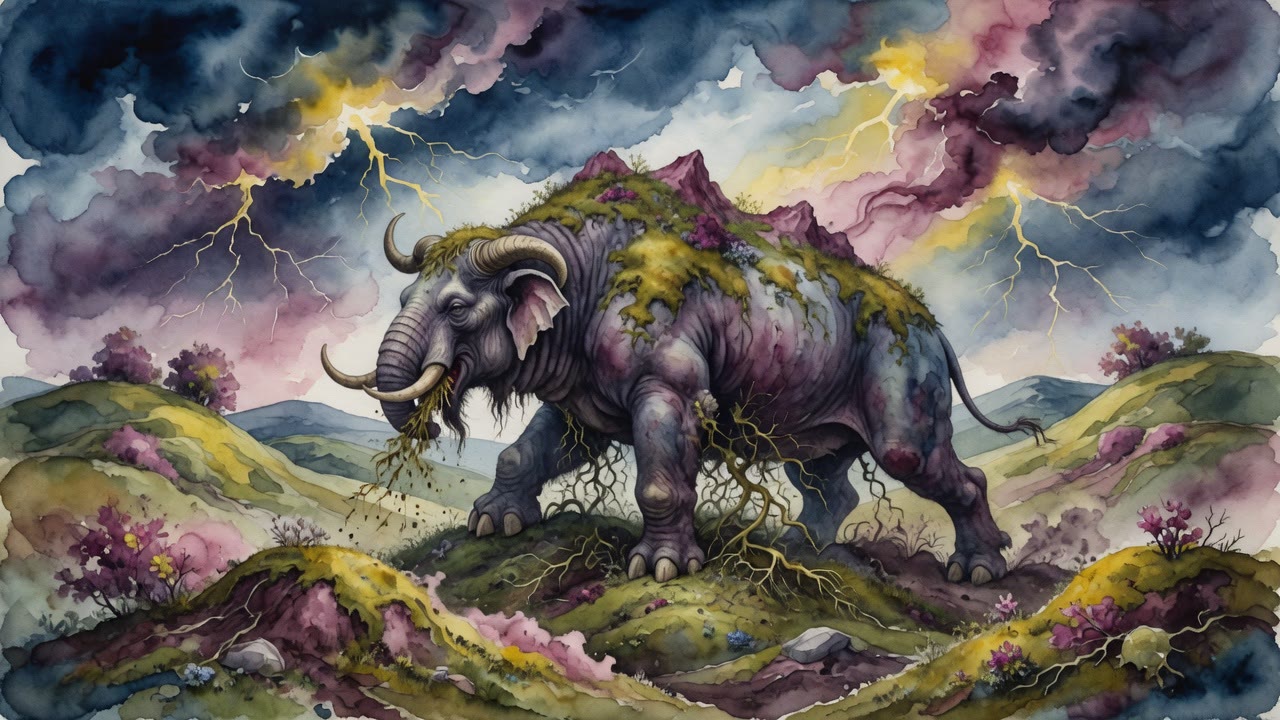
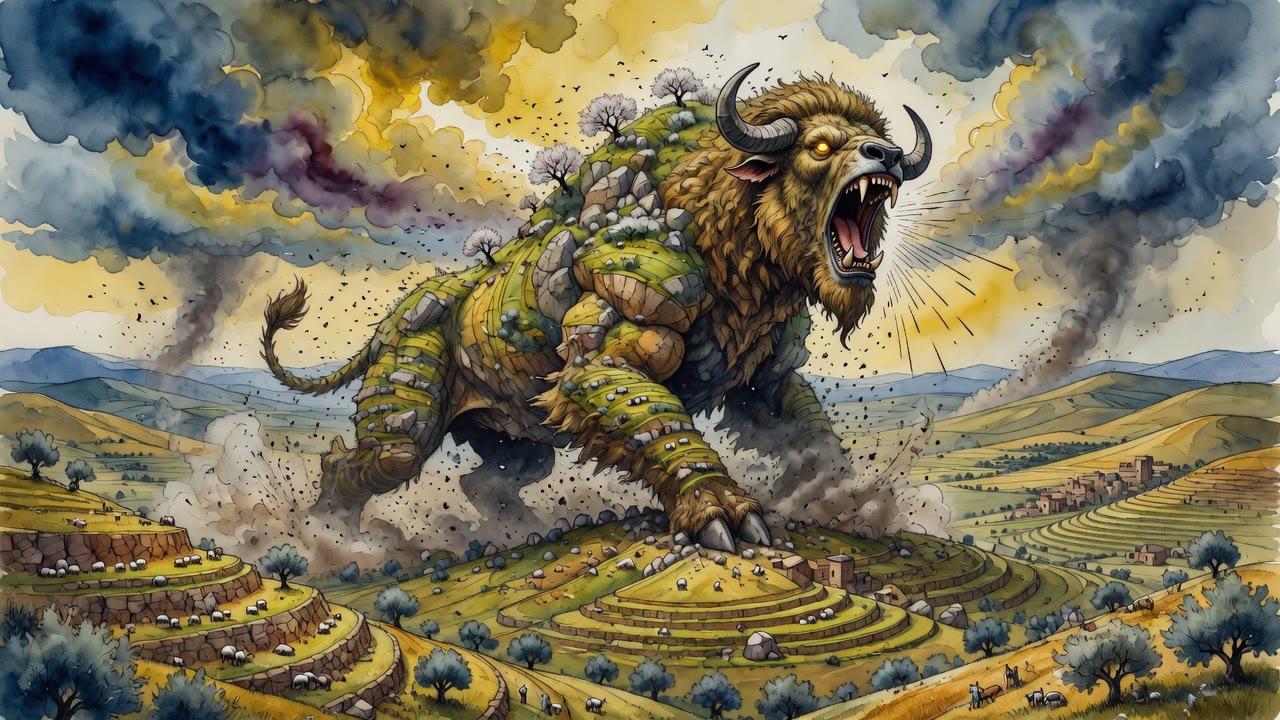
The hills move when it breathes. Not the wind in the grass, the hills themselves, the whole green spine of a thousand mountains rising and settling under a weight that has lain there since the sixth morning of the world. A traveler who climbed high enough to see it would not understand what he was looking at. He would think the range itself was alive, that the earth had a chest, that the valleys were the spaces between ribs. Then a mouth the size of a canyon would open in the slope below him and tear the grass off an entire mountainside in one slow pull, and he would understand, and he would run.
The Beast That Eats the Mountains

This is Behemoth, brought up out of the earth on the day the dry land filled with creatures, and it eats the way nothing else eats. Ordinary animals forage. Behemoth consumes geography. Every day it strips the green growth from a thousand hills, the way a man clears a single field, and it needs every blade of it. There is no foraging in this, no wandering for the next mouthful. The beast was given a dedicated country to feed from, and it empties that country daily.

By any reckoning this should be the end of the hills. A thousand mountains grazed to bare rock, year upon year since creation, should long ago have become a desert of stone. They are not. The miracle is quiet and it happens in the dark. Through the night the cropped slopes green over again, every blade returning as though no jaw had ever closed on it, so that the beast wakes each morning to a thousand hills made new. "Surely the mountains bring him forth food" (Job 40:20). The mountains feed him and the night repairs them, and the cycle has held without a single failure for longer than there have been men to count it.

The River That Circles the World

Such an appetite needs a thirst to match, and no spring or pond would do. The water comes from the Jordan, but not the thin ribbon a person could wade across. The Jordan that Behemoth drinks encircles the whole earth, half of it running in the open light, half of it hidden beneath the ground, a single river wrapped around the world like a belt. The beast lowers its head and the river swells against its mouth, and it is not afraid. "He is confident, though the Jordan swell even to his mouth" (Job 40:23).

Even that is not enough. A second water was opened for it, a river that runs straight out of the garden at the beginning of all gardens, cold and clear from a place no living man walks. That stream exists for one drinker. It was cut into the ground for the sole purpose of carrying water to a throat too large for any natural source to fill. So the beast eats a continent of grass and drinks a river that holds the planet in its arms, and still its strength is held in check, coiled and waiting. "Lo now, his strength is in his loins, and his force is in the navel of his belly. He moveth his tail like a cedar" (Job 40:16-17).

The Roar in the Month of Tammuz

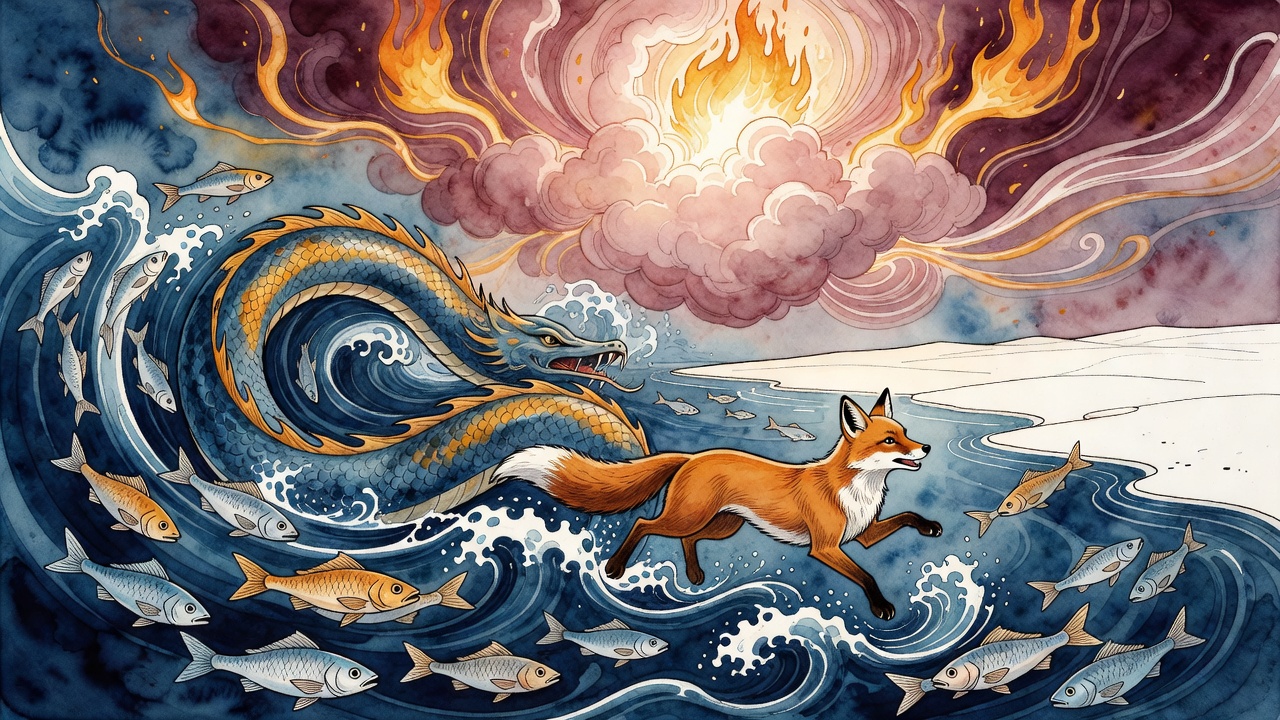
Once in the turning year the beast lifts its head and makes a sound. It comes in Tammuz, in the heat of high summer, and it comes only once. Across the world, every animal alive stops. The lion holds its paw above the ground. The bird forgets the next wingbeat. The fish hangs in the current. For one held breath the whole moving world goes still, listening to a voice that rolls up out of a thousand hills at once.

The silence is not only terror, though the terror is real. The roar sets an order and renews it. Behemoth was made the master of the dry land, the way another great creature was made master of the sea, and the yearly sound is the reminder that the arrangement still stands, that the hierarchy of the made world is intact for one more year. When the echo dies the lion sets down its paw, the bird beats its wing, the fish slides forward, and the world resumes as though nothing had spoken. But everything that breathes has been reminded who eats the mountains.

Why It Was Never Allowed to Mate

The beast was not made alone. In the beginning there was a male and a female, a pair as vast as each other, and for a moment the world stood at the edge of a different fate. A pair like that could breed. The young of two thousand-hill creatures would have come in numbers no land could hold, each one needing its own thousand hills, each one drinking its own circling river, until there was no earth left under them and the world simply gave out beneath the weight of them.

So the pairing was forbidden before it began. The beast was made unable to bring forth more of its kind, sealed against increase, left to live out its single enormous life with no mate and no offspring and no end through ordinary death. That is why it has lain on the hills since the sixth day, alone, the last and only one, neither growing nor dying, simply waiting.

What the Waiting Is For

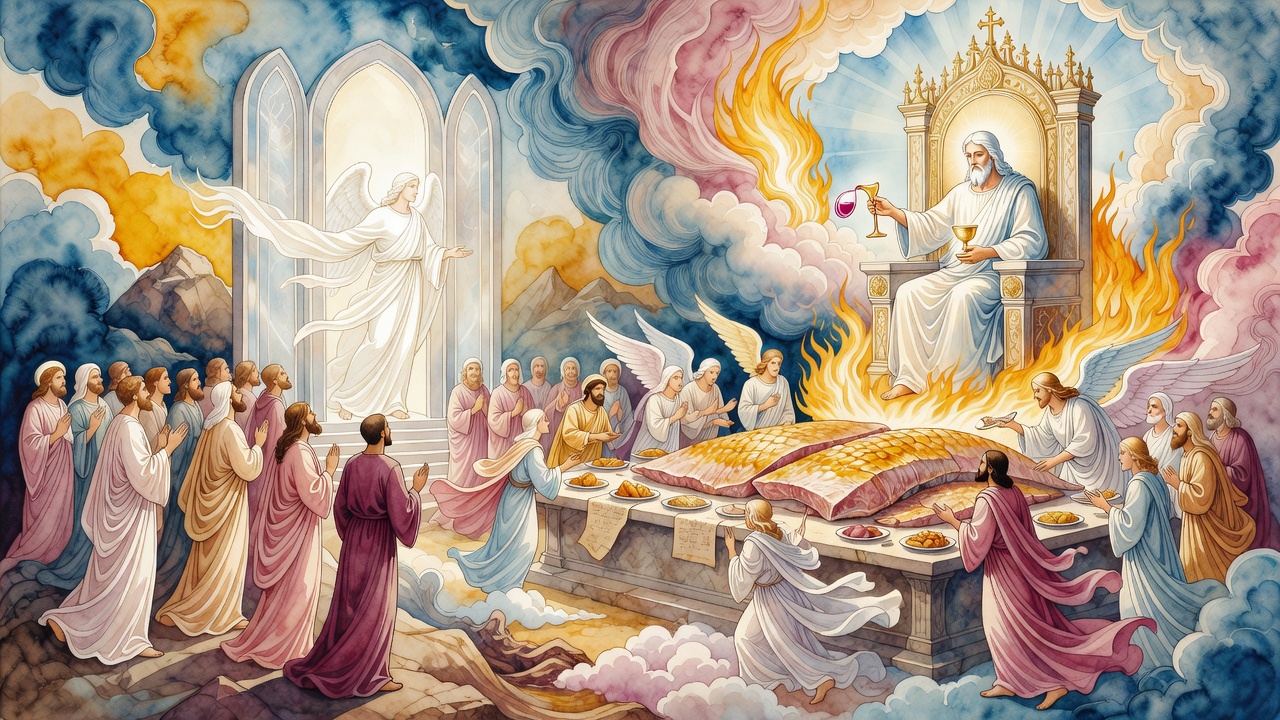
The waiting has a purpose, and the purpose is a meal. At the end of days a feast will be set for the righteous, and Behemoth is not a guest at that table. Behemoth is the table. The great beast of the land will be served beside the great beast of the sea, the two masters of the made world brought down at last and laid out for those who kept faith, with Jacob among them and the scholars and the students gathered close. The creature that ate a thousand hills will itself be eaten. The thirst that drank a river will be quenched in another's joy.

So everything about the beast points one direction. The sterility that left it without children, the long unkillable life, the daily miracle that keeps the hills green under it, the once-a-year roar that holds the animals in their places, all of it preserves one creature whole and enormous for one appointed meal. It is being fattened by the centuries. It eats the mountains so that, on the last day, it can be the main course.


← All myths
From the tradition

Sources

4 sources

The texts this telling draws on, in full. Open a card to read inline, or expand it for a wider, quieter read.

Bava Batra 74bTalmud Bavli, Bava

"And God created the great sea-monsters" (Genesis 1:21). Here they translated it: the sea-gazelles. Rabbi Yohanan said: this is Leviathan the slant serpent and Leviathan the coiled serpent, as it is said, "On that day the LORD with His hard sword will punish" (Isaiah 27:1).

Rav Yehudah said in the name of Rav: everything that the Holy One, blessed be He, created in His world, He created male and female. So too Leviathan the slant serpent and Leviathan the coiled serpent He created male and female; and had they coupled with one another they would have destroyed the entire world. What did the Holy One, blessed be He, do? He castrated the male and killed the female and salted her away for the righteous in the time to come, as it is said, "and He shall slay the dragon that is in the sea" (Isaiah 27:1).

And so too the Behemoth on the thousand mountains, He created male and female; and had they coupled with one another they would have destroyed the entire world. What did the Holy One, blessed be He, do? He castrated the male and cooled the female and preserved her for the righteous in the time to come, as it is said, "Behold now his strength is in his loins" (Job 40:16), this is the male, "and his force is in the muscles of his belly" (Job 40:16), this is the female.

And Rav Yehudah said in the name of Rav: the Jordan issues from the cave of Pamias, and flows through the Sea of Sivkhi and through the Sea of Tiberias, and rolls down into the Great Sea; and it rolls down until it reaches the mouth of Leviathan, as it is said, "he is confident though the Jordan rushes against his mouth" (Job 40:23).

Full source
Bava Batra 74b-75aTalmud Bavli, Bava Batra

Rav Yehuda said in the name of Rav: Everything that the Holy One, blessed be He, created in His world, He created male and female. Even the Leviathan the slant serpent and the Leviathan the tortuous serpent He created male and female; and had they mated with one another, they would have destroyed the entire world.

What did the Holy One, blessed be He, do? He castrated the male and killed the female and salted it for the righteous in the time to come, as it is said: "And He shall slay the dragon that is in the sea" (Isaiah 27:1).

And the behemoth on the thousand mountains too He created male and female; and had they mated with one another, they would have destroyed the entire world. What did the Holy One, blessed be He, do? He castrated the male and cooled the female and preserved it for the righteous in the time to come, as it is said: "Behold now, his strength is in his loins" (Job 40:16), this is the male, "and his force is in the muscles of his belly," this is the female.

Full source
Bava Batra 74bTalmud Bavli, Bava Batra

i.e., a diver [bar amoraei] went into the water to bring up this chest, and the fish became angry and sought to sever his thigh, but the diver threw upon it a flask of vinegar and they descended and swam away. A Divine Voice emerged and said to us: What right do you have to touch the crate of the wife of Rabbi Ḥanina ben Dosa, as she is destined to insert sky-blue wool in it to be used in the ritual fringes of the righteous in the World-to-Come?

Rav Yehuda from India relates: Once we were traveling in a ship and we saw a certain precious stone that was encircled by a snake. A diver descended to bring it up, and the snake came and sought to swallow the ship. A raven came and cut off its head, and the water turned into blood due to the enormousness of the snake. Another snake came, took the precious stone, and hung it on the dead snake, and it recovered.

It returned and again sought to swallow the ship, and yet again a bird came and cut off its head, took that precious stone, and threw it onto the ship. We had with us these salted birds; we placed the stone on them, and they took the stone and flew away with it. § Apropos the stories of large sea creatures, the Gemara discusses the large sea creatures mentioned in the Bible. The Sages taught: There was an incident involving Rabbi Eliezer and Rabbi Yehoshua, who were traveling on a ship, and Rabbi Eliezer was sleeping and Rabbi Yehoshua was awake.

Rabbi Yehoshua trembled, and Rabbi Eliezer awoke. Rabbi Eliezer said to him: What is this, Yehoshua; for what reason did you tremble? Rabbi Yehoshua said to him: I saw a great light in the sea. Rabbi Eliezer said to him: Perhaps you saw the eyes of the leviathan, as it is written: “And his eyes are like the eyelids of the morning” (Job 41:10).

Rav Ashi said: Huna bar Natan said to me: Once we were traveling in the desert, and we had a thigh of meat with us. We cut open the thigh and tore off the sciatic nerve and the forbidden fat and put it on the grass. By the time that we brought wood, the thigh had repaired itself, and we roasted it. When we returned to that place after twelve months of the year had passed, we saw that those coals were still glowing.

When I came before Ameimar, he said to me: That grass was a drug of life [samterei], while those coals were of broom. The verse states: “And God created the great sea monsters” (Genesis 1:21). Here, in Babylonia, they interpreted this as a reference to the sea oryx. Rabbi Yoḥanan says: This is leviathan the slant serpent, and leviathan the tortuous serpent, as it is stated: “In that day the Lord with His sore and great and strong sword will punish leviathan the slant serpent, and leviathan the tortuous serpent” (Isaiah 27:1). § The Gemara provides a mnemonic for the following statements of Rav Yehuda citing Rav: Everything; time; Jordan.

Rav Yehuda says that Rav says: Everything that the Holy One, Blessed be He, created in His world, He created male and female. Even leviathan the slant serpent and leviathan the tortuous serpent He created male and female. And if they would have coupled and produced offspring, they would have destroyed the entire world. What did the Holy One, Blessed be He, do?

He castrated the male and killed the female, and salted the female to preserve it for the banquet for the righteous in the future. As it is stated: “And He will slay the serpent that is in the sea” (Isaiah 27:1). And He created even the beasts on the thousand hills (see Psalms 50:10) male and female. And they were so enormous that if they would have coupled and produced offspring, they would have destroyed the entire world.

What did the Holy One, Blessed be He, do? He castrated the male and cooled the sexual desire of the female and preserved it for the righteous in the future. As it is stated about the beasts: “Lo now, his strength is in his loins” (Job 40:16); this is referring to the male. The continuation of the verse: “And his force is in the stays of his body”; this is the female, alluding to the idea that they did not use their genitals for the purpose of procreation.

The Gemara asks: There too, with regard to the leviathan, let Him castrate the male and cool the female; why was it necessary to kill the female? The Gemara answers: Fish are unrestrained, and therefore even if the female was cooled, the female would still procreate. The Gemara suggests: And let Him do the opposite, and kill and preserve the male leviathan. The Gemara responds: If you wish, say that the salted female is better; if you wish, say instead that since it is written: “There is leviathan, whom You have formed to sport with” (Psalms 104:26), the male must be left alive for sport, because it is not proper conduct to sport with a female.

The Gemara asks: Here too, with regard to the beasts, let Him preserve the female in salt, instead of cooling it. The Gemara answers: Salted fish is good, but salted meat is not good. And Rav Yehuda says that Rav says: At the time when the Holy One, Blessed be He, sought to create the world, He said to the minister of the sea: Open your mouth and swallow all the waters of the world, so that there will be room for land.

The minister of the sea said before Him: Master of the Universe, it is enough that I will stay within my own waters. God immediately struck him and killed him; as it is stated: “He stirs up the sea with His power, and by His understanding He smites through Rahab” (Job 26:12). Rabbi Yitzḥak said: Conclude from here that the name of the minister of the sea is Rahab, and were it not for waters of the sea that cover him, no creature could withstand his smell, as his corpse emits a terrible stench.

As it is stated: “They shall not hurt nor destroy in all My holy mountain; for the earth shall be full of the knowledge of the Lord, as the waters cover the sea” (Isaiah 11:9). Do not read this phrase as “cover the sea”; rather read it as: Cover the minister of the sea, i.e., the term sea is referring to the minister of the sea, not to the sea itself. And Rav Yehuda says that Rav says: The Jordan issues forth from the cave of Pamyas.

That is also taught in a baraita: The Jordan issues forth from the cave of Pamyas, and travels in the Sea of Sivkhi, i.e., the Hula Lake, and in the Sea of Tiberias, the Sea of Galilee, and rolls down to the Great Sea, and rolls down until it reaches the mouth of the leviathan. As it is stated: “He is confident, though the Jordan rush forth to his mouth” (Job 40:23). Rava bar Ulla strongly objects to this explanation of the verse, stating: But this verse is written about the beasts on the thousand hills.

Rather, Rava bar Ulla said that this is the meaning of the verse: When are the beasts on the thousand hills confident? When the Jordan rushes forth into the mouth of the leviathan. § The Gemara provides a mnemonic for the upcoming statements of Rav Dimi: Seas; Gabriel; hungry. When Rav Dimi came from Eretz Yisrael to Babylonia, he said that Rabbi Yoḥanan said: What is the meaning of that which is written: “For He has founded it upon the seas, and established it upon the floods” (Psalms 24:2)?

These are the seven seas and four rivers that surround Eretz Yisrael. And these are the seven seas: The Sea of Tiberias, the Sea of Sodom, i.e., the Dead Sea, the Sea of Ḥeilat, the Sea of Ḥeilata, the Sea of Sivkhi, the Sea of Aspamya, and the Great Sea, i.e., the Mediterranean. And these are the four rivers: The Jordan, the Jarmuth, and the Keiromyon, and the Piga, which are the rivers of Damascus. When Rav Dimi came from Eretz Yisrael to Babylonia he said that Rabbi Yonatan says: In the future, Gabriel will perform

Full source
Pirkei DeRabbi Eliezer 11:4Pirkei DeRabbi Eliezer

It tells us that on the sixth day of creation, God brought forth from the earth a beast so massive it sprawls across a thousand hills. A creature so large it uses entire mountain ranges as its personal La-Z-Boy.

The appetite? Forget grazing; this is more like landscape architecture. Every day, Behemoth chows down on the verdant growth of a thousand hills. But here's the kicker: overnight, the vegetation regrows as if it were never touched! It’s like a divine all-you-can-eat buffet that magically replenishes itself. As it says in (Job 40:20), "Surely the mountains bring him forth food."

So, where does a beast of this magnitude quench its thirst? The Pirkei DeRabbi Eliezer continues, telling us the waters of the Jordan River itself provide Behemoth’s refreshment. But not just any Jordan River – the Jordan, encircling the entire earth, half flowing above and half below. It's a cosmic river system that feeds this epic creature. "He is confident, though Jordan swell even to his mouth" (Job 40:23).

The story doesn't end there.

This magnificent, gargantuan beast has a destiny. It's not just wandering around, eating hills and drinking rivers for eternity. the verse says, Behemoth is destined for the day of sacrifice, for the great banquet of the righteous. A celestial feast of epic proportions! The Pirkei DeRabbi Eliezer quotes (Job 40:19), "He only that made him can make his sword to approach unto him." Only God, the creator of this incredible creature, can ultimately bring it to its purpose.

So, what does it all mean? Is it just a wild tale of a giant beast? Maybe. But within Jewish tradition, these stories often carry deeper meaning.

Perhaps Behemoth represents the untamed power of creation, the raw, unbridled force that only God can control. Or maybe it's a reminder that even the largest, most intimidating things in the world have a purpose within the divine plan.

Whatever the interpretation, the story of Behemoth leaves us with a sense of awe and wonder at the vastness and mystery of God's creation. And it certainly makes you think twice about your next all-you-can-eat buffet!

Full source