5 min read

Behemoth and the Thousand Hills That Grew Back

On the sixth day, Behemoth rose from the earth, ate a thousand hills each day, drank from the Jordan, and waited for its appointed end.

Curated by Arthur · Told by Maggid ·
Table of Contents
  1. The Earth Raised a Body Too Large to Hide
  2. The Hills Fed It and Rose Again
  3. The Jordan Climbed to Its Mouth
  4. The Tooth Hid in the Warning
  5. The Beast Stayed Inside the Boundary

The earth had already opened for grass, trees, creeping things, cattle, and wild beasts. On the sixth day it opened again, and this time the ground did not give birth to something that could be counted.
The Earth Raised a Body Too Large to Hide

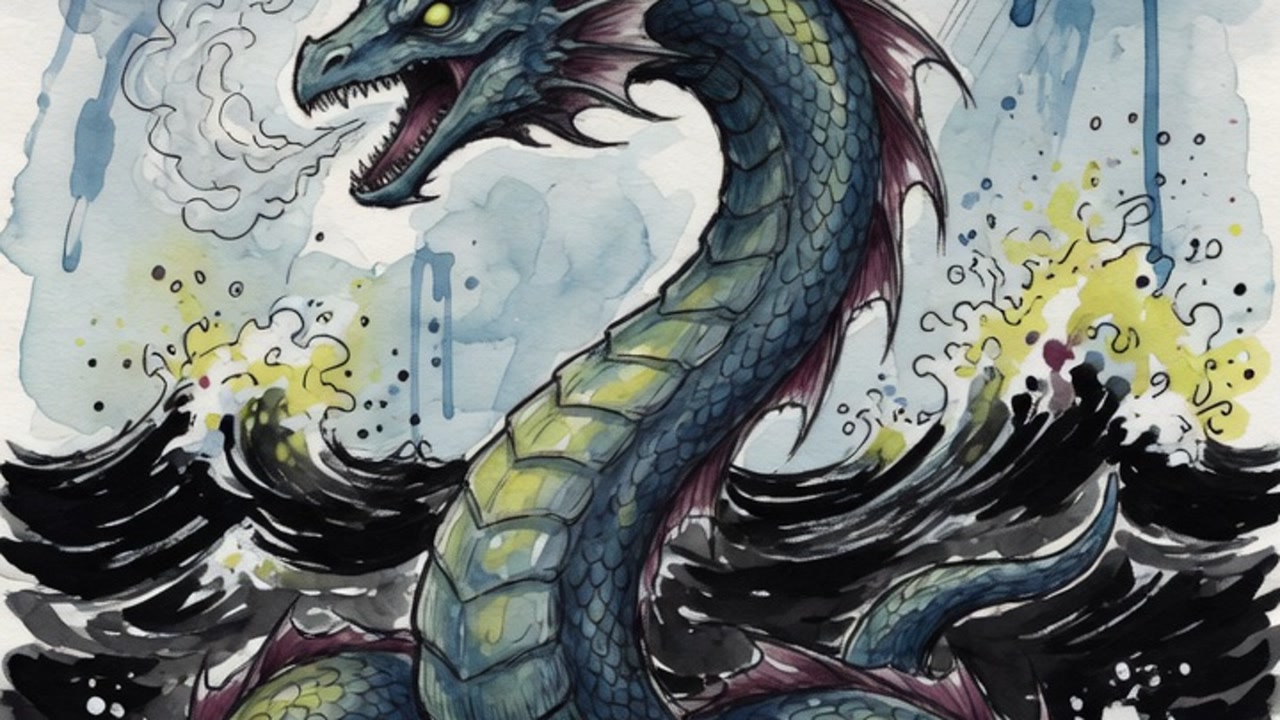
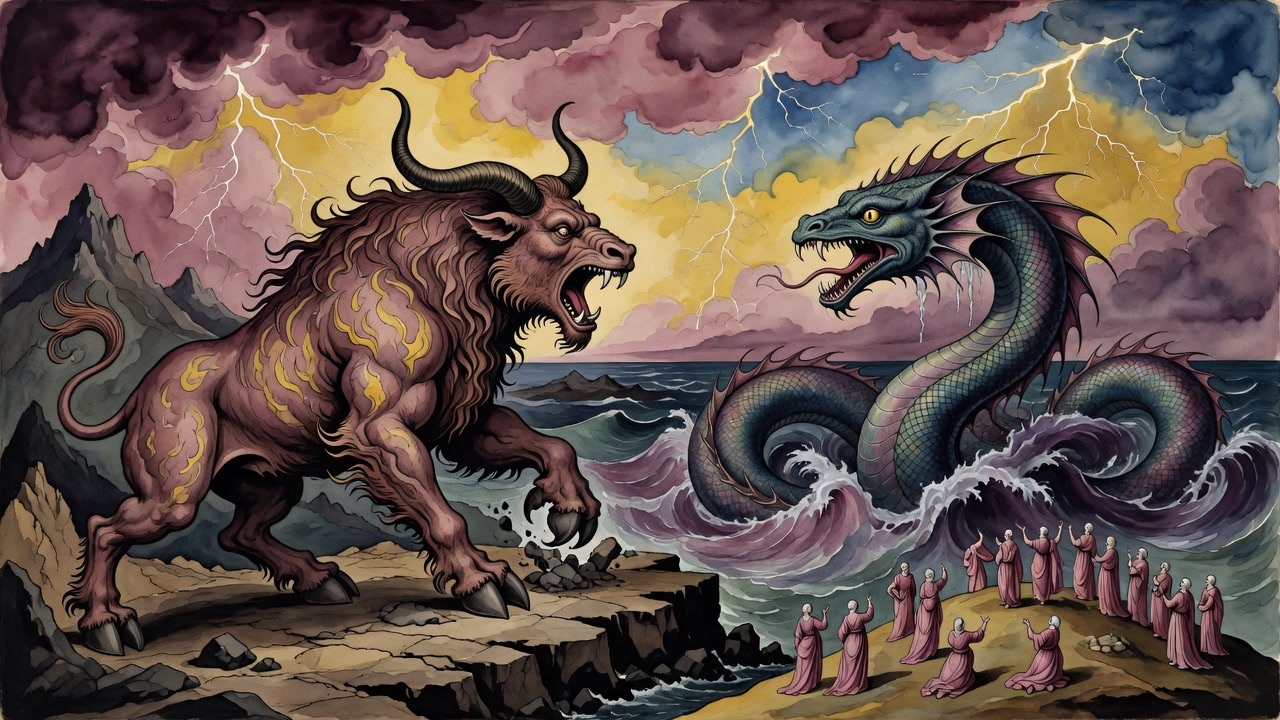
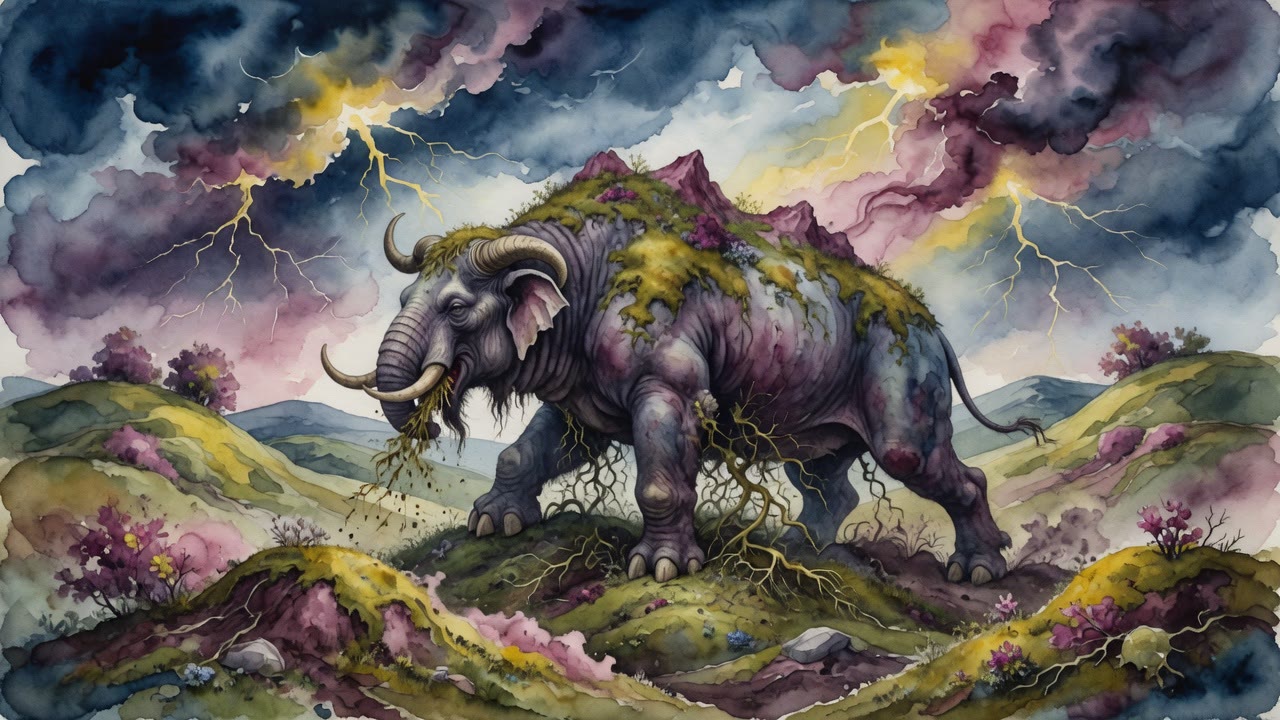
God drew Behemoth out of the soil with the other land creatures, but the beast did not fit beside them. Its back ran across ridges. Its belly settled into valleys. Its breath moved through the hills like weather. The smaller animals could scatter, mate, hide, and sleep under brush. Behemoth lay across a thousand hills and made the hills look like a single feeding trough.

It was not a rebel. No rival throne rose under its ribs. The beast had no kingdom except the pasture assigned to it. Its power was obedience stretched to impossible size. Hooves pressed into the ground. Its mouth opened. Whole slopes bent toward it.

No shepherd could whistle it back. No fence could turn it. The only boundary strong enough for Behemoth was the measure God had set into the world before the beast lowered its head.

The Hills Fed It and Rose Again

At dawn the hills were green. By afternoon they were stripped. Grass, shoots, leaves, and tender growth vanished into the creature's mouth until the slopes looked shaved down to the bones of the earth. A thousand hills emptied themselves into one hunger.

Then night came.

Dew settled. Roots stirred. Green pushed back through the torn places. By morning the hills had returned, as if the creature had not spent the day grinding them away. Behemoth rose to the same feast again. The miracle was not only the mouth. It was the pasture that refused to stay consumed. The beast ate creation, and creation answered by growing back under God's command.

The Jordan Climbed to Its Mouth

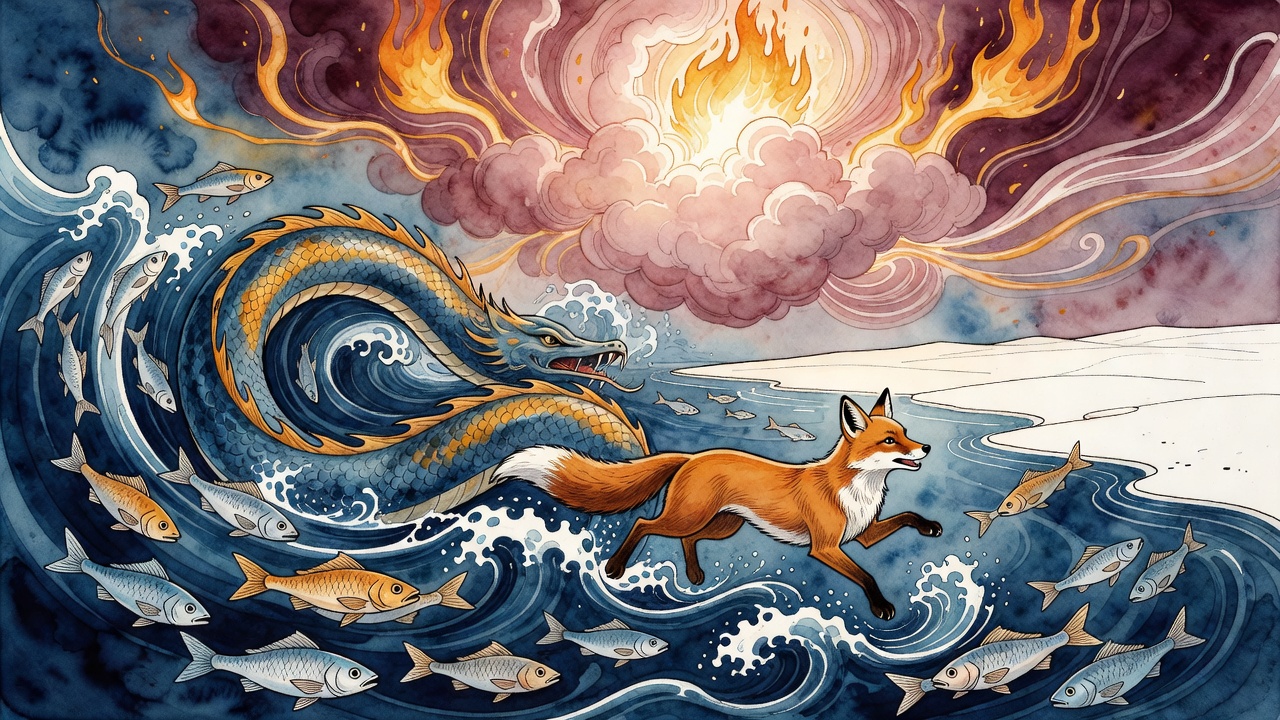
A beast that eats hills cannot drink from a ditch. The Jordan rose for it, not only the river known by villages and crossings, but the river imagined as a belt around the world, half above the ground and half under it. The waters moved in hidden courses where roots and graves could not follow. They circled until they reached the place where the huge mouth waited.

The river swelled toward Behemoth's lips. The creature did not panic when the water climbed. It did not turn its head away. It drank the Jordan as an animal drinks from a trough, except the trough was a river wrapped around the earth. Water went in. The hills stood wet in the morning light. The land creature carried a sea-sized thirst.

The Tooth Hid in the Warning

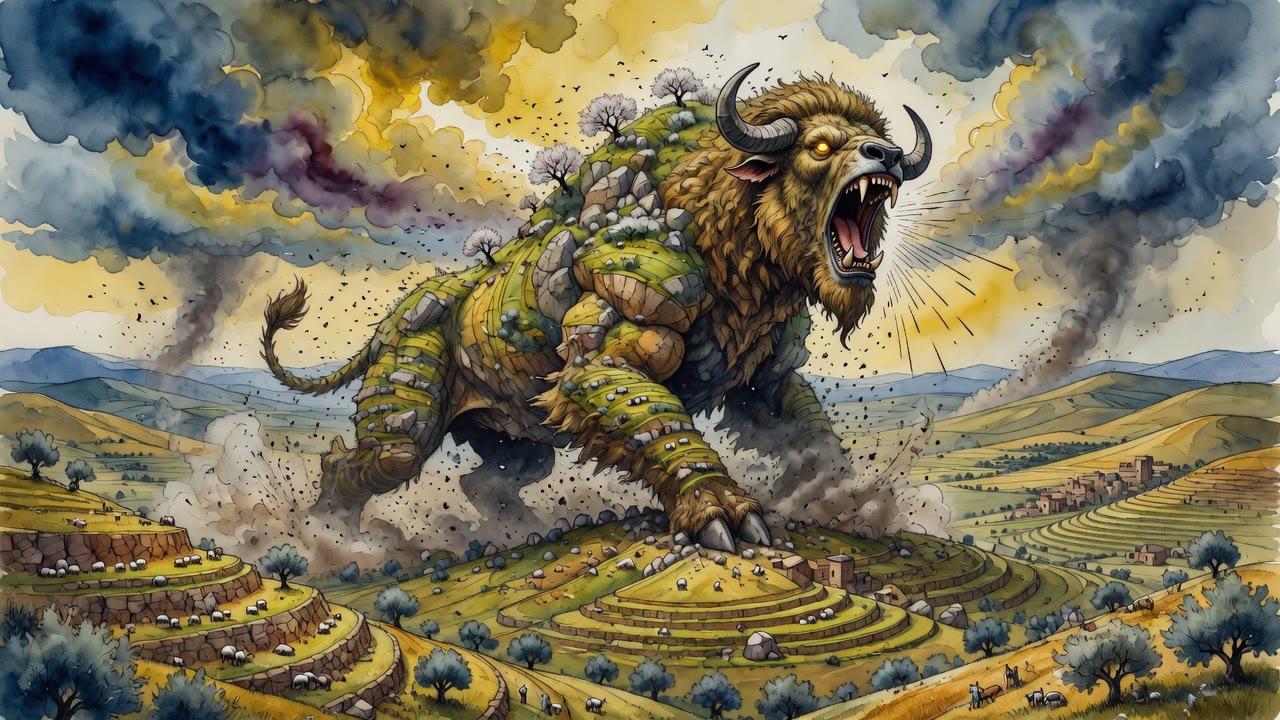
Later, when Israel heard warnings of hunger, flame, poison, and teeth, the beast's name grew sharper in the mouth. The word for beasts did not stay safely outside the body, somewhere beyond the camp. It could be heard as a tooth. It could be heard as death sent inward, biting where no hunter could see the animal.

That is the terror of Behemoth when its name enters a curse. The danger is not only a giant body on distant hills. It is heat in the blood, venom in the bite, a mouth that turns against flesh. The beast outside the horizon becomes a pressure inside the ribs. A creature large enough to eat mountains also teaches the smallness of a human throat.

The word moves like the creature itself. First it covers the landscape. Then it enters the body. First it is pasture and river. Then it is tooth and fever. The same mouth that amazes the eye can become the mouth that judges.

The Beast Stayed Inside the Boundary

Behemoth did not devour the world. That matters. A thousand hills were enough because God had measured the portion. The Jordan was enough because God had measured the thirst. The beast could look endless and still remain held.

Its end had already been placed somewhere ahead of it. The creature that ate each day from renewed hills would one day belong to a table not yet set, a feast for the righteous in the world-to-come. Until then it grazed, drank, breathed, and waited.

That waiting is part of its size. Behemoth is enormous, but not free to spend itself however it wants. It lives inside an appointed hunger and an appointed ending. Morning after morning, the hills came back green. The beast lowered its mouth again.


← All myths
From the tradition

Sources

2 sources

The texts this telling draws on, in full. Open a card to read inline, or expand it for a wider, quieter read.

Pirkei DeRabbi Eliezer 11:4Pirkei DeRabbi Eliezer

It tells us that on the sixth day of creation, God brought forth from the earth a beast so massive it sprawls across a thousand hills. A creature so large it uses entire mountain ranges as its personal La-Z-Boy.

The appetite? Forget grazing; this is more like landscape architecture. Every day, Behemoth chows down on the verdant growth of a thousand hills. But here's the kicker: overnight, the vegetation regrows as if it were never touched! It’s like a divine all-you-can-eat buffet that magically replenishes itself. As it says in (Job 40:20), "Surely the mountains bring him forth food."

So, where does a beast of this magnitude quench its thirst? The Pirkei DeRabbi Eliezer continues, telling us the waters of the Jordan River itself provide Behemoth’s refreshment. But not just any Jordan River – the Jordan, encircling the entire earth, half flowing above and half below. It's a cosmic river system that feeds this epic creature. "He is confident, though Jordan swell even to his mouth" (Job 40:23).

The story doesn't end there.

This magnificent, gargantuan beast has a destiny. It's not just wandering around, eating hills and drinking rivers for eternity. the verse says, Behemoth is destined for the day of sacrifice, for the great banquet of the righteous. A celestial feast of epic proportions! The Pirkei DeRabbi Eliezer quotes (Job 40:19), "He only that made him can make his sword to approach unto him." Only God, the creator of this incredible creature, can ultimately bring it to its purpose.

So, what does it all mean? Is it just a wild tale of a giant beast? Maybe. But within Jewish tradition, these stories often carry deeper meaning.

Perhaps Behemoth represents the untamed power of creation, the raw, unbridled force that only God can control. Or maybe it's a reminder that even the largest, most intimidating things in the world have a purpose within the divine plan.

Whatever the interpretation, the story of Behemoth leaves us with a sense of awe and wonder at the vastness and mystery of God's creation. And it certainly makes you think twice about your next all-you-can-eat buffet!

Full source
Sifrei Devarim 321:10Sifrei Devarim

One particular verse, (Deuteronomy 32:24-25), jumped out. It paints a grim picture of divine punishment, listing various calamities. But it's not just the calamities themselves, it's the way they're described, the little twists the Rabbis find hidden within the words.

(Deut. 32:24). Now, the Hebrew word for "beasts" here is behemoth. But the Rabbis, in a brilliant piece of wordplay, suggest we read it differently. Instead of "the tooth of beasts," they propose "a tooth – death – will I send in them (bam)." A subtle shift in pronunciation, but a massive shift in meaning! It's no longer an external threat, but an internal one. Death from within. Powerful. Then there’s the word chamath, usually translated as "wrath" or "poison." But the Sifrei offers two interpretations. The first is particularly gruesome: that someone, consumed by this chamath, will become heated (mithchamem), bite themselves, develop a terrible ulcer, and die. A horrifying image of self-destruction fueled by inner turmoil.

The second interpretation takes a different turn, suggesting that this "heating up" refers to lust and illicit relations. It's like the text is saying: the real poison isn't just physical, it's also moral and spiritual.

What about "the crawlers in the dust?" (Deut. 32:24). Simple enough. Well, On one level, it means exactly what it sounds like: people humiliated, groveling. But then the text adds: "The crawlers in the dust are the serpents, whose 'realm' is the dust." Suddenly, the image evokes the primordial serpent, the embodiment of temptation and evil, forever bound to the earth. As we know, snakes are symbols of cunning and danger in many cultures, not just Jewish tradition.

Finally, we arrive at (Deuteronomy 32:25): "On the outside (of the city) the sword (of legions) shall devour (them)." This verse becomes the basis for a very practical piece of advice: "In time of war, 'gather in' your legs (i.e., stay at home); in time of famine, 'spread out' your legs (and leave)."

It's a stark reminder of the dangers lurking both inside and outside. During wartime, staying put offers the best chance of survival, avoiding the roaming armies. But during a famine, staying put means certain starvation. You have to venture out, to take risks in order to find food.

The commentaries then bring in verses from Jeremiah and Ezekiel to reinforce this point. "If I go out to the field, there are the slain of the sword! And if I enter the city, there are the sick with famine!" (Jeremiah 14:18). And, "Whoever is in the field will die by the sword, and whoever is in the city, famine and plague will consume him" (Ezekiel 7:15). It's a classic "damned if you do, damned if you don't" scenario.

But maybe, just maybe, that's the point. Life is full of impossible choices. There are no easy answers, no guarantees. Sometimes, all we can do is weigh the risks, trust our instincts, and pray for the best. And perhaps, most importantly, to be aware of the dangers that lurk both within and without, both the external threats and the internal struggles that can consume us from the inside out.

Full source