6 min read

The Ziz, the Giant Bird Whose Egg Flooded Sixty Cities

Sailors saw a bird standing in the sea with water only to its ankles and thought they could swim. A voice from heaven knew better about the Ziz.

Curated by Arthur · Told by Maggid ·
Table of Contents
  1. The Sailors Decide the Sea Is Shallow
  2. The Bird That Reaches the Throne
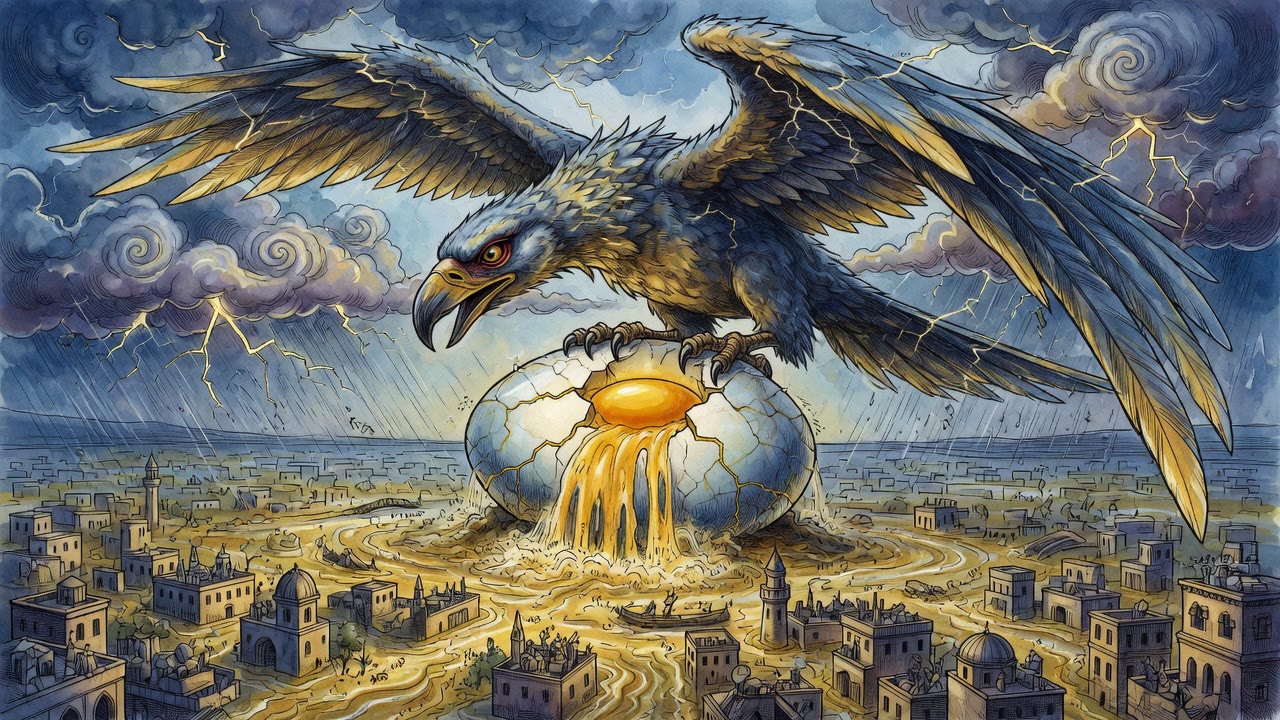
  3. The Egg That Drowned Sixty Cities
  4. A Bird, Therefore Kosher
  5. The Three Kept for the End

The deck pitched, the rigging groaned, and the sailors saw what looked like salvation off the bow. A bird stood in the open water. Not floating, standing, its legs going straight down into the swell like two columns, and the sea climbed only to its ankles. Ankle deep. After weeks of black water with no bottom anyone could name, here at last was shallow ground.
The Sailors Decide the Sea Is Shallow

One of them was already stripping off his belt. The water came up the bird's legs no higher than a man's calf would stand in a tide pool. If a creature that size touched bottom there, then the bottom was close, and a swimmer could reach it, and reaching it meant they could wade, rest, stop fighting the deep that had been trying to swallow them since the harbor fell behind. He climbed onto the rail. He bent his knees to dive.

A voice came down out of the sky before his feet left the wood. It was not the wind and it was not a gull. It told him to stop. A carpenter had dropped his axe into this exact water seven years ago, the voice said, and the axe had not yet struck the floor of the sea. Seven years of falling. The man froze on the rail and looked again at the bird, and only then did the scale of the thing arrive in him like cold seawater. What he had taken for shallows was a bird so vast that the whole depth of the ocean rose no higher than its ankle bone.

The Bird That Reaches the Throne

The sailors followed the legs upward with their eyes. Past the waterline, past the great breast, past where any neck of any bird they had ever plucked or eaten should have ended, and still upward, until the head was lost somewhere past the top of the sky. They could not see it. They could only hear it, faint and constant, threaded through the high air above the clouds. The thing was singing. Feet planted on the floor of the deep, head pressing up against the Throne of Glory, the Ziz stood in both places at once, the lowest creature in the world and the highest, and out of that impossible height it sang praises to God.

The men did not dive. They turned the ship and ran with the wind, and not one of them spoke for a long time, because there is a kind of size that closes the throat.

The Egg That Drowned Sixty Cities

Such a bird builds a nest, and such a nest holds an egg. There is a country that remembers what happened when one of those eggs slipped loose. It did not crack against a branch. It fell the whole distance from a height no eye could follow, and it came down through a forest of three hundred trees and snapped them off at the trunk like a man walking through dry reeds. Then the egg burst. What was inside a single egg of the Ziz came out as a flood, and the flood spread, and when it stopped spreading it had drowned sixty cities. One egg. The people who measured the ruin afterward understood something the sailors had only glimpsed. The bird was not large. The bird was a landscape that flew.

A Bird, Therefore Kosher

Here is where the carefulness comes in, the cold practical care of people who must know what may be eaten and what may not. A bird is a bird. The Ziz has the feet of a bird and the wings of a bird and lays the egg of a bird, and a bird of the permitted kind may be brought to the table. So the Ziz is kosher. The reasoning is plain, even if the meal it points toward is hard to picture. A creature whose single egg drowns sixty cities will one day be carved and served, and the carving will not be at any human kitchen.

The Three Kept for the End

For the Ziz does not stand alone. Three great beasts were set aside from the beginning and held back for the close of all days. In the sea waits Leviathan, who was made male and female, until it became clear that if the two of them bred, the world could not hold their young. So the female was killed and her flesh salted away, kept for the feast of the righteous, and the male lives on alone. When he is hungry his breath boils the whole deep (Job 41:23), and only because he keeps his head in the Garden could any other creature bear the smell of him. Even the angel Gabriel, sent to hunt him, cannot bring him down alone.

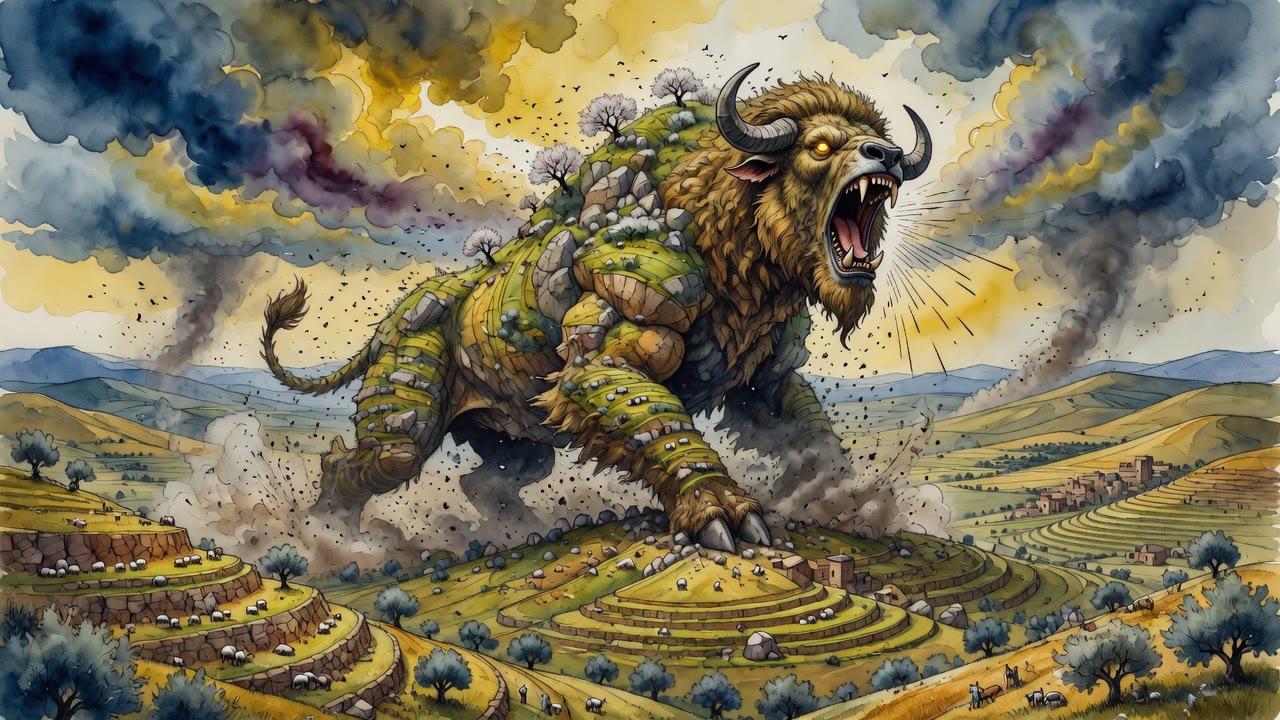
On the dry land waits Behemoth, the size of a thousand mountains, who eats the grass of a thousand hills every day and drinks from a river that runs to him straight out of Paradise. Once a year, in the heat of the month of Tammuz, he lets out a single roar, and every animal on the earth hears it and is afraid, and that fear is the leash that keeps the beasts of the world in their place.

Sea, land, and sky. Leviathan below, Behemoth across the plains, and above them both the Ziz with its feet in the ocean and its voice at the Throne. Three plates for one table. The sailors who almost dove that day had stood, without knowing it, at the foot of the third guest, and lived only because a voice in the sky cared whether they understood how deep the water really was.


← All myths
From the tradition

Sources

3 sources

The texts this telling draws on, in full. Open a card to read inline, or expand it for a wider, quieter read.

Bava Batra 73aTalmud Bavli, Bava

And Rabbah bar bar Channah said: One time we were traveling on a ship, and we saw a certain bird that was standing up to its ankles in the water, with its head in the sky. And we said: There is no water here, and we wanted to go down to cool ourselves off. But a heavenly voice came forth and said to us:

"Do not go down here, for an axe fell from a carpenter's hand here seven years ago, and it has not yet reached the ground." And this was not because the water was deep, but because the water was swift. Rav Ashi said: And that bird was the Ziz of the field, as it is written:

"And the Ziz of the field is with Me" (Psalms 50:11).

Full source
Bava Batra 74bTalmud Bavli, Bava

"And God created the great sea-monsters" (Genesis 1:21). Here they translated it: the sea-gazelles. Rabbi Yohanan said: this is Leviathan the slant serpent and Leviathan the coiled serpent, as it is said, "On that day the LORD with His hard sword will punish" (Isaiah 27:1).

Rav Yehudah said in the name of Rav: everything that the Holy One, blessed be He, created in His world, He created male and female. So too Leviathan the slant serpent and Leviathan the coiled serpent He created male and female; and had they coupled with one another they would have destroyed the entire world. What did the Holy One, blessed be He, do? He castrated the male and killed the female and salted her away for the righteous in the time to come, as it is said, "and He shall slay the dragon that is in the sea" (Isaiah 27:1).

And so too the Behemoth on the thousand mountains, He created male and female; and had they coupled with one another they would have destroyed the entire world. What did the Holy One, blessed be He, do? He castrated the male and cooled the female and preserved her for the righteous in the time to come, as it is said, "Behold now his strength is in his loins" (Job 40:16), this is the male, "and his force is in the muscles of his belly" (Job 40:16), this is the female.

And Rav Yehudah said in the name of Rav: the Jordan issues from the cave of Pamias, and flows through the Sea of Sivkhi and through the Sea of Tiberias, and rolls down into the Great Sea; and it rolls down until it reaches the mouth of Leviathan, as it is said, "he is confident though the Jordan rushes against his mouth" (Job 40:23).

Full source
Bava Batra 74bTalmud Bavli, Bava Batra

i.e., a diver [bar amoraei] went into the water to bring up this chest, and the fish became angry and sought to sever his thigh, but the diver threw upon it a flask of vinegar and they descended and swam away. A Divine Voice emerged and said to us: What right do you have to touch the crate of the wife of Rabbi Ḥanina ben Dosa, as she is destined to insert sky-blue wool in it to be used in the ritual fringes of the righteous in the World-to-Come?

Rav Yehuda from India relates: Once we were traveling in a ship and we saw a certain precious stone that was encircled by a snake. A diver descended to bring it up, and the snake came and sought to swallow the ship. A raven came and cut off its head, and the water turned into blood due to the enormousness of the snake. Another snake came, took the precious stone, and hung it on the dead snake, and it recovered.

It returned and again sought to swallow the ship, and yet again a bird came and cut off its head, took that precious stone, and threw it onto the ship. We had with us these salted birds; we placed the stone on them, and they took the stone and flew away with it. § Apropos the stories of large sea creatures, the Gemara discusses the large sea creatures mentioned in the Bible. The Sages taught: There was an incident involving Rabbi Eliezer and Rabbi Yehoshua, who were traveling on a ship, and Rabbi Eliezer was sleeping and Rabbi Yehoshua was awake.

Rabbi Yehoshua trembled, and Rabbi Eliezer awoke. Rabbi Eliezer said to him: What is this, Yehoshua; for what reason did you tremble? Rabbi Yehoshua said to him: I saw a great light in the sea. Rabbi Eliezer said to him: Perhaps you saw the eyes of the leviathan, as it is written: “And his eyes are like the eyelids of the morning” (Job 41:10).

Rav Ashi said: Huna bar Natan said to me: Once we were traveling in the desert, and we had a thigh of meat with us. We cut open the thigh and tore off the sciatic nerve and the forbidden fat and put it on the grass. By the time that we brought wood, the thigh had repaired itself, and we roasted it. When we returned to that place after twelve months of the year had passed, we saw that those coals were still glowing.

When I came before Ameimar, he said to me: That grass was a drug of life [samterei], while those coals were of broom. The verse states: “And God created the great sea monsters” (Genesis 1:21). Here, in Babylonia, they interpreted this as a reference to the sea oryx. Rabbi Yoḥanan says: This is leviathan the slant serpent, and leviathan the tortuous serpent, as it is stated: “In that day the Lord with His sore and great and strong sword will punish leviathan the slant serpent, and leviathan the tortuous serpent” (Isaiah 27:1). § The Gemara provides a mnemonic for the following statements of Rav Yehuda citing Rav: Everything; time; Jordan.

Rav Yehuda says that Rav says: Everything that the Holy One, Blessed be He, created in His world, He created male and female. Even leviathan the slant serpent and leviathan the tortuous serpent He created male and female. And if they would have coupled and produced offspring, they would have destroyed the entire world. What did the Holy One, Blessed be He, do?

He castrated the male and killed the female, and salted the female to preserve it for the banquet for the righteous in the future. As it is stated: “And He will slay the serpent that is in the sea” (Isaiah 27:1). And He created even the beasts on the thousand hills (see Psalms 50:10) male and female. And they were so enormous that if they would have coupled and produced offspring, they would have destroyed the entire world.

What did the Holy One, Blessed be He, do? He castrated the male and cooled the sexual desire of the female and preserved it for the righteous in the future. As it is stated about the beasts: “Lo now, his strength is in his loins” (Job 40:16); this is referring to the male. The continuation of the verse: “And his force is in the stays of his body”; this is the female, alluding to the idea that they did not use their genitals for the purpose of procreation.

The Gemara asks: There too, with regard to the leviathan, let Him castrate the male and cool the female; why was it necessary to kill the female? The Gemara answers: Fish are unrestrained, and therefore even if the female was cooled, the female would still procreate. The Gemara suggests: And let Him do the opposite, and kill and preserve the male leviathan. The Gemara responds: If you wish, say that the salted female is better; if you wish, say instead that since it is written: “There is leviathan, whom You have formed to sport with” (Psalms 104:26), the male must be left alive for sport, because it is not proper conduct to sport with a female.

The Gemara asks: Here too, with regard to the beasts, let Him preserve the female in salt, instead of cooling it. The Gemara answers: Salted fish is good, but salted meat is not good. And Rav Yehuda says that Rav says: At the time when the Holy One, Blessed be He, sought to create the world, He said to the minister of the sea: Open your mouth and swallow all the waters of the world, so that there will be room for land.

The minister of the sea said before Him: Master of the Universe, it is enough that I will stay within my own waters. God immediately struck him and killed him; as it is stated: “He stirs up the sea with His power, and by His understanding He smites through Rahab” (Job 26:12). Rabbi Yitzḥak said: Conclude from here that the name of the minister of the sea is Rahab, and were it not for waters of the sea that cover him, no creature could withstand his smell, as his corpse emits a terrible stench.

As it is stated: “They shall not hurt nor destroy in all My holy mountain; for the earth shall be full of the knowledge of the Lord, as the waters cover the sea” (Isaiah 11:9). Do not read this phrase as “cover the sea”; rather read it as: Cover the minister of the sea, i.e., the term sea is referring to the minister of the sea, not to the sea itself. And Rav Yehuda says that Rav says: The Jordan issues forth from the cave of Pamyas.

That is also taught in a baraita: The Jordan issues forth from the cave of Pamyas, and travels in the Sea of Sivkhi, i.e., the Hula Lake, and in the Sea of Tiberias, the Sea of Galilee, and rolls down to the Great Sea, and rolls down until it reaches the mouth of the leviathan. As it is stated: “He is confident, though the Jordan rush forth to his mouth” (Job 40:23). Rava bar Ulla strongly objects to this explanation of the verse, stating: But this verse is written about the beasts on the thousand hills.

Rather, Rava bar Ulla said that this is the meaning of the verse: When are the beasts on the thousand hills confident? When the Jordan rushes forth into the mouth of the leviathan. § The Gemara provides a mnemonic for the upcoming statements of Rav Dimi: Seas; Gabriel; hungry. When Rav Dimi came from Eretz Yisrael to Babylonia, he said that Rabbi Yoḥanan said: What is the meaning of that which is written: “For He has founded it upon the seas, and established it upon the floods” (Psalms 24:2)?

These are the seven seas and four rivers that surround Eretz Yisrael. And these are the seven seas: The Sea of Tiberias, the Sea of Sodom, i.e., the Dead Sea, the Sea of Ḥeilat, the Sea of Ḥeilata, the Sea of Sivkhi, the Sea of Aspamya, and the Great Sea, i.e., the Mediterranean. And these are the four rivers: The Jordan, the Jarmuth, and the Keiromyon, and the Piga, which are the rivers of Damascus. When Rav Dimi came from Eretz Yisrael to Babylonia he said that Rabbi Yonatan says: In the future, Gabriel will perform

Full source